Why Is Silver Price Falling After Hitting Record Highs? Volatility Signals a Potential Blow-Off Top
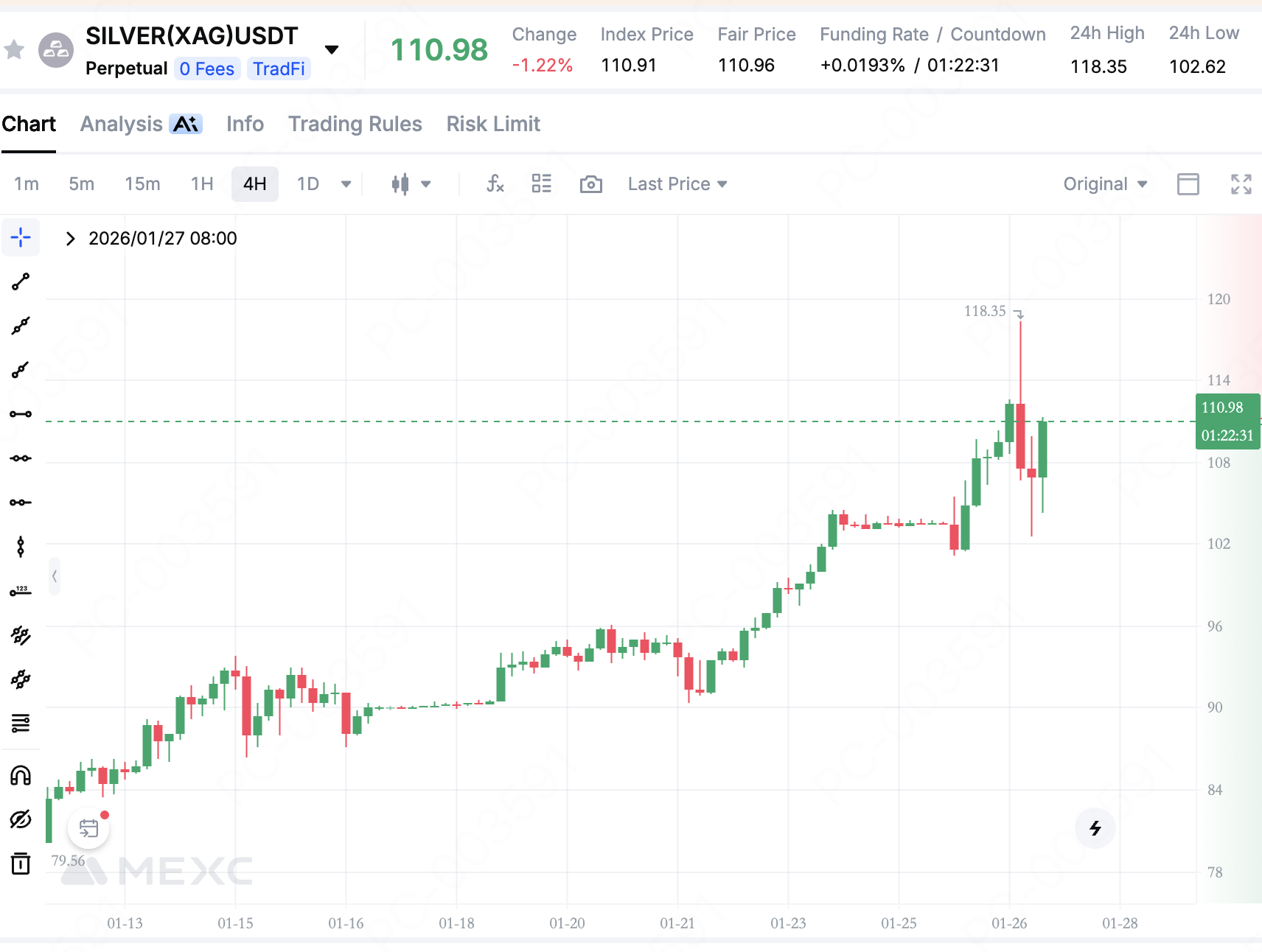
Silver has entered an extraordinary phase of price behavior. During the most recent trading session, silver surged toward the $118 per ounce level, setting a new historical high, before reversing sharply and giving back most of its intraday gains.
While dramatic price moves are not uncommon in commodities, the scale and speed of this move signal that silver is no longer trading in a “normal” market environment.
For traders, the critical issue is not whether silver is bullish or bearish in the long term, but how extreme volatility changes risk, execution, and short-term market dynamics. Understanding this shift is essential before making any trading decision.
What Triggered the Sudden Spike in Silver Prices?
Silver’s rapid rise was driven by several forces acting simultaneously rather than a single catalyst. A weaker U.S. dollar increased demand for dollar-denominated assets, while ongoing geopolitical uncertainty continued to support precious metals as a hedge. At the same time, silver had already been in a strong uptrend, attracting momentum-based traders who tend to amplify price moves once key technical levels are broken. Short sellers were also forced to cover positions as prices accelerated, adding further upside pressure.
When these factors aligned during Asian and early U.S. trading hours, price action became nearly vertical. However, markets that move too fast often do so at the cost of stability. When prices rise faster than liquidity and market depth can absorb, the structure becomes fragile, making reversals more likely once buying pressure weakens.
Why the Sharp Reversal Matters More Than the Record High
Reaching a new all-time high is psychologically powerful, but from a trading perspective, what happened afterward is far more important. After touching record levels, silver did not consolidate or trade sideways to establish acceptance at higher prices. Instead, it reversed sharply within hours, erasing most of the gains.
This behavior suggests that buyers were unwilling or unable to continue supporting price at elevated levels. In practical terms, this tells traders that much of the demand was reactive rather than strategic. Markets that lack sustained acceptance at new highs are more vulnerable to volatility, false breakouts, and rapid pullbacks. For traders, reversals like this often serve as early warnings that conditions have shifted.
Extreme Volatility Signals a Change in Market Regime
One of the clearest signals of changing conditions is the surge in volatility. Implied volatility in silver-related instruments has climbed into triple-digit territory, meaning the market is pricing in daily moves of roughly 7%. This level of volatility is rare for silver and even uncommon among many high-risk assets.
When volatility reaches such extremes, the market environment fundamentally changes. Stop-loss orders are triggered more easily, slippage increases, and small position-sizing mistakes can lead to outsized losses. Strategies that worked well in low- or moderate-volatility conditions often fail when volatility expands this rapidly. Traders must recognize that the market has moved into a different regime where risk management matters more than directional conviction.
Why Silver Is Behaving Like a High-Risk Asset
Silver is traditionally viewed as a hybrid asset, combining industrial demand with monetary characteristics. Under normal conditions, this makes it less volatile than many speculative instruments. However, current price behavior suggests silver is trading more like a high-risk asset. Daily ranges have expanded dramatically, demand for upside volatility has surged, and a large share of trading activity is concentrated near peak prices.
In such environments, price movements are driven less by fundamentals and more by positioning, leverage, and short-term sentiment. This does not invalidate silver’s longer-term investment thesis, but it does mean that traders must approach the market differently in the short term.
Technical Stretch Increases Sensitivity to Pullbacks
From a technical perspective, silver prices have become significantly stretched relative to medium- and long-term averages. Large deviations from equilibrium are not inherently bearish, but they increase sensitivity to any negative catalyst.
In commodity markets, extreme extensions are typically resolved in one of two ways: either through time, where prices move sideways and allow indicators to catch up, or through price, where sharp pullbacks reset positioning. The further prices move from equilibrium, the less tolerance the market has for disappointment. Traders should be aware that stretched technical conditions often lead to faster and deeper retracements than expected.
ETF Activity Suggests Late-Stage Participation
Trading volume in silver-backed ETFs has surged to record levels, signaling a wave of participation at elevated prices. Historically, such spikes in ETF volume often occur later in a move rather than at the beginning. Early participants tend to accumulate positions quietly, while late participants enter during periods of heightened excitement and visibility.
While ETF volume alone cannot predict a top, it provides useful context. High turnover at extreme prices suggests that risk is becoming more concentrated among newer market participants, which can increase volatility if sentiment shifts.
How the Gold–Silver Ratio Adds Context
Silver’s strong performance relative to gold has driven the gold–silver ratio sharply lower, pushing it into a historically sensitive range. Traders often use this ratio not as a directional signal but as a measure of relative stress between the two metals.
Rapid compression of the ratio typically reflects aggressive silver buying but can also indicate overextension. In past cycles, sharp moves in the gold–silver ratio have often coincided with periods of heightened volatility rather than stable trends.
What Traders Should Focus on in High-Volatility Conditions
When volatility becomes extreme, traditional forecasting becomes less reliable. Instead, traders should prioritize adaptability and risk control.
This often means reducing position size, widening risk buffers, defining clear invalidation levels, and avoiding emotional chase trades. High volatility creates opportunity, but only for traders whose strategies are designed to survive rapid price swings. Focusing on execution quality and discipline becomes more important than predicting the next price target.
Final Takeaway: Volatility Is the Signal
Silver’s historic move has pushed the market into a phase where opportunity and risk are both amplified. While macro factors such as a weaker dollar and geopolitical uncertainty may continue to support precious metals over the longer term, short-term price action has become increasingly unstable.
For traders, the key lesson is that volatility itself is now the primary signal. Markets do not need to collapse to become dangerous. In many cases, extreme movement is the warning.
জনপ্রিয় আর্টিকেল

Who Owns the Most Bitcoin in the World? Largest Holders Revealed
Bitcoin operates without a central owner, making the question "who owns Bitcoin" more complex than it appears at first glance. While no single entity controls the Bitcoin network itself, certain indiv
Setting Take-Profit and Stop-Loss for Futures Trading
In the cryptocurrency markets, price movements can be extremely volatile, and profits or losses can occur in an instant. For Futures traders, take-profit and stop-loss orders are not only essential to

What is USAT? Complete Guide to Tether's US-Regulated Stablecoin
The stablecoin landscape shifted dramatically when Tether unveiled USAT in September 2025, marking the company's first fully US-regulated digital dollar. This guide explores USAT's compliance framewor
Zero Threshold, Zero Slippage: How to Trade U.S. Stock Futures on MEXC
Recently, AI concept stocks have surged dramatically, with tech giants' share prices repeatedly hitting record highs, positioning the U.S. stock market as a focal point for global investors. However,
সম্পর্কিত আর্টিকেল
Who Owns the Most Bitcoin in the World? Largest Holders Revealed
Bitcoin operates without a central owner, making the question "who owns Bitcoin" more complex than it appears at first glance. While no single entity controls the Bitcoin network itself, certain indiv
Setting Take-Profit and Stop-Loss for Futures Trading
In the cryptocurrency markets, price movements can be extremely volatile, and profits or losses can occur in an instant. For Futures traders, take-profit and stop-loss orders are not only essential to
What is USAT? Complete Guide to Tether's US-Regulated Stablecoin
The stablecoin landscape shifted dramatically when Tether unveiled USAT in September 2025, marking the company's first fully US-regulated digital dollar. This guide explores USAT's compliance framewor
Zero Threshold, Zero Slippage: How to Trade U.S. Stock Futures on MEXC
Recently, AI concept stocks have surged dramatically, with tech giants' share prices repeatedly hitting record highs, positioning the U.S. stock market as a focal point for global investors. However,