Google Enters AI Payment Wars With Stablecoin Support

The Agent Payments Protocol (AP2) supports both traditional payment methods and digital currencies called stablecoins.
This move puts Google in direct competition with payment giants Visa and Mastercard, who are also racing to capture the growing market for AI-powered shopping. The timing appears strategic as stablecoin transactions surged to $5.7 trillion in 2024, with a 66% jump in Q1 2025.
How AI Agents Will Handle Your Money
The new protocol solves a basic problem: how can businesses trust that an AI agent actually has permission to spend someone’s money? Google’s system uses digital contracts called “mandates” that work like tamper-proof receipts. These contracts prove a user gave their AI agent specific authority to make a purchase.
James Tromans, Google’s head of Web3, told Fortune that the protocol was built “from the ground up to factor in both heritage and existing payment rail capabilities as well as forthcoming capabilities such as stablecoins.”
The system works in two ways. For immediate purchases, users can tell their AI agent something like “Find me white running shoes.” The agent then shows options and waits for approval before buying. For pre-planned purchases, users can set up rules in advance, such as “Buy concert tickets the moment they go on sale for up to $200.”
More than 60 companies helped develop the protocol, including American Express, Mastercard, PayPal, Coinbase, and Salesforce.
Stablecoins Take Center Stage
Google partnered with cryptocurrency exchange Coinbase to add stablecoin support. Stablecoins are digital currencies designed to maintain steady values, usually tied to the U.S. dollar. Unlike Bitcoin, which can swing wildly in price, stablecoins stay relatively stable.
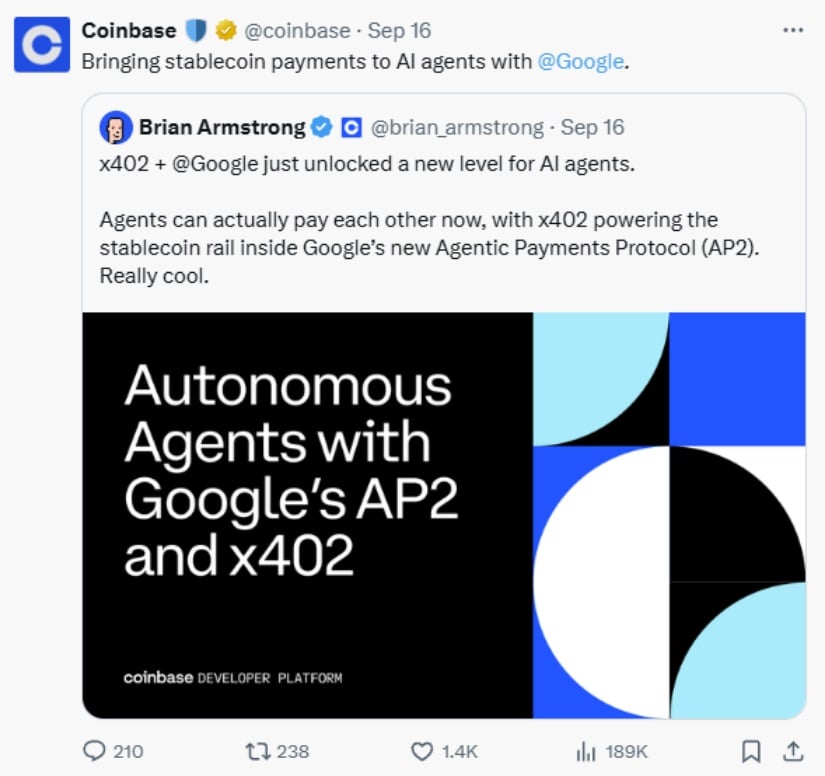
Source: @coinbase
Erik Reppel, Coinbase’s head of engineering, explained the partnership: “We’re all working to figure out how we can make AI transmit value to each other.”
The stablecoin market has exploded in recent years. These digital dollars now move more money than Visa and Mastercard combined, reaching $27.6 trillion in transaction volume during 2024. About $280 billion worth of stablecoins currently circulate globally.
This growth matters because stablecoins can process payments 24/7 without the delays that traditional banking systems often face. For AI agents that might need to make purchases at any hour, this constant availability becomes crucial.
The Competition Heats Up
Google faces strong competition in this emerging market. Stripe recently announced its own blockchain called Tempo, designed specifically for stablecoin payments. The project includes backing from major companies like Deutsche Bank, Shopify, and OpenAI.
Mastercard launched Agent Pay in April 2025, introducing special tokens that let AI agents make purchases. Visa followed with its own AI payment tools that connect directly to its massive payment network.
The race reflects broader consumer interest in AI shopping. A Salesforce study from March 2025 found that 66% of shoppers want AI agents to grab high-demand items before they sell out. Another 65% want agents that automatically buy products when prices drop to target levels.
Payment companies see huge potential. Michael Shaulov, CEO of crypto infrastructure firm Fireblocks, noted that payment companies represent just 11% of their clients but handle 16% of all stablecoin transactions, with over 30% quarterly growth.
Real-World Applications
Google envisions AI agents handling complex shopping tasks. In one example, a user planning a weekend trip could tell their agent: “Book me a flight and hotel in Palm Springs for the first weekend of November, with a $700 budget.” The agent would then coordinate with multiple booking platforms to find the best combination and execute both purchases simultaneously.
Another scenario involves smart shopping alerts. A customer wanting a specific jacket in green could tell their agent to monitor availability and automatically purchase it when found, even paying up to 20% more than the original price.
These capabilities extend beyond consumer shopping. Businesses could use AI agents for procurement, automatically ordering supplies when inventory runs low or securing better deals from suppliers.
Regulatory Tailwinds Boost Adoption
The regulatory environment has become friendlier to stablecoins. The U.S. passed the GENIUS Act, which provides clearer rules for stablecoin issuers. This regulatory clarity has encouraged more companies to explore stablecoin integration.
Major financial institutions have taken notice. Citigroup projects the stablecoin market could reach $3.7 trillion by 2030, potentially surpassing the entire current cryptocurrency market.
Several factors drive this growth. Stablecoins can reduce cross-border payment fees by 30-60% compared to traditional banks. They also enable instant settlements, which traditional banking systems often cannot match due to business hour limitations and processing delays.
The Digital Payment Revolution
Google’s entry signals that AI-powered payments have moved beyond experimentation. The company’s vast ecosystem—including Android phones and Chrome browsers—provides a massive potential user base for the new protocol.
The stakes are high. As Galaxy Digital CEO Mike Novogratz predicted, AI agents may eventually become “the biggest user of stablecoins.” Companies that establish early dominance in this space could control critical infrastructure for the next generation of digital commerce.
With Google, Stripe, Visa, and Mastercard all competing aggressively, the race to enable AI spending has only just begun.
You May Also Like

CEO Sandeep Nailwal Shared Highlights About RWA on Polygon

Laser Cutting Services San Diego: Precision Solutions for Modern Manufacturing