BitcoinWorld “Connect Token WTC Crypto” Explained: WalletConnect (WCT) vs. Waltonchain (WTC) The search query “Connect token WTC crypto” frequently leads to confusionBitcoinWorld “Connect Token WTC Crypto” Explained: WalletConnect (WCT) vs. Waltonchain (WTC) The search query “Connect token WTC crypto” frequently leads to confusion

“Connect Token WTC Crypto” Explained: WalletConnect (WCT) vs. Waltonchain (WTC)
"Connect Token WTC Crypto" Explained: WalletConnect (WCT) vs. Waltonchain (WTC)

BitcoinWorld
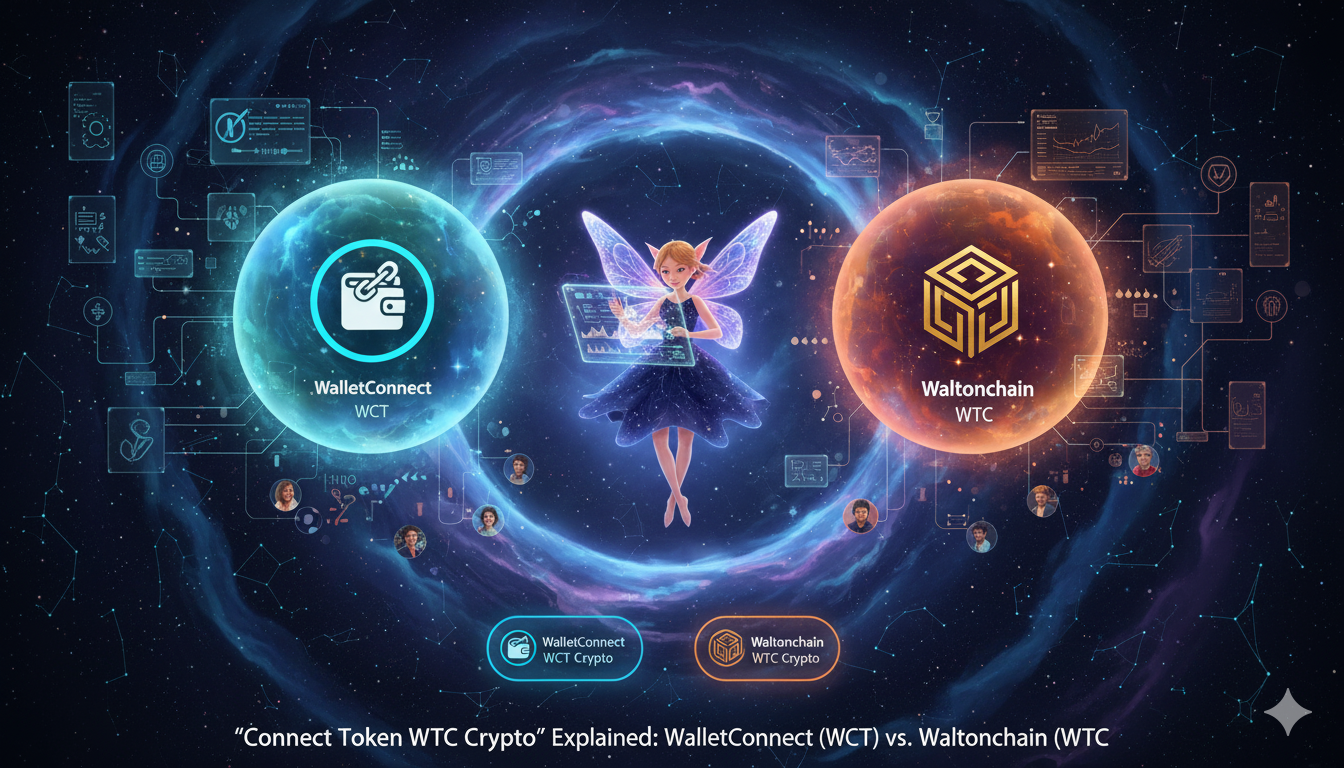
“Connect Token WTC Crypto” Explained: WalletConnect (WCT) vs. Waltonchain (WTC)

The search query “Connect token WTC crypto” frequently leads to confusion among investors in 2026 due to the striking similarity between two distinct assets: WalletConnect Token (WCT) and Waltonchain (WTC). While one is a newly launched governance token for critical Web3 infrastructure, the other is a legacy supply chain project from the 2017 era. This guide clarifies the difference, helping you identify which token aligns with your investment strategy and explaining the specific utility of each.

If you are looking for the token associated with connecting crypto wallets to dApps, you are likely searching for WalletConnect Token (WCT). As of early 2026, WCT serves as the native utility and governance backbone for the WalletConnect Network, a protocol integrated into over 600 wallets and 40,000 decentralized applications (dApps).

  • Governance Rights: WCT holders play a pivotal role in the ecosystem by voting on protocol upgrades, fee structures, and future development roadmaps, ensuring the network remains community-driven.
  • Staking and Rewards: To secure the network, users and node operators can stake their WCT tokens. In return for maintaining the integrity and performance of the relay network, stakers earn weekly rewards.
  • Ecosystem Utility: The token aligns incentives across the network, potentially acting as a payment method for network services (subject to governance) and coordinating the interests of developers, users, and node operators.

What Is Waltonchain (WTC) and What Does It Do?

Waltonchain (WTC) is often the ticker symbol users mistakenly type when searching for “Connect token.” It is a separate project that rose to fame in 2017 by combining blockchain with Radio Frequency Identification (RFID) and the Internet of Things (IoT).

  • Supply Chain Management: The primary goal of WTC is to create a transparent business ecosystem where physical assets are linked to the blockchain via RFID tags. This technology is used to track products from source to consumer, reducing counterfeiting in high-value industries like luxury clothing.
  • Sub-chain Creation: The platform allows businesses to build custom sub-chains (child chains) tailored to their specific needs, which run parallel to the main chain to ensure scalability and security.
  • Network Operations: The WTC coin functions as the primary value exchange within this ecosystem, used for paying transaction fees, rewarding nodes, and executing smart contracts related to logistics and data traceability.

Frequently Asked Questions

Is “Connect Token” the same as WTC?

No. The term “Connect token” likely refers to WalletConnect Token (WCT), which facilitates connections between wallets and dApps. WTC is the ticker for Waltonchain, a completely different project focused on supply chain management and RFID technology.

Can I stake WCT and WTC tokens?

Yes, but the mechanisms differ. WalletConnect Token (WCT) staking involves securing the relay network for Web3 connectivity to earn rewards. Waltonchain (WTC) staking is related to maintaining the consensus of its specific IoT blockchain and validating supply chain transactions.

Which token is used for connecting MetaMask to dApps?

The technology used to connect MetaMask and other wallets to dApps is the WalletConnect protocol, which is governed by WalletConnect Token (WCT). Waltonchain (WTC) has no technical relationship to the wallet connection process.

Conclusion

Understanding the distinction between WalletConnect Token (WCT) and Waltonchain (WTC) is crucial for navigating the 2026 crypto market. While the search term “Connect token WTC crypto” conflates the two, WCT represents the modern “plumbing” of decentralized finance, whereas WTC represents a specialized solution for physical supply chains. Clarifying this difference ensures you interact with the correct asset, whether your goal is participating in Web3 governance or exploring IoT blockchain solutions.

This post “Connect Token WTC Crypto” Explained: WalletConnect (WCT) vs. Waltonchain (WTC) first appeared on BitcoinWorld.

Market Opportunity
TokenFi Logo
TokenFi Price(TOKEN)
$0.002867
$0.002867$0.002867
+0.27%
USD
TokenFi (TOKEN) Live Price Chart
Disclaimer: The articles reposted on this site are sourced from public platforms and are provided for informational purposes only. They do not necessarily reflect the views of MEXC. All rights remain with the original authors. If you believe any content infringes on third-party rights, please contact [email protected] for removal. MEXC makes no guarantees regarding the accuracy, completeness, or timeliness of the content and is not responsible for any actions taken based on the information provided. The content does not constitute financial, legal, or other professional advice, nor should it be considered a recommendation or endorsement by MEXC.

You May Also Like

This Bitcoin Metric Has Never Been This Wrong: BTC Price Prediction

This Bitcoin Metric Has Never Been This Wrong: BTC Price Prediction

Bitcoin trades 35.5% below its power-law trend, marking the largest statistical pricing deviation in its history. Backtests since 2010 show every similar oversold
Share
LiveBitcoinNews2026/02/01 23:15
ProFX Summit Dubai 2026

ProFX Summit Dubai 2026

The post ProFX Summit Dubai 2026 appeared on BitcoinEthereumNews.com. ProFX Summit Dubai 2026 is a premium financial industry event bringing together the global
Share
BitcoinEthereumNews2026/02/01 22:58
Vitalik Buterin Reveals Ethereum’s Bold Plan to Stay Quantum-Secure and Simple!

Vitalik Buterin Reveals Ethereum’s Bold Plan to Stay Quantum-Secure and Simple!

Buterin unveils Ethereum’s strategy to tackle quantum security challenges ahead. Ethereum focuses on simplifying architecture while boosting security for users. Ethereum’s market stability grows as Buterin’s roadmap gains investor confidence. Ethereum founder Vitalik Buterin has unveiled his long-term vision for the blockchain, focusing on making Ethereum quantum-secure while maintaining its simplicity for users. Buterin presented his roadmap at the Japanese Developer Conference, and splits the future of Ethereum into three phases: short-term, mid-term, and long-term. Buterin’s most ambitious goal for Ethereum is to safeguard the blockchain against the threats posed by quantum computing.  The danger of such future developments is that the future may call into question the cryptographic security of most blockchain systems, and Ethereum will be able to remain ahead thanks to more sophisticated mathematical techniques to ensure the safety and integrity of its protocols. Buterin is committed to ensuring that Ethereum evolves in a way that not only meets today’s security challenges but also prepares for the unknowns of tomorrow. Also Read: Ethereum Giant The Ether Machine Takes Major Step Toward Going Public! However, in spite of such high ambitions, Buterin insisted that Ethereum also needed to simplify its architecture. An important aspect of this vision is to remove unnecessary complexity and make Ethereum more accessible and maintainable without losing its strong security capabilities. Security and simplicity form the core of Buterin’s strategy, as they guarantee that the users of Ethereum experience both security and smooth processes. Focus on Speed and Efficiency in the Short-Term In the short term, Buterin aims to enhance Ethereum’s transaction efficiency, a crucial step toward improving scalability and reducing transaction costs. These advantages are attributed to the fact that, within the mid-term, Ethereum is planning to enhance the speed of transactions in layer-2 networks. According to Butterin, this is part of Ethereum’s expansion, particularly because there is still more need to use blockchain technology to date. The other important aspect of Ethereum’s development is the layer-2 solutions. Buterin supports an approach in which the layer-2 networks are dependent on layer-1 to perform some essential tasks like data security, proof, and censorship resistance. This will enable the layer-2 systems of Ethereum to be concerned with verifying and sequencing transactions, which will improve the overall speed and efficiency of the network. Ethereum’s Market Stability Reflects Confidence in Long-Term Strategy Ethereum’s market performance has remained solid, with the cryptocurrency holding steady above $4,000. Currently priced at $4,492.15, Ethereum has experienced a slight 0.93% increase over the last 24 hours, while its trading volume surged by 8.72%, reaching $34.14 billion. These figures point to growing investor confidence in Ethereum’s long-term vision. The crypto community remains optimistic about Ethereum’s future, with many predicting the price could rise to $5,500 by mid-October. Buterin’s clear, forward-thinking strategy continues to build trust in Ethereum as one of the most secure and scalable blockchain platforms in the market. Also Read: Whales Dump 200 Million XRP in Just 2 Weeks – Is XRP’s Price on the Verge of Collapse? The post Vitalik Buterin Reveals Ethereum’s Bold Plan to Stay Quantum-Secure and Simple! appeared first on 36Crypto.
Share
Coinstats2025/09/18 01:22