

Visa launches AI-powered autonomous shopping platform
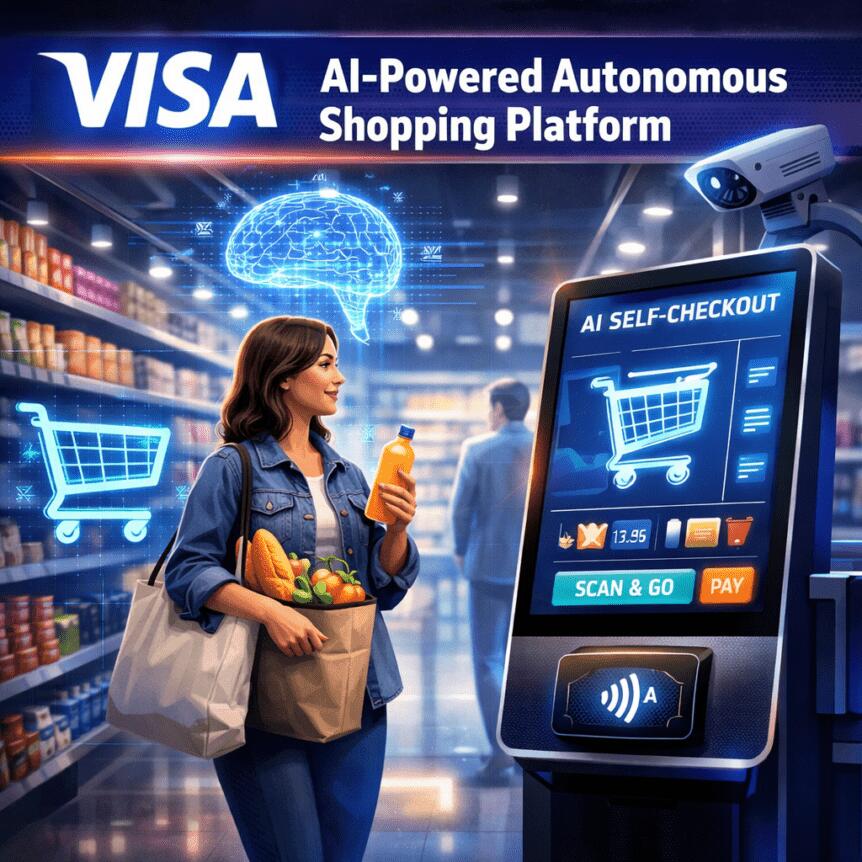
Visa is accelerating its foray into AI-powered payments with a new platform designed to let artificial intelligence agents act on behalf of consumers in online commerce. Intelligent Commerce Connect, announced by the payments giant this week, positions Visa as a universal on-ramp for agentic shopping—facilitating secure payments, tokenization, and merchant discovery through a single integration.
In a Wednesday statement, Visa described Intelligent Commerce Connect as a network, protocol, and “token vault-agnostic on-ramp” for AI agent builders and merchants. The system is pitched as a universal platform for agentic AI payments, enabling an AI agent to browse catalogs, select items, and initiate payments for a consumer’s behalf within a controlled, secure framework. Visa’s description emphasizes a streamlined integration via the Visa Acceptance Platform, with features that include secure payment initiation, tokenization, spend controls, and authentication.
The rollout comes as part of a broader industry movement toward agentic AI commerce, where AI agents—operating on behalf of users—could transact directly online. The move aligns with activity across the ecosystem, with networks like Ethereum, Tron, and Solana, alongside fintech firms, signaling interest in enabling AI-driven payments to unlock faster, more seamless shopping experiences for users.
Key takeaways
- Visa’s Intelligent Commerce Connect provides a single integration path through the Visa Acceptance Platform to initiate payments for AI agents, with built-in tokenization, spend controls, authentication, and PCI compliance.
- The platform supports both Visa and non-Visa card payments and is designed to work with major AI agent protocols, enabling merchants to be discoverable within AI ecosystems.
- Intelligent Commerce Connect is currently in pilot with select partners and is slated for a broader rollout later in 2026, signaling a measured, enterprise-oriented deployment.
- The initiative sits amid broader industry momentum around AI-agent payments, with examples of other ecosystems and partnerships testing autonomous card-based transactions.
- Recent activity from related players—such as Nevermined integrating with Visa via the x402 protocol—highlights growing collaboration between AI agents, payment rails, and programmable payment requests.
Visa’s AI-enabled payments vision: a practical on-ramp for agentic commerce
Visa positions Intelligent Commerce Connect as more than a conceptual framework. By offering a token vault-agnostic on-ramp, the platform aims to decouple AI agent payment flows from any single tokenization infrastructure, enabling merchants to participate without being tied to one ecosystem. The “one integration” approach promises developers and merchants a straightforward way to onboard, tokenize payments, and apply spend controls within AI-driven shopping flows.
Among the functional pillars are catalog discovery inside AI platforms, tokenization of payment credentials, authentication, and PCI compliance. In practical terms, an AI agent could peruse a merchant’s catalog, place an order, and trigger a payment that adheres to predefined rules—such as spending limits or merchant restrictions—while maintaining the security guarantees expected of traditional card-based payments. Visa’s emphasis on compatibility with both Visa and non-Visa cards broadens potential uptake across diverse payment rails and partner ecosystems.
The emphasis on a universal protocol also aligns with a broader industry push to standardize how AI agents request and execute payments. While the exact standards and implementations continue to evolve, Visa’s framework signals a mature, enterprise-friendly path forward that balances automation with risk controls and regulatory considerations.
Pilot status, roadmap, and related efforts
Visa indicated that Intelligent Commerce Connect is in a pilot phase with select partners, with a broader rollout expected later in 2026. This staged approach mirrors how large-scale payments platforms typically validate security, interoperability, and user experience before a wider launch. In parallel, Visa has experimented with other AI-driven payment concepts, such as an experimental tool dubbed “Visa CLI” announced in March, which aimed to enable AI agents to execute same-day payments. The existing pilots are an important signal about how Visa plans to operationalize agentic payments at scale while managing risk and compliance.
The broader market context features ongoing efforts by other blockchain networks and fintech firms to support AI-powered commerce. For example, a separate industry update described how AI agents could autonomously transact on behalf of users, with various protocols enabling programmatic payment requests and secure card-based settlements. These developments collectively illustrate a competitive yet converging landscape in which traditional card networks and crypto-native rails explore complementary roles in AI-driven shopping experiences.
Ecosystem momentum: partnerships and programmable payment rails
Visa’s Intelligent Commerce Connect is not the only thread in this evolving tapestry. In a related development, AI fintech firm Nevermined announced an integration with Visa’s on-ramp using Coinbase’s x402 protocol, enabling AI agents to purchase digital goods and services autonomously. Under this arrangement, users can enroll their Visa card and set spending rules, while AI agents operate within those guardrails, and merchants receive payments through their existing processors. Erik Reppel, the creator of the x402 protocol, described the approach as an open standard that allows agents to request payments programmatically while leveraging secure card infrastructure for real commercial transactions.
According to the x402 protocol’s public updates, the platform has processed substantial transactional activity—roughly $24 million in volume over the past 30 days. While this figure reflects activity within a specific protocol ecosystem, it underscores growing appetite for programmable payment flows that bridge AI agents and merchant ecosystems, even as traditional payment rails remain central to settlement.
The cross-pollination of payment rails, AI tooling, and merchant catalogs points to a broader trend: once-discrete payments rails are being reimagined as components of AI-enabled commerce. For builders and merchants, this could translate into faster onboarding for AI workflows, more precise spending controls, and better alignment between consumer intent and automated fulfillment—assuming interoperability and risk controls scale as envisioned.
What this means for investors and users
For investors, Visa’s Intelligent Commerce Connect represents a strategic extension of a trusted payments network into the AI-on-rails payments space. It signals a willingness to invest in infrastructure that reduces friction for AI agents while maintaining security standards and consumer protections. The pilot-and-scale approach suggests visibility into how quickly such capabilities could reach broader merchant adoption, a key factor for evaluating the economic potential of agentic commerce in the years ahead.
For developers and merchants, the promise of a unified integration route—covering tokenization, authentication, and PCI compliance—could lower the barrier to entry for AI-driven checkout experiences. The compatibility with both Visa and non-Visa cards further broadens potential use cases, from e-commerce to digital services and beyond. However, as with any nascent technology, practical adoption will hinge on measurable improvements in user experience, risk management, and regulatory clarity around autonomous payments and agent-driven transactions.
As the landscape evolves, readers should watch forthcoming pilot announcements and the timing of the broader rollout. Observers will also want to monitor how competing networks and open protocols—such as x402—address developer needs, security concerns, and the economics of AI-enabled payments. The convergence of these efforts could redefine how quickly AI agents become a routine part of online shopping, and how merchants structure offerings to accommodate automated buyers.
Visa’s latest move thus marks a notable moment in the ongoing integration of AI capabilities with mainstream payments infrastructure. The coming months will reveal which partnerships emerge from the pilot phase, how quickly merchant catalogs become AI-searchable within payment rails, and what this means for the broader adoption of agentic commerce across a global digital economy.
Readers should stay tuned for updates on pilot partners, implementation milestones, and any refinements to the Intelligent Commerce Connect framework as the industry inches toward a more automated, AI-enabled shopping era.
This article was originally published as Visa launches AI-powered autonomous shopping platform on Crypto Breaking News – your trusted source for crypto news, Bitcoin news, and blockchain updates.


You May Also Like

Why your form completion rate is below 30 percent
SEC Names David Woodcock as Enforcement Chief Amid Crypto Case Controversy




