Koinly, a popular cryptocurrency tax optimization software application, has warned users of a possible data breach of email addresses in the aftermath of a securityKoinly, a popular cryptocurrency tax optimization software application, has warned users of a possible data breach of email addresses in the aftermath of a security

Koinly Warning: Third-Party Breach Exposes User Emails – Is Your Tax Data Safe?

Koinly, a popular cryptocurrency tax optimization software application, has warned users of a possible data breach of email addresses in the aftermath of a security breach by a third-party service provider.

The company reported that the problem was not through its systems, and it insisted that sensitive financial and tax-related information is safe.
Source: degeneratenews

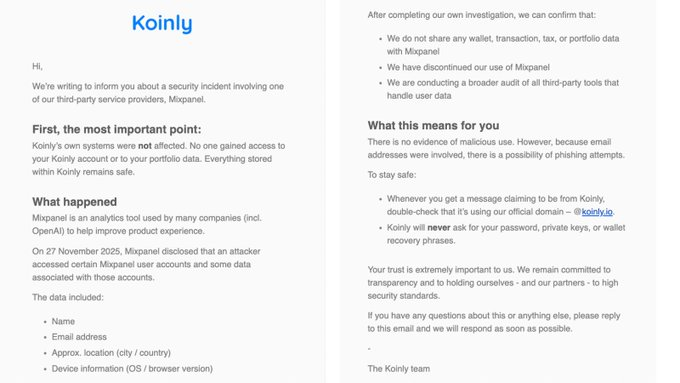
Koinly, in an email to the customers, claimed that the incident was based on Mixpanel, an analytics service it had been using to understand how the products were being used and ways of enhancing user experience.

What Was Exposed—and What Wasn’t: Koinly Addresses Third-Party Breach Fallout

Third-party breaches are a type of attack in which the attackers target vendors or service providers who have access to user information, and in most cases, they are using less secure security controls to indirectly gain access to information.

These attacks are prevalent in both crypto and non-crypto industries.

In these instances, Koinly said that Mixpanel had announced in November that one of its hackers had accessed some user accounts of Mixpanel and data belonging to these accounts.

Information disclosed could have contained names, email addresses, rough position details like city or country, and device data like the operating system and version of a browser.

Koinly reported that, according to its internal inquiries, it did not share any wallet information, transaction history, tax filings, or portfolio data with Mixpanel.

The company also stated that its main systems were not compromised, and it did not leave people with access to user accounts and financial records stored in Koinly.

Since then, it stopped using Mixpanel and initiated a larger exercise of auditing other third-party tools that process user information.

The company has failed to provide the number of users that could have been impacted and a specific timeframe in which the data exposure took place. It claimed that it is still in the process of collaborating with Mixpanel in order to know the extent of the incident.

Although Koinly asserted that it had no evidence that the information revealed had been abused, it gave a warning that users should be wary of potential exploitation by phishing.

The company also suggested that they confirm that any message that claims to be from Koinly originates from its official domain.

As Crypto Theft Hits $3.4B, Third-Party Vulnerabilities Come Into Focus

Koinly has a user base of over 1.5 million in the world, and it is active in over 20 countries.

The platform automatically imports transaction data from more than 900 exchanges, wallets, and blockchains and classifies the transactions, determines the gains and losses, and produces tax filings for tax authorities.

Source: Koinly

The size and reach of it ensure that even a small data exposure can concern the users who use it to store sensitive financial data.

The recent attacks in the crypto market and the technological industry in general demonstrate how harmful third-party hacks can be.

In September, Swiss crypto platform SwissBorg lost over $41 million of Solana tokens because attackers hacked an API provider of one of its partners’ services.

In October, Discord affirmed that they had unauthorized access to their third-party Zendesk system of support following their announcement that hackers had stolen millions of government ID pictures.

DeFi protocol Abracadabra also experienced numerous exploits this year because of code-level vulnerabilities, pointing out the scope of vulnerabilities to attacks on infrastructure.

Chainalysis industry data reveal that thefts involving crypto reached more than 3.4 billion US dollars in 2025, and the losses are growing more and more concentrated in a few more extreme cases.

Market Opportunity
Safe Token Logo
Safe Token Price(SAFE)
$0.1321
$0.1321$0.1321
+0.99%
USD
Safe Token (SAFE) Live Price Chart
Disclaimer: The articles reposted on this site are sourced from public platforms and are provided for informational purposes only. They do not necessarily reflect the views of MEXC. All rights remain with the original authors. If you believe any content infringes on third-party rights, please contact [email protected] for removal. MEXC makes no guarantees regarding the accuracy, completeness, or timeliness of the content and is not responsible for any actions taken based on the information provided. The content does not constitute financial, legal, or other professional advice, nor should it be considered a recommendation or endorsement by MEXC.

You May Also Like

Shiba Inu Price Stalls Near Lows – What Could Matter in 2026 For SHIB To Takeoff?

Shiba Inu Price Stalls Near Lows – What Could Matter in 2026 For SHIB To Takeoff?

Shiba Inu has had a tough year, and its not hiding on the chart. TheCryptoBasic shared on X that the SHIB price has printed its first-ever weekly death cross in
Share
Coinstats2025/12/25 06:00
Polygon Tops RWA Rankings With $1.1B in Tokenized Assets

Polygon Tops RWA Rankings With $1.1B in Tokenized Assets

The post Polygon Tops RWA Rankings With $1.1B in Tokenized Assets appeared on BitcoinEthereumNews.com. Key Notes A new report from Dune and RWA.xyz highlights Polygon’s role in the growing RWA sector. Polygon PoS currently holds $1.13 billion in RWA Total Value Locked (TVL) across 269 assets. The network holds a 62% market share of tokenized global bonds, driven by European money market funds. The Polygon POL $0.25 24h volatility: 1.4% Market cap: $2.64 B Vol. 24h: $106.17 M network is securing a significant position in the rapidly growing tokenization space, now holding over $1.13 billion in total value locked (TVL) from Real World Assets (RWAs). This development comes as the network continues to evolve, recently deploying its major “Rio” upgrade on the Amoy testnet to enhance future scaling capabilities. This information comes from a new joint report on the state of the RWA market published on Sept. 17 by blockchain analytics firm Dune and data platform RWA.xyz. The focus on RWAs is intensifying across the industry, coinciding with events like the ongoing Real-World Asset Summit in New York. Sandeep Nailwal, CEO of the Polygon Foundation, highlighted the findings via a post on X, noting that the TVL is spread across 269 assets and 2,900 holders on the Polygon PoS chain. The Dune and https://t.co/W6WSFlHoQF report on RWA is out and it shows that RWA is happening on Polygon. Here are a few highlights: – Leading in Global Bonds: Polygon holds 62% share of tokenized global bonds (driven by Spiko’s euro MMF and Cashlink euro issues) – Spiko U.S.… — Sandeep | CEO, Polygon Foundation (※,※) (@sandeepnailwal) September 17, 2025 Key Trends From the 2025 RWA Report The joint publication, titled “RWA REPORT 2025,” offers a comprehensive look into the tokenized asset landscape, which it states has grown 224% since the start of 2024. The report identifies several key trends driving this expansion. According to…
Share
BitcoinEthereumNews2025/09/18 00:40
Grayscale ETF Tracking XRP, Solana and Cardano to Hit Wall Street After SEC Pause

Grayscale ETF Tracking XRP, Solana and Cardano to Hit Wall Street After SEC Pause

The post Grayscale ETF Tracking XRP, Solana and Cardano to Hit Wall Street After SEC Pause appeared on BitcoinEthereumNews.com. In brief The SEC said that Grayscale’s Digital Large Cap Fund conversion into an ETF is approved for listing and trading. The fund tracks the price of Bitcoin, Ethereum, Solana, XRP, and Cardano. Other ETFs tracking XRP and Dogecoin began trading on Thursday. An exchange-traded fund from crypto asset manager Grayscale that tracks the price of XRP, Solana, and Cardano—along with Bitcoin and Ethereum—was primed for its debut on the New York Stock Exchange, following long-sought approval from the SEC.  In an order on Wednesday, the regulator permitted the listing and trading of Grayscale’s Digital Large Cap Fund (GDLC), following an indefinite pause in July. The SEC meanwhile approved of generic listing standards for commodity-based products, paving the way for other crypto ETFs. A person familiar with the matter told Decrypt that GDLC is expected to begin trading on Friday. Unlike spot Bitcoin and Ethereum ETFs that debuted in the U.S. last year, GDLC is modeled on an index tracking the five largest and most liquid digital assets. Bitcoin represents 72% of the fund’s weighting, while Ethereum makes up 17%, according to Grayscale’s website. XRP, Solana, and Cardano account for 5.6%, 4%, and 1% of the fund’s exposure, respectively.  “The Grayscale team is working expeditiously to bring the FIRST multi-crypto asset ETP to market,” CEO Peter Mintzberg said on X on Wednesday, thanking the SEC for its “unmatched efforts in bringing the regulatory clarity our industry deserves.” Decrypt reached out to Grayscale for comment but did not immediately receive a response. Meanwhile, Dogecoin and XRP ETFs from Rex Shares and Osprey funds began trading on Thursday. The funds are registered under the Investment Company Act of 1940, a distinct set of rules compared to the process most asset managers have sought approval for crypto-focused products under. Not long ago,…
Share
BitcoinEthereumNews2025/09/19 04:19