Crypto.com is moving deeper into prediction markets with plans to staff an internal market-making desk, a step that is drawing renewed attention to how these platformsCrypto.com is moving deeper into prediction markets with plans to staff an internal market-making desk, a step that is drawing renewed attention to how these platforms

Crypto.com Hires Internal Market Maker for Predictions – Is the Exchange Trading Against Users?

Crypto.com is moving deeper into prediction markets with plans to staff an internal market-making desk, a step that is drawing renewed attention to how these platforms operate and whether exchanges may end up trading directly against their own users.

The Singapore-based cryptocurrency exchange is recruiting a quantitative trader to join a team responsible for buying and selling financial contracts tied to the outcomes of sporting events on its prediction market platform.

Liquidity or Conflict? Crypto.com’s Market-Making Role Sparks Debate

According to a recent Bloomberg report, the role would sit on Crypto.com’s market-making desk and involve actively trading against customer orders to support liquidity across sports contracts and other derivatives offered on the company’s U.S. platform.

The hiring effort comes as prediction markets expand rapidly across both crypto and traditional finance.

These platforms allow users to trade contracts that settle based on real-world outcomes, such as sports results or political events, with prices reflecting the market’s implied probability.

While prediction markets have long presented themselves as neutral venues where participants trade against each other, the use of in-house market makers has raised questions about conflicts of interest.

Market making has become a sensitive issue for event-contract exchanges, particularly those operating under U.S. federal oversight.

Critics argue that when an exchange or its affiliate takes the opposite side of customer trades, the structure begins to resemble a traditional sportsbook that profits from customer losses.

Those concerns have already surfaced elsewhere in the industry. Kalshi, one of the most prominent regulated prediction market operators, runs an internal unit known as Kalshi Trading.

Polymarket, a major decentralized platform, is also reported to be building its own internal market-making team.

Crypto.com’s job listing states that the new hire would seek to “maximize profits while carefully managing risks,” language that has fueled debate over whether the firm is effectively trading against its users.

In response, in a report, a Crypto.com spokesperson said the company does not rely on proprietary trading as a revenue source and described its business model as providing customer access to digital assets and event contracts for a fee while remaining risk neutral.

The spokesperson added that the internal market maker does not receive preferential access to customer order flow or proprietary data and operates under rules disclosed to the Commodity Futures Trading Commission, which oversees derivatives markets in the U.S.

Prediction Markets Hit Record Volumes, but Trading Rules Stir Concerns

The exchange has also taken steps to attract external liquidity providers. Like its competitors, Crypto.com has sought to bring in professional trading firms to ensure continuous buying and selling, particularly in high-volume sports markets.

However, company rules grant designated market makers on sports contracts a three-second head start over smaller traders, a policy that has drawn scrutiny for potentially allowing large participants to adjust prices ahead of retail users.

The broader industry continues to grow despite these concerns, with prediction markets linked to sports and politics having driven much of the recent surge in activity.

Platforms including Kalshi, Polymarket, and Limitless recorded a combined $44 billion in trading volume this year, with Kalshi reaching roughly $1 billion in weekly volume at its peak.
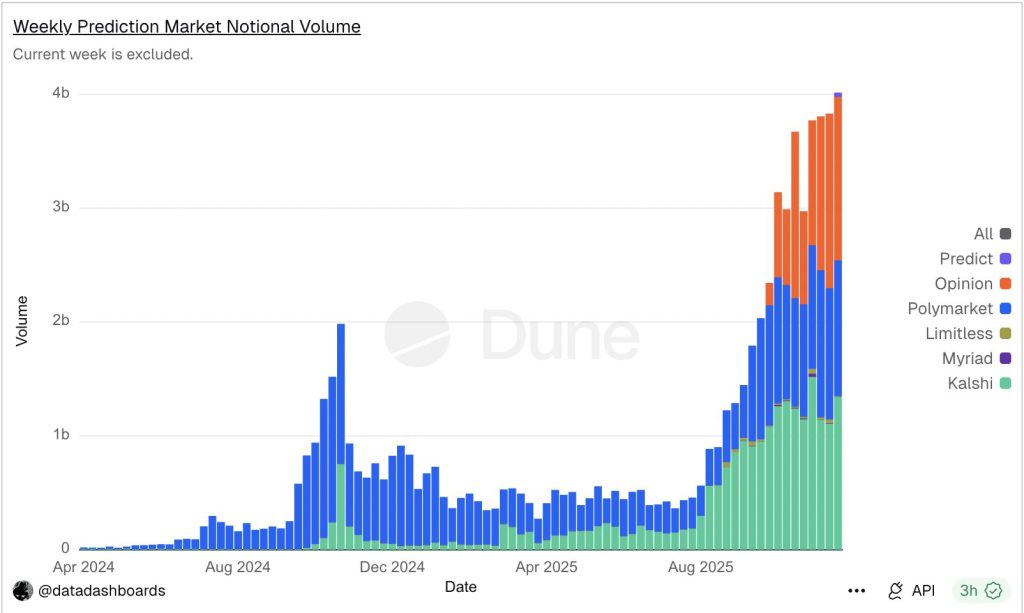
Source: Dune Analytics

On-chain prediction markets have expanded even faster, with monthly volume climbing from under $100 million in early 2024 to more than $13 billion, according to joint research from Keyrock and Dune Analytics.

Major crypto firms are also entering the space. Coinbase recently rolled out prediction market trading on its platform and agreed to acquire The Clearing Company as part of its push to scale regulated event-based markets. The move followed Kalshi’s $300 million Series D raise at a $5 billion valuation, showing investor interest in the sector.

Disclaimer: The articles reposted on this site are sourced from public platforms and are provided for informational purposes only. They do not necessarily reflect the views of MEXC. All rights remain with the original authors. If you believe any content infringes on third-party rights, please contact [email protected] for removal. MEXC makes no guarantees regarding the accuracy, completeness, or timeliness of the content and is not responsible for any actions taken based on the information provided. The content does not constitute financial, legal, or other professional advice, nor should it be considered a recommendation or endorsement by MEXC.

You May Also Like

Shiba Inu Price Stalls Near Lows – What Could Matter in 2026 For SHIB To Takeoff?

Shiba Inu Price Stalls Near Lows – What Could Matter in 2026 For SHIB To Takeoff?

Shiba Inu has had a tough year, and its not hiding on the chart. TheCryptoBasic shared on X that the SHIB price has printed its first-ever weekly death cross in
Share
Coinstats2025/12/25 06:00
Polygon Tops RWA Rankings With $1.1B in Tokenized Assets

Polygon Tops RWA Rankings With $1.1B in Tokenized Assets

The post Polygon Tops RWA Rankings With $1.1B in Tokenized Assets appeared on BitcoinEthereumNews.com. Key Notes A new report from Dune and RWA.xyz highlights Polygon’s role in the growing RWA sector. Polygon PoS currently holds $1.13 billion in RWA Total Value Locked (TVL) across 269 assets. The network holds a 62% market share of tokenized global bonds, driven by European money market funds. The Polygon POL $0.25 24h volatility: 1.4% Market cap: $2.64 B Vol. 24h: $106.17 M network is securing a significant position in the rapidly growing tokenization space, now holding over $1.13 billion in total value locked (TVL) from Real World Assets (RWAs). This development comes as the network continues to evolve, recently deploying its major “Rio” upgrade on the Amoy testnet to enhance future scaling capabilities. This information comes from a new joint report on the state of the RWA market published on Sept. 17 by blockchain analytics firm Dune and data platform RWA.xyz. The focus on RWAs is intensifying across the industry, coinciding with events like the ongoing Real-World Asset Summit in New York. Sandeep Nailwal, CEO of the Polygon Foundation, highlighted the findings via a post on X, noting that the TVL is spread across 269 assets and 2,900 holders on the Polygon PoS chain. The Dune and https://t.co/W6WSFlHoQF report on RWA is out and it shows that RWA is happening on Polygon. Here are a few highlights: – Leading in Global Bonds: Polygon holds 62% share of tokenized global bonds (driven by Spiko’s euro MMF and Cashlink euro issues) – Spiko U.S.… — Sandeep | CEO, Polygon Foundation (※,※) (@sandeepnailwal) September 17, 2025 Key Trends From the 2025 RWA Report The joint publication, titled “RWA REPORT 2025,” offers a comprehensive look into the tokenized asset landscape, which it states has grown 224% since the start of 2024. The report identifies several key trends driving this expansion. According to…
Share
BitcoinEthereumNews2025/09/18 00:40
Grayscale ETF Tracking XRP, Solana and Cardano to Hit Wall Street After SEC Pause

Grayscale ETF Tracking XRP, Solana and Cardano to Hit Wall Street After SEC Pause

The post Grayscale ETF Tracking XRP, Solana and Cardano to Hit Wall Street After SEC Pause appeared on BitcoinEthereumNews.com. In brief The SEC said that Grayscale’s Digital Large Cap Fund conversion into an ETF is approved for listing and trading. The fund tracks the price of Bitcoin, Ethereum, Solana, XRP, and Cardano. Other ETFs tracking XRP and Dogecoin began trading on Thursday. An exchange-traded fund from crypto asset manager Grayscale that tracks the price of XRP, Solana, and Cardano—along with Bitcoin and Ethereum—was primed for its debut on the New York Stock Exchange, following long-sought approval from the SEC.  In an order on Wednesday, the regulator permitted the listing and trading of Grayscale’s Digital Large Cap Fund (GDLC), following an indefinite pause in July. The SEC meanwhile approved of generic listing standards for commodity-based products, paving the way for other crypto ETFs. A person familiar with the matter told Decrypt that GDLC is expected to begin trading on Friday. Unlike spot Bitcoin and Ethereum ETFs that debuted in the U.S. last year, GDLC is modeled on an index tracking the five largest and most liquid digital assets. Bitcoin represents 72% of the fund’s weighting, while Ethereum makes up 17%, according to Grayscale’s website. XRP, Solana, and Cardano account for 5.6%, 4%, and 1% of the fund’s exposure, respectively.  “The Grayscale team is working expeditiously to bring the FIRST multi-crypto asset ETP to market,” CEO Peter Mintzberg said on X on Wednesday, thanking the SEC for its “unmatched efforts in bringing the regulatory clarity our industry deserves.” Decrypt reached out to Grayscale for comment but did not immediately receive a response. Meanwhile, Dogecoin and XRP ETFs from Rex Shares and Osprey funds began trading on Thursday. The funds are registered under the Investment Company Act of 1940, a distinct set of rules compared to the process most asset managers have sought approval for crypto-focused products under. Not long ago,…
Share
BitcoinEthereumNews2025/09/19 04:19