Wormhole, a leading interoperability protocol that enables asset transfers across multiple blockchains, has announced significant updates to its native tokenomics. These changes include the introduction of a token reserve and enhanced incentives for stakers, which could influence the protocol’s governance structure, as voting power is tied to the stake of Wormhole tokens. In a recent [...]Wormhole, a leading interoperability protocol that enables asset transfers across multiple blockchains, has announced significant updates to its native tokenomics. These changes include the introduction of a token reserve and enhanced incentives for stakers, which could influence the protocol’s governance structure, as voting power is tied to the stake of Wormhole tokens. In a recent [...]

Wormhole Token Surges After Tokenomics Reset and W Reserve Launch
Wormhole Token Surges After Tokenomics Reset And W Reserve Launch

Wormhole, a leading interoperability protocol that enables asset transfers across multiple blockchains, has announced significant updates to its native tokenomics. These changes include the introduction of a token reserve and enhanced incentives for stakers, which could influence the protocol’s governance structure, as voting power is tied to the stake of Wormhole tokens.

In a recent announcement, Wormhole outlined three primary modifications to its W token: the launch of a reserve funded through protocol fees and revenue, a fixed 4% yield on staked tokens with higher rewards for active ecosystem participants, and a shift from bulk token unlocks to biweekly unlock schedules. The protocol aims to foster increased asset transfer activity and messaging volume over the next one to two years, as more tokens become locked and revenue is reinvested into the platform.

Founded in late 2020 as a bridge between Ethereum and Solana, Wormhole introduced its native token on April 3, 2024. Initially trading at $1.66, the token experienced volatility, falling to a low of $0.54 within 10 days. However, following the tokenomics update, the token’s price surged by over 6% in a single day, reflecting investor interest in the new economic design.
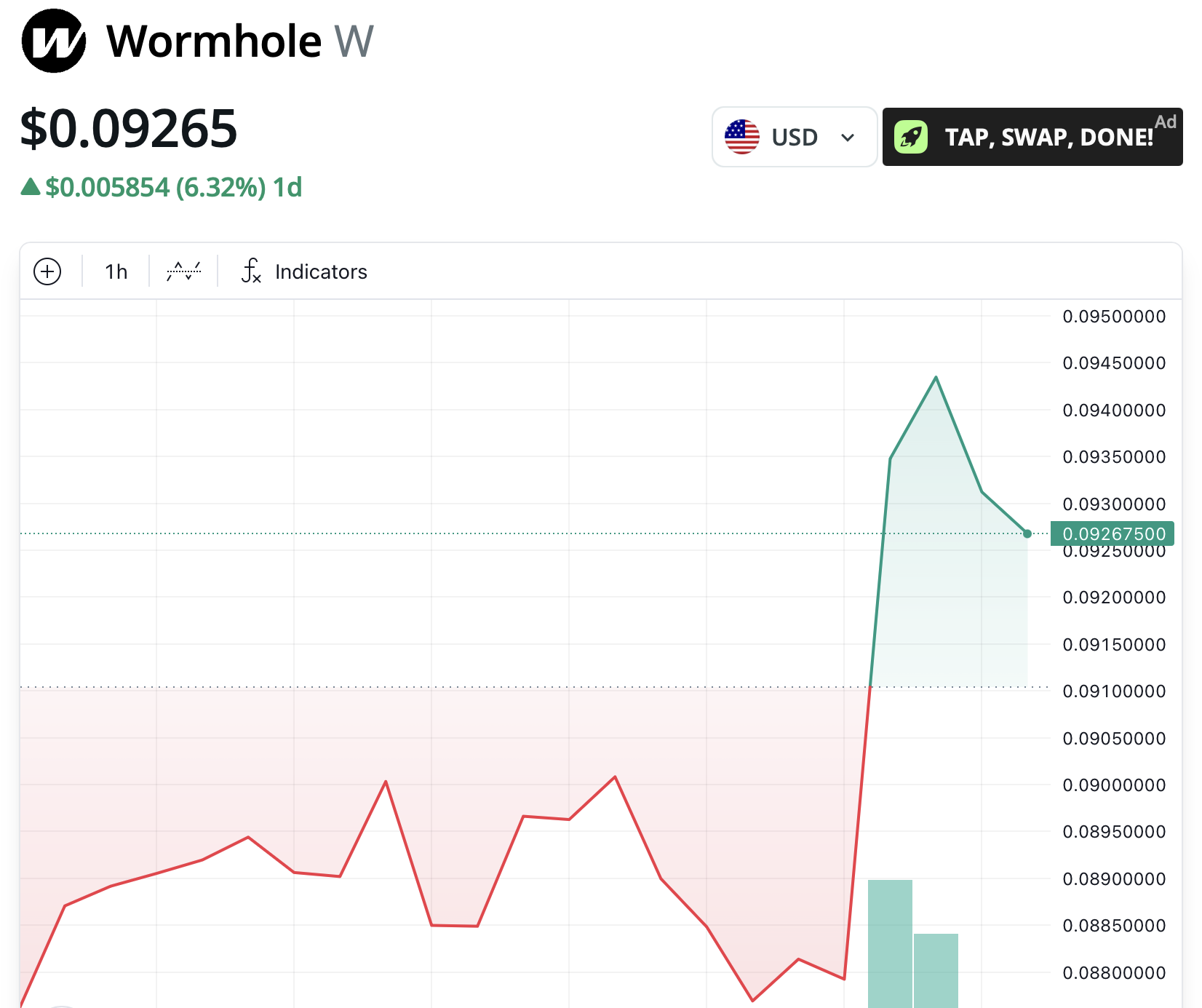
Wormhole token price on September 17, 2025. Source: Cointelegraph

The announcement garnered considerable attention on social media platform X, though some community members expressed disappointment over the absence of mechanisms like additional airdrops or buyback-and-burn strategies that could potentially reduce token supply and support price stability.

The revamped tokenomics also impacts Wormhole’s governance model. Token holders who stake their W tokens can delegate voting authority, influencing decisions such as protocol upgrades and shared protocol parameters. Currently, around $45 million worth of Wormhole tokens are staked, with approximately 485 million W participating in governance votes.
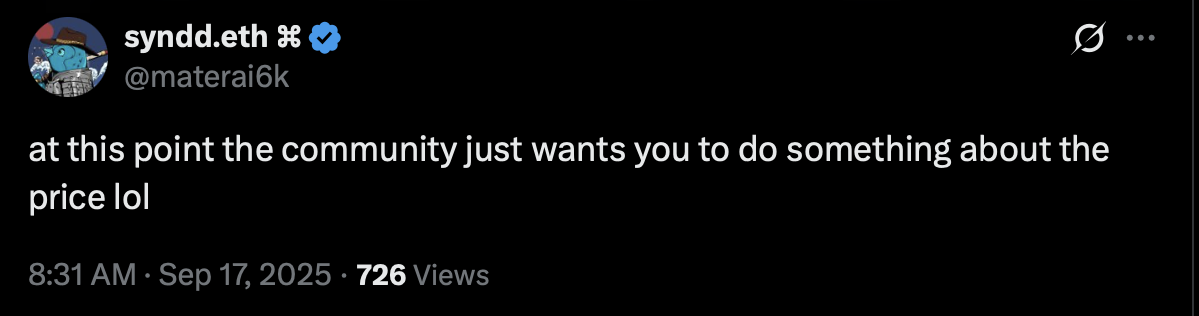
Source: syndd.eth

Notably, Dan Reecer, co-founder of the Wormhole Foundation, retains the largest influence with over $30.5 million in tokens staked, accounting for more than 25% of voting power. As the protocol evolves, the role of high-stakes stakeholders like Reecer is crucial in shaping future developments and strategic direction.

In the broader landscape, Wormhole competes with other prominent cross-chain messaging and interoperability protocols such as LayerZero, Axelar, and Chainlink. These platforms are instrumental in advancing the interoperability infrastructure necessary for the growth of DeFi, NFTs, and tokenized assets across multiple blockchain ecosystems, including Ethereum, Solana, and beyond.

Wormhole’s role in advancing crypto interoperability

As interoperability becomes a key focus in the crypto industry, protocols like Wormhole are central to enabling seamless transfer of cryptocurrencies, stablecoins, and real-world assets (RWAs) across the expanding blockchain universe. This function is vital for the future of decentralized finance (DeFi) and the broader adoption of blockchain technology.

With the ongoing evolution of crypto regulation and markets, maintaining robust, secure, and user-friendly interoperability solutions will be crucial for sustained industry growth and innovation.

This article was originally published as Wormhole Token Surges After Tokenomics Reset and W Reserve Launch on Crypto Breaking News – your trusted source for crypto news, Bitcoin news, and blockchain updates.

Market Opportunity
Wormhole Logo
Wormhole Price(W)
$0.0206
$0.0206$0.0206
-0.62%
USD
Wormhole (W) Live Price Chart
Disclaimer: The articles reposted on this site are sourced from public platforms and are provided for informational purposes only. They do not necessarily reflect the views of MEXC. All rights remain with the original authors. If you believe any content infringes on third-party rights, please contact [email protected] for removal. MEXC makes no guarantees regarding the accuracy, completeness, or timeliness of the content and is not responsible for any actions taken based on the information provided. The content does not constitute financial, legal, or other professional advice, nor should it be considered a recommendation or endorsement by MEXC.

You May Also Like

FCA komt in 2026 met aangepaste cryptoregels voor Britse markt

FCA komt in 2026 met aangepaste cryptoregels voor Britse markt

De Britse financiële waakhond, de FCA, komt in 2026 met nieuwe regels speciaal voor crypto bedrijven. Wat direct opvalt: de toezichthouder laat enkele klassieke financiële verplichtingen los om beter aan te sluiten op de snelle en grillige wereld van digitale activa. Tegelijkertijd wordt er extra nadruk gelegd op digitale beveiliging,... Het bericht FCA komt in 2026 met aangepaste cryptoregels voor Britse markt verscheen het eerst op Blockchain Stories.
Share
Coinstats2025/09/18 00:33
United States Building Permits Change dipped from previous -2.8% to -3.7% in August

United States Building Permits Change dipped from previous -2.8% to -3.7% in August

The post United States Building Permits Change dipped from previous -2.8% to -3.7% in August appeared on BitcoinEthereumNews.com. Information on these pages contains forward-looking statements that involve risks and uncertainties. Markets and instruments profiled on this page are for informational purposes only and should not in any way come across as a recommendation to buy or sell in these assets. You should do your own thorough research before making any investment decisions. FXStreet does not in any way guarantee that this information is free from mistakes, errors, or material misstatements. It also does not guarantee that this information is of a timely nature. Investing in Open Markets involves a great deal of risk, including the loss of all or a portion of your investment, as well as emotional distress. All risks, losses and costs associated with investing, including total loss of principal, are your responsibility. The views and opinions expressed in this article are those of the authors and do not necessarily reflect the official policy or position of FXStreet nor its advertisers. The author will not be held responsible for information that is found at the end of links posted on this page. If not otherwise explicitly mentioned in the body of the article, at the time of writing, the author has no position in any stock mentioned in this article and no business relationship with any company mentioned. The author has not received compensation for writing this article, other than from FXStreet. FXStreet and the author do not provide personalized recommendations. The author makes no representations as to the accuracy, completeness, or suitability of this information. FXStreet and the author will not be liable for any errors, omissions or any losses, injuries or damages arising from this information and its display or use. Errors and omissions excepted. The author and FXStreet are not registered investment advisors and nothing in this article is intended…
Share
BitcoinEthereumNews2025/09/18 02:20
Google's AP2 protocol has been released. Does encrypted AI still have a chance?

Google's AP2 protocol has been released. Does encrypted AI still have a chance?

Following the MCP and A2A protocols, the AI Agent market has seen another blockbuster arrival: the Agent Payments Protocol (AP2), developed by Google. This will clearly further enhance AI Agents' autonomous multi-tasking capabilities, but the unfortunate reality is that it has little to do with web3AI. Let's take a closer look: What problem does AP2 solve? Simply put, the MCP protocol is like a universal hook, enabling AI agents to connect to various external tools and data sources; A2A is a team collaboration communication protocol that allows multiple AI agents to cooperate with each other to complete complex tasks; AP2 completes the last piece of the puzzle - payment capability. In other words, MCP opens up connectivity, A2A promotes collaboration efficiency, and AP2 achieves value exchange. The arrival of AP2 truly injects "soul" into the autonomous collaboration and task execution of Multi-Agents. Imagine AI Agents connecting Qunar, Meituan, and Didi to complete the booking of flights, hotels, and car rentals, but then getting stuck at the point of "self-payment." What's the point of all that multitasking? So, remember this: AP2 is an extension of MCP+A2A, solving the last mile problem of AI Agent automated execution. What are the technical highlights of AP2? The core innovation of AP2 is the Mandates mechanism, which is divided into real-time authorization mode and delegated authorization mode. Real-time authorization is easy to understand. The AI Agent finds the product and shows it to you. The operation can only be performed after the user signs. Delegated authorization requires the user to set rules in advance, such as only buying the iPhone 17 when the price drops to 5,000. The AI Agent monitors the trigger conditions and executes automatically. The implementation logic is cryptographically signed using Verifiable Credentials (VCs). Users can set complex commission conditions, including price ranges, time limits, and payment method priorities, forming a tamper-proof digital contract. Once signed, the AI Agent executes according to the conditions, with VCs ensuring auditability and security at every step. Of particular note is the "A2A x402" extension, a technical component developed by Google specifically for crypto payments, developed in collaboration with Coinbase and the Ethereum Foundation. This extension enables AI Agents to seamlessly process stablecoins, ETH, and other blockchain assets, supporting native payment scenarios within the Web3 ecosystem. What kind of imagination space can AP2 bring? After analyzing the technical principles, do you think that's it? Yes, in fact, the AP2 is boring when it is disassembled alone. Its real charm lies in connecting and opening up the "MCP+A2A+AP2" technology stack, completely opening up the complete link of AI Agent's autonomous analysis+execution+payment. From now on, AI Agents can open up many application scenarios. For example, AI Agents for stock investment and financial management can help us monitor the market 24/7 and conduct independent transactions. Enterprise procurement AI Agents can automatically replenish and renew without human intervention. AP2's complementary payment capabilities will further expand the penetration of the Agent-to-Agent economy into more scenarios. Google obviously understands that after the technical framework is established, the ecological implementation must be relied upon, so it has brought in more than 60 partners to develop it, almost covering the entire payment and business ecosystem. Interestingly, it also involves major Crypto players such as Ethereum, Coinbase, MetaMask, and Sui. Combined with the current trend of currency and stock integration, the imagination space has been doubled. Is web3 AI really dead? Not entirely. Google's AP2 looks complete, but it only achieves technical compatibility with Crypto payments. It can only be regarded as an extension of the traditional authorization framework and belongs to the category of automated execution. There is a "paradigm" difference between it and the autonomous asset management pursued by pure Crypto native solutions. The Crypto-native solutions under exploration are taking the "decentralized custody + on-chain verification" route, including AI Agent autonomous asset management, AI Agent autonomous transactions (DeFAI), AI Agent digital identity and on-chain reputation system (ERC-8004...), AI Agent on-chain governance DAO framework, AI Agent NPC and digital avatars, and many other interesting and fun directions. Ultimately, once users get used to AI Agent payments in traditional fields, their acceptance of AI Agents autonomously owning digital assets will also increase. And for those scenarios that AP2 cannot reach, such as anonymous transactions, censorship-resistant payments, and decentralized asset management, there will always be a time for crypto-native solutions to show their strength? The two are more likely to be complementary rather than competitive, but to be honest, the key technological advancements behind AI Agents currently all come from web2AI, and web3AI still needs to keep up the good work!
Share
PANews2025/09/18 07:00