In this head-to-head we put Pepeto (PEPETO) up against Blockdag, Layer Brett, Remittix, and Little Pepe using simple yardsticks, team […] The post Best Crypto Investment 2025: Pepeto vs Blockdag Vs Layer Brett Vs Remittix and Little Pepe appeared first on Coindoo.In this head-to-head we put Pepeto (PEPETO) up against Blockdag, Layer Brett, Remittix, and Little Pepe using simple yardsticks, team […] The post Best Crypto Investment 2025: Pepeto vs Blockdag Vs Layer Brett Vs Remittix and Little Pepe appeared first on Coindoo.

Best Crypto Investment 2025: Pepeto vs Blockdag Vs Layer Brett Vs Remittix and Little Pepe

2025/09/18 10:39
6 min read

In this head-to-head we put Pepeto (PEPETO) up against Blockdag, Layer Brett, Remittix, and Little Pepe using simple yardsticks, team intent and delivery, on-chain proofs, tokenomics clarity, DEX and bridge readiness, PayFi rails, staking, and listing prep, so you can act on facts, not hype, and decide confidently before the next leg higher catches you watching from the sidelines.

Pepeto’s Utility Play: Zero-Fee DEX, Bridge, And StrongPotential

Pepeto treats the meme coin playbook like a platform brief, not a joke. The team ships fast, polishes details, and shows up weekly, aiming for staying power rather than a momentary pop. A hard-capped design anchors PepetoSwap, a zero-fee exchange where every trade routes through PEPETO for built-in usage instead of buzz.

Already 850+ projects have applied to list, fertile ground for volume if listings follow. A built-in cross-chain bridge adds smart routing to unify liquidity, cut extra hops, and reduce slippage, turning activity into steady token demand because every swap touches PEPETO.

Pepeto is audited by independent experts Solidproof and Coinsult, a trust marker reflected in more than $6,7 Million already raised in presale. Early momentum is visible.

The presale puts early buyers at the front of the line with staking and stage-based price increases, and that line is getting long. Utility plus purpose, culture plus tools, the combo that tends to run farther than hype alone.

Translation for you: Pepeto is graduating from noise to usage. If listings land and on-chain activity scales, the setup favors bigger potential returns than legacy meme coins.

If any name is primed to outshine the old meme cohort in 2025, this is the one people will brag about spotting early. Serious investors won’t sit this out. Buy Pepeto now at the current price of $0.000000153, the lowest Pepeto price you will ever see again, and don’t let it pass.
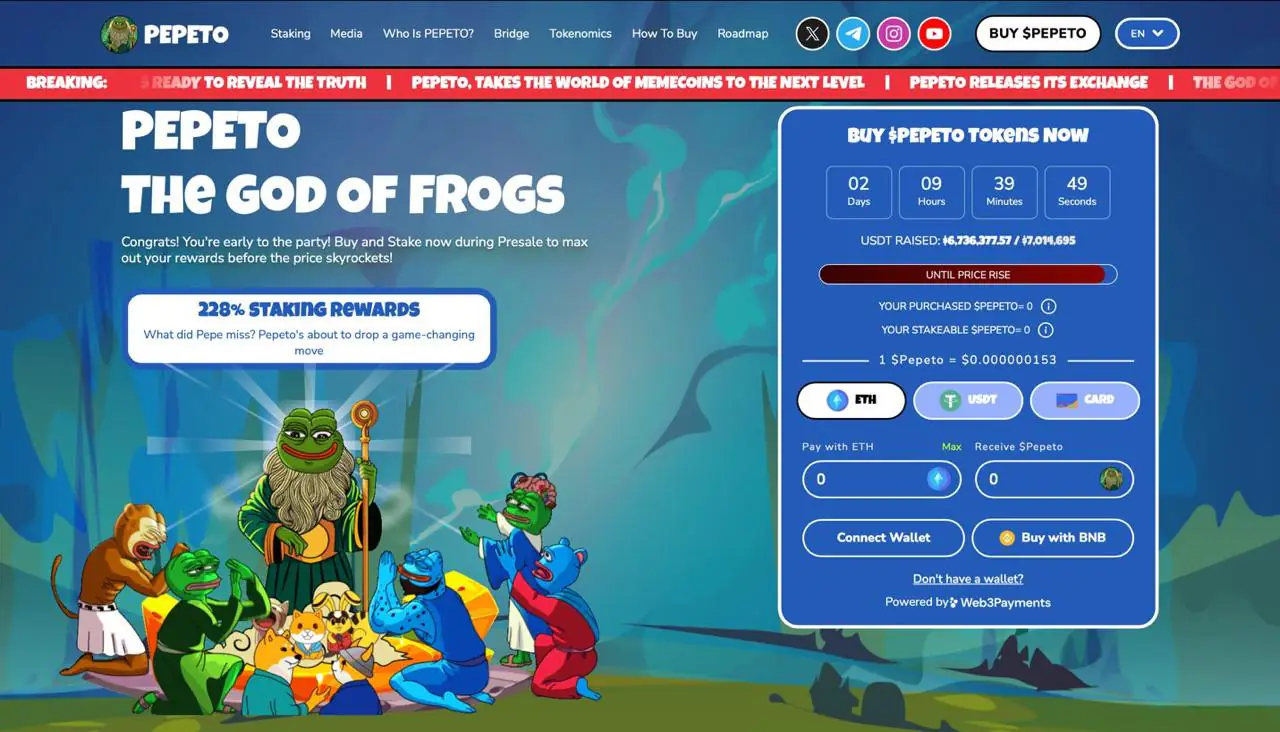
Early SHIB and DOGE buyers made the right call at the right time, early. Pepeto appears to be at a similar stage now, set to lift, missing this crypto presale could mean missing the next millionaire coin.

Blockdag Reality Check: Marketing Claims vs On-Chain Proof

Before you chase the next banner, separate what’s shipped from what’s promised. BlockDAG (BDAG) talks up “10x upside,” but slogans don’t equal staying power. After the BDAG Deployment Event and a price reset to $0.0013, the question is transparency: limited independently verifiable on-chain proof for key metrics, unclear exchange-ready liquidity and post-listing unlocks, and few public engineering artifacts to audit.

The team highlights a DAG-plus-Proof-of-Work design claiming 15,000 TPS, instant payments, smart contracts, and eco-friendly operation, yet third-party tests and deep public code remain light.

Sports tie-ups (Inter Milan, Seattle Seawolves, Seattle Orcas) expand reach via NFTs, but holder utility is vague, the audit covered a narrow slice, and user reports on claims/withdrawals are mixed. Confidence now requires live releases and transparent, on-chain evidence.

Layer Brett, Remittix, Little Pepe: Sorting Signal From Noise

Layer Brett frames itself as an Ethereum Layer-2 with fast, low-fee transactions, staking, and meme energy, yet most coverage reads like paid placement, not independent review. Bold claims on throughput, fees, and cross-chain support lack third-party benchmarks; public code, audits, and traction look thin. Treat it as early stage and verify audited code, live activity, and listings before committing funds.

Remittix pitches a PayFi wallet that routes crypto to bank accounts, supporting 40+ coins, 30+ fiats, and same-day processing. Exchange access still looks tentative, licensing/compliance isn’t clear, the public audit appears limited, the team lacks third-party KYC, and early user ratings are weak, so execution risk remains high until rails and licenses are verified.

Little Pepe sells an EVM-compatible Layer-2 with low fees, quick confirmations, and a bridge to move assets in and out. The challenge is differentiation: most L2s make the same promises, and nothing shown so far looks measurably novel against Optimism, Arbitrum, or Base. Without transparent benchmarks, open documentation of its rollup design and bridge security, or demand beyond incentives, it reads like yet another copy-paste L2. Liquidity could fragment, bridge risk isn’t trivial, and any token value depends on sustained real usage, not meme momentum. Until verifiable, better tech ships, it’s more generic than groundbreaking.

Where To Invest?

Pepeto reads like a different story. The team is deliberately chasing two outcomes at once, sharp upside now and durability after, not a sugar high that fizzles. You can feel the pulse in how they ship, communicate, and keep showing up; it feels like holders are stepping into a story people will talk about in the meme coin arena. It speaks across the stack: big wallets seeking a fresh narrative with serious multiple potential, and smaller buyers who’ve waited for a clean shot at life-changing gains. If you hesitated on early Shiba or Dogecoin and swore you wouldn’t miss the next one, this is the moment to act.

On the flip side, BlockDAG has fewer live releases and little verifiable on-chain evidence so far; Layer Brett coverage still reads promotional with scarce independent benchmarks; Remittix needs clearer licensing and visible listings; and Little Pepe’s Layer-2 pitch isn’t clearly differentiated from established rollups. Ask the plain question, Which is The Best Crypto Investment 2025?, and Pepeto separates itself on delivery, openness, and intent, a meme coin engineered to surge quickly and sustain momentum. Remember, today’s Pepeto price is presented as the lowest you’ll ever see; several analysts tag it among the best crypto to buy now. It looks like the shot no sharp buyer should let go, the one that will change many lives this year.

Pepeto Media Links :

Website: https://pepeto.io/
• X (Twitter): https://x.com/Pepetocoin
• YouTube Channel: https://www.youtube.com/@Pepetocoin

This publication is sponsored. Coindoo does not endorse or assume responsibility for the content, accuracy, quality, advertising, products, or any other materials on this page. Readers are encouraged to conduct their own research before engaging in any cryptocurrency-related actions. Coindoo will not be liable, directly or indirectly, for any damages or losses resulting from the use of or reliance on any content, goods, or services mentioned. Always do your own research.

The post Best Crypto Investment 2025: Pepeto vs Blockdag Vs Layer Brett Vs Remittix and Little Pepe appeared first on Coindoo.

Market Opportunity
Solayer Logo
Solayer Price(LAYER)
$0.08926
$0.08926$0.08926
+12.61%
USD
Solayer (LAYER) Live Price Chart
Disclaimer: The articles reposted on this site are sourced from public platforms and are provided for informational purposes only. They do not necessarily reflect the views of MEXC. All rights remain with the original authors. If you believe any content infringes on third-party rights, please contact [email protected] for removal. MEXC makes no guarantees regarding the accuracy, completeness, or timeliness of the content and is not responsible for any actions taken based on the information provided. The content does not constitute financial, legal, or other professional advice, nor should it be considered a recommendation or endorsement by MEXC.

You May Also Like

What Is an Uncontested Divorce and How Does It Work?

What Is an Uncontested Divorce and How Does It Work?

Divorce continues to be a common legal matter for families across Washington, reflecting broader shifts in how relationships change over time. Recent statewide
Share
Techbullion2026/02/12 18:08
Google's AP2 protocol has been released. Does encrypted AI still have a chance?

Google's AP2 protocol has been released. Does encrypted AI still have a chance?

Following the MCP and A2A protocols, the AI Agent market has seen another blockbuster arrival: the Agent Payments Protocol (AP2), developed by Google. This will clearly further enhance AI Agents' autonomous multi-tasking capabilities, but the unfortunate reality is that it has little to do with web3AI. Let's take a closer look: What problem does AP2 solve? Simply put, the MCP protocol is like a universal hook, enabling AI agents to connect to various external tools and data sources; A2A is a team collaboration communication protocol that allows multiple AI agents to cooperate with each other to complete complex tasks; AP2 completes the last piece of the puzzle - payment capability. In other words, MCP opens up connectivity, A2A promotes collaboration efficiency, and AP2 achieves value exchange. The arrival of AP2 truly injects "soul" into the autonomous collaboration and task execution of Multi-Agents. Imagine AI Agents connecting Qunar, Meituan, and Didi to complete the booking of flights, hotels, and car rentals, but then getting stuck at the point of "self-payment." What's the point of all that multitasking? So, remember this: AP2 is an extension of MCP+A2A, solving the last mile problem of AI Agent automated execution. What are the technical highlights of AP2? The core innovation of AP2 is the Mandates mechanism, which is divided into real-time authorization mode and delegated authorization mode. Real-time authorization is easy to understand. The AI Agent finds the product and shows it to you. The operation can only be performed after the user signs. Delegated authorization requires the user to set rules in advance, such as only buying the iPhone 17 when the price drops to 5,000. The AI Agent monitors the trigger conditions and executes automatically. The implementation logic is cryptographically signed using Verifiable Credentials (VCs). Users can set complex commission conditions, including price ranges, time limits, and payment method priorities, forming a tamper-proof digital contract. Once signed, the AI Agent executes according to the conditions, with VCs ensuring auditability and security at every step. Of particular note is the "A2A x402" extension, a technical component developed by Google specifically for crypto payments, developed in collaboration with Coinbase and the Ethereum Foundation. This extension enables AI Agents to seamlessly process stablecoins, ETH, and other blockchain assets, supporting native payment scenarios within the Web3 ecosystem. What kind of imagination space can AP2 bring? After analyzing the technical principles, do you think that's it? Yes, in fact, the AP2 is boring when it is disassembled alone. Its real charm lies in connecting and opening up the "MCP+A2A+AP2" technology stack, completely opening up the complete link of AI Agent's autonomous analysis+execution+payment. From now on, AI Agents can open up many application scenarios. For example, AI Agents for stock investment and financial management can help us monitor the market 24/7 and conduct independent transactions. Enterprise procurement AI Agents can automatically replenish and renew without human intervention. AP2's complementary payment capabilities will further expand the penetration of the Agent-to-Agent economy into more scenarios. Google obviously understands that after the technical framework is established, the ecological implementation must be relied upon, so it has brought in more than 60 partners to develop it, almost covering the entire payment and business ecosystem. Interestingly, it also involves major Crypto players such as Ethereum, Coinbase, MetaMask, and Sui. Combined with the current trend of currency and stock integration, the imagination space has been doubled. Is web3 AI really dead? Not entirely. Google's AP2 looks complete, but it only achieves technical compatibility with Crypto payments. It can only be regarded as an extension of the traditional authorization framework and belongs to the category of automated execution. There is a "paradigm" difference between it and the autonomous asset management pursued by pure Crypto native solutions. The Crypto-native solutions under exploration are taking the "decentralized custody + on-chain verification" route, including AI Agent autonomous asset management, AI Agent autonomous transactions (DeFAI), AI Agent digital identity and on-chain reputation system (ERC-8004...), AI Agent on-chain governance DAO framework, AI Agent NPC and digital avatars, and many other interesting and fun directions. Ultimately, once users get used to AI Agent payments in traditional fields, their acceptance of AI Agents autonomously owning digital assets will also increase. And for those scenarios that AP2 cannot reach, such as anonymous transactions, censorship-resistant payments, and decentralized asset management, there will always be a time for crypto-native solutions to show their strength? The two are more likely to be complementary rather than competitive, but to be honest, the key technological advancements behind AI Agents currently all come from web2AI, and web3AI still needs to keep up the good work!
Share
PANews2025/09/18 07:00
The FRS 102 Deadline Is Accelerating Finance Modernisation Across the UK

The FRS 102 Deadline Is Accelerating Finance Modernisation Across the UK

By Artie Minson, CEO of Trullion Every major change in accounting standards presents finance leaders […] The post The FRS 102 Deadline Is Accelerating Finance Modernisation
Share
ffnews2026/02/12 18:43