Blockscout, the leading open-source block explorer for EVM chains, has appointed Eva Zhang, former CEO of Alipay UK, as its new chief executive officer.Blockscout, the leading open-source block explorer for EVM chains, has appointed Eva Zhang, former CEO of Alipay UK, as its new chief executive officer.

Ex-Alipay UK Chief Eva Zhang to Lead Blockscout Into AI-Driven Growth

blockscout

Blockscout, the leading open-source block explorer for Ethereum Virtual Machine (EVM) based chains, has named Eva Zhang as its new chief executive officer. Zhang joins Blockscout from Alipay UK, where she most recently served as CEO and led the company’s expansion into new markets across Europe.

She brings more than 15 years of experience spanning fintech, cloud computing and artificial intelligence, including over five years at Ant Group, where she helped create new business lines, and a role as Director of Business Development at Alibaba Cloud. Earlier in her career, she held product management roles at HP and Equinix, giving her experience at the intersection of infrastructure and innovation.
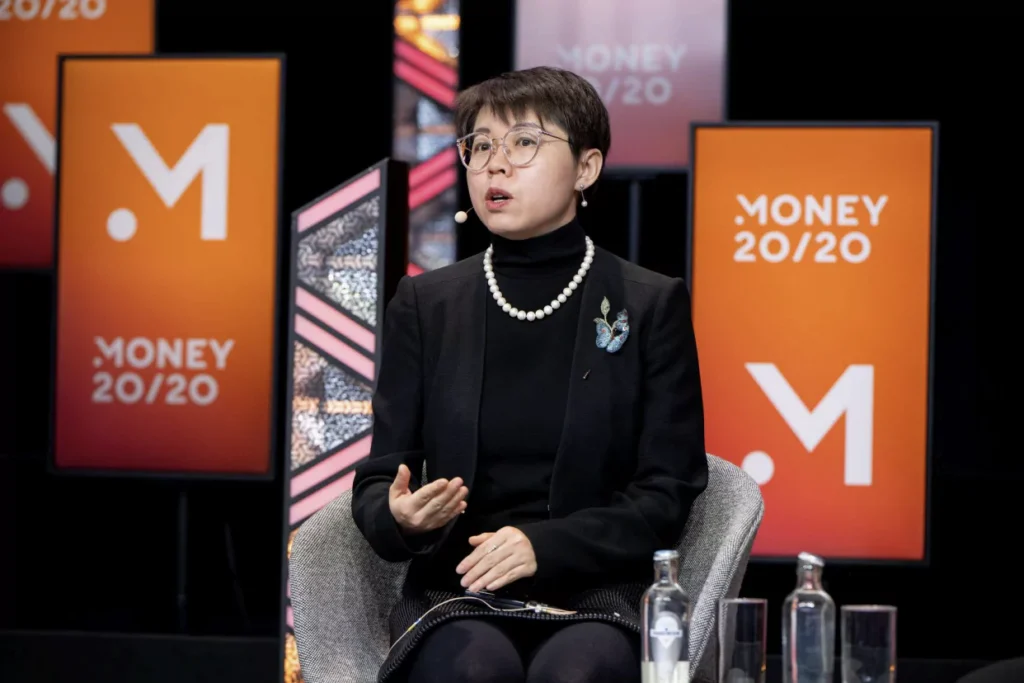
eva zhang

Academically, Zhang holds a Dual MBA from London Business School and Columbia Business School, along with a Master’s in Engineering. She is a recognized voice in the global fintech and payments community and is regularly invited to speak at industry events such as Money20/20, London Tech Week, and the European Women in Payments Network. She has also been included in the Women in FinTech Powerlist.

Her appointment follows Blockscout’s recent seed round led by 1kx, a move that company backers say shows confidence in Blockscout’s open-source mission. Christopher Heymann, Founding Partner at 1kx, welcomed the hire, “Eva brings the right mix of scaled fintech leadership and product rigor. Blockscout sits at the center of onchain activity, and turning that data into actionable intelligence is the next step. We backed Blockscout because open source and neutrality win in infrastructure, and Eva will accelerate that momentum.”

Blockscout’s founder Igor Barinov praised Zhang’s fit with the company culture and product ambitions, “Eva has scaled teams, opened markets, and brought structure to fast-moving products. More importantly, she understands the culture behind open-source. That matters to us. We’re thrilled to welcome her as CEO to drive our AI transformation both in the product and internal processes.”

Next Phase of Growth

Under Zhang’s leadership, Blockscout says it will evolve from trusted infrastructure into an intelligent, enterprise-grade tooling. Drawing on her track record of scaling fintech and cloud platforms, she will guide the company’s next phase of growth by expanding partnerships, opening new markets, and embedding AI into both products and operations.

As Zhang put it, “Blockscout is already a trusted part of the Web3 ecosystem. The next challenge is to build intelligence into the core. Not just displaying blockchain data, but helping users understand and act on it in real time. That’s where AI comes in. We want to build tools that help developers and enterprises to not only access data, but also use it meaningfully.”

Blockscout is live on more than 1,000 networks, including Ethereum and Arbitrum, and is available on major Superchain networks such as OP Mainnet, Base, Unichain, Ink Chain, and Sony’s Soneium. The company recently launched its Multichain Explorer, a unified search engine for the entire EVM ecosystem that enables users to discover tokens, wallets, contracts and dApps across dozens of chains from a single interface.

Blockscout positions itself as the #1 open-source block explorer for all EVM-based chains. Its platform offers a robust interface for searching blocks, transactions, accounts and tokens, developer tooling including smart contract verification and optimized APIs, and the Dappscout marketplace for secure decentralized app discovery, exploration and interaction.

Market Opportunity
Sleepless AI Logo
Sleepless AI Price(AI)
$0.04222
$0.04222$0.04222
+2.22%
USD
Sleepless AI (AI) Live Price Chart
Disclaimer: The articles reposted on this site are sourced from public platforms and are provided for informational purposes only. They do not necessarily reflect the views of MEXC. All rights remain with the original authors. If you believe any content infringes on third-party rights, please contact [email protected] for removal. MEXC makes no guarantees regarding the accuracy, completeness, or timeliness of the content and is not responsible for any actions taken based on the information provided. The content does not constitute financial, legal, or other professional advice, nor should it be considered a recommendation or endorsement by MEXC.

You May Also Like

From Tiny Moves to Massive Gains: 8 High ROI Tokens in 2025 Set to Skyrocket

From Tiny Moves to Massive Gains: 8 High ROI Tokens in 2025 Set to Skyrocket

MoonBull leads 2025’s high ROI tokens with whitelist access, 1000x potential, staking rewards, and exclusive bonuses, alongside DOGE, SHIB, PEPE, NOT, ANDY, and TUT.
Share
Blockchainreporter2025/09/20 05:15
Why Is Shiba Inu (SHIB) Price Pumping Today?

Why Is Shiba Inu (SHIB) Price Pumping Today?

Shiba Inu is back in focus after a sharp move higher that surprised a lot of traders. After days of going nowhere, SHIB suddenly caught a bid, with volume picking
Share
Coinstats2026/01/03 06:30
Powell says young Americans face toughest job market in years

Powell says young Americans face toughest job market in years

Youth unemployment in the United States has climbed sharply in 2025. Economists and policy officials describe the pattern as a “no hire, no fire” phase, where companies mainly hold on to current staff, add few positions, and seldom cut jobs, rather than a sudden shock from artificial intelligence. Federal Reserve Chair Jerome Powell gave that view public weight at his regular press conference after the Federal Open Market Committee meeting. He called it an “interesting labor market,” noting that “kids coming out of college and younger people, minorities, are having a hard time finding jobs.” He pointed to a low job-finding rate paired with a low redundancy rate, “you’ve got a low firing, low hiring environment”, which makes it tougher than usual for first-time jobseekers to get in the door. Deutsche Bank has dubbed recent months “the summer AI turned ugly,” and some studies link AI uptake to pressure on entry-level hiring. Powell, however, said AI “may be part of the story,” while arguing the main drivers are a cooler economy and tighter hiring plans. Economists at Goldman Sachs and UBS soon echoed that reading, concluding that this is not primarily an AI event, at least not yet. On Friday, UBS chief economist Paul Donovan released an analysis titled “The Kids Are Alright?”  As reported by Fortune, he argued that the U.S. spike in youth unemployment runs counter to trends abroad and cannot be laid solely at the feet of automation. Decline in job reallocation slows opportunities Goldman Sachs economist Pierfrancesco Mei wrote on Thursday that “finding a job takes longer in a low-turnover labor market.” He examined “job reallocation”, the creation and destruction of roles, and showed it has fallen since the late 1990s, though more gradually in recent years. Today, most movement is “churn,” or switching among existing jobs. Goldman reported that in 2025 churn sits well below its pre-pandemic pace across industries and states, and the drag “mostly fall[s] on younger workers.” In 2019, a young unemployed person in a low-churn state typically landed work in about 10 weeks; now it takes about 12 weeks on average. Donovan writes that “it might be tempting to blame technology,” since stories of machines replacing people are common. He concludes, in line with Goldman, that the U.S. pattern “more convincingly fits a broader hiring freeze narrative, affecting new entrants to the workforce.” Trade careers offer a safer path Donovan also argues this helps explain why less-educated young workers seem less exposed. Many high school dropouts secure full-time roles earlier, and a number likely did so before the 2025 slowdown set in. With college enrollment trending lower over time, more young people are opting for skilled trades. Some build blue-collar businesses earning six-figure incomes, while classmates take on student-loan debt. Past experience shows the risks for new graduates during “no fire, no hire” periods. In the Great Recession, when hiring stalled across entire sectors, those finishing college between 2007 and 2011 faced too few entry-level openings. A Stanford briefing found they earned less than cohorts graduating in normal times, and the gap lingered for 10–15 years. That history raises the stakes for Gen Z and for minority job seekers now. Economists warn about “scarring effects”, lasting hits to pay, the ability to buy a home, and wealth building. Starting out in a slump often means lower wages and a tougher climb. Powell, speaking Wednesday, also pointed to other forces weighing on labor supply, including stricter immigration policies, and said minorities are having a harder time finding work in the 2025 freeze. Don’t just read crypto news. Understand it. Subscribe to our newsletter. It's free.
Share
Coinstats2025/09/22 05:00