AI is more efficient, more accessible and more affordable; in addition, Asians are more optimistic about AI.AI is more efficient, more accessible and more affordable; in addition, Asians are more optimistic about AI.

Highlights of Stanford HAI's 2025 Artificial Intelligence Index Report

2025/04/14 16:25
4 min read

Author: Stanford HAI (Stanford Artificial Intelligence Institute)

Compiled by: Felix, PANews

Stanford HAI recently released the 456-page "Artificial Intelligence Index Report 2025". Here are some key points about artificial intelligence trends:

1. AI is becoming much more powerful than imagined

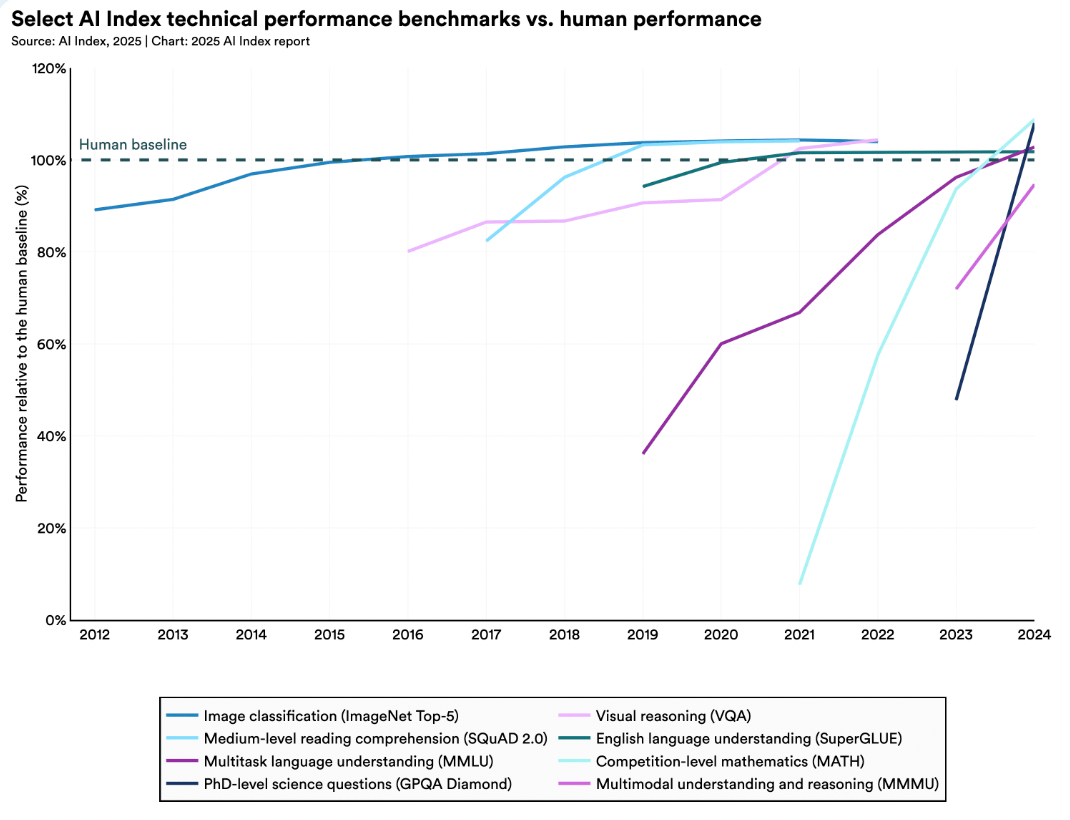
In the new benchmarks MMMU, GPQA, and SWE-bench, AI performance improved significantly: scores increased by 18.8%, 48.9%, and 67.3%, respectively. In addition to the benchmarks, AI systems made significant progress in generating high-quality videos, and in some cases, large language models (LLMs) even surpassed humans in timed programming tasks.

Note:

MMMU is a novel, carefully designed benchmark for multi-disciplinary multimodal understanding and reasoning at the university level, aiming to evaluate the expert-level multimodal understanding capabilities of underlying models on a wide range of tasks.

GPQA is a challenging dataset consisting of 448 high-quality and difficult multiple-choice questions written by experts in different fields. Experts who hold or are pursuing a PhD in the corresponding field achieve only 65% accuracy, while highly skilled non-expert verifiers achieve only 34% accuracy despite spending an average of more than 30 minutes and having unlimited access to the Internet.

SWE-bench is a benchmark for evaluating the performance of Large Language Models (LLMs) on real-world software questions collected from GitHub.
Highlights of Stanford HAI's 2025 Artificial Intelligence Index Report

2. AI is more efficient, accessible, and affordable

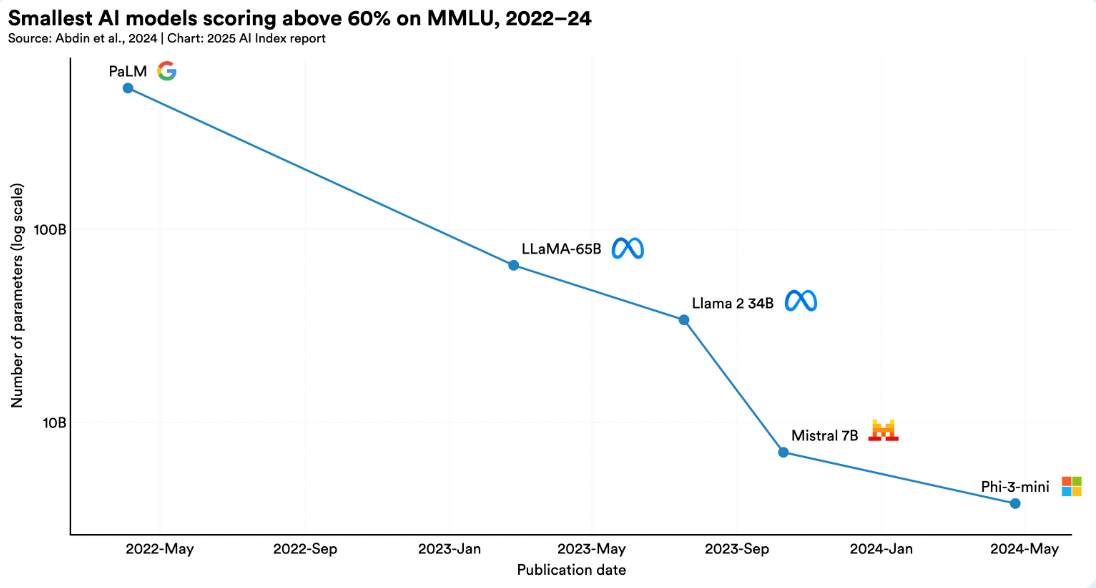
Smaller AI models with fewer parameters are becoming increasingly powerful: in just two years, the number of parameters has been reduced by about 100 times, while still scoring over 60% on the Massive Multi-Task Language Understanding (MMLU) test.

The gap between open source and closed source models is also narrowing, with the performance gap falling from 8% to just 1.7% in some benchmarks.
Highlights of Stanford HAI's 2025 Artificial Intelligence Index Report

Furthermore, the cost of inference for systems reaching the level of GPT-3.5 dropped by more than 280 times from November 2022 to October 2024. At the hardware level, costs dropped by 30% per year, while energy efficiency improved by 40% per year.

The threshold for advanced AI is rapidly decreasing. Not to mention the development of sparse models like DeepSeek, where only relevant parameters are activated to answer the user’s query under the Mixture of Experts (MoE) structure, making the whole thing more efficient.

Indeed, as smaller but more powerful AI models continue to emerge, the requirements for AI model training have been reduced, and cost-effective distributed training is expected to become mainstream in the next decade. There are currently some top projects conducting related research based on different theoretical frameworks.

3. AI is increasingly integrated into everyday life

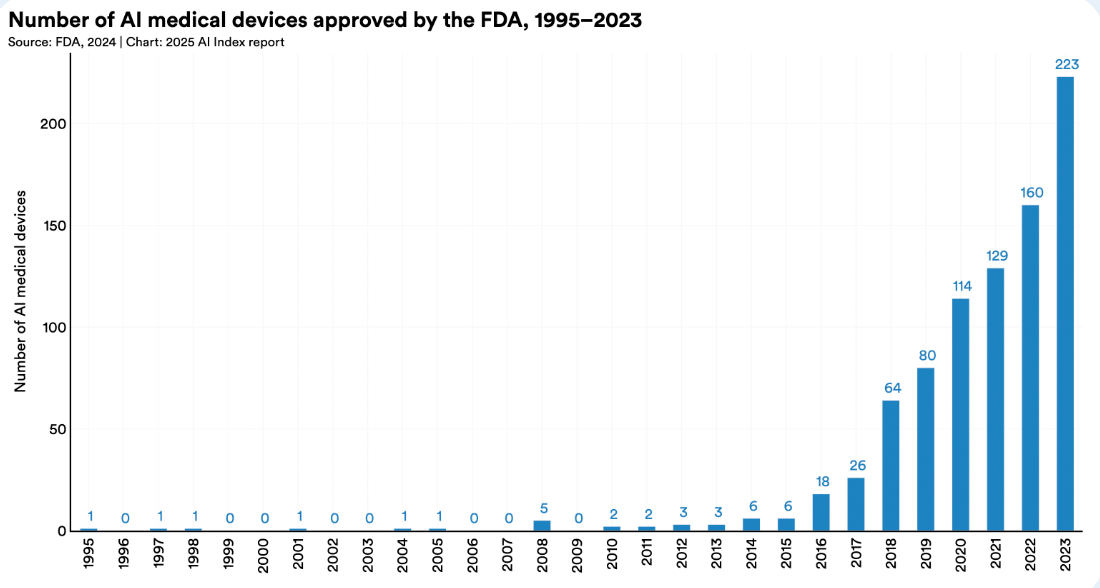
In 2023, the U.S. Food and Drug Administration (FDA) approved 223 AI-assisted medical devices, up from just six in 2015. On the roads, self-driving cars are no longer experiments: Waymo, one of the largest operators in the U.S., provides more than 150,000 self-driving rides per week, and Baidu’s Apollo Go fleet of driverless taxis is now operational in several Chinese cities.
Highlights of Stanford HAI's 2025 Artificial Intelligence Index Report

4. Corporate investment in AI has increased significantly, driving record investments and adoption

The adoption of AI in business is also accelerating: 78% of organizations are using AI in 2024, up from 55% the year before. At the same time, a growing body of research confirms that AI can increase productivity and help close skills gaps across the workforce.

In fact, product-market fit breakdowns will occur more frequently as AI causes customer expectations to grow exponentially, making existing solutions obsolete overnight, leaving incumbents with no chance to adapt.

5. Despite rising optimism about AI globally, Asians are more optimistic about AI

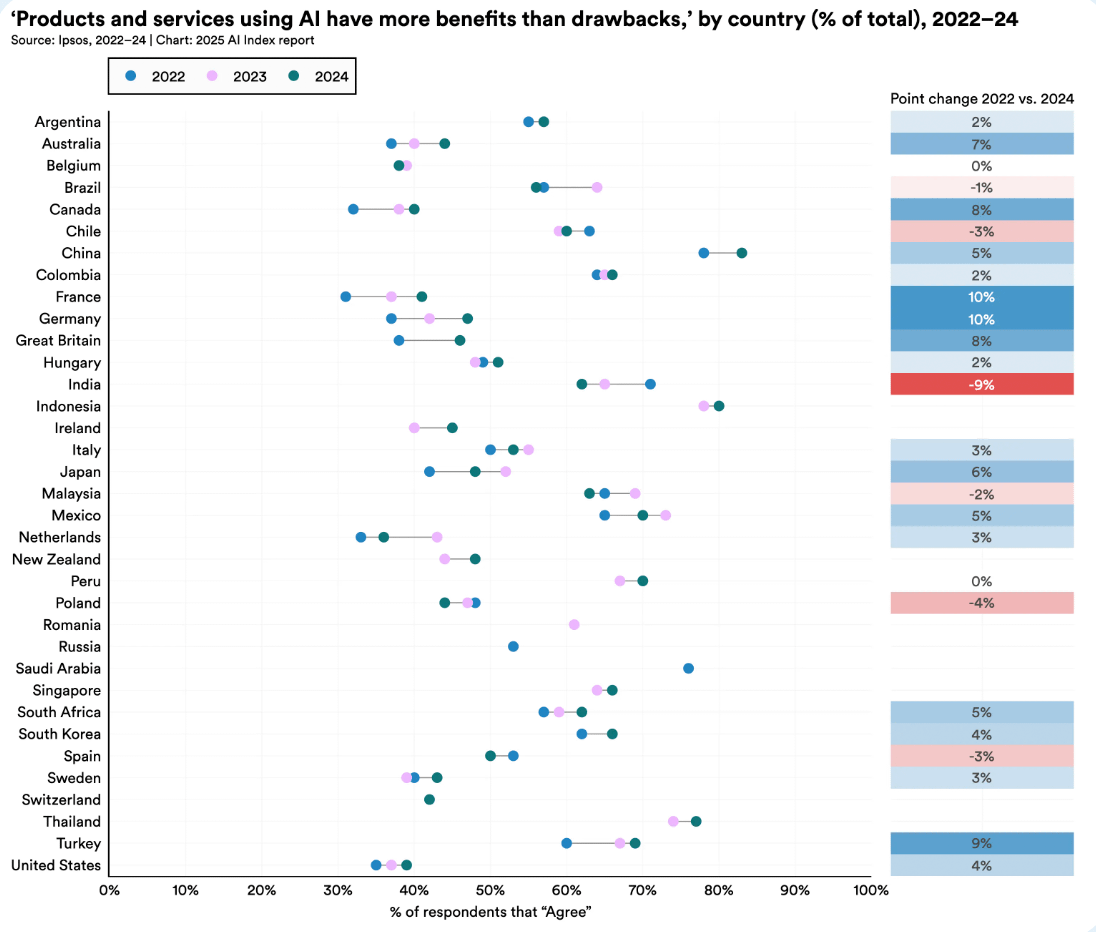
In countries such as China (83%), Indonesia (80%) and Thailand (77%), the majority believe that the benefits of AI products and services outweigh the risks. In contrast, optimism remains far lower in places such as Canada (40%), the United States (39%) and the Netherlands (36%).

However, this attitude is changing: since 2022, optimism has grown significantly in a number of previously skeptical countries, including Germany (up 10%), France (up 10%), Canada (up 8%), the United Kingdom (up 8%) and the United States (up 4%).
Highlights of Stanford HAI's 2025 Artificial Intelligence Index Report

6. The influence of artificial intelligence in scientific research is increasing, and it has become an important driving force for scientific progress

The growing importance of AI is reflected in major scientific prizes: two Nobel Prizes were awarded for research into deep learning (physics) and its application to protein folding (chemistry), while the Turing Award recognized groundbreaking contributions to reinforcement learning.

Clearly, AI is advancing at an exponential and unexpected pace, which is significant to most people. As a result, AI security is becoming increasingly important. While AI makes forgery easier, cryptography makes it more difficult. Look forward to crypto projects that can leverage the native properties of blockchain (verifiability and transparency) to build practical solutions in this area.

Related reading: Interview with Chris Dixon, founder of a16z: The intersection of artificial intelligence and encryption technology


Market Opportunity
Moonveil Logo
Moonveil Price(MORE)
$0.0007941
$0.0007941$0.0007941
-0.13%
USD
Moonveil (MORE) Live Price Chart
Disclaimer: The articles reposted on this site are sourced from public platforms and are provided for informational purposes only. They do not necessarily reflect the views of MEXC. All rights remain with the original authors. If you believe any content infringes on third-party rights, please contact [email protected] for removal. MEXC makes no guarantees regarding the accuracy, completeness, or timeliness of the content and is not responsible for any actions taken based on the information provided. The content does not constitute financial, legal, or other professional advice, nor should it be considered a recommendation or endorsement by MEXC.

You May Also Like

Best Crypto to Buy as Saylor & Crypto Execs Meet in US Treasury Council

Best Crypto to Buy as Saylor & Crypto Execs Meet in US Treasury Council

The post Best Crypto to Buy as Saylor & Crypto Execs Meet in US Treasury Council appeared on BitcoinEthereumNews.com. Michael Saylor and a group of crypto executives met in Washington, D.C. yesterday to push for the Strategic Bitcoin Reserve Bill (the BITCOIN Act), which would see the U.S. acquire up to 1M $BTC over five years. With Bitcoin being positioned yet again as a cornerstone of national monetary policy, many investors are turning their eyes to projects that lean into this narrative – altcoins, meme coins, and presales that could ride on the same wave. Read on for three of the best crypto projects that seem especially well‐suited to benefit from this macro shift:  Bitcoin Hyper, Best Wallet Token, and Remittix. These projects stand out for having a strong use case and high adoption potential, especially given the push for a U.S. Bitcoin reserve.   Why the Bitcoin Reserve Bill Matters for Crypto Markets The strategic Bitcoin Reserve Bill could mark a turning point for the U.S. approach to digital assets. The proposal would see America build a long-term Bitcoin reserve by acquiring up to one million $BTC over five years. To make this happen, lawmakers are exploring creative funding methods such as revaluing old gold certificates. The plan also leans on confiscated Bitcoin already held by the government, worth an estimated $15–20B. This isn’t just a headline for policy wonks. It signals that Bitcoin is moving from the margins into the core of financial strategy. Industry figures like Michael Saylor, Senator Cynthia Lummis, and Marathon Digital’s Fred Thiel are all backing the bill. They see Bitcoin not just as an investment, but as a hedge against systemic risks. For the wider crypto market, this opens the door for projects tied to Bitcoin and the infrastructure that supports it. 1. Bitcoin Hyper ($HYPER) – Turning Bitcoin Into More Than Just Digital Gold The U.S. may soon treat Bitcoin as…
Share
BitcoinEthereumNews2025/09/18 00:27
BlackRock boosts AI and US equity exposure in $185 billion models

BlackRock boosts AI and US equity exposure in $185 billion models

The post BlackRock boosts AI and US equity exposure in $185 billion models appeared on BitcoinEthereumNews.com. BlackRock is steering $185 billion worth of model portfolios deeper into US stocks and artificial intelligence. The decision came this week as the asset manager adjusted its entire model suite, increasing its equity allocation and dumping exposure to international developed markets. The firm now sits 2% overweight on stocks, after money moved between several of its biggest exchange-traded funds. This wasn’t a slow shuffle. Billions flowed across multiple ETFs on Tuesday as BlackRock executed the realignment. The iShares S&P 100 ETF (OEF) alone brought in $3.4 billion, the largest single-day haul in its history. The iShares Core S&P 500 ETF (IVV) collected $2.3 billion, while the iShares US Equity Factor Rotation Active ETF (DYNF) added nearly $2 billion. The rebalancing triggered swift inflows and outflows that realigned investor exposure on the back of performance data and macroeconomic outlooks. BlackRock raises equities on strong US earnings The model updates come as BlackRock backs the rally in American stocks, fueled by strong earnings and optimism around rate cuts. In an investment letter obtained by Bloomberg, the firm said US companies have delivered 11% earnings growth since the third quarter of 2024. Meanwhile, earnings across other developed markets barely touched 2%. That gap helped push the decision to drop international holdings in favor of American ones. Michael Gates, lead portfolio manager for BlackRock’s Target Allocation ETF model portfolio suite, said the US market is the only one showing consistency in sales growth, profit delivery, and revisions in analyst forecasts. “The US equity market continues to stand alone in terms of earnings delivery, sales growth and sustainable trends in analyst estimates and revisions,” Michael wrote. He added that non-US developed markets lagged far behind, especially when it came to sales. This week’s changes reflect that position. The move was made ahead of the Federal…
Share
BitcoinEthereumNews2025/09/18 01:44
Trump Denies Involvement in $500M Abu Dhabi WLFI Stake

Trump Denies Involvement in $500M Abu Dhabi WLFI Stake

The post Trump Denies Involvement in $500M Abu Dhabi WLFI Stake appeared on BitcoinEthereumNews.com. US President Donald Trump has denied knowledge of a reported
Share
BitcoinEthereumNews2026/02/03 23:26



