Polymarket has introduced a new incentive for prediction market participants, offering a 4% annualized yield on certain long-term positions. The reward, which is paid out daily, is designed to keep long-term pricing accurate and is currently funded through the Polymarket Treasury. According to the exchange, the yield applies to positions in a set of political and geopolitical markets, including the 2028 U.S. presidential race, the balance of power in the 2026 midterms, and leadership outcomes in countries such as Russia, China, Turkey, Israel, and Ukraine. Positions are valued based on the number of “Yes” and “No” shares held and the most recent mid-price, with rewards distributed after an hourly random sampling of accounts. The 4% rate is variable and may be adjusted or capped at the company’s discretion. Prediction Market Rivalry Heats Up as Kalshi Tops Polymarket by Volumes While Polymarket’s new holding rewards seek to attract long-term bettors, competitor Kalshi has been dominating in terms of trading activity. For three consecutive weeks, Kalshi has posted higher volumes than Polymarket, recording $728 million in trades last week. That figure is nearly 60% higher than Polymarket’s volume and close to Kalshi’s record $749 million during the run-up to the 2024 U.S. presidential election.Source: Dune Analytics Data from Dune Analytics shows that between September 11 and 17, Kalshi captured 62% of total on-chain prediction market volume, with more than $500 million in trades and $189 million in open interest. Polymarket, by comparison, registered $430 million in trading volume and $164 million in open interest over the same period. Analysts note that Polymarket’s higher open interest relative to volume reflects longer-term positions, while Kalshi’s lower ratio points to faster turnover and more active trading. The competition between the two platforms shows diverging strategies. Kalshi, operating as a CFTC-authorized exchange, has capitalized on regulated event-based contract trading in the U.S. Polymarket, meanwhile, has historically catered to international users through blockchain-based markets but is expanding in the U.S. following its acquisition of the regulated exchange QCX. The company also recently launched earnings-based prediction markets in partnership with Stocktwits. Despite the differences in structure and oversight, both platforms continue to grow, with Kalshi solidifying its lead in weekly volume and Polymarket focusing on user retention through higher yields and long-term markets. CFTC Clears Polymarket for U.S. Return as Kalshi Faces State Lawsuit The prediction market space is entering a new phase as regulators in the U.S. take divergent approaches to two of its biggest players. On September 3, the CFTC cleared Polymarket to re-enter the U.S. through a no-action letter covering event contracts. The move marks Polymarket’s official return after a 2022 settlement forced it to block American users. CEO Shayne Coplan hailed the clearance as “a green light” for U.S. operations, noting that it gives the company space to scale legally. The breakthrough comes as Polymarket pursues a valuation of up to $10 billion, more than triple its last known $1 billion valuation in June. The firm rose to prominence after its markets accurately predicted Donald Trump’s 2024 victory, drawing major institutional backing and user growth. While Polymarket is regaining ground, rival Kalshi is facing legal hurdles. On September 13, Massachusetts Attorney General Andrea Joy Campbell filed a civil lawsuit accusing Kalshi of running unlicensed sports betting disguised as “event contracts.” The suit alleges that between January and June 2025, 70–75% of Kalshi’s $1 billion in wagers came from sports markets, rivaling licensed operators like DraftKings. Regulators say the platform allowed underage betting and lacked safeguards required by state law. As Polymarket moves forward with regulatory cover, Kalshi’s future could hinge on a growing clash between state gambling laws and federal commodities oversightPolymarket has introduced a new incentive for prediction market participants, offering a 4% annualized yield on certain long-term positions. The reward, which is paid out daily, is designed to keep long-term pricing accurate and is currently funded through the Polymarket Treasury. According to the exchange, the yield applies to positions in a set of political and geopolitical markets, including the 2028 U.S. presidential race, the balance of power in the 2026 midterms, and leadership outcomes in countries such as Russia, China, Turkey, Israel, and Ukraine. Positions are valued based on the number of “Yes” and “No” shares held and the most recent mid-price, with rewards distributed after an hourly random sampling of accounts. The 4% rate is variable and may be adjusted or capped at the company’s discretion. Prediction Market Rivalry Heats Up as Kalshi Tops Polymarket by Volumes While Polymarket’s new holding rewards seek to attract long-term bettors, competitor Kalshi has been dominating in terms of trading activity. For three consecutive weeks, Kalshi has posted higher volumes than Polymarket, recording $728 million in trades last week. That figure is nearly 60% higher than Polymarket’s volume and close to Kalshi’s record $749 million during the run-up to the 2024 U.S. presidential election.Source: Dune Analytics Data from Dune Analytics shows that between September 11 and 17, Kalshi captured 62% of total on-chain prediction market volume, with more than $500 million in trades and $189 million in open interest. Polymarket, by comparison, registered $430 million in trading volume and $164 million in open interest over the same period. Analysts note that Polymarket’s higher open interest relative to volume reflects longer-term positions, while Kalshi’s lower ratio points to faster turnover and more active trading. The competition between the two platforms shows diverging strategies. Kalshi, operating as a CFTC-authorized exchange, has capitalized on regulated event-based contract trading in the U.S. Polymarket, meanwhile, has historically catered to international users through blockchain-based markets but is expanding in the U.S. following its acquisition of the regulated exchange QCX. The company also recently launched earnings-based prediction markets in partnership with Stocktwits. Despite the differences in structure and oversight, both platforms continue to grow, with Kalshi solidifying its lead in weekly volume and Polymarket focusing on user retention through higher yields and long-term markets. CFTC Clears Polymarket for U.S. Return as Kalshi Faces State Lawsuit The prediction market space is entering a new phase as regulators in the U.S. take divergent approaches to two of its biggest players. On September 3, the CFTC cleared Polymarket to re-enter the U.S. through a no-action letter covering event contracts. The move marks Polymarket’s official return after a 2022 settlement forced it to block American users. CEO Shayne Coplan hailed the clearance as “a green light” for U.S. operations, noting that it gives the company space to scale legally. The breakthrough comes as Polymarket pursues a valuation of up to $10 billion, more than triple its last known $1 billion valuation in June. The firm rose to prominence after its markets accurately predicted Donald Trump’s 2024 victory, drawing major institutional backing and user growth. While Polymarket is regaining ground, rival Kalshi is facing legal hurdles. On September 13, Massachusetts Attorney General Andrea Joy Campbell filed a civil lawsuit accusing Kalshi of running unlicensed sports betting disguised as “event contracts.” The suit alleges that between January and June 2025, 70–75% of Kalshi’s $1 billion in wagers came from sports markets, rivaling licensed operators like DraftKings. Regulators say the platform allowed underage betting and lacked safeguards required by state law. As Polymarket moves forward with regulatory cover, Kalshi’s future could hinge on a growing clash between state gambling laws and federal commodities oversight

Polymarket Lures Bettors With Highest 4% Yield Amid Kalshi’s Weekly Volume Surge

4 min read

Polymarket has introduced a new incentive for prediction market participants, offering a 4% annualized yield on certain long-term positions. The reward, which is paid out daily, is designed to keep long-term pricing accurate and is currently funded through the Polymarket Treasury.

According to the exchange, the yield applies to positions in a set of political and geopolitical markets, including the 2028 U.S. presidential race, the balance of power in the 2026 midterms, and leadership outcomes in countries such as Russia, China, Turkey, Israel, and Ukraine.

Positions are valued based on the number of “Yes” and “No” shares held and the most recent mid-price, with rewards distributed after an hourly random sampling of accounts. The 4% rate is variable and may be adjusted or capped at the company’s discretion.

Prediction Market Rivalry Heats Up as Kalshi Tops Polymarket by Volumes

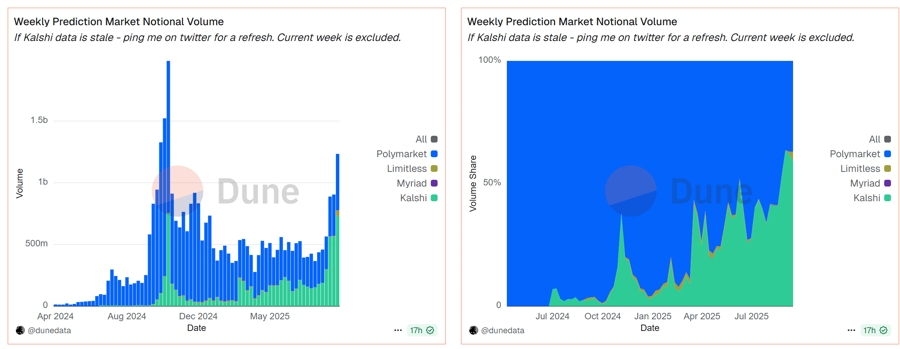
While Polymarket’s new holding rewards seek to attract long-term bettors, competitor Kalshi has been dominating in terms of trading activity. For three consecutive weeks, Kalshi has posted higher volumes than Polymarket, recording $728 million in trades last week.

That figure is nearly 60% higher than Polymarket’s volume and close to Kalshi’s record $749 million during the run-up to the 2024 U.S. presidential election.
Source: Dune Analytics

Data from Dune Analytics shows that between September 11 and 17, Kalshi captured 62% of total on-chain prediction market volume, with more than $500 million in trades and $189 million in open interest.

Polymarket, by comparison, registered $430 million in trading volume and $164 million in open interest over the same period.

Analysts note that Polymarket’s higher open interest relative to volume reflects longer-term positions, while Kalshi’s lower ratio points to faster turnover and more active trading.

The competition between the two platforms shows diverging strategies. Kalshi, operating as a CFTC-authorized exchange, has capitalized on regulated event-based contract trading in the U.S.

Polymarket, meanwhile, has historically catered to international users through blockchain-based markets but is expanding in the U.S. following its acquisition of the regulated exchange QCX. The company also recently launched earnings-based prediction markets in partnership with Stocktwits.

Despite the differences in structure and oversight, both platforms continue to grow, with Kalshi solidifying its lead in weekly volume and Polymarket focusing on user retention through higher yields and long-term markets.

CFTC Clears Polymarket for U.S. Return as Kalshi Faces State Lawsuit

The prediction market space is entering a new phase as regulators in the U.S. take divergent approaches to two of its biggest players.

On September 3, the CFTC cleared Polymarket to re-enter the U.S. through a no-action letter covering event contracts.

The move marks Polymarket’s official return after a 2022 settlement forced it to block American users.

CEO Shayne Coplan hailed the clearance as “a green light” for U.S. operations, noting that it gives the company space to scale legally. The breakthrough comes as Polymarket pursues a valuation of up to $10 billion, more than triple its last known $1 billion valuation in June.

The firm rose to prominence after its markets accurately predicted Donald Trump’s 2024 victory, drawing major institutional backing and user growth.

While Polymarket is regaining ground, rival Kalshi is facing legal hurdles. On September 13, Massachusetts Attorney General Andrea Joy Campbell filed a civil lawsuit accusing Kalshi of running unlicensed sports betting disguised as “event contracts.”

The suit alleges that between January and June 2025, 70–75% of Kalshi’s $1 billion in wagers came from sports markets, rivaling licensed operators like DraftKings. Regulators say the platform allowed underage betting and lacked safeguards required by state law.

As Polymarket moves forward with regulatory cover, Kalshi’s future could hinge on a growing clash between state gambling laws and federal commodities oversight.

Disclaimer: The articles reposted on this site are sourced from public platforms and are provided for informational purposes only. They do not necessarily reflect the views of MEXC. All rights remain with the original authors. If you believe any content infringes on third-party rights, please contact [email protected] for removal. MEXC makes no guarantees regarding the accuracy, completeness, or timeliness of the content and is not responsible for any actions taken based on the information provided. The content does not constitute financial, legal, or other professional advice, nor should it be considered a recommendation or endorsement by MEXC.

You May Also Like

Fed Decides On Interest Rates Today—Here’s What To Watch For

Fed Decides On Interest Rates Today—Here’s What To Watch For

The post Fed Decides On Interest Rates Today—Here’s What To Watch For appeared on BitcoinEthereumNews.com. Topline The Federal Reserve on Wednesday will conclude a two-day policymaking meeting and release a decision on whether to lower interest rates—following months of pressure and criticism from President Donald Trump—and potentially signal whether additional cuts are on the way. President Donald Trump has urged the central bank to “CUT INTEREST RATES, NOW, AND BIGGER” than they might plan to. Getty Images Key Facts The central bank is poised to cut interest rates by at least a quarter-point, down from the 4.25% to 4.5% range where they have been held since December to between 4% and 4.25%, as Wall Street has placed 100% odds of a rate cut, according to CME’s FedWatch, with higher odds (94%) on a quarter-point cut than a half-point (6%) reduction. Fed governors Christopher Waller and Michelle Bowman, both Trump appointees, voted in July for a quarter-point reduction to rates, and they may dissent again in favor of a large cut alongside Stephen Miran, Trump’s Council of Economic Advisers’ chair, who was sworn in at the meeting’s start on Tuesday. It’s unclear whether other policymakers, including Kansas City Fed President Jeffrey Schmid and St. Louis Fed President Alberto Musalem, will favor larger cuts or opt for no reduction. Fed Chair Jerome Powell said in his Jackson Hole, Wyoming, address last month the central bank would likely consider a looser monetary policy, noting the “shifting balance of risks” on the U.S. economy “may warrant adjusting our policy stance.” David Mericle, an economist for Goldman Sachs, wrote in a note the “key question” for the Fed’s meeting is whether policymakers signal “this is likely the first in a series of consecutive cuts” as the central bank is anticipated to “acknowledge the softening in the labor market,” though they may not “nod to an October cut.” Mericle said he…
Share
BitcoinEthereumNews2025/09/18 00:23
While Shiba Inu and Turbo Chase Price, 63% APY Staking Puts APEMARS at the Forefront of the Best Meme Coin Presale 2026 – Stage 6 Ends in 3 Days!
While Shiba Inu and Turbo Chase Price, 63% APY Staking Puts APEMARS at the Forefront of the Best Meme Coin Presale 2026 – Stage 6 Ends in 3 Days!

What if your meme coin investment could generate passive income without selling a single token? Shiba Inu climbed 4.97% as 207 billion tokens left exchanges. Turbo
Share
Coinstats2026/02/04 03:15
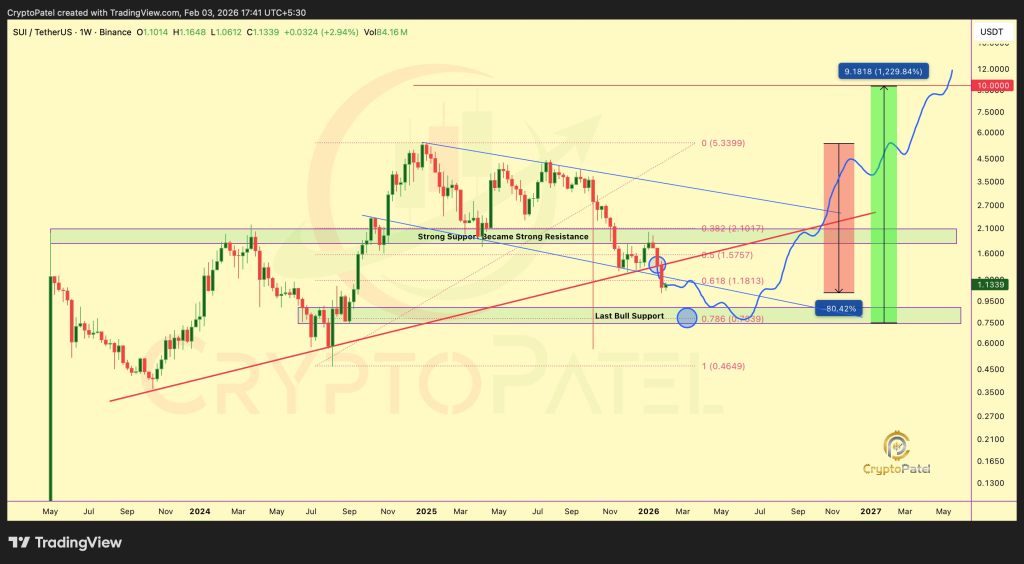
SUI Price Is Down 80%: Price Nears Level Bulls Cannot Afford to Lose

SUI Price Is Down 80%: Price Nears Level Bulls Cannot Afford to Lose

SUI price has quietly slipped into a zone that usually decides everything. Charts show an 80% drop from the peak, yet the market is no longer moving fast. This
Share
Captainaltcoin2026/02/04 03:00