📑 Table of Contents Polkadot: A Network of Networks The Vision Behind Polkadot’s Creation How Polkadot’s Modular Technology Works Governance and Community Power Polkadot in Action: Examples and Partners DOT Tokenomics Explained Polkadot’s Roadmap and Future Outlook FAQ: 10 Unanswered Questions About Polkadot 🌐 Polkadot: A Network of Networks Polkadot is one of the most [...]]]>📑 Table of Contents Polkadot: A Network of Networks The Vision Behind Polkadot’s Creation How Polkadot’s Modular Technology Works Governance and Community Power Polkadot in Action: Examples and Partners DOT Tokenomics Explained Polkadot’s Roadmap and Future Outlook FAQ: 10 Unanswered Questions About Polkadot 🌐 Polkadot: A Network of Networks Polkadot is one of the most [...]]]>

Polkadot (DOT) in 2025: The Network of Networks Powering Interoperable Web3

📑 Table of Contents

  • Polkadot: A Network of Networks
  • The Vision Behind Polkadot’s Creation
  • How Polkadot’s Modular Technology Works
  • Governance and Community Power
  • Polkadot in Action: Examples and Partners
  • DOT Tokenomics Explained
  • Polkadot’s Roadmap and Future Outlook
  • FAQ: 10 Unanswered Questions About Polkadot

🌐 Polkadot: A Network of Networks

Polkadot is one of the most promising innovations in blockchain technology. Unlike traditional single-chain blockchains such as Bitcoin or Ethereum, Polkadot is designed as a network of blockchains. Through its modular architecture, it enables a wide range of specialized applications to run in parallel while benefiting from shared security and interoperability.

The native token DOT functions as a cryptocurrency, governance tool, and utility token. Its goal is to build an interoperable Web3 ecosystem where blockchains can communicate securely and efficiently. This design allows projects to develop custom solutions without compromising network stability or scalability.

🚀 The Vision Behind Polkadot’s Creation

Polkadot was conceived by Dr. Gavin Wood, one of Ethereum’s co-founders, in 2016. His vision was to overcome the limitations of existing blockchains. The development is led by the Web3 Foundation and Parity Technologies. The mission: to build a decentralized internet free from gatekeepers, where users retain full control over their data and applications.

⚙ How Polkadot’s Modular Technology Works

Polkadot is built on a modular architecture with three key components:

  • Relay Chain: The central chain providing security, governance, and transaction validation.
  • Parachains: Independent blockchains that run in parallel, customized for specific applications like DeFi, gaming, or identity management.
  • Bridges: Connect Polkadot with external blockchains such as Ethereum and Bitcoin, enhancing interoperability.

This design allows scalability, specialization, and seamless communication between blockchains.

🏛 Governance and Community Power

Unlike off-chain governance models, Polkadot implements on-chain governance. DOT holders directly vote on protocol upgrades, parameter adjustments, and feature integrations. This democratic model empowers the community and promotes transparency. A notable example is Parachain Auctions, where projects compete for relay chain slots, and the community votes on which projects are integrated.

💡 Polkadot in Action: Examples and Partner Projects

Polkadot supports a wide variety of applications, including:

  • DeFi: Acala (stablecoins, financial products) and Parallel Finance (lending, staking, trading).
  • Smart Contracts: Moonbeam, offering Ethereum compatibility for developers.
  • Digital Identity: KILT Protocol, providing verifiable credentials.
  • Other Sectors: Energy, logistics, and sustainability through collaborations with companies and NGOs.

ProjectFocus AreaRole within Polkadot
AcalaDeFi / StablecoinsFinancial hub for decentralized services
MoonbeamSmart ContractsEthereum-compatible environment
KILT ProtocolDigital IdentityIdentity verification and data management

💰 DOT Tokenomics Explained

The DOT token underpins the economic model of Polkadot. Unlike capped-supply cryptocurrencies, DOT uses an inflation-based model to ensure continuous network incentives. Key functions include:

  • Governance: Voting on protocol changes and new features.
  • Staking: Securing the network by rewarding validators and nominators.
  • Parachain Auctions: Funding slots on the relay chain for project integration.
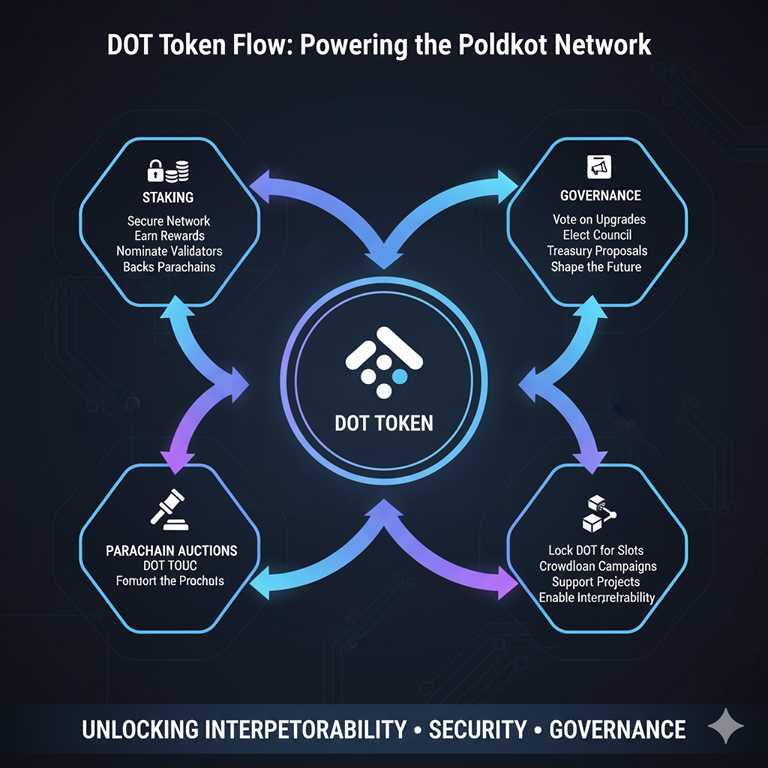
infographic showing the DOT Token flow, including staking, governance, and parachain auctions

🔮 Polkadot’s Roadmap and Future Outlook

In 2025, Polkadot is focused on expanding its parachain ecosystem and building additional bridges to external networks. Regulatory clarity could accelerate institutional adoption. With its multi-chain architecture, Polkadot is becoming a key infrastructure provider for Web3.

The development of Polkadot 2.0 will transform the platform into a global computing environment. Its JAM architecture (Join-Accumulate Machine) introduces vertical scalability and service-oriented design, aiming to support decentralized Web3 cloud functions.
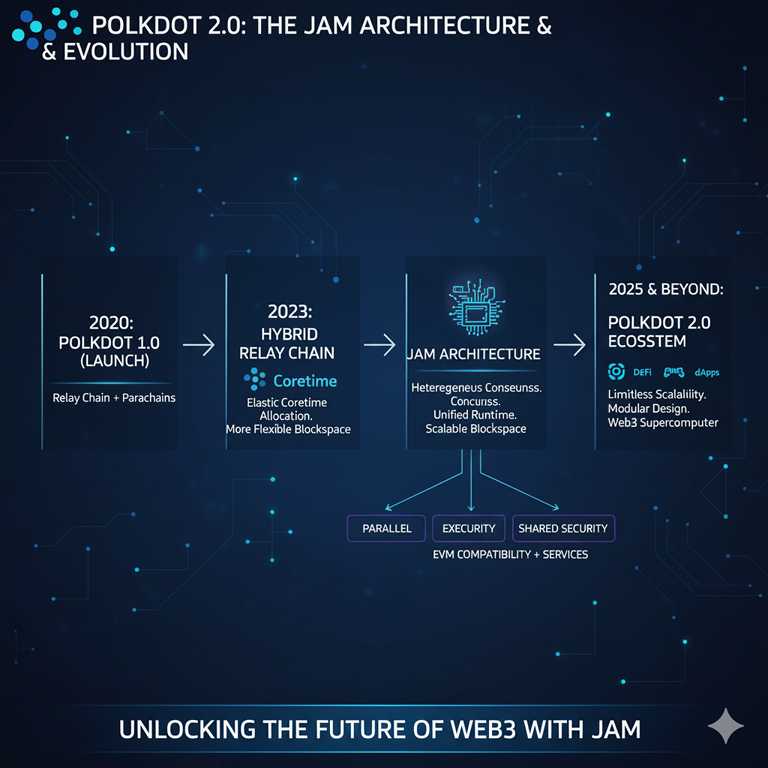
image of the Polkadot 2.0 roadmap timeline, including JAM architecture features

❓ FAQ: 10 Unanswered Questions About Polkadot

1. How will Polkadot 2.0 impact developers?
Polkadot 2.0 will expand opportunities for developers by introducing the JAM (Join-Accumulate Machine) architecture. This enables vertical scalability, more flexible runtime environments, and a service-oriented infrastructure, allowing developers to build Web3 apps with greater efficiency and customizability.
2. Can Polkadot surpass Ethereum in adoption?
Polkadot could surpass Ethereum in specific niches like interoperability, parachain customization, and enterprise blockchain use cases. However, Ethereum’s dominant ecosystem and first-mover advantage in DeFi and NFTs make it difficult to overtake on a broad scale.
3. How secure are Polkadot’s parachains?
Parachains benefit from shared security provided by the relay chain. However, individual parachains can still face risks such as vulnerabilities in their own smart contract code or governance decisions. Shared security reduces systemic risk, but not all parachain-level risks.
4. Will regulatory changes affect Polkadot’s growth?
Yes, regulation will play a major role. Stricter frameworks could limit adoption in some regions, while clear guidelines might accelerate institutional and enterprise integration. Polkadot’s flexibility and governance model position it well to adapt to evolving compliance requirements.
5. What role do bridges play in Polkadot’s success?
Bridges are essential to Polkadot’s interoperability. They allow data and assets to flow between Polkadot and external blockchains like Ethereum and Bitcoin. Successful bridge deployment will determine Polkadot’s ability to become a true hub in the multi-chain ecosystem.
6. Can DOT tokenomics remain sustainable long-term?
DOT’s inflationary model incentivizes validators and nominators to secure the network. Over the long term, governance may adjust inflation parameters to balance rewards, security, and scarcity. The model is flexible but depends on active and responsible community governance.
7. How does Polkadot compare to Cosmos?
Both Polkadot and Cosmos aim to solve interoperability. Polkadot emphasizes shared security and a unified relay chain, while Cosmos prioritizes chain sovereignty with independent blockchains connected by the IBC protocol. The choice depends on whether projects value independence or pooled security.
8. Could Polkadot attract more enterprises?
Yes, Polkadot’s customizable parachains, regulatory adaptability, and strong developer community make it attractive to enterprises seeking tailored blockchain solutions. Its compliance-friendly approach and focus on interoperability also appeal to institutional use cases.
9. How active is the Polkadot developer community?
Polkadot consistently ranks among the top blockchain projects in GitHub commits and developer activity. Its community is one of the most active, with continuous contributions to core protocol upgrades, parachain development, and tooling for Web3.
10. What’s next for parachain auctions?
Parachain auctions will likely evolve with new models, such as shorter leasing terms, dynamic pricing, or alternative allocation mechanisms. These changes aim to increase accessibility for projects and further decentralize participation in the ecosystem.
]]>
Market Opportunity
Polkadot Logo
Polkadot Price(DOT)
$1.401
$1.401$1.401
+0.21%
USD
Polkadot (DOT) Live Price Chart
Disclaimer: The articles reposted on this site are sourced from public platforms and are provided for informational purposes only. They do not necessarily reflect the views of MEXC. All rights remain with the original authors. If you believe any content infringes on third-party rights, please contact [email protected] for removal. MEXC makes no guarantees regarding the accuracy, completeness, or timeliness of the content and is not responsible for any actions taken based on the information provided. The content does not constitute financial, legal, or other professional advice, nor should it be considered a recommendation or endorsement by MEXC.

You May Also Like

Wormhole launches reserve tying protocol revenue to token

Wormhole launches reserve tying protocol revenue to token

The post Wormhole launches reserve tying protocol revenue to token appeared on BitcoinEthereumNews.com. Wormhole is changing how its W token works by creating a new reserve designed to hold value for the long term. Announced on Wednesday, the Wormhole Reserve will collect onchain and offchain revenues and other value generated across the protocol and its applications (including Portal) and accumulate them into W, locking the tokens within the reserve. The reserve is part of a broader update called W 2.0. Other changes include a 4% targeted base yield for tokenholders who stake and take part in governance. While staking rewards will vary, Wormhole said active users of ecosystem apps can earn boosted yields through features like Portal Earn. The team stressed that no new tokens are being minted; rewards come from existing supply and protocol revenues, keeping the cap fixed at 10 billion. Wormhole is also overhauling its token release schedule. Instead of releasing large amounts of W at once under the old “cliff” model, the network will shift to steady, bi-weekly unlocks starting October 3, 2025. The aim is to avoid sharp periods of selling pressure and create a more predictable environment for investors. Lockups for some groups, including validators and investors, will extend an additional six months, until October 2028. Core contributor tokens remain under longer contractual time locks. Wormhole launched in 2020 as a cross-chain bridge and now connects more than 40 blockchains. The W token powers governance and staking, with a capped supply of 10 billion. By redirecting fees and revenues into the new reserve, Wormhole is betting that its token can maintain value as demand for moving assets and data between chains grows. This is a developing story. This article was generated with the assistance of AI and reviewed by editor Jeffrey Albus before publication. Get the news in your inbox. Explore Blockworks newsletters: Source: https://blockworks.co/news/wormhole-launches-reserve
Share
BitcoinEthereumNews2025/09/18 01:55
VanEck Targets Stablecoins & Next-Gen ICOs

VanEck Targets Stablecoins & Next-Gen ICOs

The post VanEck Targets Stablecoins & Next-Gen ICOs appeared on BitcoinEthereumNews.com. Welcome to the US Crypto News Morning Briefing—your essential rundown of the most important developments in crypto for the day ahead. Grab a coffee because the firms shaping crypto’s future are not just building products, but also trying to reshape how capital flows. Crypto News of the Day: VanEck Maps Next Frontier of Crypto Venture Investing VanEck, a Wall Street player known for financial “firsts,” is pushing that legacy into Web3. The firsts include pioneering US gold funds and launching one of the earliest spot Bitcoin ETFs. Sponsored Sponsored “Financial instruments have always been a kind of tokenization. From seashells to traveler’s checks, from relational databases to today’s on-chain assets. You could even joke that VanEck’s first gold mutual funds were the original ‘tokenized gold,’” Juan C. Lopez, General Partner at VanEck Ventures, told BeInCrypto. That same instinct drives the firm’s venture bets. Lopez said VanEck goes beyond writing checks and brings the full weight of the firm. This extends from regulatory proximity to product experiments to founders building the next phase of crypto infrastructure. Asked about key investment priorities, Lopez highlighted stablecoins. “We care deeply about three questions: How do we accelerate stablecoin ubiquity? What will users want to do with them once highly distributed? And what net new assets can we construct now that we have sophisticated market infrastructure?” Lopez added. However, VanEck is not limiting itself to the hottest narrative, acknowledging that decentralized finance (DeFi) is having a renaissance. The VanEck executive also noted that success will depend on new approaches to identity and programmable compliance layered on public blockchains. Backing Legion With A New Model for ICOs Sponsored Sponsored That compliance-first angle explains VanEck Ventures’ recent co-lead of Legion’s $5 million seed round alongside Brevan Howard. Legion aims to reinvent token fundraising by making early-stage access…
Share
BitcoinEthereumNews2025/09/18 03:52
SUI: Where the Price Might Be Heading After the $1.02 Breakout Attempt

SUI: Where the Price Might Be Heading After the $1.02 Breakout Attempt

SUI is trading near $1.034, attempting to hold above the key $1.02 resistance level after breaking out from a rounded base formation. The level that matters is $
Share
Ethnews2026/02/15 16:35