OpenSea Sets Q1 2026 Launch Date for SEA Token With 50% Revenue Buyback Program

OpenSea CEO Devin Finzer announced on October 17, 2025 that the platform’s native SEA token will launch in the first quarter of 2026.
The timing coincides with OpenSea’s strongest performance in three years. The platform processed over $2.6 billion in trading volume in October 2025, with more than 90% coming from regular cryptocurrency trading rather than NFTs. This marks a significant shift for what was once the world’s largest NFT marketplace.
Token Distribution and Community Rewards
Half of the total SEA supply will go directly to community members. The distribution prioritizes two groups: longtime “OG” users and participants in OpenSea’s rewards programs. These groups will be considered separately for allocation.
The initial token claim will instantly provide around 25% of the total SEA supply to community users. Another 25% will be distributed to the same group over time. OpenSea has emphasized that historical platform usage matters more than recent activity alone when determining who qualifies.
Unlike many crypto token launches, the SEA distribution won’t require identity verification, and U.S. users remain eligible to participate. This approach differs from recent launches like Berachain that excluded American users.
How the Buyback Program Works
The 50% revenue buyback represents a substantial commitment to supporting token value. This mechanism directs half of all platform earnings toward purchasing SEA tokens from the market. The strategy aims to create consistent buying pressure and align the platform’s financial success with token holder benefits.
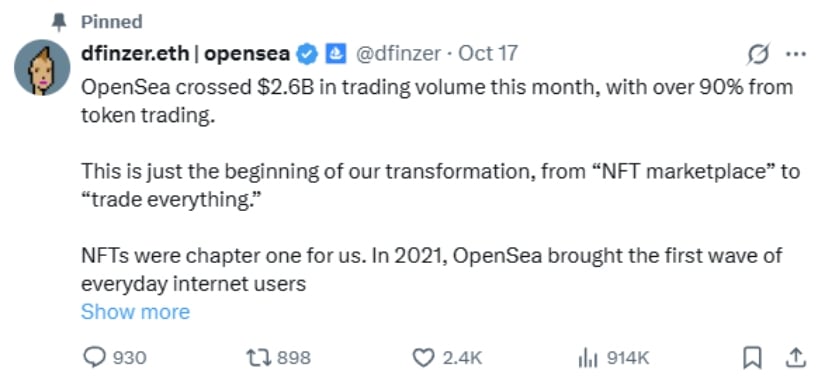
Source: @dfinzer
Users will also be able to stake their SEA tokens on the platform. The staking feature allows holders to support their favorite tokens and NFT collections while earning rewards. This creates direct engagement between token utility and platform activity.
OpenSea’s Major Transformation
OpenSea has evolved far beyond its NFT marketplace roots. The platform now supports trading across 22 different blockchains, handling everything from Bitcoin and Ethereum to newer networks. In the first two weeks of October alone, OpenSea processed $1.6 billion in crypto trades and $230 million in NFT transactions.
The company acquired Rally, a mobile portfolio and trading application, in July to improve its mobile experience. That app is currently in closed alpha testing. OpenSea also plans to add perpetual futures trading, a type of derivative product popular among professional crypto traders.
The platform’s OS2 upgrade represents a complete rebuild. Marketplace fees dropped to 0.5%, and swap fees were eliminated entirely during the launch period. The system now combines NFT trading and regular token trading in one interface, with cross-chain functionality that lets users buy assets on one blockchain using tokens from another.
Recent Market Performance
OpenSea’s recent trading volume surge brings it back to levels not seen since 2022. At its peak in May 2022, the platform facilitated $476 million in daily trading volume. But as NFT interest declined, monthly volume fell as low as $38 million in 2024.
The platform currently holds about 51% of the NFT market share, according to recent data. This represents a significant recovery from earlier in 2025 when competitors like Blur had captured a larger portion of the market.
CEO Finzer described the platform’s evolution as becoming “the destination for the onchain economy in its entirety.” The goal is to let users trade tokens, digital art, collectibles, and eventually physical goods all from one place. He emphasized that users shouldn’t need to navigate multiple chains, bridges, wallets, and protocols to access crypto markets.
Token Utility and Governance
SEA will function as more than a simple trading token. Holders will receive governance rights, giving them voting power on protocol upgrades, fee structures, and how the platform develops. The OpenSea Foundation, an independent entity, will oversee token distribution and governance processes.
The platform started its final pre-token rewards phase on September 15, 2025. Users could open “Treasure Chests” containing rewards, which can be leveled up through daily challenges. OpenSea committed to funneling 50% of all platform fees into a prize vault for distribution to users. The vault already contained $1 million worth of Optimism and Arbitrum tokens.
Certain NFT collections provide experience point multipliers for trading activity. Doodles and Kaito Genesis offer 5x boosts, Pudgy Penguins provides 4x, while Bored Ape Yacht Club and other blue-chip collections give 3x multipliers.
The Road Ahead
Finzer stated that “SEA is not being created to be launched and forgotten.” He emphasized the importance of making sure the platform deserves the spotlight that comes with a major token launch. The token represents OpenSea’s commitment to building for the long term rather than chasing short-term hype.
The SEC closed its investigation into OpenSea on February 21, 2025, removing regulatory uncertainty that had pressured the company and the broader NFT market. The agency had issued a Wells notice in August 2024, suggesting possible enforcement action.
OpenSea plans to launch its mobile app between now and the token generation event in Q1 2026. The company also continues developing cross-chain abstraction features and perpetual futures trading capabilities.
A Defining Moment
OpenSea’s SEA token launch marks the platform’s transition from NFT marketplace to full-spectrum crypto trading hub. The combination of generous community allocation, revenue buybacks, staking rewards, and governance rights creates multiple ways for users to benefit from platform growth. With trading volume back in the billions and new features on the horizon, Q1 2026 will test whether OpenSea can maintain momentum in an increasingly competitive market.
You May Also Like

The Channel Factories We’ve Been Waiting For
eToro (ETOR) Stock Surges 20% – Here’s What Drove the Q4 Beat