Recent advancements in quantum computing have pushed the boundaries of cryptographic security, raising alarms across the crypto industry. Google’s latest experiment demonstrates a breakthrough in quantum advantage, but experts warn that the immense power of future quantum computers may threaten the very foundations of digital assets and blockchain security. This milestone highlights both technological progress [...]Recent advancements in quantum computing have pushed the boundaries of cryptographic security, raising alarms across the crypto industry. Google’s latest experiment demonstrates a breakthrough in quantum advantage, but experts warn that the immense power of future quantum computers may threaten the very foundations of digital assets and blockchain security. This milestone highlights both technological progress [...]

Google’s Willow Processor Maps Molecules 13,000x Faster Than Supercomputers
Google’s Willow Processor Maps Molecules 13,000x Faster Than Supercomputers
Recent advancements in quantum computing have pushed the boundaries of cryptographic security, raising alarms across the crypto industry. Google’s latest experiment demonstrates a breakthrough in quantum advantage, but experts warn that the immense power of future quantum computers may threaten the very foundations of digital assets and blockchain security. This milestone highlights both technological progress and the urgent need for the crypto community to prepare for a post-quantum future.
  • Google’s quantum experiment achieved the first verifiable quantum advantage using the Willow quantum processor.
  • The experiment maps the structure of a molecule 13,000 times faster than classical supercomputers.
  • Future quantum computers could compromise cryptographic algorithms securing cryptocurrencies like Bitcoin and Ethereum.
  • Experts are calling for accelerated development and adoption of quantum-resistant encryption standards.
  • Regulatory and industry efforts are underway to address the potential risks posed by powerful quantum systems.

Researchers at Google have announced a significant milestone in quantum computing: they have successfully mapped out a molecule 13,000 times faster than the most advanced classical supercomputers, claiming the achievement as the first verifiable quantum advantage. This breakthrough was accomplished using Google’s Willow Quantum processor combined with innovative techniques known as “quantum echoes,” which utilize targeted waves to precisely image objects in detail.

The experiment focused on a single qubit, the fundamental unit of quantum information, applying a specific signal to induce a reaction. By reversing the process and measuring the returning “echo,” the scientists could efficiently capture detailed information about the molecule’s structure. Google confirms that this process is verifiable and reproducible on other quantum systems with similar specifications, marking a critical step toward practical quantum applications.

This groundbreaking development has important implications beyond scientific curiosity. A sufficiently powerful quantum computer could effectively break the cryptographic algorithms currently safeguarding digital assets. Encryption methods such as elliptic curve digital signatures, which underpin Bitcoin and many other cryptocurrencies, could become obsolete as early as 2030, according to experts.
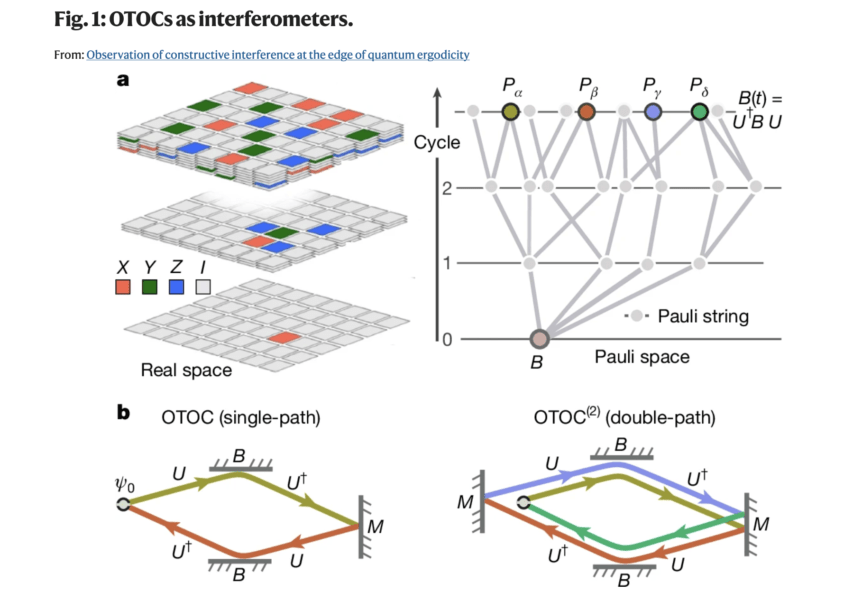
Quantum Interference and SecurityAn illustration demonstrating how quantum interference strengthens echoes for detailed information mapping. Source: Nature

While current quantum computers lack the power to crack modern encryption—thanks to large key sizes ranging from 2,048 to 4,096 bits—advances in hardware could change this paradigm. Experts like David Carvalho, chief scientist at the Naoris cybersecurity protocol, warn that the threat to Bitcoin and other decentralized protocols is imminent if the community does not act proactively. The industry is now racing to adopt post-quantum cryptography standards before powerful quantum systems become a reality.

Despite ongoing efforts, some remain skeptical about how soon quantum computers will reach the ability to threaten crypto security. Pseudonymous tech analyst Mental Outlaw explains that current quantum systems are only capable of breaking very small keys, far from the size needed for secure encryption today.

Nevertheless, regulators and industry leaders are pushing for measures to mitigate future risks. The U.S. Securities and Exchange Commission (SEC) has received proposals outlining a roadmap for quantum-safe encryption standards by 2035. The crypto sector recognizes that addressing quantum threats now could safeguard digital assets and foster continued innovation in blockchain, DeFi, NFT platforms, and beyond.

This article was originally published as Google’s Willow Processor Maps Molecules 13,000x Faster Than Supercomputers on Crypto Breaking News – your trusted source for crypto news, Bitcoin news, and blockchain updates.

Market Opportunity
QUANTUM Logo
QUANTUM Price(QUANTUM)
$0.00297
$0.00297$0.00297
-0.30%
USD
QUANTUM (QUANTUM) Live Price Chart
Disclaimer: The articles reposted on this site are sourced from public platforms and are provided for informational purposes only. They do not necessarily reflect the views of MEXC. All rights remain with the original authors. If you believe any content infringes on third-party rights, please contact [email protected] for removal. MEXC makes no guarantees regarding the accuracy, completeness, or timeliness of the content and is not responsible for any actions taken based on the information provided. The content does not constitute financial, legal, or other professional advice, nor should it be considered a recommendation or endorsement by MEXC.

You May Also Like

SEC Approves Generic ETF Standards for Digital Assets Market

SEC Approves Generic ETF Standards for Digital Assets Market

The United States Securities and Exchange Commission (SEC) has approved new rules for listing Commodity-Based Trust Shares, which now cover digital assets, including cryptocurrencies. The decision will now make it easier and faster for exchange-traded funds (ETFs) to get approved, allowing for more assets beyond just Bitcoin and Ethereum, while still protecting investors.  This recently announced action, under the leadership of Chairman Paul Atkins, represents a shift from previous approaches, making the market more transparent and more attractive to investors. SEC’s Landmark Rule Change The SEC’s new rules apply to major stock exchanges like Nasdaq, NYSE Arca, and Cboe BZX. These rules enable the listing and trading of exchange-traded funds (ETFs) and other similar products that hold real commodities, including digital assets, without requiring separate approval for each one. Qualifying security products can now be approved more quickly under Rule 19b-4(e). If specific requirements are met, the approval process can be completed in as little as 75 days. This method involves rigorous market monitoring, strict custody rules, and enhanced disclosures. To qualify for the faster process, a digital asset must be traded on a regulated market and should have at least six months of trading history on a designated futures market. Alternatively, it can be part of an existing ETF with at least 40% of its net asset value (NAV) in that asset. Impact on Digital Assets Market The change is essential because it shows that the SEC is being less cautious about crypto ETFs. In the past, the SEC took a long time to review these products because it was worried about market manipulation and wanted to protect investors. Now, new general standards will allow more crypto products to be approved without needing individual reviews for each one. The U.S. is moving closer to the European Union’s MiCA framework and Hong Kong’s crypto licensing rules. The shift will help to strengthen the U.S.’s role in regulating digital assets. Under Chairman Paul Atkins, the government has made it easier for investors in the crypto space by lowering regulatory hurdles. For example, earlier this month, in July, the SEC provided clear rules about what must be disclosed for crypto exchange-traded products. This guidance clarifies how federal securities laws apply, encouraging innovation while remaining compliant.  These actions, under Atkins’ leadership, represent a shift from previous approaches, making the market more transparent and more attractive for investors. The post SEC Approves Generic ETF Standards for Digital Assets Market appeared first on Cointab.
Share
Coinstats2025/09/18 15:24
Will SEC Approve T. Rowe’s XRP-Inclusive Crypto ETF?

Will SEC Approve T. Rowe’s XRP-Inclusive Crypto ETF?

SEC to decide by Feb. 26, 2026 on NYSE Arca’s proposal to list T. Rowe Price’s Active Crypto ETF, which includes XRP exposure. The U.S. Securities and Exchange
Share
LiveBitcoinNews2026/02/19 13:00
SEC clears framework for fast-tracked crypto ETF listings

SEC clears framework for fast-tracked crypto ETF listings

The post SEC clears framework for fast-tracked crypto ETF listings appeared on BitcoinEthereumNews.com. The Securities and Exchange Commission has approved new generic listing standards for spot crypto exchange-traded funds, clearing the way for faster approvals. Summary SEC has greenlighted new generic listing standards for spot crypto ETFs. Rule change eliminates lengthy case-by-case approvals, aligning crypto ETFs with commodity funds. Grayscale’s Digital Large Cap Fund and Bitcoin ETF options also gain approval. The U.S. SEC has approved new generic listing standards that will allow exchanges to fast-track spot crypto ETFs, marking a pivotal shift in U.S. digital asset regulation. According to a Sept. 17 press release, the SEC voted to approve rule changes from Nasdaq, NYSE Arca, and Cboe BZX, enabling them to list and trade commodity-based trust shares, including those holding spot digital assets, without submitting individual proposals for each product. A streamlined path for crypto ETFs Under the new rules, an ETF can be listed without SEC sign-off if its underlying asset trades on a market with surveillance-sharing agreements, has active CFTC-regulated futures contracts for at least six months, or already represents at least 40% of an existing listed ETF. This brings crypto ETFs in line with traditional commodity-based funds under Rule 6c-11, eliminating a process that could take up to 240 days. SEC chair Paul Atkins said the move was designed to “maximize investor choice and foster innovation” while ensuring the U.S. remains the leading market for digital assets. Jamie Selway, director of the division of trading and markets, called the framework “a rational, rules-based approach” that balances access with investor protection. First products already approved Alongside the new standards, the SEC cleared the listing of the Grayscale Digital Large Cap Fund, which tracks spot assets based on the CoinDesk 5 Index. It also approved trading of options tied to the Cboe Bitcoin U.S. ETF Index and its mini version, with…
Share
BitcoinEthereumNews2025/09/18 14:04