The post 2025 Marks the Year America Became Crypto-Friendly Again appeared on BitcoinEthereumNews.com. AltcoinsBitcoin After years of uncertainty and regulatory pressure, the United States has re-emerged as one of the most promising environments for digital assets. According to a16z’s State of Crypto 2025 report, the world’s largest economy is entering a new era of clarity, confidence, and capital inflows, signaling that crypto’s center of gravity is once again shifting back to U.S. soil. From Hostility to Leadership Just two years ago, the American crypto landscape was defined by enforcement actions, confusion, and hesitation. Many projects relocated offshore to escape unclear rules, and venture funding for U.S.-based blockchain startups plummeted. But 2025 has marked a dramatic reversal. The bipartisan GENIUS Act, combined with the CLARITY Act, has transformed the tone of U.S. policy toward crypto. Together, these laws provide a structured framework for stablecoins, market oversight, and digital asset classification. The legislation has brought long-awaited predictability to how crypto companies operate – a critical factor for innovation and capital formation. We’re excited to share our 2025 State of Crypto report. This year’s story: the maturation of the crypto industry — with growing institutional adoption, the rise of stablecoins, better infrastructure, new consumer experiences, and long-awaited regulatory clarity. Read the full… pic.twitter.com/c8NESXnQE3 — Chris Dixon (@cdixon) October 22, 2025 Complementing these legislative milestones, Executive Order 14178 reversed earlier restrictive measures, mandating federal agencies to coordinate on pro-innovation digital asset policies. A cross-agency task force was established to modernize how government systems interact with blockchain-based infrastructure, creating channels for collaboration rather than confrontation. a16z notes that this environment has reignited builder optimism across the country. The U.S. is once again seen as a viable home for blockchain development, startup formation, and institutional deployment of crypto products. Capital and Talent Return Home With the legal fog lifting, capital is flowing back into U.S.-based blockchain ventures. Venture firms,… The post 2025 Marks the Year America Became Crypto-Friendly Again appeared on BitcoinEthereumNews.com. AltcoinsBitcoin After years of uncertainty and regulatory pressure, the United States has re-emerged as one of the most promising environments for digital assets. According to a16z’s State of Crypto 2025 report, the world’s largest economy is entering a new era of clarity, confidence, and capital inflows, signaling that crypto’s center of gravity is once again shifting back to U.S. soil. From Hostility to Leadership Just two years ago, the American crypto landscape was defined by enforcement actions, confusion, and hesitation. Many projects relocated offshore to escape unclear rules, and venture funding for U.S.-based blockchain startups plummeted. But 2025 has marked a dramatic reversal. The bipartisan GENIUS Act, combined with the CLARITY Act, has transformed the tone of U.S. policy toward crypto. Together, these laws provide a structured framework for stablecoins, market oversight, and digital asset classification. The legislation has brought long-awaited predictability to how crypto companies operate – a critical factor for innovation and capital formation. We’re excited to share our 2025 State of Crypto report. This year’s story: the maturation of the crypto industry — with growing institutional adoption, the rise of stablecoins, better infrastructure, new consumer experiences, and long-awaited regulatory clarity. Read the full… pic.twitter.com/c8NESXnQE3 — Chris Dixon (@cdixon) October 22, 2025 Complementing these legislative milestones, Executive Order 14178 reversed earlier restrictive measures, mandating federal agencies to coordinate on pro-innovation digital asset policies. A cross-agency task force was established to modernize how government systems interact with blockchain-based infrastructure, creating channels for collaboration rather than confrontation. a16z notes that this environment has reignited builder optimism across the country. The U.S. is once again seen as a viable home for blockchain development, startup formation, and institutional deployment of crypto products. Capital and Talent Return Home With the legal fog lifting, capital is flowing back into U.S.-based blockchain ventures. Venture firms,…

2025 Marks the Year America Became Crypto-Friendly Again

6 min read
AltcoinsBitcoin

After years of uncertainty and regulatory pressure, the United States has re-emerged as one of the most promising environments for digital assets.

According to a16z’s State of Crypto 2025 report, the world’s largest economy is entering a new era of clarity, confidence, and capital inflows, signaling that crypto’s center of gravity is once again shifting back to U.S. soil.

From Hostility to Leadership

Just two years ago, the American crypto landscape was defined by enforcement actions, confusion, and hesitation. Many projects relocated offshore to escape unclear rules, and venture funding for U.S.-based blockchain startups plummeted. But 2025 has marked a dramatic reversal.

The bipartisan GENIUS Act, combined with the CLARITY Act, has transformed the tone of U.S. policy toward crypto. Together, these laws provide a structured framework for stablecoins, market oversight, and digital asset classification. The legislation has brought long-awaited predictability to how crypto companies operate – a critical factor for innovation and capital formation.

Complementing these legislative milestones, Executive Order 14178 reversed earlier restrictive measures, mandating federal agencies to coordinate on pro-innovation digital asset policies. A cross-agency task force was established to modernize how government systems interact with blockchain-based infrastructure, creating channels for collaboration rather than confrontation.

a16z notes that this environment has reignited builder optimism across the country. The U.S. is once again seen as a viable home for blockchain development, startup formation, and institutional deployment of crypto products.

Capital and Talent Return Home

With the legal fog lifting, capital is flowing back into U.S.-based blockchain ventures. Venture firms, hedge funds, and corporates have resumed large-scale investments in crypto startups and infrastructure providers. According to the a16z report, several major financial players – including JPMorgan, Fidelity, and Mastercard – have expanded their blockchain divisions, hiring engineers and product managers to develop payment systems, custody solutions, and tokenized financial instruments.

Tech giants that once distanced themselves from crypto are also re-engaging. PayPal, Stripe, and Square have all deepened their integration with stablecoin payment systems and Web3 wallets. Meanwhile, public companies like Coinbase, Marathon, and Galaxy Digital continue to serve as examples of U.S.-regulated crypto enterprises operating at scale.

Perhaps most tellingly, the venture ecosystem is showing early signs of revival. a16z’s own investments, along with those from other major funds like Paradigm and Pantera Capital, have concentrated heavily on U.S.-based teams building tools for DeFi, AI-integrated protocols, and onchain infrastructure.

The Economic Engine of Tokenization

The report emphasizes that regulatory clarity has enabled a new wave of tokenized financial products to emerge. With clearer rules around asset-backed tokens, companies can now issue digital representations of equities, treasuries, and private credit instruments onchain.

This is not merely a technical upgrade – it’s a structural transformation. The tokenization of real-world assets (RWAs) is already reshaping how capital markets function. Startups and institutions are experimenting with tokenized bond markets, yield-bearing stablecoins, and digitally native treasuries that settle in seconds rather than days.

Such innovation, a16z argues, is turning the U.S. into a testbed for the next generation of global finance. Whereas the previous decade saw the rise of centralized crypto exchanges, the coming decade may be defined by tokenized capital markets operating with full regulatory oversight.

The implications are far-reaching: as more tokens generate real economic value – through fees, staking, or smart contract revenue – the American crypto ecosystem could evolve into a self-sustaining digital economy with transparent cash flows and accountable governance.

A Foundation for the Next Cycle

a16z’s analysis highlights that the new U.S. policy framework doesn’t just benefit startups and investors – it stabilizes the broader global crypto market. When the U.S. leads with clear standards, it sets the tone for other nations, creating a unified foundation for digital asset interoperability and regulation.

This leadership is especially important as the industry moves into its next phase: integrating blockchain with emerging technologies like artificial intelligence and decentralized infrastructure networks (DePIN). The U.S. regulatory environment, once perceived as a major obstacle, now stands to accelerate this convergence by encouraging both public and private sector collaboration.

The firm’s report characterizes this shift as “crypto’s comeback moment in America.” Builders who once left the country are returning, startups are registering locally instead of abroad, and major exchanges are expanding rather than retreating. Venture inflows are once again matching levels seen before the 2022 downturn.

A Renewed American Role in Crypto’s Global Future

The United States’ re-engagement in crypto marks a turning point not just for domestic policy but for the global digital asset landscape. With the passage of progressive legislation and the re-establishment of a dialogue between regulators and innovators, America is regaining its status as a central hub for blockchain advancement.

If current trends hold, a16z predicts that the U.S. could become the largest market for regulated tokenized assets within five years. Stablecoins, DeFi products, and tokenized treasuries could drive billions in daily volume under a compliant framework that balances innovation and consumer protection.

In a sense, the U.S. has rediscovered its original role in the digital revolution: not as a gatekeeper, but as a catalyst. By replacing uncertainty with clarity, and hostility with collaboration, the country has positioned itself to lead the next wave of crypto innovation – and perhaps the next era of global finance itself.


The information provided in this article is for educational purposes only and does not constitute financial, investment, or trading advice. Coindoo.com does not endorse or recommend any specific investment strategy or cryptocurrency. Always conduct your own research and consult with a licensed financial advisor before making any investment decisions.

Author

Alex is an experienced financial journalist and cryptocurrency enthusiast. With over 8 years of experience covering the crypto, blockchain, and fintech industries, he is well-versed in the complex and ever-evolving world of digital assets. His insightful and thought-provoking articles provide readers with a clear picture of the latest developments and trends in the market. His approach allows him to break down complex ideas into accessible and in-depth content. Follow his publications to stay up to date with the most important trends and topics.

Next article

Source: https://coindoo.com/2025-marks-the-year-america-became-crypto-friendly-again/

Disclaimer: The articles reposted on this site are sourced from public platforms and are provided for informational purposes only. They do not necessarily reflect the views of MEXC. All rights remain with the original authors. If you believe any content infringes on third-party rights, please contact [email protected] for removal. MEXC makes no guarantees regarding the accuracy, completeness, or timeliness of the content and is not responsible for any actions taken based on the information provided. The content does not constitute financial, legal, or other professional advice, nor should it be considered a recommendation or endorsement by MEXC.

You May Also Like

Best Crypto to Buy as Saylor & Crypto Execs Meet in US Treasury Council

Best Crypto to Buy as Saylor & Crypto Execs Meet in US Treasury Council

The post Best Crypto to Buy as Saylor & Crypto Execs Meet in US Treasury Council appeared on BitcoinEthereumNews.com. Michael Saylor and a group of crypto executives met in Washington, D.C. yesterday to push for the Strategic Bitcoin Reserve Bill (the BITCOIN Act), which would see the U.S. acquire up to 1M $BTC over five years. With Bitcoin being positioned yet again as a cornerstone of national monetary policy, many investors are turning their eyes to projects that lean into this narrative – altcoins, meme coins, and presales that could ride on the same wave. Read on for three of the best crypto projects that seem especially well‐suited to benefit from this macro shift:  Bitcoin Hyper, Best Wallet Token, and Remittix. These projects stand out for having a strong use case and high adoption potential, especially given the push for a U.S. Bitcoin reserve.   Why the Bitcoin Reserve Bill Matters for Crypto Markets The strategic Bitcoin Reserve Bill could mark a turning point for the U.S. approach to digital assets. The proposal would see America build a long-term Bitcoin reserve by acquiring up to one million $BTC over five years. To make this happen, lawmakers are exploring creative funding methods such as revaluing old gold certificates. The plan also leans on confiscated Bitcoin already held by the government, worth an estimated $15–20B. This isn’t just a headline for policy wonks. It signals that Bitcoin is moving from the margins into the core of financial strategy. Industry figures like Michael Saylor, Senator Cynthia Lummis, and Marathon Digital’s Fred Thiel are all backing the bill. They see Bitcoin not just as an investment, but as a hedge against systemic risks. For the wider crypto market, this opens the door for projects tied to Bitcoin and the infrastructure that supports it. 1. Bitcoin Hyper ($HYPER) – Turning Bitcoin Into More Than Just Digital Gold The U.S. may soon treat Bitcoin as…
Share
BitcoinEthereumNews2025/09/18 00:27
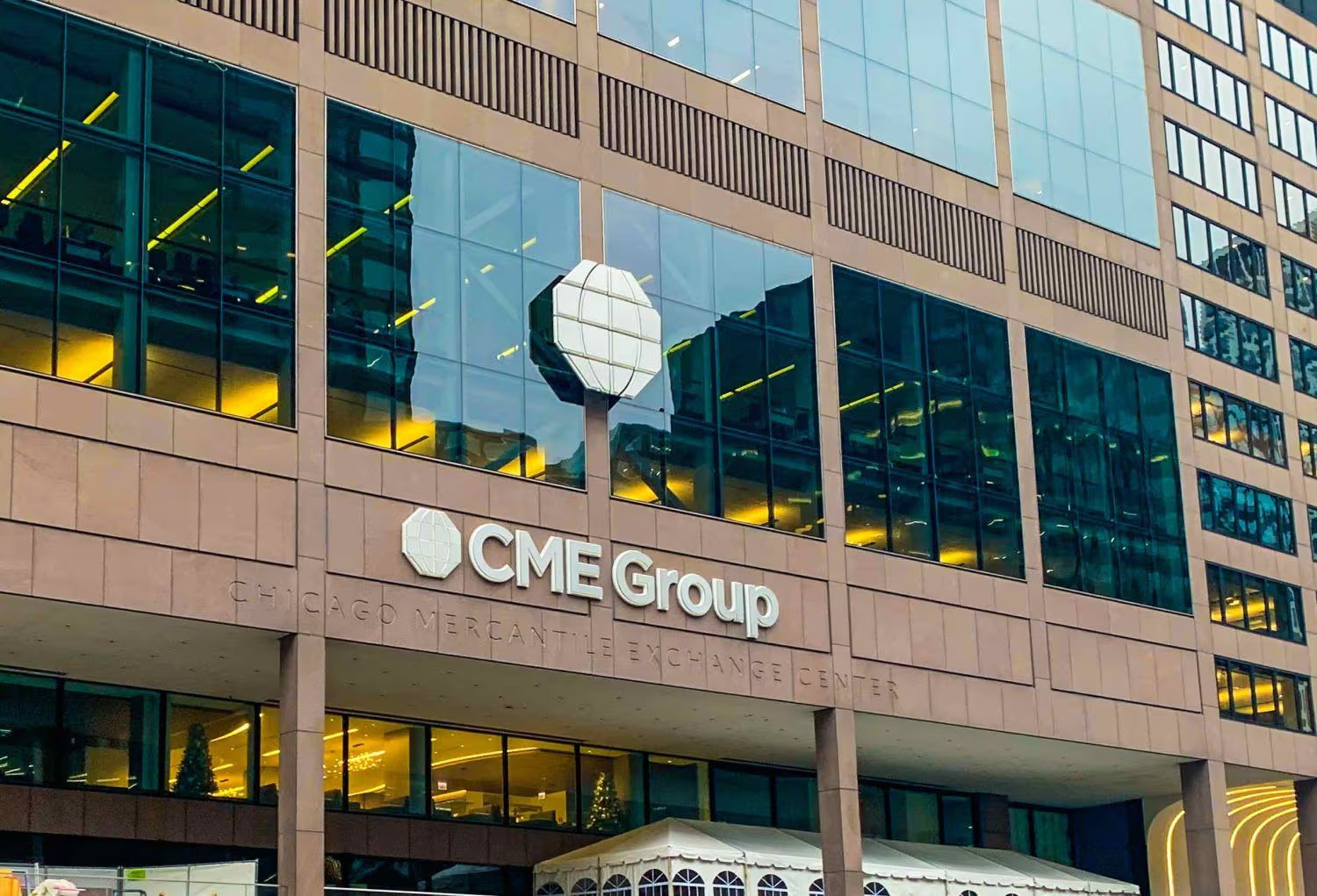
Breaking: CME Group Unveils Solana and XRP Options

Breaking: CME Group Unveils Solana and XRP Options

CME Group launches Solana and XRP options, expanding crypto offerings. SEC delays Solana and XRP ETF approvals, market awaits clarity. Strong institutional demand drives CME’s launch of crypto options contracts. In a bold move to broaden its cryptocurrency offerings, CME Group has officially launched options on Solana (SOL) and XRP futures. Available since October 13, 2025, these options will allow traders to hedge and manage exposure to two of the most widely traded digital assets in the market. The new contracts come in both full-size and micro-size formats, with expiration options available daily, monthly, and quarterly, providing flexibility for a diverse range of market participants. This expansion aligns with the rising demand for innovative products in the crypto space. Giovanni Vicioso, CME Group’s Global Head of Cryptocurrency Products, noted that the new options offer increased flexibility for traders, from institutions to active individual investors. The growing liquidity in Solana and XRP futures has made the introduction of these options a timely move to meet the needs of an expanding market. Also Read: Vitalik Buterin Reveals Ethereum’s Bold Plan to Stay Quantum-Secure and Simple! Rapid Growth in Solana and XRP Futures Trading CME Group’s decision to roll out options on Solana and XRP futures follows the substantial growth in these futures products. Since the launch of Solana futures in March 2025, more than 540,000 contracts, totaling $22.3 billion in notional value, have been traded. In August 2025, Solana futures set new records, with an average daily volume (ADV) of 9,000 contracts valued at $437.4 million. The average daily open interest (ADOI) hit 12,500 contracts, worth $895 million. Similarly, XRP futures, which launched in May 2025, have seen significant adoption, with over 370,000 contracts traded, totaling $16.2 billion. XRP futures also set records in August 2025, with an ADV of 6,600 contracts valued at $385 million and a record ADOI of 9,300 contracts, worth $942 million. Institutional Demand for Advanced Hedging Tools CME Group’s expansion into options is a direct response to growing institutional interest in sophisticated cryptocurrency products. Roman Makarov from Cumberland Options Trading at DRW highlighted the market demand for more varied crypto products, enabling more advanced risk management strategies. Joshua Lim from FalconX also noted that the new options products meet the increasing need for institutional hedging tools for assets like Solana and XRP, further cementing their role in the digital asset space. The launch of options on Solana and XRP futures marks another step toward the maturation of the cryptocurrency market, providing a broader range of tools for managing digital asset exposure. SEC’s Delay on Solana and XRP ETF Approvals While CME Group expands its offerings, the broader market is also watching the progress of Solana and XRP exchange-traded funds (ETFs). The U.S. Securities and Exchange Commission (SEC) has delayed its decisions on multiple crypto-related ETF filings, including those for Solana and XRP. Despite the delay, analysts anticipate approval may be on the horizon. This week, REX Shares and Osprey Funds are expected to launch an XRP ETF that will hold XRP directly and allocate at least 40% of its assets to other XRP-related ETFs. Despite the delays, some analysts believe that approval could come soon, fueling further interest in these assets. The delay by the SEC has left many crypto investors awaiting clarity, but approval of these ETFs could fuel further momentum in the Solana and XRP futures markets. Also Read: Tether CEO Breaks Silence on $117,000 Bitcoin Price – Market Reacts! The post Breaking: CME Group Unveils Solana and XRP Options appeared first on 36Crypto.
Share
Coinstats2025/09/18 02:35
Optimizely Named a Leader in the 2026 Gartner® Magic Quadrant™ for Personalization Engines

Optimizely Named a Leader in the 2026 Gartner® Magic Quadrant™ for Personalization Engines

Company recognized as a Leader for the second consecutive year NEW YORK, Feb. 5, 2026 /PRNewswire/ — Optimizely, the leading digital experience platform (DXP) provider
Share
AI Journal2026/02/06 00:47