Bipartisan talks on a long-awaited U.S. crypto market regulation package, the CLARITY Act, have resumed in the Senate, even as Washington remains paralyzed by a government shutdown now in its 31st day, one of the longest in U.S. history. Lawmakers from both parties are racing to finalize the market structure bill that could reshape oversight of digital assets before election politics stall progress. The negotiations, led by key Senate committees, have accelerated in recent weeks despite the broader gridlock. Can the CLARITY Act pass by Thanksgiving? According to the report, Senate Agriculture Committee Chair John Boozman (R-Ark.) said he and Sen. Cory Booker (D-N.J.) are working “daily” to complete their section of the legislation, which would establish a regulatory framework for digital assets treated as commodities. Boozman said he expects a committee vote “before Thanksgiving,” adding, “We’re going to get it done this year.” Booker echoed that sentiment, saying the goal was to “get the policy right” rather than rush the timeline. Their work represents one part of a broader bipartisan effort spanning multiple committees, including Banking and Finance, to define how digital assets fit within U.S. regulations and the tax code. Talks within the Senate Banking Committee have also gained momentum. Senators Cynthia Lummis (R-Wyo.), Ruben Gallego (D-Ariz.), and Angela Alsobrooks (D-Md.) said discussions had resumed after weeks of delay. Notably, Committee Chair Tim Scott (R-S.C.) said he was “encouraged” by the progress and looks forward to advancing “meaningful legislation.” Still, some members caution that the bill is not yet ready. Sen. John Kennedy (R-La.) said the legislation requires a public hearing and that many lawmakers still need to understand the issue. The push for progress comes amid warnings that time is running out. Sen. Thom Tillis (R-N.C.) said Congress must act by early 2026 or risk losing momentum as election politics take over. “I’m not optimistic about us moving much further on anything around digital assets, stablecoins, or crypto in this Congress,” he said on Monday. Longest Shutdown in History Looms — What’s Next for America? The shutdown, now stretching into its fifth week, has added further strain. The Senate adjourned Thursday without progress on a continuing resolution, guaranteeing the shutdown will last at least 34 days, tying the longest lapse in U.S. history. As of October 20, 25% of Polymarket bettors predict that the shutdown will last until at least November 16 and may drag on for almost another month to become the longest in American history. Funding for food assistance under the Supplemental Nutrition Assistance Program (SNAP) is set to expire Saturday, threatening benefits for 42 million Americans. The closure, triggered by disputes over healthcare subsidies, has left 1.4 million federal workers without pay, including air traffic controllers and employees at key agencies. Despite the stalemate, Senate Democrats and Republicans are expected to meet separately with industry executives next week to keep crypto talks alive. U.S. Lawmakers Renew Crypto Talks, but Prediction Markets Cut Odds of 2025 Passage to 25% On October 20, Sen. Kirsten Gillibrand (D-N.Y.) hosted a closed-door roundtable with major industry figures, including Galaxy’s Mike Novogratz, Coinbase CEO Brian Armstrong, and Chainlink’s Sergey Nazarov. Armstrong told CNBC that roughly 90% of the bill’s issues had already been resolved and that Thanksgiving had been floated as a possible target for completion. The House-passed Digital Asset Market Clarity Act, approved in July by a 294–137 vote, remains stalled due to the shutdown. The measure defines which digital assets fall under the jurisdiction of the Commodity Futures Trading Commission (CFTC) and which are overseen by the Securities and Exchange Commission (SEC). Together with the GENIUS Act, signed by President Donald Trump earlier this year, it forms the foundation of the emerging U.S. crypto regulatory framework. White House AI and Crypto Czar David Sacks said the administration remains optimistic that bipartisan support could still deliver progress by the end of 2025.Source: Polymarket But prediction markets paint a different picture, with data from Polymarket showing just a 25% chance the CLARITY Act becomes law this year, down from 87% in mid-JulyBipartisan talks on a long-awaited U.S. crypto market regulation package, the CLARITY Act, have resumed in the Senate, even as Washington remains paralyzed by a government shutdown now in its 31st day, one of the longest in U.S. history. Lawmakers from both parties are racing to finalize the market structure bill that could reshape oversight of digital assets before election politics stall progress. The negotiations, led by key Senate committees, have accelerated in recent weeks despite the broader gridlock. Can the CLARITY Act pass by Thanksgiving? According to the report, Senate Agriculture Committee Chair John Boozman (R-Ark.) said he and Sen. Cory Booker (D-N.J.) are working “daily” to complete their section of the legislation, which would establish a regulatory framework for digital assets treated as commodities. Boozman said he expects a committee vote “before Thanksgiving,” adding, “We’re going to get it done this year.” Booker echoed that sentiment, saying the goal was to “get the policy right” rather than rush the timeline. Their work represents one part of a broader bipartisan effort spanning multiple committees, including Banking and Finance, to define how digital assets fit within U.S. regulations and the tax code. Talks within the Senate Banking Committee have also gained momentum. Senators Cynthia Lummis (R-Wyo.), Ruben Gallego (D-Ariz.), and Angela Alsobrooks (D-Md.) said discussions had resumed after weeks of delay. Notably, Committee Chair Tim Scott (R-S.C.) said he was “encouraged” by the progress and looks forward to advancing “meaningful legislation.” Still, some members caution that the bill is not yet ready. Sen. John Kennedy (R-La.) said the legislation requires a public hearing and that many lawmakers still need to understand the issue. The push for progress comes amid warnings that time is running out. Sen. Thom Tillis (R-N.C.) said Congress must act by early 2026 or risk losing momentum as election politics take over. “I’m not optimistic about us moving much further on anything around digital assets, stablecoins, or crypto in this Congress,” he said on Monday. Longest Shutdown in History Looms — What’s Next for America? The shutdown, now stretching into its fifth week, has added further strain. The Senate adjourned Thursday without progress on a continuing resolution, guaranteeing the shutdown will last at least 34 days, tying the longest lapse in U.S. history. As of October 20, 25% of Polymarket bettors predict that the shutdown will last until at least November 16 and may drag on for almost another month to become the longest in American history. Funding for food assistance under the Supplemental Nutrition Assistance Program (SNAP) is set to expire Saturday, threatening benefits for 42 million Americans. The closure, triggered by disputes over healthcare subsidies, has left 1.4 million federal workers without pay, including air traffic controllers and employees at key agencies. Despite the stalemate, Senate Democrats and Republicans are expected to meet separately with industry executives next week to keep crypto talks alive. U.S. Lawmakers Renew Crypto Talks, but Prediction Markets Cut Odds of 2025 Passage to 25% On October 20, Sen. Kirsten Gillibrand (D-N.Y.) hosted a closed-door roundtable with major industry figures, including Galaxy’s Mike Novogratz, Coinbase CEO Brian Armstrong, and Chainlink’s Sergey Nazarov. Armstrong told CNBC that roughly 90% of the bill’s issues had already been resolved and that Thanksgiving had been floated as a possible target for completion. The House-passed Digital Asset Market Clarity Act, approved in July by a 294–137 vote, remains stalled due to the shutdown. The measure defines which digital assets fall under the jurisdiction of the Commodity Futures Trading Commission (CFTC) and which are overseen by the Securities and Exchange Commission (SEC). Together with the GENIUS Act, signed by President Donald Trump earlier this year, it forms the foundation of the emerging U.S. crypto regulatory framework. White House AI and Crypto Czar David Sacks said the administration remains optimistic that bipartisan support could still deliver progress by the end of 2025.Source: Polymarket But prediction markets paint a different picture, with data from Polymarket showing just a 25% chance the CLARITY Act becomes law this year, down from 87% in mid-July

US Senators Push to Finalize Crypto Market Bill as Shutdown Standoff Deepens: Report

4 min read

Bipartisan talks on a long-awaited U.S. crypto market regulation package, the CLARITY Act, have resumed in the Senate, even as Washington remains paralyzed by a government shutdown now in its 31st day, one of the longest in U.S. history.

Lawmakers from both parties are racing to finalize the market structure bill that could reshape oversight of digital assets before election politics stall progress.

The negotiations, led by key Senate committees, have accelerated in recent weeks despite the broader gridlock.

Can the CLARITY Act pass by Thanksgiving?

According to the report, Senate Agriculture Committee Chair John Boozman (R-Ark.) said he and Sen. Cory Booker (D-N.J.) are working “daily” to complete their section of the legislation, which would establish a regulatory framework for digital assets treated as commodities.

Boozman said he expects a committee vote “before Thanksgiving,” adding, “We’re going to get it done this year.”

Booker echoed that sentiment, saying the goal was to “get the policy right” rather than rush the timeline.

Their work represents one part of a broader bipartisan effort spanning multiple committees, including Banking and Finance, to define how digital assets fit within U.S. regulations and the tax code.

Talks within the Senate Banking Committee have also gained momentum. Senators Cynthia Lummis (R-Wyo.), Ruben Gallego (D-Ariz.), and Angela Alsobrooks (D-Md.) said discussions had resumed after weeks of delay.

Notably, Committee Chair Tim Scott (R-S.C.) said he was “encouraged” by the progress and looks forward to advancing “meaningful legislation.”

Still, some members caution that the bill is not yet ready. Sen. John Kennedy (R-La.) said the legislation requires a public hearing and that many lawmakers still need to understand the issue.

The push for progress comes amid warnings that time is running out. Sen. Thom Tillis (R-N.C.) said Congress must act by early 2026 or risk losing momentum as election politics take over.

“I’m not optimistic about us moving much further on anything around digital assets, stablecoins, or crypto in this Congress,” he said on Monday.

Longest Shutdown in History Looms — What’s Next for America?

The shutdown, now stretching into its fifth week, has added further strain. The Senate adjourned Thursday without progress on a continuing resolution, guaranteeing the shutdown will last at least 34 days, tying the longest lapse in U.S. history.

As of October 20, 25% of Polymarket bettors predict that the shutdown will last until at least November 16 and may drag on for almost another month to become the longest in American history.

Funding for food assistance under the Supplemental Nutrition Assistance Program (SNAP) is set to expire Saturday, threatening benefits for 42 million Americans.

The closure, triggered by disputes over healthcare subsidies, has left 1.4 million federal workers without pay, including air traffic controllers and employees at key agencies.

Despite the stalemate, Senate Democrats and Republicans are expected to meet separately with industry executives next week to keep crypto talks alive.

U.S. Lawmakers Renew Crypto Talks, but Prediction Markets Cut Odds of 2025 Passage to 25%

On October 20, Sen. Kirsten Gillibrand (D-N.Y.) hosted a closed-door roundtable with major industry figures, including Galaxy’s Mike Novogratz, Coinbase CEO Brian Armstrong, and Chainlink’s Sergey Nazarov.

Armstrong told CNBC that roughly 90% of the bill’s issues had already been resolved and that Thanksgiving had been floated as a possible target for completion.

The House-passed Digital Asset Market Clarity Act, approved in July by a 294–137 vote, remains stalled due to the shutdown.

The measure defines which digital assets fall under the jurisdiction of the Commodity Futures Trading Commission (CFTC) and which are overseen by the Securities and Exchange Commission (SEC).

Together with the GENIUS Act, signed by President Donald Trump earlier this year, it forms the foundation of the emerging U.S. crypto regulatory framework.

White House AI and Crypto Czar David Sacks said the administration remains optimistic that bipartisan support could still deliver progress by the end of 2025.
Source: Polymarket

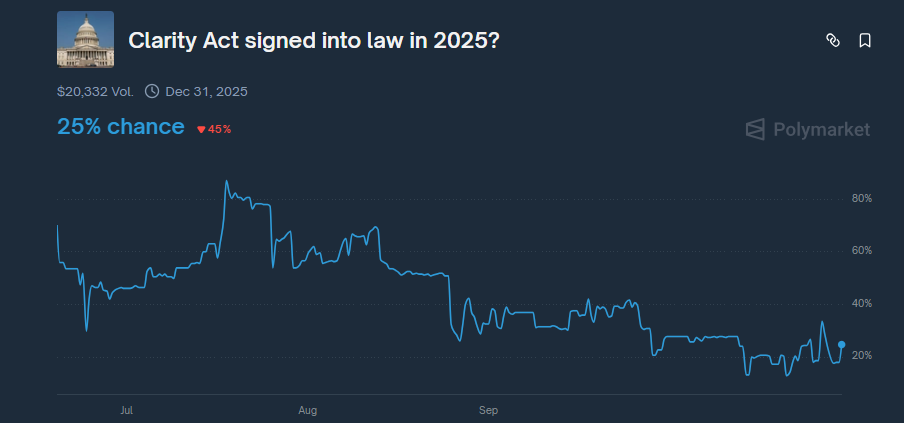
But prediction markets paint a different picture, with data from Polymarket showing just a 25% chance the CLARITY Act becomes law this year, down from 87% in mid-July

Market Opportunity
EPNS Logo
EPNS Price(PUSH)
$0.013756
$0.013756$0.013756
-0.49%
USD
EPNS (PUSH) Live Price Chart
Disclaimer: The articles reposted on this site are sourced from public platforms and are provided for informational purposes only. They do not necessarily reflect the views of MEXC. All rights remain with the original authors. If you believe any content infringes on third-party rights, please contact [email protected] for removal. MEXC makes no guarantees regarding the accuracy, completeness, or timeliness of the content and is not responsible for any actions taken based on the information provided. The content does not constitute financial, legal, or other professional advice, nor should it be considered a recommendation or endorsement by MEXC.

You May Also Like

Three dormant wallets, suspected to belong to the same entity, purchased 5,970 ETH eight hours ago.
Three dormant wallets, suspected to belong to the same entity, purchased 5,970 ETH eight hours ago.

PANews reported on February 4 that, according to Lookonchain monitoring, three wallets that had been dormant for four years (likely controlled by the same entity
Share
PANews2026/02/04 11:36
NVIDIA Stock Price Analysis as OpenAI Issues Concerns About its Chips

NVIDIA Stock Price Analysis as OpenAI Issues Concerns About its Chips

Key Insights NVIDIA stock started the week in the red. It crashed by over 2%. Meanwhile, the S&P 500, Dow Jones, and Nasdaq 100 moved close to their all-time highs
Share
Themarketperiodical2026/02/04 11:27
Ondo Finance Launches USDY Yieldcoin on Stellar, Bringing Tokenized U.S. Treasuries to Users

Ondo Finance Launches USDY Yieldcoin on Stellar, Bringing Tokenized U.S. Treasuries to Users

Ondo Finance, a U.S.-based digital asset firm specializing in bringing traditional financial products on-chain through tokenization, is expanding its yieldcoin USDY to the Stellar network. This lates update marks a step forward in merging tokenized real-world assets with a global payments infrastructure, unlocking new opportunities for users worldwide. The announcement was made at the Stellar Meridian event in Copacabana, Rio de Janeiro, on September 17. USDY Joins the Stellar Ecosystem Ondo Finance, a recognized leader in tokenized real-world assets, announced the deployment of United States Dollar Yield (USDY) on Stellar, the payments-focused blockchain known for speed and low transaction costs. USDY is the most widely available “yieldcoin,” offering investors access to onchain assets backed by U.S. Treasuries. This launch allows Stellar’s global user base to tap into permissionless, yield-bearing assets tied to one of the safest financial instruments in the world. It also aligns with Stellar’s mission of driving fast, affordable cross-border payments. Combining Yield with Payments Infrastructure “Stablecoins unlocked global access to the U.S. dollar. With USDY, we’re taking the next step by bringing U.S. Treasuries onchain in a form that combines stability, liquidity, and yield,” said Ian De Bode, Chief Strategy Officer at Ondo Finance. “Fast, affordable cross-border payments are at the center of what Stellar was designed to do. The global reach of the Stellar ecosystem combined with a yield-bearing asset like USDY levels up what is possible onchain, allowing wallets and businesses to offer yield opportunities to their users,” said Denelle Dixon, CEO of the Stellar Development Foundation. Ondo claims by pairing USDY with Stellar’s infrastructure, new possibilities open up in treasury management, collateralization, and everyday financial applications. Unlocking Institutional and Retail Use Cases USDY currently manages over $650 million in total value locked (TVL) across nine blockchains and offers a 5.3% APY. By launching on Stellar, Ondo Finance extends these benefits to global retail and institutional users. The firm explains balances on Stellar can now become productive, supporting use cases such as onchain savings, institutional treasury strategies, cost-efficient collateral for DeFi protocols, and remittance flows that carry yield rather than remaining static. A Milestone for Tokenized Treasuries With the integration of USDY, Stellar users gain more than just access to stable-value assets—they gain access to institutional-grade yield. For investors outside the U.S., the launch represents a new way to combine the safety of Treasuries with the accessibility of blockchain technology. As tokenization accelerates globally, Ondo Finance’s decision to deploy USDY on Stellar reinforces the narrative that blockchain is not just about speculation, but about reimagining the global financial system through secure, yield-bearing digital assets
Share
CryptoNews2025/09/18 00:46
