YZiLabs says BNB Network’s rollout has faltered, citing sluggish investor updates and a gap between the stock and its underlying BNB holdings.YZiLabs says BNB Network’s rollout has faltered, citing sluggish investor updates and a gap between the stock and its underlying BNB holdings.

Changpeng Zhao-backed YZiLabs launches boardroom coup at BNB treasury firm BNC

3 min read

Changpeng Zhao–backed YZiLabs has launched an activist campaign to seize control of CEA Industries, now known as BNB Network (ticker BNC), just months after helping bankroll the company’s $500 million PIPE and its pivot into a leading BNB corporate treasury.

In a preliminary Schedule 14A filed Monday, the firm moved to expand the board, unwind any recent bylaw changes, and install its own slate of directors through a written-consent process. If a majority of outstanding shares sign on, the proposals would effectively hand control of the BNB-focused treasury company to Zhao’s family office without a shareholder meeting.

The coup attempt comes only months after the company was being pitched as the largest publicly traded BNB treasury in the United States.

BNB Network — formerly CEA Industries, a nicotine-vape manufacturer — surged more than 600% in July after 10X Capital and YZiLabs led an upsized private placement that included $400 million in cash and $100 million in crypto. Leadership installed during the PIPE, including CEO David Namdar and former CalPERS CIO Russell Read, framed the pivot as a way to give institutions long-term, transparent exposure to the Binance-linked ecosystem. 

YZiLabs now argues the rollout has stumbled.

The filing accuses management of basic execution missteps, including slow filings and incomplete investor-relations materials, and describes a near-total absence of institution-facing marketing. It also alleges Namdar has promoted other digital-asset treasury efforts while BNB Network's rollout struggled for traction.

It further raises concerns about 10X Capital’s dual role as asset manager and a dominant presence on the board.

Down market

The market backdrop adds another layer of pressure. BNB is trading near a three-month low just above $800, according to The Block's price page, and that is starting to weigh on BNB Network’s treasury.
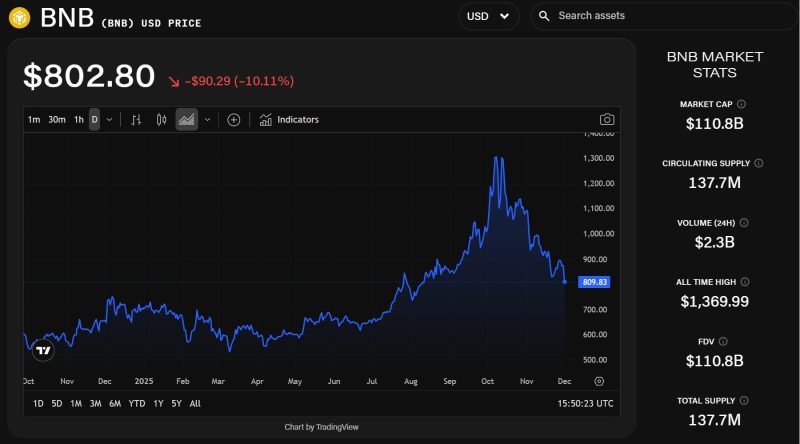
BNB Price Chart. Source: The Block/TradingView

The current BNB Treasury dashboard shows about 515,000 BNB worth roughly $412 million at an average cost of $851.

BNC shares fell nearly 11% in early Monday trading to $6.35, deepening the discount to its reported NAV of $8.09 per share and pushing its mNAV multiple down to roughly 0.8×.

The Block reached out to Namdar, BNB Network, and a contact at YZi Labs but has not yet received a response.


Disclaimer: The Block is an independent media outlet that delivers news, research, and data. As of November 2023, Foresight Ventures is a majority investor of The Block. Foresight Ventures invests in other companies in the crypto space. Crypto exchange Bitget is an anchor LP for Foresight Ventures. The Block continues to operate independently to deliver objective, impactful, and timely information about the crypto industry. Here are our current financial disclosures.

© 2025 The Block. All Rights Reserved. This article is provided for informational purposes only. It is not offered or intended to be used as legal, tax, investment, financial, or other advice.

Market Opportunity
Binance Coin Logo
Binance Coin Price(BNB)
$757,41
$757,41$757,41
-2,48%
USD
Binance Coin (BNB) Live Price Chart
Disclaimer: The articles reposted on this site are sourced from public platforms and are provided for informational purposes only. They do not necessarily reflect the views of MEXC. All rights remain with the original authors. If you believe any content infringes on third-party rights, please contact [email protected] for removal. MEXC makes no guarantees regarding the accuracy, completeness, or timeliness of the content and is not responsible for any actions taken based on the information provided. The content does not constitute financial, legal, or other professional advice, nor should it be considered a recommendation or endorsement by MEXC.

You May Also Like

FCA komt in 2026 met aangepaste cryptoregels voor Britse markt

FCA komt in 2026 met aangepaste cryptoregels voor Britse markt

De Britse financiële waakhond, de FCA, komt in 2026 met nieuwe regels speciaal voor crypto bedrijven. Wat direct opvalt: de toezichthouder laat enkele klassieke financiële verplichtingen los om beter aan te sluiten op de snelle en grillige wereld van digitale activa. Tegelijkertijd wordt er extra nadruk gelegd op digitale beveiliging,... Het bericht FCA komt in 2026 met aangepaste cryptoregels voor Britse markt verscheen het eerst op Blockchain Stories.
Share
Coinstats2025/09/18 00:33
Cashing In On University Patents Means Giving Up On Our Innovation Future
Cashing In On University Patents Means Giving Up On Our Innovation Future

The post Cashing In On University Patents Means Giving Up On Our Innovation Future appeared on BitcoinEthereumNews.com. “It’s a raid on American innovation that would deliver pennies to the Treasury while kneecapping the very engine of our economic and medical progress,” writes Pipes. Getty Images Washington is addicted to taxing success. Now, Commerce Secretary Howard Lutnick is floating a plan to skim half the patent earnings from inventions developed at universities with federal funding. It’s being sold as a way to shore up programs like Social Security. In reality, it’s a raid on American innovation that would deliver pennies to the Treasury while kneecapping the very engine of our economic and medical progress. Yes, taxpayer dollars support early-stage research. But the real payoff comes later—in the jobs created, cures discovered, and industries launched when universities and private industry turn those discoveries into real products. By comparison, the sums at stake in patent licensing are trivial. Universities collectively earn only about $3.6 billion annually in patent income—less than the federal government spends on Social Security in a single day. Even confiscating half would barely register against a $6 trillion federal budget. And yet the damage from such a policy would be anything but trivial. The true return on taxpayer investment isn’t in licensing checks sent to Washington, but in the downstream economic activity that federally supported research unleashes. Thanks to the bipartisan Bayh-Dole Act of 1980, universities and private industry have powerful incentives to translate early-stage discoveries into real-world products. Before Bayh-Dole, the government hoarded patents from federally funded research, and fewer than 5% were ever licensed. Once universities could own and license their own inventions, innovation exploded. The result has been one of the best returns on investment in government history. Since 1996, university research has added nearly $2 trillion to U.S. industrial output, supported 6.5 million jobs, and launched more than 19,000 startups. Those companies pay…
Share
BitcoinEthereumNews2025/09/18 03:26
Trump foe devises plan to starve him of what he 'craves' most

Trump foe devises plan to starve him of what he 'craves' most

A longtime adversary of President Donald Trump has a plan for a key group to take away what Trump craves the most — attention. EX-CNN journalist Jim Acosta, who
Share
Rawstory2026/02/04 01:19