WeFund Lending Corp., operator of the JuanHand online lending application, has secured a multimillion-peso credit facility with HSBC in the Philippines. The proceeds will be deployed to expand financial access for underserved yet creditworthy Filipinos. The credit facility aims to strengthen financial inclusion by providing immediate and sustainable access to financing for individuals with limited […]WeFund Lending Corp., operator of the JuanHand online lending application, has secured a multimillion-peso credit facility with HSBC in the Philippines. The proceeds will be deployed to expand financial access for underserved yet creditworthy Filipinos. The credit facility aims to strengthen financial inclusion by providing immediate and sustainable access to financing for individuals with limited […]

JuanHand secures a multimillion-peso credit facility in the Philippines

2025/12/09 14:10
2 min read

WeFund Lending Corp., operator of the JuanHand online lending application, has secured a multimillion-peso credit facility with HSBC in the Philippines. The proceeds will be deployed to expand financial access for underserved yet creditworthy Filipinos.

The credit facility aims to strengthen financial inclusion by providing immediate and sustainable access to financing for individuals with limited or no credit history. This initiative underscores WeFund’s commitment to advancing responsible lending and promoting long-term financial empowerment across the country.

WeFund, operator of the JuanHand lending platform, has disbursed over P85 billion in loans to more than 20 million registered users. Recognized as one of the Philippines’ leading fintech cash lending apps, JuanHand provides fast and reliable access to funds, approving and disbursing loans in under five minutes. With its strong focus on fair interest rates, regulatory compliance, and customer-centric service, JuanHand continues to lead the way in offering trusted, technology-driven financial solutions to mainstream Filipinos.

According to Francisco “Coco” Mauricio, president and CEO of WeFund Lending Corp. | JuanHand, “This credit facility will enable us to extend our reach and impact, ensuring that millions of Filipinos, particularly those historically underserved, can gain access to responsible credit. Empowering individuals through financial inclusion is at the core of what we do, and this collaboration marks a meaningful step toward that goal.”

The credit facility represents a significant milestone in bridging traditional banking and fintech collaboration, demonstrating how collaboration between established financial institutions and agile digital lenders can create scalable and sustainable solutions for inclusive economic growth.

About WeFund | JuanHand

WeFund Lending Corp. operates the JuanHand mobile lending platform, one of the Philippines’ most trusted fintech apps. To date, JuanHand has extended more than P85 billion in loans to over 20 million Filipinos. The platform’s mission is to empower underserved communities by providing fast, fair, and accessible credit, supported by robust technology and strong compliance standards.

Download the JuanHand app today via the iOS App Store or Google Play Store, or visit www.juanhand.com.


Spotlight is BusinessWorld’s sponsored section that allows advertisers to amplify their brand and connect with BusinessWorld’s audience by publishing their stories on the BusinessWorld Web site. For more information, send an email to [email protected].

Join us on Viber at https://bit.ly/3hv6bLA to get more updates and subscribe to BusinessWorld’s titles and get exclusive content through www.bworld-x.com.

Disclaimer: The articles reposted on this site are sourced from public platforms and are provided for informational purposes only. They do not necessarily reflect the views of MEXC. All rights remain with the original authors. If you believe any content infringes on third-party rights, please contact [email protected] for removal. MEXC makes no guarantees regarding the accuracy, completeness, or timeliness of the content and is not responsible for any actions taken based on the information provided. The content does not constitute financial, legal, or other professional advice, nor should it be considered a recommendation or endorsement by MEXC.

You May Also Like

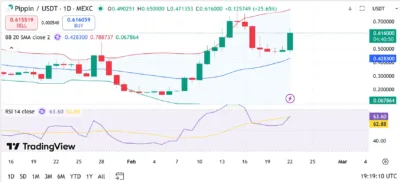
Pippin (PIPPIN) Price Prediction 2026–2030: Can PIPPIN Hit $0.70 Soon?

Pippin (PIPPIN) Price Prediction 2026–2030: Can PIPPIN Hit $0.70 Soon?

PIPPIN has surged sharply on the daily timeframe, printing a powerful bullish candle with over 25% gains. RSI is holding above 60, signaling strengthening momentum
Share
Coinstats2026/02/23 04:29
Will Cardano Reach $10 by 2030? Analysts Break Down ADA’s Growth Cycles

Will Cardano Reach $10 by 2030? Analysts Break Down ADA’s Growth Cycles

The post Will Cardano Reach $10 by 2030? Analysts Break Down ADA’s Growth Cycles appeared first on Coinpedia Fintech News Cardano (ADA) is trading at $0.9024 with a market cap of $32.91 billion. Experts say ADA has the potential to climb much higher, with some placing long-term targets as high as $10. The token continues to benefit from stronger visibility, rising liquidity, and increasing inflows from both institutional and retail markets. Can Cardano Hit $10 …
Share
CoinPedia2025/09/18 17:19
Crypto whale loses $6M to sneaky phishing scheme targeting staked Ethereum

Crypto whale loses $6M to sneaky phishing scheme targeting staked Ethereum

The post Crypto whale loses $6M to sneaky phishing scheme targeting staked Ethereum appeared on BitcoinEthereumNews.com. A crypto whale lost more than $6 million in staked Ethereum (stETH) and Aave-wrapped Bitcoin (aEthWBTC) after approving malicious signatures in a phishing scheme on Sept. 18, according to blockchain security firm Scam Sniffer. According to the firm, the attackers disguised their move as a routine wallet confirmation through “Permit” signatures, which tricked the victim into authorizing fund transfers without triggering obvious red flags. Yu Xian, founder of blockchain security company SlowMist, noted that the victim did not recognize the danger because the transaction required no gas fees. He wrote: “From the victim’s perspective, he just clicked a few times to confirm the wallet’s pop-up signature requests, didn’t spend a single penny of gas, and $6.28 million was gone.” How Permit exploits work Permit approvals were originally designed to simplify token transfers. Instead of submitting an on-chain approval and paying fees, a user can sign an off-chain message authorizing a spender. That efficiency, however, has created a new attack surface for malicious players. Once a user signs such a permit, attackers can combine two functions—Permit and TransferFrom—to drain assets directly. Because the authorization takes place off-chain, wallet dashboards show no unusual activity until the funds move. As a result, the assets are gone when the approval executes on-chain, and tokens are redirected to the attacker’s wallet. This loophole has made permit exploits increasingly attractive for malicious actors, who can siphon millions without needing complex hacks or high-cost gas wars. Phishing losses The latest theft highlights a wider trend of escalating phishing campaigns. Scam Sniffer reported that in August alone, attackers stole $12.17 million from more than 15,200 victims. That figure represented a 72% jump in losses compared with July. According to the firm, the most significant share of August’s damages came from three large accounts that accounted for nearly half…
Share
BitcoinEthereumNews2025/09/19 02:31