BitcoinWorld Horizen’s Bold Migration: Unlocking Scalability by Moving to a Layer 3 on Base In a decisive move that reshapes its technological foundation, the privacy-focused blockchain Horizen (ZEN) has completed a major migration. The project has officially launched its mainnet as a Layer 3 on Base, moving away from its original, standalone Layer 1 chain. This strategic pivot, ratified by a DAO governance vote, signals a profound commitment to […] This post Horizen’s Bold Migration: Unlocking Scalability by Moving to a Layer 3 on Base first appeared on BitcoinWorld.BitcoinWorld Horizen’s Bold Migration: Unlocking Scalability by Moving to a Layer 3 on Base In a decisive move that reshapes its technological foundation, the privacy-focused blockchain Horizen (ZEN) has completed a major migration. The project has officially launched its mainnet as a Layer 3 on Base, moving away from its original, standalone Layer 1 chain. This strategic pivot, ratified by a DAO governance vote, signals a profound commitment to […] This post Horizen’s Bold Migration: Unlocking Scalability by Moving to a Layer 3 on Base first appeared on BitcoinWorld.

Horizen’s Bold Migration: Unlocking Scalability by Moving to a Layer 3 on Base
2025/12/09 21:25
5 min read
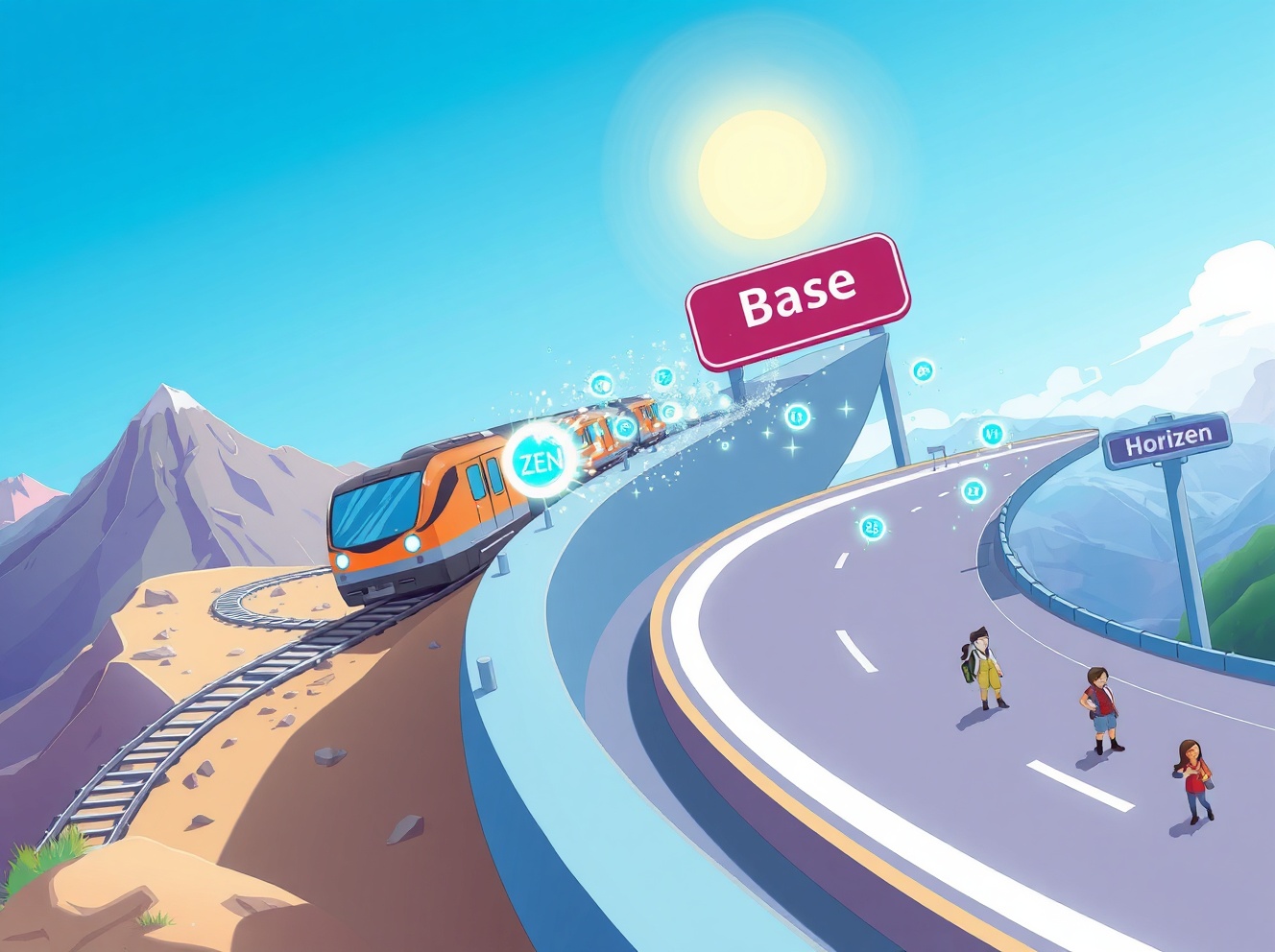
Horizen Layer 3 migration to Base depicted as a vibrant transition to a faster blockchain network.

BitcoinWorld

Horizen’s Bold Migration: Unlocking Scalability by Moving to a Layer 3 on Base

In a decisive move that reshapes its technological foundation, the privacy-focused blockchain Horizen (ZEN) has completed a major migration. The project has officially launched its mainnet as a Layer 3 on Base, moving away from its original, standalone Layer 1 chain. This strategic pivot, ratified by a DAO governance vote, signals a profound commitment to scalability, interoperability, and community-driven growth within the broader Ethereum ecosystem.

Why Did Horizen Choose a Layer 3 on Base?

The transition from a proprietary Layer 1 to a Layer 3 on Base is not merely a technical upgrade; it’s a fundamental strategic realignment. Horizen’s previous architecture, while robust, faced the common challenges of blockchain trilemma—balancing decentralization, security, and scalability. By building as a Layer 3, Horizen leverages the established security of Ethereum (via Base’s Layer 2) while gaining access to superior transaction speed and drastically lower costs. This move directly addresses user and developer pain points, positioning Horizen for sustainable, high-volume adoption.

What Are the Immediate Benefits of This Migration?

The launch of Horizen’s Layer 3 on Base unlocks several key advantages. First, it inherits the robust security model of Ethereum. Second, transaction fees become predictable and minimal, removing a significant barrier for users. Third, integration with the vast Base and Ethereum ecosystems becomes seamless, opening doors to new DeFi protocols, NFT platforms, and user bases.

  • Enhanced Scalability: Processes thousands of transactions per second.
  • Reduced Costs: Users enjoy near-zero gas fees for everyday actions.
  • Stronger Security: Inherits from Ethereum’s battle-tested consensus.
  • Ecosystem Access: Immediate connectivity to apps on Base and Ethereum.

How Will the 100 Million ZEN Grant Program Fuel Growth?

Beyond the infrastructure shift, Horizen is making a powerful statement with capital. The announcement of a 100 million ZEN grant program is a masterstroke to attract developer talent. This substantial fund is dedicated to builders who create applications, tools, and services within the new Horizen Layer 3 on Base environment. The goal is clear: to rapidly bootstrap a vibrant, utility-driven ecosystem that showcases the unique capabilities of Horizen’s privacy-focused technology on a scalable platform.

What Challenges Did This Migration Overcome?

Migrating an entire blockchain ecosystem is a monumental task. Horizen navigated complex technical hurdles, including ensuring asset security during the bridge process and maintaining network integrity. Moreover, the project had to align its community through transparent DAO governance. The successful execution demonstrates a high level of technical competence and strong community stewardship, critical factors for long-term credibility in the web3 space.

Conclusion: A Strategic Leap Forward for Horizen

Horizen’s migration to a Layer 3 on Base is a transformative leap. It exchanges the limitations of an isolated chain for the boundless potential of a connected, scalable future. By combining cutting-edge Layer 3 architecture with a massive developer incentive program, Horizen is not just upgrading its tech stack—it’s strategically positioning itself as a major player in the next wave of scalable, application-specific blockchains. This move could very well redefine Horizen’s trajectory and value proposition in the competitive blockchain landscape.

Frequently Asked Questions (FAQs)

Q: What is a Layer 3 blockchain?
A: A Layer 3 is a specialized blockchain built on top of a Layer 2 (like Base). It allows for highly customized features (like Horizen’s privacy tools) while benefiting from the Layer 2’s speed and low cost, which in turn derives security from Ethereum (Layer 1).

Q: Do I need to do anything with my ZEN tokens after the migration?
A: If you hold ZEN on a major exchange or in a self-custody wallet that supports the new network, your tokens should automatically represent the new Layer 3 on Base version. Always check official Horizen channels for specific wallet instructions.

Q: How does moving to Base improve Horizen’s privacy features?
A: The migration itself doesn’t change Horizen’s core privacy technology. However, by operating on a scalable and low-cost Layer 3, these privacy features become practical and affordable for everyday use, from private transactions to secure smart contracts.

Q: Who can apply for the 100 million ZEN grant?
A: The grant program targets developers and teams building within the Base ecosystem who want to integrate or leverage Horizen’s technology. Details and application guidelines will be released through Horizen’s official governance and developer portals.

Q: Is the original Horizen Layer 1 chain being shut down?
A: The migration involves moving the main operational focus and economic activity to the new Layer 3 on Base. The legacy chain may enter a maintenance phase, but the community DAO will govern its final state based on utility and security assessments.

Did this deep dive into Horizen’s strategic migration help you? This shift is a major case study in blockchain evolution. Share this article with your network on X (Twitter) or LinkedIn to discuss what this means for the future of scalable, application-specific blockchains!

To learn more about the latest Ethereum ecosystem trends, explore our article on key developments shaping Layer 2 and Layer 3 innovation and institutional adoption.

This post Horizen’s Bold Migration: Unlocking Scalability by Moving to a Layer 3 on Base first appeared on BitcoinWorld.

Market Opportunity
Solayer Logo
Solayer Price(LAYER)
$0.08534
$0.08534$0.08534
-4.03%
USD
Solayer (LAYER) Live Price Chart
Disclaimer: The articles reposted on this site are sourced from public platforms and are provided for informational purposes only. They do not necessarily reflect the views of MEXC. All rights remain with the original authors. If you believe any content infringes on third-party rights, please contact [email protected] for removal. MEXC makes no guarantees regarding the accuracy, completeness, or timeliness of the content and is not responsible for any actions taken based on the information provided. The content does not constitute financial, legal, or other professional advice, nor should it be considered a recommendation or endorsement by MEXC.

You May Also Like

Structural job strain caps rand gains – Commerzbank

Structural job strain caps rand gains – Commerzbank

The post Structural job strain caps rand gains – Commerzbank appeared on BitcoinEthereumNews.com. Commerzbank’s Volkmar Baur highlights that South Africa’s unemployment
Share
BitcoinEthereumNews2026/02/19 05:27
Trump gushes over Nicki Minaj's skin to mark Black History Month: 'So beautiful'

Trump gushes over Nicki Minaj's skin to mark Black History Month: 'So beautiful'

President Donald Trump used an event marking Black History Month to remark on Nicki Minaj's complexion."I love Nikki Minaj," the president told the audience. "She
Share
Rawstory2026/02/19 05:07
Google's AP2 protocol has been released. Does encrypted AI still have a chance?

Google's AP2 protocol has been released. Does encrypted AI still have a chance?

Following the MCP and A2A protocols, the AI Agent market has seen another blockbuster arrival: the Agent Payments Protocol (AP2), developed by Google. This will clearly further enhance AI Agents' autonomous multi-tasking capabilities, but the unfortunate reality is that it has little to do with web3AI. Let's take a closer look: What problem does AP2 solve? Simply put, the MCP protocol is like a universal hook, enabling AI agents to connect to various external tools and data sources; A2A is a team collaboration communication protocol that allows multiple AI agents to cooperate with each other to complete complex tasks; AP2 completes the last piece of the puzzle - payment capability. In other words, MCP opens up connectivity, A2A promotes collaboration efficiency, and AP2 achieves value exchange. The arrival of AP2 truly injects "soul" into the autonomous collaboration and task execution of Multi-Agents. Imagine AI Agents connecting Qunar, Meituan, and Didi to complete the booking of flights, hotels, and car rentals, but then getting stuck at the point of "self-payment." What's the point of all that multitasking? So, remember this: AP2 is an extension of MCP+A2A, solving the last mile problem of AI Agent automated execution. What are the technical highlights of AP2? The core innovation of AP2 is the Mandates mechanism, which is divided into real-time authorization mode and delegated authorization mode. Real-time authorization is easy to understand. The AI Agent finds the product and shows it to you. The operation can only be performed after the user signs. Delegated authorization requires the user to set rules in advance, such as only buying the iPhone 17 when the price drops to 5,000. The AI Agent monitors the trigger conditions and executes automatically. The implementation logic is cryptographically signed using Verifiable Credentials (VCs). Users can set complex commission conditions, including price ranges, time limits, and payment method priorities, forming a tamper-proof digital contract. Once signed, the AI Agent executes according to the conditions, with VCs ensuring auditability and security at every step. Of particular note is the "A2A x402" extension, a technical component developed by Google specifically for crypto payments, developed in collaboration with Coinbase and the Ethereum Foundation. This extension enables AI Agents to seamlessly process stablecoins, ETH, and other blockchain assets, supporting native payment scenarios within the Web3 ecosystem. What kind of imagination space can AP2 bring? After analyzing the technical principles, do you think that's it? Yes, in fact, the AP2 is boring when it is disassembled alone. Its real charm lies in connecting and opening up the "MCP+A2A+AP2" technology stack, completely opening up the complete link of AI Agent's autonomous analysis+execution+payment. From now on, AI Agents can open up many application scenarios. For example, AI Agents for stock investment and financial management can help us monitor the market 24/7 and conduct independent transactions. Enterprise procurement AI Agents can automatically replenish and renew without human intervention. AP2's complementary payment capabilities will further expand the penetration of the Agent-to-Agent economy into more scenarios. Google obviously understands that after the technical framework is established, the ecological implementation must be relied upon, so it has brought in more than 60 partners to develop it, almost covering the entire payment and business ecosystem. Interestingly, it also involves major Crypto players such as Ethereum, Coinbase, MetaMask, and Sui. Combined with the current trend of currency and stock integration, the imagination space has been doubled. Is web3 AI really dead? Not entirely. Google's AP2 looks complete, but it only achieves technical compatibility with Crypto payments. It can only be regarded as an extension of the traditional authorization framework and belongs to the category of automated execution. There is a "paradigm" difference between it and the autonomous asset management pursued by pure Crypto native solutions. The Crypto-native solutions under exploration are taking the "decentralized custody + on-chain verification" route, including AI Agent autonomous asset management, AI Agent autonomous transactions (DeFAI), AI Agent digital identity and on-chain reputation system (ERC-8004...), AI Agent on-chain governance DAO framework, AI Agent NPC and digital avatars, and many other interesting and fun directions. Ultimately, once users get used to AI Agent payments in traditional fields, their acceptance of AI Agents autonomously owning digital assets will also increase. And for those scenarios that AP2 cannot reach, such as anonymous transactions, censorship-resistant payments, and decentralized asset management, there will always be a time for crypto-native solutions to show their strength? The two are more likely to be complementary rather than competitive, but to be honest, the key technological advancements behind AI Agents currently all come from web2AI, and web3AI still needs to keep up the good work!
Share
PANews2025/09/18 07:00