A $2.7M oracle hit is one problem for Aevo; a 19% payback cap on a 32% vault loss is another for anyone still underwriting Ribbon risk. The post Aevo’s Ribbon VaultA $2.7M oracle hit is one problem for Aevo; a 19% payback cap on a 32% vault loss is another for anyone still underwriting Ribbon risk. The post Aevo’s Ribbon Vault

Aevo’s Ribbon Vault Exploit Spurs Backlash Over 19% Payout Plan

2025/12/15 15:53

Aevo, the derivatives venue built by the former Ribbon Finance team, confirmed a $2.7 million loss from its legacy Ribbon DOV vaults after an oracle-related smart contract upgrade on December 12.

Shortly after, the project team relayed that Aevo will permanently disable all Ribbon vaults and run a capped recovery process for affected users. It explained that the old Ribbon DOV vault was hacked on December 12 due to smart contract vulnerabilities in a recent update, leading to a $2.7 million loss.

As a consequence, all Ribbon vaults were paused and should soon be permanently disabled, with a six‑month claims window through June 12, 2026. The post adds that the DAO will liquidate remaining assets to compensate users “up to 19% of the missing amount or the remaining balance,” whichever is lower.

How the Ribbon vault hack actually happened

Blockchain investigators reconstructed the attack path using the exploit contract at 0x3c212A044760DE5a529B3Ba59363ddeCcc2210bE and at least 15 recipient addresses first flagged by on‑chain analyst Specter on X. Specter wrote that “the old contract of @ribbonfinance has been drained for a total of $2.7M,” listing theft addresses that received drained [NC] and stablecoins.

Security write‑ups from multiple venues agree that the attacker abused the oracle proxy admin to submit arbitrary expiry prices for wstETH, AAVE, [NC] , and other underlyings, then settled oToken positions against Ribbon’s MarginPool to pull assets from the vaults.

Post‑mortems point to a decimal‑mismatch bug introduced six days earlier, when Ribbon updated the oracle pricer to 18‑decimal feeds for stETH, PAXG, LINK, and AAVE while keeping USDC at eight decimals. Web3 security researcher Weilin highlighted that the configuration allowed forged expiry prices at a shared timestamp across assets, which the settlement pipeline then treated as valid for prominent short oToken positions. Funds now sit spread across the original 15 addresses and several consolidation wallets, with no public recovery negotiation from the attacker.

Aevo price reacts with a drop

The market has already marked Aevo down. AEVO trades at about $0.041 per token today, with a 7-day drop of 7% and a market cap of $37.7 million on a circulating supply of 915.8 million. That price sits 98.9% below the March 28, 2024, all‑time high of $3.86.
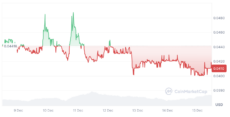
Aevo price in 7 days | Source: CoinMarketCap

Aevo price in 7 days | Source: CoinMarketCap

Implied protocol value now hovers close to the on‑chain TVL of around $28.2 million, which compresses the margin for error when the DAO socializes a 32% vault loss yet only promises up to 19% reimbursement.

Community backlash over Ribbon recovery plan

Community reaction to the recovery terms of 19% has turned hostile across social channels and secondary reporting.

Commenters argue that early Ribbon depositors, who left assets in deprecated DOV vaults based on prior assurances, now eat an 80%+ haircut. At the same time, Aevo continues to run its main derivatives exchange and L2 stack unaffected.

Users also report that some threads have been deleted, and that commenting on Aevo’s posts is now limited to verified accounts and those previously mentioned by Aevo. The company directs users toward the formal claims process rather than open debate.

From an institutional angle, the exploit itself looks like a textbook oracle‑config failure. Still, the response mirrors prior stress episodes around Mango, Euler, and others, where the technical fix landed faster than the social one.

A desk that routes size through Aevo now has to price not just smart contract risk, but governance and social‑layer risk in any vault product that carries the Ribbon legacy brand, since the DAO has set a precedent that losses in older vault lines can clear at a fraction of face value even while the core trading venue and token remain live.

next

The post Aevo’s Ribbon Vault Exploit Spurs Backlash Over 19% Payout Plan appeared first on Coinspeaker.

Market Opportunity
Aevo Logo
Aevo Price(AEVO)
$0.03799
$0.03799$0.03799
-2.38%
USD
Aevo (AEVO) Live Price Chart
Disclaimer: The articles reposted on this site are sourced from public platforms and are provided for informational purposes only. They do not necessarily reflect the views of MEXC. All rights remain with the original authors. If you believe any content infringes on third-party rights, please contact [email protected] for removal. MEXC makes no guarantees regarding the accuracy, completeness, or timeliness of the content and is not responsible for any actions taken based on the information provided. The content does not constitute financial, legal, or other professional advice, nor should it be considered a recommendation or endorsement by MEXC.

You May Also Like

The Channel Factories We’ve Been Waiting For

The Channel Factories We’ve Been Waiting For

The post The Channel Factories We’ve Been Waiting For appeared on BitcoinEthereumNews.com. Visions of future technology are often prescient about the broad strokes while flubbing the details. The tablets in “2001: A Space Odyssey” do indeed look like iPads, but you never see the astronauts paying for subscriptions or wasting hours on Candy Crush.  Channel factories are one vision that arose early in the history of the Lightning Network to address some challenges that Lightning has faced from the beginning. Despite having grown to become Bitcoin’s most successful layer-2 scaling solution, with instant and low-fee payments, Lightning’s scale is limited by its reliance on payment channels. Although Lightning shifts most transactions off-chain, each payment channel still requires an on-chain transaction to open and (usually) another to close. As adoption grows, pressure on the blockchain grows with it. The need for a more scalable approach to managing channels is clear. Channel factories were supposed to meet this need, but where are they? In 2025, subnetworks are emerging that revive the impetus of channel factories with some new details that vastly increase their potential. They are natively interoperable with Lightning and achieve greater scale by allowing a group of participants to open a shared multisig UTXO and create multiple bilateral channels, which reduces the number of on-chain transactions and improves capital efficiency. Achieving greater scale by reducing complexity, Ark and Spark perform the same function as traditional channel factories with new designs and additional capabilities based on shared UTXOs.  Channel Factories 101 Channel factories have been around since the inception of Lightning. A factory is a multiparty contract where multiple users (not just two, as in a Dryja-Poon channel) cooperatively lock funds in a single multisig UTXO. They can open, close and update channels off-chain without updating the blockchain for each operation. Only when participants leave or the factory dissolves is an on-chain transaction…
Share
BitcoinEthereumNews2025/09/18 00:09
SOLANA NETWORK Withstands 6 Tbps DDoS Without Downtime

SOLANA NETWORK Withstands 6 Tbps DDoS Without Downtime

The post SOLANA NETWORK Withstands 6 Tbps DDoS Without Downtime appeared on BitcoinEthereumNews.com. In a pivotal week for crypto infrastructure, the Solana network
Share
BitcoinEthereumNews2025/12/16 20:44
Why The Green Bay Packers Must Take The Cleveland Browns Seriously — As Hard As That Might Be

Why The Green Bay Packers Must Take The Cleveland Browns Seriously — As Hard As That Might Be

The post Why The Green Bay Packers Must Take The Cleveland Browns Seriously — As Hard As That Might Be appeared on BitcoinEthereumNews.com. Jordan Love and the Green Bay Packers are off to a 2-0 start. Getty Images The Green Bay Packers are, once again, one of the NFL’s better teams. The Cleveland Browns are, once again, one of the league’s doormats. It’s why unbeaten Green Bay (2-0) is a 8-point favorite at winless Cleveland (0-2) Sunday according to betmgm.com. The money line is also Green Bay -500. Most expect this to be a Packers’ rout, and it very well could be. But Green Bay knows taking anyone in this league for granted can prove costly. “I think if you look at their roster, the paper, who they have on that team, what they can do, they got a lot of talent and things can turn around quickly for them,” Packers safety Xavier McKinney said. “We just got to kind of keep that in mind and know we not just walking into something and they just going to lay down. That’s not what they going to do.” The Browns certainly haven’t laid down on defense. Far from. Cleveland is allowing an NFL-best 191.5 yards per game. The Browns gave up 141 yards to Cincinnati in Week 1, including just seven in the second half, but still lost, 17-16. Cleveland has given up an NFL-best 45.5 rushing yards per game and just 2.1 rushing yards per attempt. “The biggest thing is our defensive line is much, much improved over last year and I think we’ve got back to our personality,” defensive coordinator Jim Schwartz said recently. “When we play our best, our D-line leads us there as our engine.” The Browns rank third in the league in passing defense, allowing just 146.0 yards per game. Cleveland has also gone 30 straight games without allowing a 300-yard passer, the longest active streak in the NFL.…
Share
BitcoinEthereumNews2025/09/18 00:41