UNI holders are like "cows" that are about to be squeezed dry, and the value of their tokens has never been captured.UNI holders are like "cows" that are about to be squeezed dry, and the value of their tokens has never been captured.

Analyst: The Uniswap Foundation has passed a huge investment plan of US$165.5 million, but why do I think it is only a temporary solution and not a fundamental solution?

2025/03/06 18:15
3 min read

Author: Ignas

Compiled by: Tim, PANews

The Uniswap Foundation voted to approve a huge investment plan of US$165.5 million. Why?

Because the performance of Uniswap v4 and Unichain after their release was far from market expectations.

In a little over a month:

  • Uni v4’s total locked value (TVL) is only $85 million
  • Unichain’s TVL is only $8.2 million

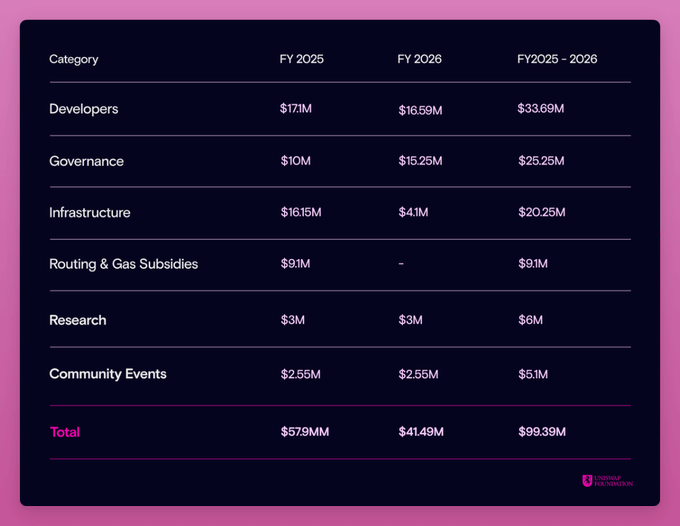
To foster growth, the Uniswap Foundation proposes to allocate $165.5 million to:

  • $95.4 million for funding (developer programs, core contributors, validators);
  • $25.1 million for operations (team expansion, governance tool development);
  • $45 million for liquidity incentives.

Analyst: The Uniswap Foundation has passed a huge investment plan of US$165.5 million, but why do I think it is only a temporary solution and not a fundamental solution?

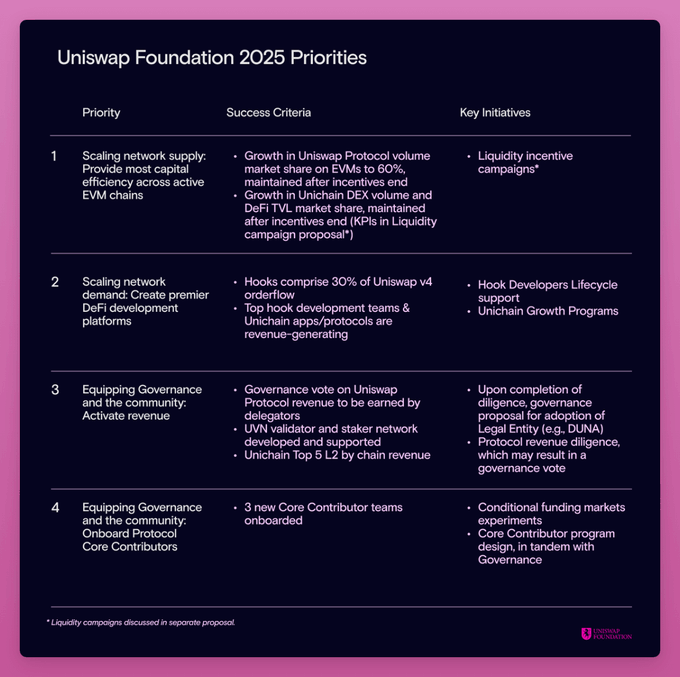
As you can see, Uni v4 is not only a DEX, but also a liquidity platform, and Hooks is the application built on it.

Hooks should drive growth in the Uni v4 ecosystem, so this needs to be accelerated through funding programs.

Detailed allocation of funding budget:
Analyst: The Uniswap Foundation has passed a huge investment plan of US$165.5 million, but why do I think it is only a temporary solution and not a fundamental solution?

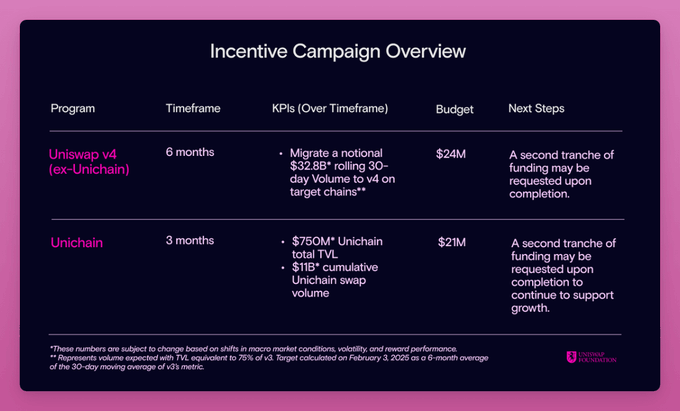
$45 million in liquidity provider (LP) incentives will be used for the following:

  • $24 million (disbursed over 6 months): used to incentivize the migration of liquidity from other platforms to Uni v4;
  • $21 million (disbursed in 3 months): Push Unichain’s total locked value (TVL) from the current $8.2 million to $750 million.
Analyst: The Uniswap Foundation has passed a huge investment plan of US$165.5 million, but why do I think it is only a temporary solution and not a fundamental solution?

In comparison, Aerodrome mints approximately $40-50 million worth of AERO tokens per month for liquidity provider (LP) incentives.

The proposal has passed the temperature check stage, but still faces some criticism:

As the industry landscape changes, Aave proposes to repurchase $1 million of AAVE tokens per week, and Maker plans to repurchase $30 million per month. However, UNI holders are like "cows" that are about to be squeezed dry, and the value of their tokens has never been captured.

The UNI token does not have a fee-sharing mechanism enabled, and Uniswap Labs has earned $171 million through front-end fees in two years.

The key to the entire system lies in Uniswap’s organizational structure design:

  • Uniswap Labs: Focus on protocol technology development;
  • Uniswap Foundation: Promotes ecosystem growth, governance, and funding initiatives (such as grants, liquidity incentives).

What a savvy legal team.

Aave and Maker have established a closer interest binding relationship with token holders, and I don’t understand why Uniswap’s front-end fees cannot be shared with UNI holders.

In summary, other criticisms focus on the high salaries of the core team, Gauntlet’s responsibility for liquidity incentive enforcement, and the establishment of a new centralized DAO legal structure (DUNA).

As a small Uniswap governance representative, I voted in favor of this proposal, but still have significant concerns about the future of UNI holders: the incentive mechanism is not aligned with the interests of holders.

However, I am a big fan of Uniswap and highly recognize its role in promoting the DeFi field. The current growth of Uni v4 and Unichain is very bleak, and they need to introduce incentives to promote development.

The next Uni DAO vote should focus on the value capture mechanism of the UNI token.

Market Opportunity
Wink Logo
Wink Price(LIKE)
$0.002031
$0.002031$0.002031
-0.29%
USD
Wink (LIKE) Live Price Chart
Disclaimer: The articles reposted on this site are sourced from public platforms and are provided for informational purposes only. They do not necessarily reflect the views of MEXC. All rights remain with the original authors. If you believe any content infringes on third-party rights, please contact [email protected] for removal. MEXC makes no guarantees regarding the accuracy, completeness, or timeliness of the content and is not responsible for any actions taken based on the information provided. The content does not constitute financial, legal, or other professional advice, nor should it be considered a recommendation or endorsement by MEXC.

You May Also Like

Cashing In On University Patents Means Giving Up On Our Innovation Future
Cashing In On University Patents Means Giving Up On Our Innovation Future

The post Cashing In On University Patents Means Giving Up On Our Innovation Future appeared on BitcoinEthereumNews.com. “It’s a raid on American innovation that would deliver pennies to the Treasury while kneecapping the very engine of our economic and medical progress,” writes Pipes. Getty Images Washington is addicted to taxing success. Now, Commerce Secretary Howard Lutnick is floating a plan to skim half the patent earnings from inventions developed at universities with federal funding. It’s being sold as a way to shore up programs like Social Security. In reality, it’s a raid on American innovation that would deliver pennies to the Treasury while kneecapping the very engine of our economic and medical progress. Yes, taxpayer dollars support early-stage research. But the real payoff comes later—in the jobs created, cures discovered, and industries launched when universities and private industry turn those discoveries into real products. By comparison, the sums at stake in patent licensing are trivial. Universities collectively earn only about $3.6 billion annually in patent income—less than the federal government spends on Social Security in a single day. Even confiscating half would barely register against a $6 trillion federal budget. And yet the damage from such a policy would be anything but trivial. The true return on taxpayer investment isn’t in licensing checks sent to Washington, but in the downstream economic activity that federally supported research unleashes. Thanks to the bipartisan Bayh-Dole Act of 1980, universities and private industry have powerful incentives to translate early-stage discoveries into real-world products. Before Bayh-Dole, the government hoarded patents from federally funded research, and fewer than 5% were ever licensed. Once universities could own and license their own inventions, innovation exploded. The result has been one of the best returns on investment in government history. Since 1996, university research has added nearly $2 trillion to U.S. industrial output, supported 6.5 million jobs, and launched more than 19,000 startups. Those companies pay…
Share
BitcoinEthereumNews2025/09/18 03:26
Trump foe devises plan to starve him of what he 'craves' most
Trump foe devises plan to starve him of what he 'craves' most

A longtime adversary of President Donald Trump has a plan for a key group to take away what Trump craves the most — attention. EX-CNN journalist Jim Acosta, who
Share
Rawstory2026/02/04 01:19
Why Bitcoin Is Struggling: 8 Factors Impacting Crypto Markets

Why Bitcoin Is Struggling: 8 Factors Impacting Crypto Markets

Failed blockchain adoption narratives and weak fee capture have undercut confidence in major crypto projects.
Share
CryptoPotato2026/02/04 01:05