The so-called "Bitcoin DeFi" does not actually exist. Whether it is BitVM, BitcoinOS, Rootstock or Soveryn, these projects are either extremely centralized or completely unrealistic.The so-called "Bitcoin DeFi" does not actually exist. Whether it is BitVM, BitcoinOS, Rootstock or Soveryn, these projects are either extremely centralized or completely unrealistic.

Opinion: Under the technical limitations, "Bitcoin DeFi" is just nonsense and an investment trap

2025/04/24 15:50
8 min read

Opinion: Under the technical limitations, "Bitcoin DeFi" is just nonsense and an investment trap

Original article: Justin Bons , Founder of Cyber Capital

Compiled by: Yuliya, PANews

The so-called "Bitcoin DeFi" does not exist at all. Whether it is BitVM, BitcoinOS, Rootstock or Soveryn, these projects are either extremely centralized or completely unrealistic. After in-depth research, the truth is shocking, and many of the propaganda of these projects can almost be called fraud.

The fundamental reason why Bitcoin cannot support DeFi

The reason why Bitcoin cannot achieve true DeFi is that it lacks a Turing-complete VM. Simply put, it cannot support complex smart contracts like Ethereum or Solana. This means that no matter how the project party promotes it, Bitcoin does not have the core capabilities required for DeFi.

The “De” in DeFi stands for “decentralized.” All current projects claiming to be “Bitcoin DeFi” are centralized in nature, misleading users and causing investors to lose hundreds of millions of dollars.

BitVM

BitVM claims to enable smart contracts on Bitcoin through "optimistic two-party computation," similar to how many Ethereum Layer 2 networks (ETH L2) operate, involving a "prover" and a "verifier." However, unlike most centralized ETH L2s, BitVM is more centralized because its "verifiers" are also permissioned.

In most ETH L2s, such as Optimism, users can submit fraud proofs even if the centralized "certifier" attempts to cheat. BitVM is different, it only has a licensed "verifier", which essentially constitutes a highly centralized system.

In reality, BitVM relies on two computers run by trusted parties selected by a single authority, which is almost the most centralized form. Although BitVM2 plans to make "validators" permissionless, this is only possible after the initial setup, which still requires a set of permissioned participants and requires a "1-of-n honesty assumption." The reality of current deployments makes these future promises irrelevant.

In addition, the BitVM system is extremely inefficient. This is because Bitcoin (BTC) does not have a Turing-complete programming language, but in theory any function can be implemented with a simple switch. BitVM attempts to achieve this by stringing opcodes together in dispute situations and publishing them into taproot transactions, combining opcodes into logic gates using Boolean Logic. However, this approach is overly complex and inefficient.

However, this solution is extremely impractical as it is orders of magnitude inefficient and requires very powerful computer processing, leading to significant centralization pressures, even if both computers are permissionless. This also severely limits the capacity of the system, as equivalent processing by a Turing-complete virtual machine requires only a small amount of resources, making BitVM difficult to scale in comparison. Even ignoring BTC's inherent lack of ability to support large-scale BitVM, it still explains why BitVM adopts an optimistic model, as the amount of processing required is too large, leading to its current and future situation being worrying.

Rootstock

Rootstock is a sidechain connected to BTC, featuring smart contract functions. However, it relies on a "permissioned federation" to maintain a two-way peg, which means that the federation can censor or even steal user assets.

Although Rootstock is essentially the same as a bank, which goes against the original intention of Bitcoin’s decentralization, Rootstock at least acknowledged its centralized nature in the project introduction, which at least shows its honest attitude.

Sovryn

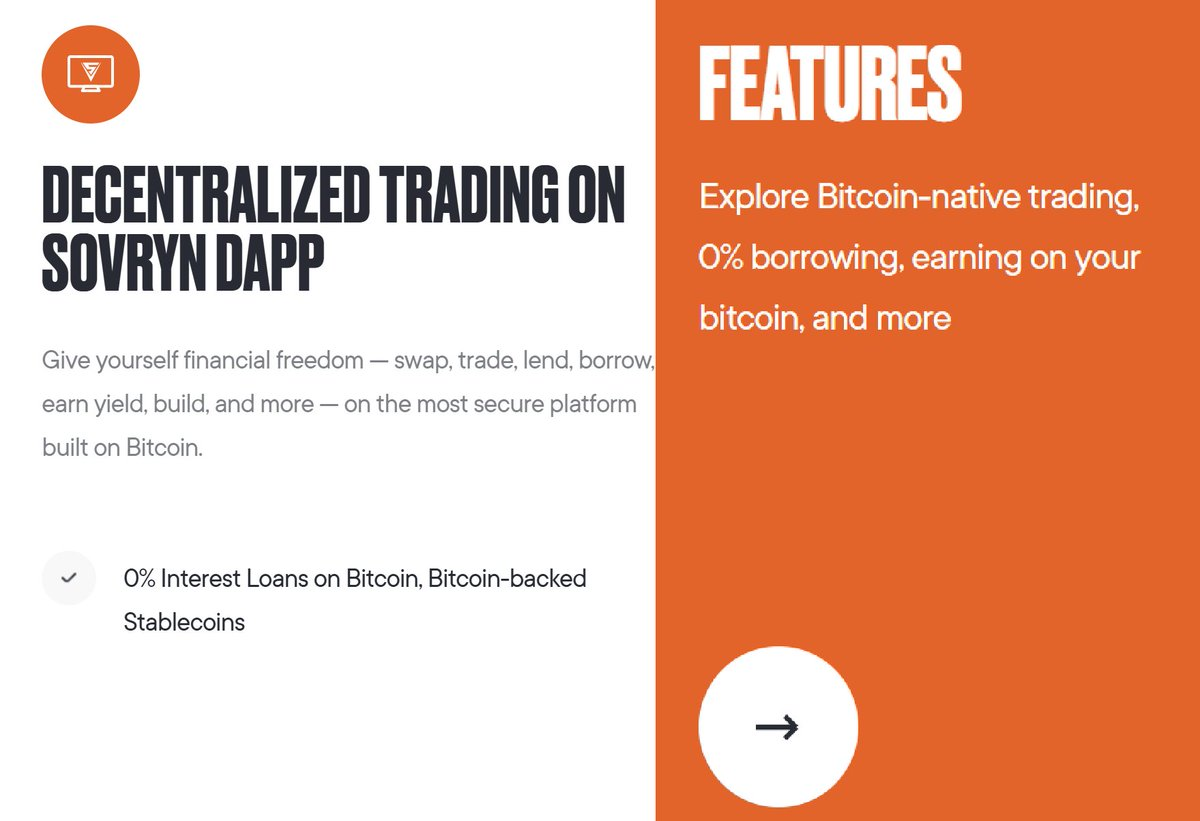
Sovryn is actually built on Rootstock and relies on its smart contracts and anchoring mechanism, so it is also highly centralized.

However, it claims on its official website that it is “decentralized” and provides “native Bitcoin transactions”, which is obviously misleading. What is even more alarming is that the team behind Sovryn is also involved in the next project, BitcoinOS.
Opinion: Under the technical limitations, "Bitcoin DeFi" is just nonsense and an investment trap

BitcoinOS

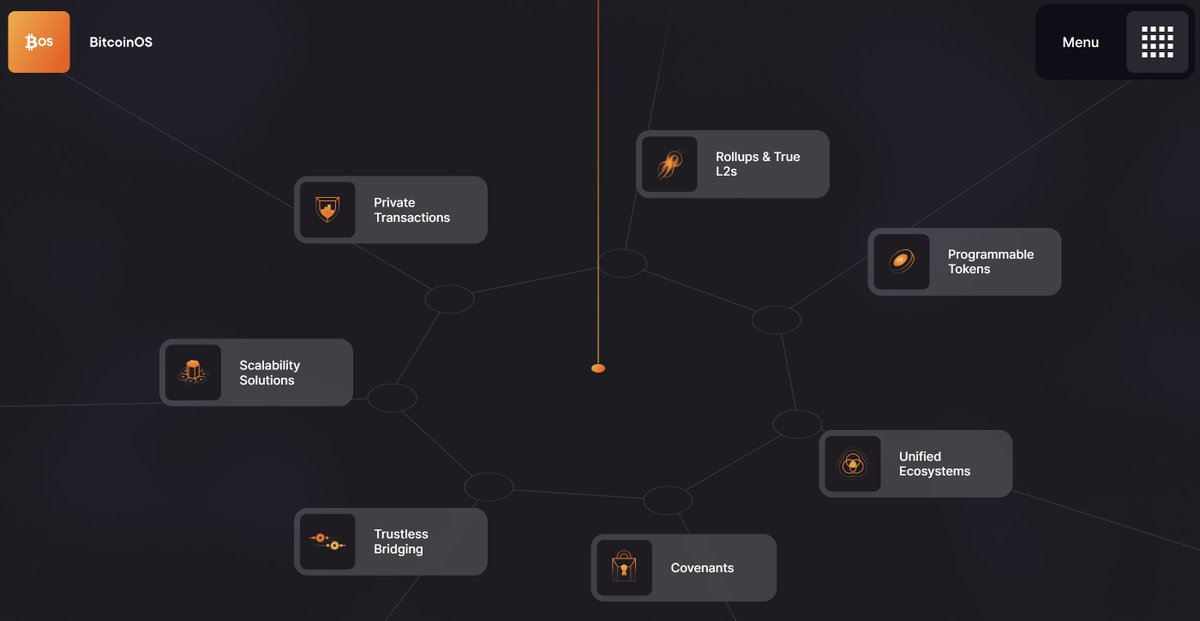
BitcoinOS is the most exaggerated of these projects. It claims to have solved all the problems that Ethereum has not solved: privacy, cross-chain, trustless bridging, and even "real Rollup".

But the fact is that its white paper has serious information gaps and completely avoids the key "off-chain execution" part of the project design, which is the core of introducing trust risks.
Opinion: Under the technical limitations, "Bitcoin DeFi" is just nonsense and an investment trap

BitcoinOS still uses a "certifier-verifier" structure similar to BitVM, and the document does not mention how to achieve decentralization of verifiers. This "deliberate omission" is extremely deceptive, suggesting that its verifiers are still centrally controlled.

In addition, the project claims to support Rollups that are "more advanced than Ethereum," but it is technically impossible to achieve this goal. Bitcoin's lack of Turing completeness means that L2 execution, sequencing, and verification must all be done off-chain. This inevitably requires a centralized sequencer or consortium to intervene, exposing more centralized risks.

Even more ridiculous is that BitcoinOS's Rollup system needs to submit a 400KB state proof on the main chain every six blocks, which takes up 10% of the Bitcoin block capacity. This makes Bitcoin OS an extremely slow and expensive data availability solution that is difficult to compete with other solutions, and also makes DeFi on BTC not only completely centralized but also unsafe. However, these details are not mentioned in the official documents, which is shocking.

The so-called "L2 extension" is actually an illusion

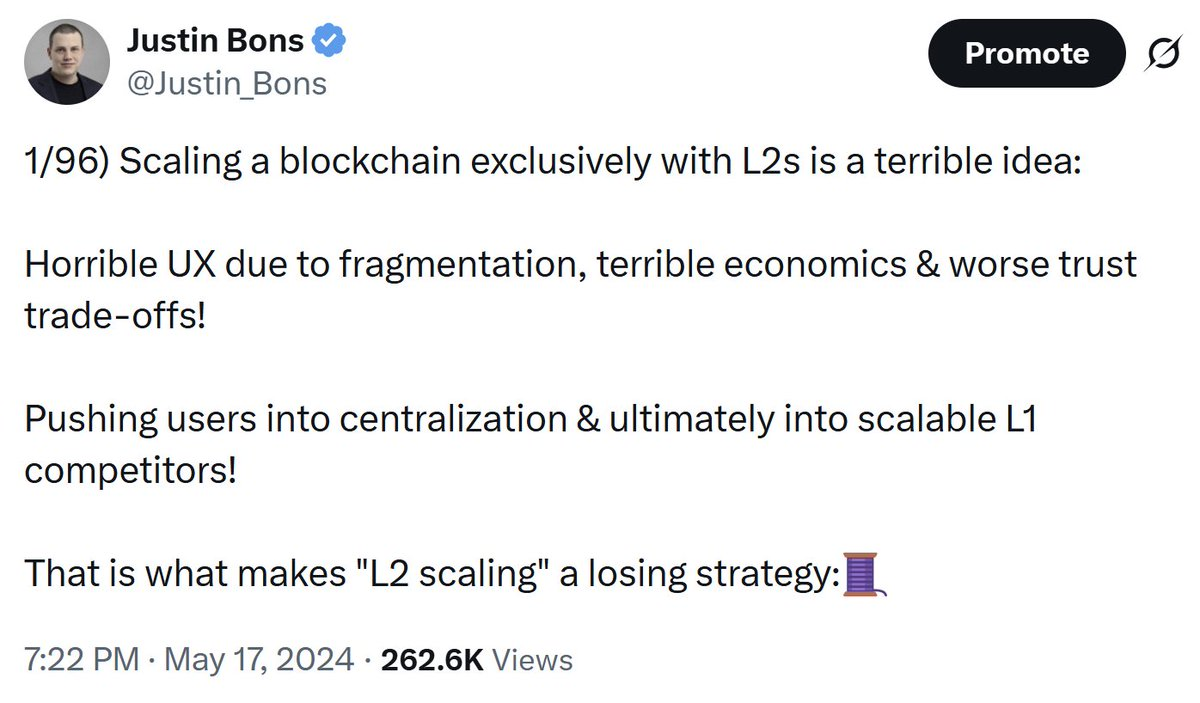
Many current Bitcoin (BTC) "DeFi" projects are based on the narrative of "second-layer expansion" (L2 scaling). Broadly speaking, L2/modular "scaling" attempts to expand the functionality and performance of the base layer (L1) by building additional layers on top of it.

However, this approach has almost never been successful in practice. Pushing transaction traffic to another competing chain does not actually expand the capacity of the original chain, but instead provides a harbinger of decline for the actual use of the original chain, because this practice provides some degree of excuse for "never having to expand L1".

Worse still, this approach often completely distorts the incentives of the original chain’s leadership through the corrosive influence of L2 tokens and equity. Take Ethereum, for example, which has long dominated the DeFi space, but has now been surpassed by Solana in terms of “real usage.” This is not accidental, but a structural consequence of the L2 narrative.
Opinion: Under the technical limitations, "Bitcoin DeFi" is just nonsense and an investment trap

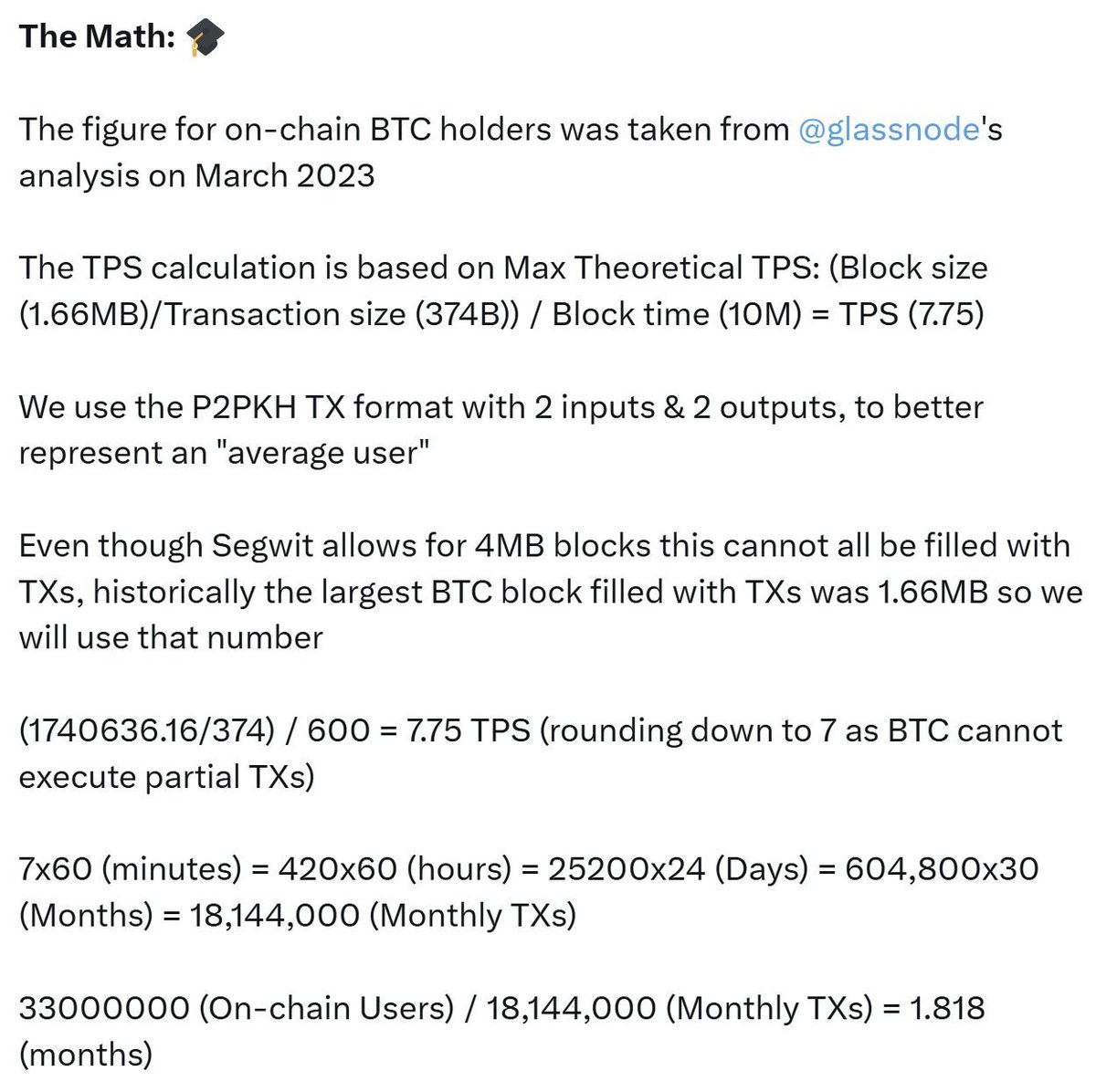
BTC’s L2 expansion plan may make large-scale self-custody impractical. If users want to control their own private keys, they still need to conduct multiple on-chain transactions to access L2. However, the current on-chain capacity cannot support such large-scale operations.

For example, if all holders wanted to move their coins now, the transaction queue would be more than two months; if everyone in the world only made one transaction, the queue would be more than twenty years. This means that self-custody is almost impossible to achieve, and the public will have to access it through a custodial service provider, which completely violates the original purpose of Bitcoin.
Opinion: Under the technical limitations, "Bitcoin DeFi" is just nonsense and an investment trap

Why Bitcoin Won’t Change

Many people still have illusions that Bitcoin may be adapted to DeFi functions in the future, but in-depth political and economic analysis shows that such a transformation is almost impossible.

The governance mechanism of the Bitcoin community is extremely closed, and the Bitcoin Core team can almost unilaterally block any protocol upgrade. For example, even a relatively mild opcode recovery proposal such as OP_CAT has been blocked for a long time; not to mention "disruptive" proposals such as the introduction of a Turing-complete virtual machine. Therefore, it is not realistic to expect Bitcoin to adapt to DeFi.
Opinion: Under the technical limitations, "Bitcoin DeFi" is just nonsense and an investment trap

It’s a scam cycle

Projects around Bitcoin DeFi have actually formed a "scam cycle": every few years, a new wave of projects claiming to "implement DeFi on Bitcoin" will appear on the market, and these projects can often raise hundreds of millions of dollars from investors. However, they will soon disappear due to technical bottlenecks, model loopholes and other problems. A few years later, new projects will make a comeback, targeting a group of new investors who do not understand history.

Most of these projects take advantage of people's fantasy that "DeFi can also be played with Bitcoin", but the reality is that there have been almost no major technical changes in the Bitcoin protocol in the past decade. With so much money and resources invested, DeFi still cannot be realized. It is hard to believe that it can be "suddenly realized" today with the same code.

Bitcoin DeFi is just a fantasy

Among all the projects investigated, Soveryn and BitcoinOS are the most controversial. Their publicity is extremely exaggerated, but it completely conceals the huge trade-offs and flaws of the projects. Although Rootstock is still a centralized solution, it at least acknowledges this point. BitVM has some highlights in innovation, but it still cannot get rid of the limitations of its efficiency and structure.

What’s even more ironic is that after an in-depth study of the L2 project of the BTC ecosystem, people have a greater appreciation for the transparency and self-critical spirit of Ethereum L2. The Ethereum ecosystem even has a dedicated “L2Beat” project to track the risks and operating conditions of each L2, while Bitcoin L2 has almost no similar disclosure mechanism.

The bottom line is, the so-called "Bitcoin DeFi" does not exist. It has no native support capabilities and no realistic landing path. It is a collective fantasy driven by greed, delusion and ignorance, just like the myth that Bitcoin itself once brought. We don't need to continue to tolerate Bitcoin's mediocrity and stagnation. There is a real DeFi economy on the chain, generating billions of dollars in revenue each year - instead of indulging in fantasy, it is better to support the real crypto revolution.

Market Opportunity
DeFi Logo
DeFi Price(DEFI)
$0.000339
$0.000339$0.000339
-3.96%
USD
DeFi (DEFI) Live Price Chart
Disclaimer: The articles reposted on this site are sourced from public platforms and are provided for informational purposes only. They do not necessarily reflect the views of MEXC. All rights remain with the original authors. If you believe any content infringes on third-party rights, please contact [email protected] for removal. MEXC makes no guarantees regarding the accuracy, completeness, or timeliness of the content and is not responsible for any actions taken based on the information provided. The content does not constitute financial, legal, or other professional advice, nor should it be considered a recommendation or endorsement by MEXC.

You May Also Like

Botanix launches stBTC to deliver Bitcoin-native yield

Botanix launches stBTC to deliver Bitcoin-native yield

The post Botanix launches stBTC to deliver Bitcoin-native yield appeared on BitcoinEthereumNews.com. Botanix Labs has launched stBTC, a liquid staking token designed to turn Bitcoin into a yield-bearing asset by redistributing network gas fees directly to users. The protocol will begin yield accrual later this week, with its Genesis Vault scheduled to open on Sept. 25, capped at 50 BTC. The initiative marks one of the first attempts to generate Bitcoin-native yield without relying on inflationary token models or centralized custodians. stBTC works by allowing users to deposit Bitcoin into Botanix’s permissionless smart contract, receiving stBTC tokens that represent their share of the staking vault. As transactions occur, 50% of Botanix network gas fees, paid in BTC, flow back to stBTC holders. Over time, the value of stBTC increases relative to BTC, enabling users to redeem their original deposit plus yield. Botanix estimates early returns could reach 20–50% annually before stabilizing around 6–8%, a level similar to Ethereum staking but fully denominated in Bitcoin. Botanix says that security audits have been completed by Spearbit and Sigma Prime, and the protocol is built on the EIP-4626 vault standard, which also underpins Ethereum-based staking products. The company’s Spiderchain architecture, operated by 16 independent entities including Galaxy, Alchemy, and Fireblocks, secures the network. If adoption grows, Botanix argues the system could make Bitcoin a productive, composable asset for decentralized finance, while reinforcing network consensus. This is a developing story. This article was generated with the assistance of AI and reviewed by editor Jeffrey Albus before publication. Get the news in your inbox. Explore Blockworks newsletters: Source: https://blockworks.co/news/botanix-launches-stbtc
Share
BitcoinEthereumNews2025/09/18 02:37
Unprecedented Surge: Gold Price Hits Astounding New Record High

Unprecedented Surge: Gold Price Hits Astounding New Record High

BitcoinWorld Unprecedented Surge: Gold Price Hits Astounding New Record High While the world often buzzes with the latest movements in Bitcoin and altcoins, a traditional asset has quietly but powerfully commanded attention: gold. This week, the gold price has once again made headlines, touching an astounding new record high of $3,704 per ounce. This significant milestone reminds investors, both traditional and those deep in the crypto space, of gold’s enduring appeal as a store of value and a hedge against uncertainty. What’s Driving the Record Gold Price Surge? The recent ascent of the gold price to unprecedented levels is not a random event. Several powerful macroeconomic forces are converging, creating a perfect storm for the precious metal. Geopolitical Tensions: Escalating conflicts and global instability often drive investors towards safe-haven assets. Gold, with its long history of retaining value during crises, becomes a preferred choice. Inflation Concerns: Persistent inflation in major economies erodes the purchasing power of fiat currencies. Consequently, investors seek assets like gold that historically maintain their value against rising prices. Central Bank Policies: Many central banks globally are accumulating gold at a significant pace. This institutional demand provides a strong underlying support for the gold price. Furthermore, expectations around interest rate cuts in the future also make non-yielding assets like gold more attractive. These factors collectively paint a picture of a cautious market, where investors are looking for stability amidst a turbulent economic landscape. Understanding Gold’s Appeal in Today’s Market For centuries, gold has held a unique position in the financial world. Its latest record-breaking performance reinforces its status as a critical component of a diversified portfolio. Gold offers a tangible asset that is not subject to the same digital vulnerabilities or regulatory shifts that can impact cryptocurrencies. While digital assets offer exciting growth potential, gold provides a foundational stability that appeals to a broad spectrum of investors. Moreover, the finite supply of gold, much like Bitcoin’s capped supply, contributes to its perceived value. The current market environment, characterized by economic uncertainty and fluctuating currency values, only amplifies gold’s intrinsic benefits. It serves as a reliable hedge when other asset classes, including stocks and sometimes even crypto, face downward pressure. How Does This Record Gold Price Impact Investors? A soaring gold price naturally raises questions for investors. For those who already hold gold, this represents a significant validation of their investment strategy. For others, it might spark renewed interest in this ancient asset. Benefits for Investors: Portfolio Diversification: Gold often moves independently of other asset classes, offering crucial diversification benefits. Wealth Preservation: It acts as a robust store of value, protecting wealth against inflation and economic downturns. Liquidity: Gold markets are highly liquid, allowing for relatively easy buying and selling. Challenges and Considerations: Opportunity Cost: Investing in gold means capital is not allocated to potentially higher-growth assets like equities or certain cryptocurrencies. Volatility: While often seen as stable, gold prices can still experience significant fluctuations, as evidenced by its rapid ascent. Considering the current financial climate, understanding gold’s role can help refine your overall investment approach. Looking Ahead: The Future of the Gold Price What does the future hold for the gold price? While no one can predict market movements with absolute certainty, current trends and expert analyses offer some insights. Continued geopolitical instability and persistent inflationary pressures could sustain demand for gold. Furthermore, if global central banks continue their gold acquisition spree, this could provide a floor for prices. However, a significant easing of inflation or a de-escalation of global conflicts might reduce some of the immediate upward pressure. Investors should remain vigilant, observing global economic indicators and geopolitical developments closely. The ongoing dialogue between traditional finance and the emerging digital asset space also plays a role. As more investors become comfortable with both gold and cryptocurrencies, a nuanced understanding of how these assets complement each other will be crucial for navigating future market cycles. The recent surge in the gold price to a new record high of $3,704 per ounce underscores its enduring significance in the global financial landscape. It serves as a powerful reminder of gold’s role as a safe haven asset, a hedge against inflation, and a vital component for portfolio diversification. While digital assets continue to innovate and capture headlines, gold’s consistent performance during times of uncertainty highlights its timeless value. Whether you are a seasoned investor or new to the market, understanding the drivers behind gold’s ascent is crucial for making informed financial decisions in an ever-evolving world. Frequently Asked Questions (FAQs) Q1: What does a record-high gold price signify for the broader economy? A record-high gold price often indicates underlying economic uncertainty, inflation concerns, and geopolitical instability. Investors tend to flock to gold as a safe haven when they lose confidence in traditional currencies or other asset classes. Q2: How does gold compare to cryptocurrencies as a safe-haven asset? Both gold and some cryptocurrencies (like Bitcoin) are often considered safe havens. Gold has a centuries-long history of retaining value during crises, offering tangibility. Cryptocurrencies, while newer, offer decentralization and can be less susceptible to traditional financial system failures, but they also carry higher volatility and regulatory risks. Q3: Should I invest in gold now that its price is at a record high? Investing at a record high requires careful consideration. While the price might continue to climb due to ongoing market conditions, there’s also a risk of a correction. It’s crucial to assess your personal financial goals, risk tolerance, and consider diversifying your portfolio rather than putting all your capital into a single asset. Q4: What are the main factors that influence the gold price? The gold price is primarily influenced by global economic uncertainty, inflation rates, interest rate policies by central banks, the strength of the U.S. dollar, and geopolitical tensions. Demand from jewelers and industrial uses also play a role, but investment and central bank demand are often the biggest drivers. Q5: Is gold still a good hedge against inflation? Historically, gold has proven to be an effective hedge against inflation. When the purchasing power of fiat currencies declines, gold tends to hold its value or even increase, making it an attractive asset for preserving wealth during inflationary periods. To learn more about the latest crypto market trends, explore our article on key developments shaping Bitcoin’s price action. This post Unprecedented Surge: Gold Price Hits Astounding New Record High first appeared on BitcoinWorld.
Share
Coinstats2025/09/18 02:30
China Bans Nvidia’s RTX Pro 6000D Chip Amid AI Hardware Push

China Bans Nvidia’s RTX Pro 6000D Chip Amid AI Hardware Push

TLDR China instructs major firms to cancel orders for Nvidia’s RTX Pro 6000D chip. Nvidia shares drop 1.5% after China’s ban on key AI hardware. China accelerates development of domestic AI chips, reducing U.S. tech reliance. Crypto and AI sectors may seek alternatives due to limited Nvidia access in China. China has taken a bold [...] The post China Bans Nvidia’s RTX Pro 6000D Chip Amid AI Hardware Push appeared first on CoinCentral.
Share
Coincentral2025/09/18 01:09