The post World Liberty Markets Launches USD1 Crypto Lending appeared on BitcoinEthereumNews.com. Amid a recovery in decentralized finance, World Liberty MarketsThe post World Liberty Markets Launches USD1 Crypto Lending appeared on BitcoinEthereumNews.com. Amid a recovery in decentralized finance, World Liberty Markets

World Liberty Markets Launches USD1 Crypto Lending

Amid a recovery in decentralized finance, World Liberty Markets has debuted as a new venue for crypto lending and borrowing built around the USD1 stablecoin.

World Liberty Markets goes live as a new crypto lending platform

World Liberty Financial has unveiled its second major product, a crypto lending marketplace called World Liberty Markets, allowing users to borrow and lend digital assets using a range of supported tokens as collateral.

The platform is powered by Dolomite, a blockchain technology provider that underpins trading and lending functions with infrastructure designed for fast and secure on-chain execution. Moreover, this integration aims to lower technical barriers for both retail and institutional users.

At launch, World Liberty Markets supports the USD1 stablecoin as a core asset, alongside cryptocurrencies such as ETH and USDC, which can all be used as collateral. Users can take out loans in supported tokens or lend out their holdings to earn interest.

Second flagship product for World Liberty Financial

This new marketplace follows the rapid rise of USD1, which recently reached a $3.5 billion market cap. That growth has helped position the asset as a central component of the companys ecosystem and strengthened its role in on-chain liquidity.

According to World Liberty Financial, the lending platform is intended as a bridge between decentralized finance and traditional finance, offering familiar credit-style products while keeping settlement on-chain. However, the firm is positioning the product as a conservative step toward mainstream adoption rather than a purely experimental DeFi protocol.

The companys ties to the Trump family have attracted additional media and market scrutiny. As a result, World Liberty Markets has drawn attention beyond the usual crypto audience, helping spotlight the firms broader crypto strategy.

Market timing and early user response

The launch comes as the DeFi market rebounds after an extended period of muted activity and lower on-chain volumes. That said, market participants remain selective about new protocols, prioritizing security, transparency, and clear use cases.

Analysts suggest that tools like World Liberty Markets could support further adoption of USD1 and other digital assets by offering yield opportunities and collateralized borrowing. Moreover, deeper liquidity around USD1 may reinforce its role within the projects ecosystem.

Despite this potential, initial engagement on the platform has been relatively modest. This indicates that while the product could gain traction over time, achieving a large and active user base may require sustained education, incentives, and trust-building.

How the lending and borrowing mechanisms work

On World Liberty Markets, users can obtain loans by posting supported cryptocurrencies as collateral. For example, a user might lock ETH or USD1 and borrow USDC, depending on risk parameters and collateral ratios defined in the protocol.

Conversely, users can supply their assets to lending pools and earn interest from borrowers. The yield depends on utilization levels and market demand, creating a dynamic rate environment familiar to long-time DeFi users but now accessible through a more curated interface.

The system runs on Dolomites technology stack, which is designed to deliver fast confirmations and secure settlement of transactions. However, as with any on-chain lending protocol, users must still consider smart contract risk and collateral volatility when deploying capital.

Bridging DeFi and traditional finance participants

By supporting a broad set of collateral options, including USD1, ETH, and USDC, World Liberty Markets aims to serve both experienced DeFi traders and institutions more familiar with traditional markets. Moreover, the platform design mirrors conventional margin and credit products, which may make it more approachable for finance professionals.

For World Liberty Financial, World Liberty Markets is more than a standalone product; it is a strategic step toward building an integrated suite of crypto and DeFi services. The company is signaling that it intends to compete not only with on-chain protocols but also with centralized platforms offering similar credit and yield features.

While user activity has started slowly, observers expect that adoption could increase as more participants test the lending and borrowing flows and gain confidence in the underlying infrastructure. Over time, the platform may benefit from network effects if liquidity and collateral diversity continue to expand.

Outlook for USD1 and the broader DeFi ecosystem

The introduction of a dedicated crypto lending venue centered on USD1 adds another utility layer for the stablecoin and could help sustain its $3.5 billion capitalization. However, long-term success will depend on consistent demand for credit and robust risk management across volatile market cycles.

More broadly, the launch illustrates the ongoing convergence between blockchain-based finance and traditional markets, with projects like World Liberty Markets attempting to offer familiar financial services on-chain. As the DeFi sector evolves, platforms that combine usability, security, and real economic demand are likely to stand out.

In summary, World Liberty Markets marks a significant expansion of World Liberty Financials ecosystem by pairing USD1 with a live lending and borrowing marketplace. If liquidity deepens and user confidence builds, the platform could become an important venue in the next phase of DeFi growth.

Source: https://en.cryptonomist.ch/2026/01/13/world-liberty-markets-lending/

Market Opportunity
USD1 Logo
USD1 Price(USD1)
$0.9993
$0.9993$0.9993
+0.04%
USD
USD1 (USD1) Live Price Chart
Disclaimer: The articles reposted on this site are sourced from public platforms and are provided for informational purposes only. They do not necessarily reflect the views of MEXC. All rights remain with the original authors. If you believe any content infringes on third-party rights, please contact [email protected] for removal. MEXC makes no guarantees regarding the accuracy, completeness, or timeliness of the content and is not responsible for any actions taken based on the information provided. The content does not constitute financial, legal, or other professional advice, nor should it be considered a recommendation or endorsement by MEXC.

You May Also Like

The Stunning ASEAN Winner Emerges As Manufacturing Shifts Accelerate

The Stunning ASEAN Winner Emerges As Manufacturing Shifts Accelerate

The post The Stunning ASEAN Winner Emerges As Manufacturing Shifts Accelerate appeared on BitcoinEthereumNews.com. Vietnam US Tariffs: The Stunning ASEAN Winner
Share
BitcoinEthereumNews2026/02/24 08:20
MySQL Single Leader Replication with Node.js and Docker

MySQL Single Leader Replication with Node.js and Docker

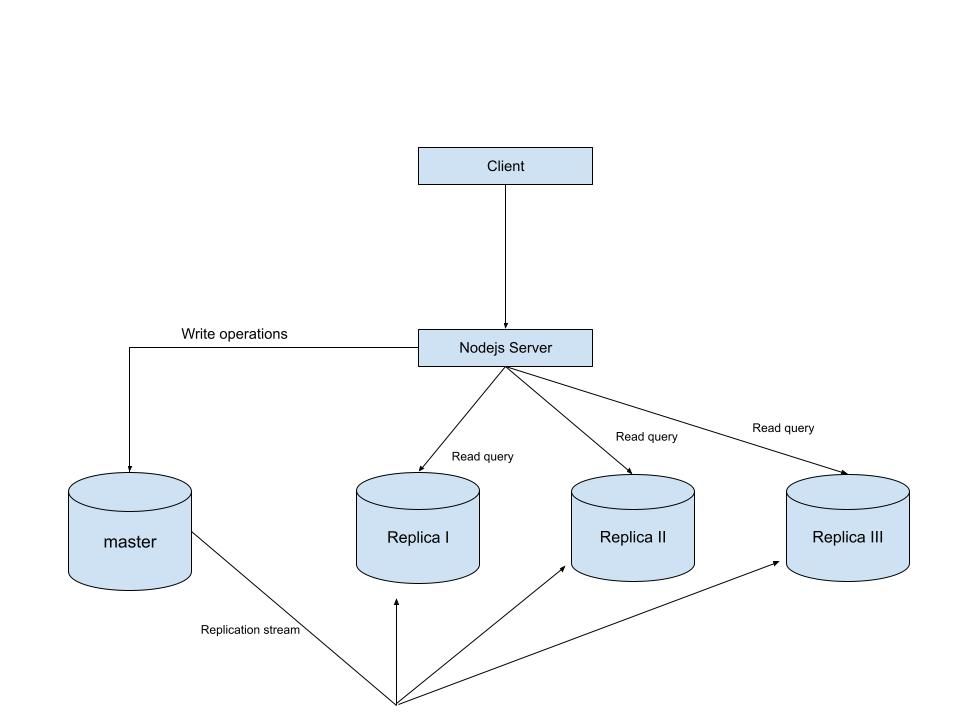
Modern applications demand high availability and the ability to scale reads without compromising performance. One of the most common strategies to achieve this is Replication. In this setup, we configured a single database to act as the leader (master) and handle all write operations, while three replicas handle read operations. In this article, we’ll walk through how to set up MySQL single-leader replication on your local machine using Docker. Once the replication is working, we’ll connect it to a Node.js application using Sequelize ORM, so that reads are routed to the replica and writes go to the master. By the end, you’ll have a working environment where you can see replication in real time Prerequisites knowledge of database replication Background knowledge of docker and docker compose Background knowledge of Nodejs and how to run a NodeJS server An Overview of what we are building Setup Setup our database servers on docker compose in the root of our project directory, create a file named docker-compose.yml with the following content to setup our mysql primary and replica databases. \ \ name: "learn-replica" volumes: mysqlMasterDatabase: mysqlSlaveDatabase: mysqlSlaveDatabaseII: mysqlSlaveDatabaseIII: networks: mysql-replication-network: services: mysql-master: image: mysql:latest container_name: mysql-master command: --server-id=1 --log-bin=ON environment: MYSQL_ROOT_PASSWORD: master MYSQL_DATABASE: replicaDb ports: - "3306:3306" volumes: - mysqlMasterDatabase:/var/lib/mysql networks: - mysql-replication-network mysql-slave: image: mysql:latest container_name: mysql-slave command: --server-id=2 --log-bin=ON environment: MYSQL_ROOT_PASSWORD: slave MYSQL_DATABASE: replicaDb MYSQL_ROOT_HOST: "%" ports: - "3307:3306" volumes: - mysqlSlaveDatabase:/var/lib/mysql depends_on: - mysql-master networks: - mysql-replication-network mysql-slaveII: image: mysql:latest container_name: mysql-slaveII command: --server-id=2 --log-bin=ON environment: MYSQL_ROOT_PASSWORD: slave MYSQL_DATABASE: replicaDb MYSQL_ROOT_HOST: "%" ports: - "3308:3306" volumes: - mysqlSlaveDatabaseII:/var/lib/mysql depends_on: - mysql-master networks: - mysql-replication-network mysql-slaveIII: image: mysql:latest container_name: mysql-slaveIII command: --server-id=3 --log-bin=ON environment: MYSQL_ROOT_PASSWORD: slave MYSQL_DATABASE: replicaDb MYSQL_ROOT_HOST: "%" ports: - "3309:3306" volumes: - mysqlSlaveDatabaseIII:/var/lib/mysql depends_on: - mysql-master networks: - mysql-replication-network In this setup, I’m creating a master database container called mysql-master and 3 replica containers called mysql-slave, mysql-slaveII and mysql-slaveIII. I won’t go too deep into the docker-compose.yml file since it’s just a basic setup, but I do want to walk you through the command line instructions used in all four services because that’s where things get interesting.
command: --server-id=1 --log-bin=ON The --server-id option gives each MySQL server in your replication setup its own name tag. Each one has to be unique and without it, replication won’t work at all. Another cool option not included here is binlog_format=ROW. This tells MySQL how to keep track of changes before passing them along to the replicas. By default, MySQL already uses row-based replication, but you can explicitly set it to ROW to be sure or switch it to STATEMENT if you’d rather log the actual SQL statements instead of row-by-row changes. \ Run our containers on docker Now, in the terminal, we can run the following command to spin up our database containers: docker-compose up -d \ Setting Up Our Master (Primary) Server To configure our master server, we would have to first access the running instance on docker using the following command docker exec -it mysql-master bash This command opens an interactive Bash shell inside the running Docker container named mysql-master, allowing us to run commands directly inside that container. \ Now that we’re inside the container, we can access the MySQL server and start running commands. type: mysql -uroot -p This will log you into MySQL as the root user. You’ll be prompted to enter the password you set in your docker-compose.yml file. \ Next, we need to create a special user that our replicas will use to connect to the master server and pull data. Inside the MySQL prompt, run the following commands: \ CREATE USER 'repl_user'@'%' IDENTIFIED BY 'replication_pass'; GRANT REPLICATION SLAVE ON . TO 'repl_user'@'%'; FLUSH PRIVILEGES; Here’s what’s happening: CREATE USER makes a new MySQL user called repl_user with the password replication_pass. GRANT REPLICATION SLAVE gives this user permission to act as a replication client. FLUSH PRIVILEGES tells MySQL to reload the user permissions so they take effect immediately. \ Time to Configure the Replica (Secondary) Servers a. First, let’s access the replica containers the same way we did with the master. Run this command in your terminal for each of the replica containers: \ docker exec -it <replica_container_name> bash mysql -uroot -p <replica_container_name> should be replace with the name of the replica container you are trying to setup b. Now it’s time to tell our replica where to get its data from. While inside the replica’s MySQL shell, run the following command to configure replication using the master’s details: CHANGE REPLICATION SOURCE TO SOURCE_HOST='mysql-master', SOURCE_USER='repl_user', SOURCE_PASSWORD='replication_pass', GET_SOURCE_PUBLIC_KEY=1; With the replication settings in place, let’s fire up the replica and get it syncing with the master. Still inside the MySQL shell on the replica, run: START REPLICA; This starts the replication process. To make sure everything is working, check the replica’s status with:
SHOW REPLICA STATUS\G; Look for Replica_IO_Running and Replica_SQL_Running — if both say Yes, congratulations! 🎉 Your replica is now successfully connected to the master and replicating data in real time.
Testing Our Replication Setup from the Node.js App Now that our replication is successfully set up, we can configure our Node.js server to observe the real-time effect of data being replicated from the master server to the replica server whenever we write to it. We start by installing the following dependencies:
npm i express mysql2 sequelize \ Now create a folder called src in the root directory and add the following files inside that folder connection.js, index.js and model.js. Our current directory should look like this We can now set up our connections to our master and replica server in the connection.js file as shown below
const Sequelize = require("sequelize"); const sequelize = new Sequelize({ dialect: "mysql", replication: { write: { host: "127.0.0.1", username: "root", password: "master", database: "replicaDb", }, read: [ { host: "127.0.0.1", username: "root", password: "slave", database: "replicaDb", port: 3307 }, { host: "127.0.0.1", username: "root", password: "slave", database: "replicaDb", port: 3308 }, { host: "127.0.0.1", username: "root", password: "slave", database: "replicaDb", port: 3309 }, ], }, }); async function connectdb() { try { await sequelize.authenticate(); } catch (error) { console.error("❌ unable to connect to the follower database", error); } } connectdb(); module.exports = { sequelize, }; \ We can now create a User table in the model.js file
const {DataTypes} = require("sequelize"); const { sequelize } = require("./connection"); const User = sequelize.define("User", { name: { type: DataTypes.STRING, allowNull: false, }, email: { type: DataTypes.STRING, unique: true, allowNull: false, }, }); module.exports = User \ and finally in our index.js file we can start our server and listen for connections on port 3000. from the code sample below, all inserts or updates will be routed by sequelize to the master server. while all read queries will be routed to the read replicas.
const express = require("express"); const { sequelize } = require("./connection"); const User = require("./model"); const app = express(); app.use(express.json()); async function main() { await sequelize.sync({ alter: true }); app.get("/", (req, res) => { res.status(200).json({ message: "first step to setting server up", }); }); app.post("/user", async (req, res) => { const { email, name } = req.body; let newUser = await User.build({ name, email, }); // This INSERT will go to the write (master) connection newUser = newUser.save({ returning: false }); res.status(201).json({ message: "User successfully created", }); }); app.get("/user", async (req, res) => { // This SELECT query will go to one of the read replicas const users = await User.findAll(); res.status(200).json(users); }); app.listen(3000, () => { console.log("server has connected"); }); } main(); When you make a POST request to the /users endpoint, take a moment to check both the master and replica servers to observe how data is replicated in real time. Right now, we are relying on Sequelize to automatically route requests, which works for development but isn’t robust enough for a production environment. In particular, if the master node goes down, Sequelize cannot automatically redirect requests to a newly elected leader. In the next part of this series, we’ll explore strategies to handle these challenges
Share
Hackernoon2025/09/18 14:44
Robinhood: Investors Are Looking Beyond BTC

Robinhood: Investors Are Looking Beyond BTC

The post Robinhood: Investors Are Looking Beyond BTC appeared on BitcoinEthereumNews.com. Investors Diversifying Beyond BTC and ETH Robinhood’s crypto division
Share
BitcoinEthereumNews2026/02/24 08:32