The post World Liberty Markets Goes Live as USD1 Enters DeFi Lending With $3B Supply and Dolomite Liquidity appeared on BitcoinEthereumNews.com. Key Takeaways: The post World Liberty Markets Goes Live as USD1 Enters DeFi Lending With $3B Supply and Dolomite Liquidity appeared on BitcoinEthereumNews.com. Key Takeaways:

World Liberty Markets Goes Live as USD1 Enters DeFi Lending With $3B Supply and Dolomite Liquidity

Key Takeaways:

  • World Liberty Financial has launched World Liberty Markets, a live web app enabling lending and borrowing for its USD1 stablecoin.
  • The platform runs on Dolomite’s liquidity infrastructure, supporting USD1 alongside WLFI, ETH, cbBTC, USDC, and USDT.
  • USD1’s circulating supply has surpassed $3 billion, and the launch expands its utility beyond trading into onchain credit and yield.

World Liberty Financial has switched on its first web-based product, World Liberty Markets, bringing lending and borrowing functionality to USD1 and signaling a shift from distribution to active onchain use. The rollout positions USD1 inside DeFi credit markets from day one, with plans to broaden products and integrations over time.

Read More: World Liberty Financial Nets Trump Family Crypto Billions

World Liberty Markets Opens USD1 to Onchain Credit

World Liberty Markets is now live, giving users a single interface to supply assets for yield or borrow against their portfolios. The platform is powered by Dolomite, a DeFi protocol known for flexible, high-performance liquidity markets.

At launch, users can supply USD1 to earn returns or unlock borrowing by posting supported collateral. Those collateral options include the WLFI governance token, ether (ETH), Coinbase-wrapped bitcoin (cbBTC), and major stablecoins USDC and USDT. The setup places USD1 directly alongside established assets rather than isolating it in a closed ecosystem.

This matters because stablecoins often reach scale before they gain deep utility. USD1 has already crossed $3 billion in circulating supply, but World Liberty Markets marks the first time holders can systematically deploy it for yield or credit within the WLFI ecosystem.

According to World Liberty Financial, the goal is speed and simplicity. Markets are designed to work immediately, without complex configuration, allowing users to make their USD1 productive as soon as they connect.

Read More: WLFI Mints $100M USD1 Stablecoin on Solana Ahead of Major DeFi Push

Built on Dolomite, Designed for Expansion

The decision to build on Dolomite gives World Liberty Markets access to an existing lending framework optimized for fast execution and flexible risk parameters. Rather than reinventing DeFi credit, WLFI is plugging USD1 into infrastructure that already supports multi-asset lending at scale.

A Unified Interface for WLFI Products

World Liberty Markets is intended to become the central hub for WLFI’s growing product suite. While today’s focus is lending and borrowing, the roadmap points toward a broader financial stack.

The platform is expected to expand in several directions:

  • Support for additional collateral and tokenized assets as they launch
  • Access to WLFI-branded and third-party real-world asset (RWA) products
  • Deeper integration of USD1 across partner apps and networks

As USD1 appears in more external protocols, World Liberty Markets is positioned as the place where those opportunities converge. Instead of fragmenting liquidity across interfaces, WLFI aims to keep discovery and usage centralized.

USD1 Moves From Circulation to Utility

USD1’s growth has been rapid. The dollar-backed stablecoin recently exceeded $3 billion in supply and has seen rising trading activity across major exchanges. Until now, much of that activity centered on transfers and trading pairs.

World Liberty Markets reframes that growth as a starting point rather than a finish line. By embedding USD1 into lending markets, WLFI is testing whether the stablecoin can hold demand when users are asked to commit capital rather than simply move it.

Company leadership has been explicit about this shift. The launch is presented as a shift towards implementation of the concept, and USD1 is likely to seek attention in the more challenging onchain credit space.

Initial adoption will probably be limited as liquidity accumulates, but the form is the reflection of how other leading stablecoins gained momentum, first dissemination, then functionality, and then increased integration in DeFi.

Governance and Community Control Built In

Another characteristic of World Liberty Markets is the place given to the holders of WLFI tokens. Governance is not an ex-post facto. As the platform is going to evolve, token holders can suggest and vote on new collateral assets, incentive models, and market parameters.

This provides the community with power on the development of USD1 and other related markets. The higher the liquidity, the more consequential such decisions will be, defining the risk profiles and yield opportunities.

The governance model also fits within the larger positioning of WLFI as a DeFi native platform as opposed to a fixed product. Typically, markets will evolve due to patterns of usage and entry of new assets into the ecosystem.

World Liberty Markets is launched using USD1 Points Program. Users that provide USD1 are potentially able to receive a point, depending on the terms and conditions of each launch partner.

SUBSCRIBE TO OUR NEWSLETTER

The latest news, articles, and resources, sent to your inbox weekly. [convertkit form=7791140]

Source: https://www.cryptoninjas.net/news/world-liberty-markets-goes-live-as-usd1-enters-defi-lending-with-3b-supply-and-dolomite-liquidity/

Market Opportunity
USD1 Logo
USD1 Price(USD1)
$0.9992
$0.9992$0.9992
+0.03%
USD
USD1 (USD1) Live Price Chart
Disclaimer: The articles reposted on this site are sourced from public platforms and are provided for informational purposes only. They do not necessarily reflect the views of MEXC. All rights remain with the original authors. If you believe any content infringes on third-party rights, please contact [email protected] for removal. MEXC makes no guarantees regarding the accuracy, completeness, or timeliness of the content and is not responsible for any actions taken based on the information provided. The content does not constitute financial, legal, or other professional advice, nor should it be considered a recommendation or endorsement by MEXC.

You May Also Like

The Stunning ASEAN Winner Emerges As Manufacturing Shifts Accelerate

The Stunning ASEAN Winner Emerges As Manufacturing Shifts Accelerate

The post The Stunning ASEAN Winner Emerges As Manufacturing Shifts Accelerate appeared on BitcoinEthereumNews.com. Vietnam US Tariffs: The Stunning ASEAN Winner
Share
BitcoinEthereumNews2026/02/24 08:20
MySQL Single Leader Replication with Node.js and Docker

MySQL Single Leader Replication with Node.js and Docker

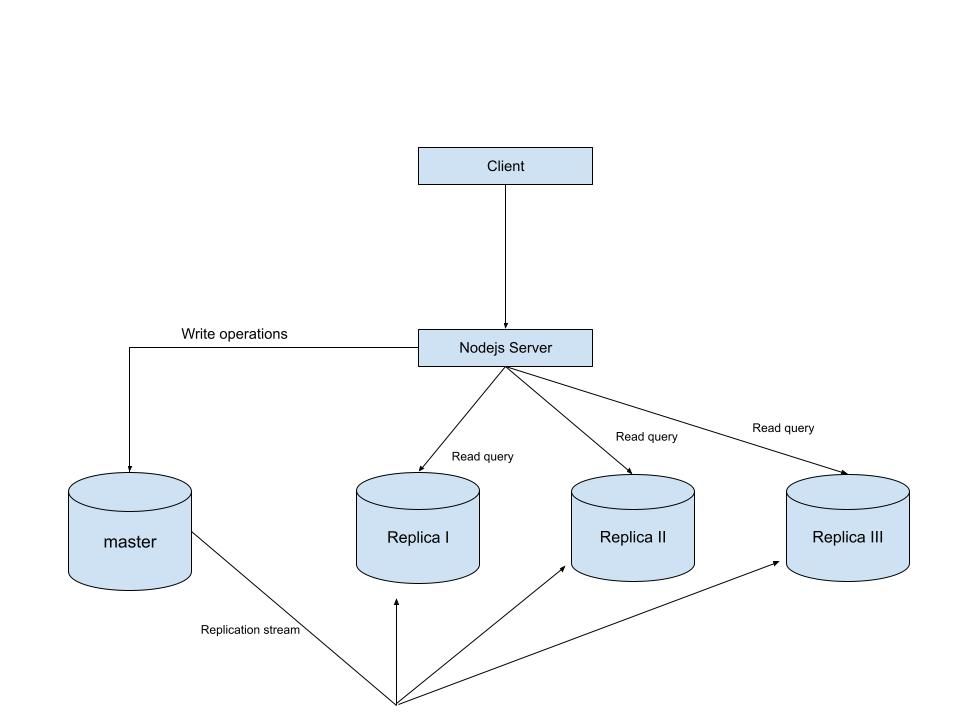
Modern applications demand high availability and the ability to scale reads without compromising performance. One of the most common strategies to achieve this is Replication. In this setup, we configured a single database to act as the leader (master) and handle all write operations, while three replicas handle read operations. In this article, we’ll walk through how to set up MySQL single-leader replication on your local machine using Docker. Once the replication is working, we’ll connect it to a Node.js application using Sequelize ORM, so that reads are routed to the replica and writes go to the master. By the end, you’ll have a working environment where you can see replication in real time Prerequisites knowledge of database replication Background knowledge of docker and docker compose Background knowledge of Nodejs and how to run a NodeJS server An Overview of what we are building Setup Setup our database servers on docker compose in the root of our project directory, create a file named docker-compose.yml with the following content to setup our mysql primary and replica databases. \ \ name: "learn-replica" volumes: mysqlMasterDatabase: mysqlSlaveDatabase: mysqlSlaveDatabaseII: mysqlSlaveDatabaseIII: networks: mysql-replication-network: services: mysql-master: image: mysql:latest container_name: mysql-master command: --server-id=1 --log-bin=ON environment: MYSQL_ROOT_PASSWORD: master MYSQL_DATABASE: replicaDb ports: - "3306:3306" volumes: - mysqlMasterDatabase:/var/lib/mysql networks: - mysql-replication-network mysql-slave: image: mysql:latest container_name: mysql-slave command: --server-id=2 --log-bin=ON environment: MYSQL_ROOT_PASSWORD: slave MYSQL_DATABASE: replicaDb MYSQL_ROOT_HOST: "%" ports: - "3307:3306" volumes: - mysqlSlaveDatabase:/var/lib/mysql depends_on: - mysql-master networks: - mysql-replication-network mysql-slaveII: image: mysql:latest container_name: mysql-slaveII command: --server-id=2 --log-bin=ON environment: MYSQL_ROOT_PASSWORD: slave MYSQL_DATABASE: replicaDb MYSQL_ROOT_HOST: "%" ports: - "3308:3306" volumes: - mysqlSlaveDatabaseII:/var/lib/mysql depends_on: - mysql-master networks: - mysql-replication-network mysql-slaveIII: image: mysql:latest container_name: mysql-slaveIII command: --server-id=3 --log-bin=ON environment: MYSQL_ROOT_PASSWORD: slave MYSQL_DATABASE: replicaDb MYSQL_ROOT_HOST: "%" ports: - "3309:3306" volumes: - mysqlSlaveDatabaseIII:/var/lib/mysql depends_on: - mysql-master networks: - mysql-replication-network In this setup, I’m creating a master database container called mysql-master and 3 replica containers called mysql-slave, mysql-slaveII and mysql-slaveIII. I won’t go too deep into the docker-compose.yml file since it’s just a basic setup, but I do want to walk you through the command line instructions used in all four services because that’s where things get interesting.
command: --server-id=1 --log-bin=ON The --server-id option gives each MySQL server in your replication setup its own name tag. Each one has to be unique and without it, replication won’t work at all. Another cool option not included here is binlog_format=ROW. This tells MySQL how to keep track of changes before passing them along to the replicas. By default, MySQL already uses row-based replication, but you can explicitly set it to ROW to be sure or switch it to STATEMENT if you’d rather log the actual SQL statements instead of row-by-row changes. \ Run our containers on docker Now, in the terminal, we can run the following command to spin up our database containers: docker-compose up -d \ Setting Up Our Master (Primary) Server To configure our master server, we would have to first access the running instance on docker using the following command docker exec -it mysql-master bash This command opens an interactive Bash shell inside the running Docker container named mysql-master, allowing us to run commands directly inside that container. \ Now that we’re inside the container, we can access the MySQL server and start running commands. type: mysql -uroot -p This will log you into MySQL as the root user. You’ll be prompted to enter the password you set in your docker-compose.yml file. \ Next, we need to create a special user that our replicas will use to connect to the master server and pull data. Inside the MySQL prompt, run the following commands: \ CREATE USER 'repl_user'@'%' IDENTIFIED BY 'replication_pass'; GRANT REPLICATION SLAVE ON . TO 'repl_user'@'%'; FLUSH PRIVILEGES; Here’s what’s happening: CREATE USER makes a new MySQL user called repl_user with the password replication_pass. GRANT REPLICATION SLAVE gives this user permission to act as a replication client. FLUSH PRIVILEGES tells MySQL to reload the user permissions so they take effect immediately. \ Time to Configure the Replica (Secondary) Servers a. First, let’s access the replica containers the same way we did with the master. Run this command in your terminal for each of the replica containers: \ docker exec -it <replica_container_name> bash mysql -uroot -p <replica_container_name> should be replace with the name of the replica container you are trying to setup b. Now it’s time to tell our replica where to get its data from. While inside the replica’s MySQL shell, run the following command to configure replication using the master’s details: CHANGE REPLICATION SOURCE TO SOURCE_HOST='mysql-master', SOURCE_USER='repl_user', SOURCE_PASSWORD='replication_pass', GET_SOURCE_PUBLIC_KEY=1; With the replication settings in place, let’s fire up the replica and get it syncing with the master. Still inside the MySQL shell on the replica, run: START REPLICA; This starts the replication process. To make sure everything is working, check the replica’s status with:
SHOW REPLICA STATUS\G; Look for Replica_IO_Running and Replica_SQL_Running — if both say Yes, congratulations! 🎉 Your replica is now successfully connected to the master and replicating data in real time.
Testing Our Replication Setup from the Node.js App Now that our replication is successfully set up, we can configure our Node.js server to observe the real-time effect of data being replicated from the master server to the replica server whenever we write to it. We start by installing the following dependencies:
npm i express mysql2 sequelize \ Now create a folder called src in the root directory and add the following files inside that folder connection.js, index.js and model.js. Our current directory should look like this We can now set up our connections to our master and replica server in the connection.js file as shown below
const Sequelize = require("sequelize"); const sequelize = new Sequelize({ dialect: "mysql", replication: { write: { host: "127.0.0.1", username: "root", password: "master", database: "replicaDb", }, read: [ { host: "127.0.0.1", username: "root", password: "slave", database: "replicaDb", port: 3307 }, { host: "127.0.0.1", username: "root", password: "slave", database: "replicaDb", port: 3308 }, { host: "127.0.0.1", username: "root", password: "slave", database: "replicaDb", port: 3309 }, ], }, }); async function connectdb() { try { await sequelize.authenticate(); } catch (error) { console.error("❌ unable to connect to the follower database", error); } } connectdb(); module.exports = { sequelize, }; \ We can now create a User table in the model.js file
const {DataTypes} = require("sequelize"); const { sequelize } = require("./connection"); const User = sequelize.define("User", { name: { type: DataTypes.STRING, allowNull: false, }, email: { type: DataTypes.STRING, unique: true, allowNull: false, }, }); module.exports = User \ and finally in our index.js file we can start our server and listen for connections on port 3000. from the code sample below, all inserts or updates will be routed by sequelize to the master server. while all read queries will be routed to the read replicas.
const express = require("express"); const { sequelize } = require("./connection"); const User = require("./model"); const app = express(); app.use(express.json()); async function main() { await sequelize.sync({ alter: true }); app.get("/", (req, res) => { res.status(200).json({ message: "first step to setting server up", }); }); app.post("/user", async (req, res) => { const { email, name } = req.body; let newUser = await User.build({ name, email, }); // This INSERT will go to the write (master) connection newUser = newUser.save({ returning: false }); res.status(201).json({ message: "User successfully created", }); }); app.get("/user", async (req, res) => { // This SELECT query will go to one of the read replicas const users = await User.findAll(); res.status(200).json(users); }); app.listen(3000, () => { console.log("server has connected"); }); } main(); When you make a POST request to the /users endpoint, take a moment to check both the master and replica servers to observe how data is replicated in real time. Right now, we are relying on Sequelize to automatically route requests, which works for development but isn’t robust enough for a production environment. In particular, if the master node goes down, Sequelize cannot automatically redirect requests to a newly elected leader. In the next part of this series, we’ll explore strategies to handle these challenges
Share
Hackernoon2025/09/18 14:44
Robinhood: Investors Are Looking Beyond BTC

Robinhood: Investors Are Looking Beyond BTC

The post Robinhood: Investors Are Looking Beyond BTC appeared on BitcoinEthereumNews.com. Investors Diversifying Beyond BTC and ETH Robinhood’s crypto division
Share
BitcoinEthereumNews2026/02/24 08:32