

Best Crypto to Buy With $500 Right Now? Investors Favour a New Crypto Under $0.1

The post Best Crypto to Buy With $500 Right Now? Investors Favour a New Crypto Under $0.1 appeared first on Coinpedia Fintech News
Many major crypto winners do not begin their runs with headlines. They begin with quiet accumulation and product development. Only later, when participation and roadmap signals line up, does the wider market notice. Several analysts argue that this shift may be happening now with a new DeFi crypto trading under $0.10. The token has spent most of early 2025 and 2026 outside of mainstream attention, but that window appears to be closing as visibility increases fast.
What Mutuum Finance Has Been Building
The project in focus is Mutuum Finance (MUTM). Mutuum Finance is creating a lending and borrowing protocol. The architecture allows users to lend assets into shared liquidity and earn yield, or borrow against collateral using structured interest models. These mechanics are designed for real usage rather than speculation.
The system will operate across two credit environments. One handles pooled liquidity for passive lenders. The other supports matched borrowing with collateral terms and loan types. Interest logic, collateral rules, and liquidation triggers allow the protocol to manage risk without intermediaries.
The main turning point for visibility is the upcoming V1 protocol activation, which will debut on the Sepolia testnet before mainnet. This is when real borrowing, lending, collateral posting, and repayment flows begin. V1 is also the moment that usage and on-chain metrics become visible to the market. This is the phase where many DeFi protocols shift from narrative to participation.
Growth Details
While the protocol was building, capital and users have been accumulating. Mutuum Finance has raised over $19.7 million and has surpassed 18,800 holders. These figures did not arrive through a sudden spike. They increased steadily as new phases opened and more investors tracked the roadmap.
This pattern is not hype-driven behavior. It suggests accumulation before broader attention. Many tokens that later became top crypto performers moved through similar quiet stages before burst phases began.
Token structure is now becoming a key talking point. Mutuum Finance sells at $0.04 in its current presale pricing stage. Phase-based pricing has pushed MUTM up 300% from early 2025 levels. The confirmed launch price sits at $0.06, positioning early holders for 500% upside at listing. The next pricing stage is set nearly 20% higher. Once a phase sells out, no more tokens become available at that price.
Supply tightening has started to influence behavior. Traders who normally wait until launch cycles are now tracking allocations more closely because remaining token supply decreases as mainnet approaches. This shift in attention is common when infrastructure and timing begin to converge.
System-Level Demand and Security
Mutuum Finance is also building internal engines that create demand at the system level rather than relying on attention cycles. One engine is mtTokens, which represent deposit positions inside liquidity pools. When borrowers draw credit, interest flows toward mtToken holders as yield. This ties token usage to financial outcomes and creates natural holding behaviour.
Another engine is the buy-and-distribute model. A portion of protocol revenue is used to purchase MUTM on the market and redistribute it to stakers. This creates buy pressure backed by platform usage instead of speculative headlines.
Before users borrow and lend real assets, security must be checked. Mutuum Finance has completed a Halborn smart contract audit, received a 90/100 Token Scan score from CertiK, and opened a $50,000 bug bounty to surface vulnerabilities before V1 deployment.
Several price outlook models point to a scenario where MUTM could trade 5x higher from current presale pricing once borrowing and yield incentives activate on-chain. They argue that revenue-linked demand tends to compound over time, especially when token buying is tied to platform usage rather than trending headlines.
Why This Moment Is Different From Earlier Stages
The current phase is nearing completion. Allocation is thinning and whale participation has begun, including a recent six-figure allocation. These signals tend to appear when conviction shifts from speculation to product readiness.
Mutuum Finance has also opened card payment access and added a 24-hour leaderboard that rewards the top contributor with $500 in MUTM daily. These elements help onboard new users and support continuous participation.
With V1 approaching in Q1 2026, and pricing still under $0.10, the visibility phase has begun. Quiet accumulation is now shifting into open rotation, positioning Mutuum Finance as one of the most tracked new crypto assets for investors allocating fresh capital.
For more information about Mutuum Finance (MUTM) visit the links below:
Website:https://www.mutuum.com
Linktree:https://linktr.ee/mutuumfinance
You May Also Like

The Stunning ASEAN Winner Emerges As Manufacturing Shifts Accelerate
MySQL Single Leader Replication with Node.js and Docker
command: --server-id=1 --log-bin=ON The --server-id option gives each MySQL server in your replication setup its own name tag. Each one has to be unique and without it, replication won’t work at all. Another cool option not included here is binlog_format=ROW. This tells MySQL how to keep track of changes before passing them along to the replicas. By default, MySQL already uses row-based replication, but you can explicitly set it to ROW to be sure or switch it to STATEMENT if you’d rather log the actual SQL statements instead of row-by-row changes. \ Run our containers on docker Now, in the terminal, we can run the following command to spin up our database containers: docker-compose up -d \ Setting Up Our Master (Primary) Server To configure our master server, we would have to first access the running instance on docker using the following command docker exec -it mysql-master bash This command opens an interactive Bash shell inside the running Docker container named mysql-master, allowing us to run commands directly inside that container. \ Now that we’re inside the container, we can access the MySQL server and start running commands. type: mysql -uroot -p This will log you into MySQL as the root user. You’ll be prompted to enter the password you set in your docker-compose.yml file. \ Next, we need to create a special user that our replicas will use to connect to the master server and pull data. Inside the MySQL prompt, run the following commands: \ CREATE USER 'repl_user'@'%' IDENTIFIED BY 'replication_pass'; GRANT REPLICATION SLAVE ON . TO 'repl_user'@'%'; FLUSH PRIVILEGES; Here’s what’s happening: CREATE USER makes a new MySQL user called repl_user with the password replication_pass. GRANT REPLICATION SLAVE gives this user permission to act as a replication client. FLUSH PRIVILEGES tells MySQL to reload the user permissions so they take effect immediately. \ Time to Configure the Replica (Secondary) Servers a. First, let’s access the replica containers the same way we did with the master. Run this command in your terminal for each of the replica containers: \ docker exec -it <replica_container_name> bash mysql -uroot -p <replica_container_name> should be replace with the name of the replica container you are trying to setup b. Now it’s time to tell our replica where to get its data from. While inside the replica’s MySQL shell, run the following command to configure replication using the master’s details: CHANGE REPLICATION SOURCE TO SOURCE_HOST='mysql-master', SOURCE_USER='repl_user', SOURCE_PASSWORD='replication_pass', GET_SOURCE_PUBLIC_KEY=1; With the replication settings in place, let’s fire up the replica and get it syncing with the master. Still inside the MySQL shell on the replica, run: START REPLICA; This starts the replication process. To make sure everything is working, check the replica’s status with:
SHOW REPLICA STATUS\G; Look for Replica_IO_Running and Replica_SQL_Running — if both say Yes, congratulations! 🎉 Your replica is now successfully connected to the master and replicating data in real time.
Testing Our Replication Setup from the Node.js App Now that our replication is successfully set up, we can configure our Node.js server to observe the real-time effect of data being replicated from the master server to the replica server whenever we write to it. We start by installing the following dependencies:
npm i express mysql2 sequelize \ Now create a folder called src in the root directory and add the following files inside that folder connection.js, index.js and model.js. Our current directory should look like this We can now set up our connections to our master and replica server in the connection.js file as shown below
const Sequelize = require("sequelize"); const sequelize = new Sequelize({ dialect: "mysql", replication: { write: { host: "127.0.0.1", username: "root", password: "master", database: "replicaDb", }, read: [ { host: "127.0.0.1", username: "root", password: "slave", database: "replicaDb", port: 3307 }, { host: "127.0.0.1", username: "root", password: "slave", database: "replicaDb", port: 3308 }, { host: "127.0.0.1", username: "root", password: "slave", database: "replicaDb", port: 3309 }, ], }, }); async function connectdb() { try { await sequelize.authenticate(); } catch (error) { console.error("❌ unable to connect to the follower database", error); } } connectdb(); module.exports = { sequelize, }; \ We can now create a User table in the model.js file
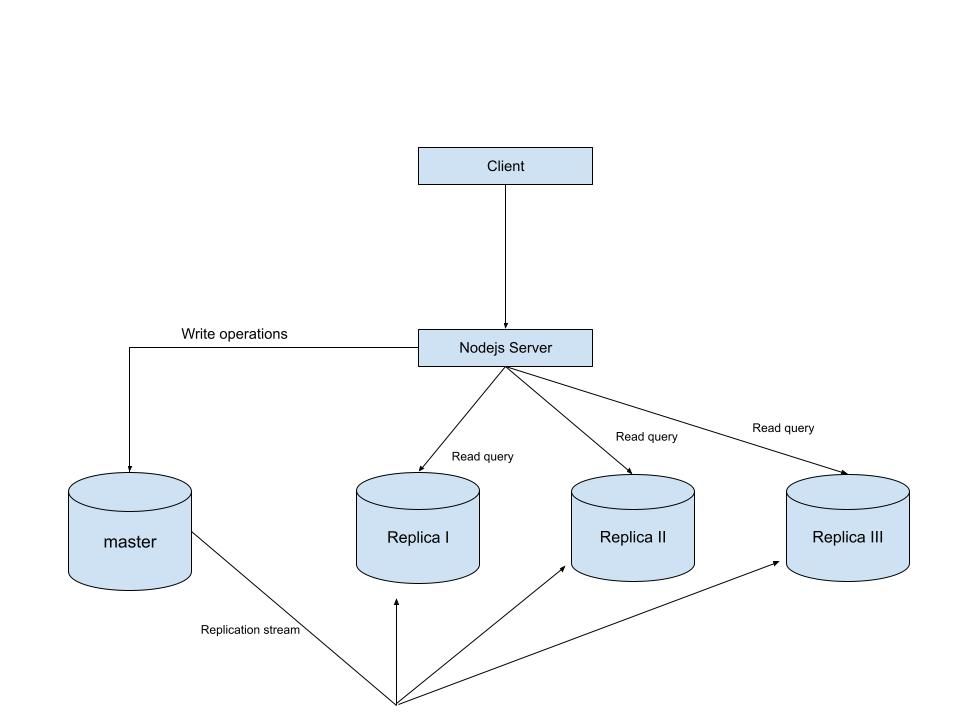
const {DataTypes} = require("sequelize"); const { sequelize } = require("./connection"); const User = sequelize.define("User", { name: { type: DataTypes.STRING, allowNull: false, }, email: { type: DataTypes.STRING, unique: true, allowNull: false, }, }); module.exports = User \ and finally in our index.js file we can start our server and listen for connections on port 3000. from the code sample below, all inserts or updates will be routed by sequelize to the master server. while all read queries will be routed to the read replicas.
const express = require("express"); const { sequelize } = require("./connection"); const User = require("./model"); const app = express(); app.use(express.json()); async function main() { await sequelize.sync({ alter: true }); app.get("/", (req, res) => { res.status(200).json({ message: "first step to setting server up", }); }); app.post("/user", async (req, res) => { const { email, name } = req.body; let newUser = await User.build({ name, email, }); // This INSERT will go to the write (master) connection newUser = newUser.save({ returning: false }); res.status(201).json({ message: "User successfully created", }); }); app.get("/user", async (req, res) => { // This SELECT query will go to one of the read replicas const users = await User.findAll(); res.status(200).json(users); }); app.listen(3000, () => { console.log("server has connected"); }); } main(); When you make a POST request to the /users endpoint, take a moment to check both the master and replica servers to observe how data is replicated in real time. Right now, we are relying on Sequelize to automatically route requests, which works for development but isn’t robust enough for a production environment. In particular, if the master node goes down, Sequelize cannot automatically redirect requests to a newly elected leader. In the next part of this series, we’ll explore strategies to handle these challenges
