As small businesses head into 2026, optimism is fading, even as resilience remains. According to Credibly’s 2025 Small Business Research Report, fewer than one As small businesses head into 2026, optimism is fading, even as resilience remains. According to Credibly’s 2025 Small Business Research Report, fewer than one

The Small Business Trends and Challenges of 2025: What to Expect in the New Year

2026/01/13 18:54
6 min read

As small businesses head into 2026, optimism is fading, even as resilience remains. According to Credibly’s 2025 Small Business Research Report, fewer than one in four small business owners feel optimistic about the U.S. economy, and revenue growth expectations have dropped sharply year over year. The findings reveal a sector that is adapting quickly, prioritizing stability, and rethinking how it accesses capital amid economic uncertainty and rapid technological change.

The Credibly 2025 Research Report

Credibly is an online lender providing loans and cash advances to small and medium-sized businesses across the United States. Each year, the company conducts a nationwide survey of small business owners to analyze shifting economic conditions, access to capital, and emerging trends shaping the SMB landscape.

Approximately 144 verified business owners were surveyed for CREDIBLY 2025 Research Report. They were questioned about their experiences accessing capital amid the impact of high inflation on financial markets and major shifts in artificial intelligence (AI) innovation. Small business owners detailed their experiences in trying to secure financing for survival and growth amid these changes in financial markets. 

As it turned out, small business owners remained resilient and learned to adapt quickly. Even though they had concerns about supply chain issues and employee retention, nearly 72% of small business owners reported confidence in the health of their businesses.

Optimism Level Over the U.S. and Local Economies

The survey revealed that only 24% of small business owners were optimistic about the U.S. economy, while 41% were not. In 2024, the survey showed that 30% of small business owners had positive outlooks on the U.S. economy, indicating a 6% drop in American economic optimism within a year.

As for the state of the local economy, around 34% of small business owners were optimistic about their local economies at the present moment. These results show that more small business owners feel good about their local economy than the U.S. economy. 

Furthermore, the survey showed that a whopping 68% of small business owners believe the economy greatly influences their financial decisions. If that is true, then only 24% to 34% of small business owners are likely seeking financing to grow or expand their businesses.  

Business Performance and Growth Expectations

Small businesses performed rather well in 2025, despite the poor sentiment about the national U.S. economy. According to the survey, 42% of small business owners reported operating their businesses at a profit, 31% reported breaking even, and 27% reported operating at a loss. 

Unfortunately, small business owners did not have a positive outlook on their revenue and growth expectations for 2026. Only 38% expect revenue growth in the next 12 months. Another 29% believe revenues will be stable, but 24% expect modest declines, and 9% expect significant losses. 

Considering that 70% of small businesses had a positive growth outlook in the 2024 survey, we now have a nearly 32% drop in positive expectations for revenue growth after just one year. This data shows that small business owners are more likely to prioritize financial stability over aggressive business expansion. 

The Shift Toward Digital Financing

Traditionally, small business owners and entrepreneurs would visit their local bank branch to seek a capital loan to fund their startups or grow their businesses. Now, as we enter 2026, it appears that more small business owners are turning to online lenders for loans due to their speed and flexibility. 

The Credibly 2025 survey revealed a significant shift in the sources of capital for small businesses, with 55% of small business owners turning to online lenders for financing, compared to 44% who turned to traditional banks. According to Canopy’s reporting, the digital lending market is expected to reach $20.5 billion in 2026. That is almost double what it was worth five years ago in 2021. 

There is no doubt that the demand for capital among small businesses is high. However, the financing approval process is always the biggest hurdle facing small businesses when applying for different kinds of loans. 

Here is a detailed outline of the percentage of financial products applied for versus how many were approved for small businesses:

  • Short-Term Loan: 45% Applied – 31% Approved
  • Line of Credit: 47% Applied – 13% Approved
  • Long-term Loan: 40% Applied – 8% Approved
  • Credit Card: 33% Applied – 17% Approved
  • Merchant Cash Advance: 22% Applied – 16% Approved
  • Equipment Financing: 17% Applied – 4% Approved

The results show that a stunning 34% of small business owners were not approved for lines of credit after applying. It also showed that 32% of them were denied approval for long-term loans. The vast gap between financing application and approval rates reflects the challenges small businesses face, such as low credit scores, insufficient revenue, and the cost of capital. 

According to 2025 Federal Reserve data, approximately 75% of small businesses say rising costs of goods, services, and/or wages remain their biggest financial challenge. Because of this, it significantly influences the strategic and operational decisions that small business owners make. 

The AI Revolution of the Small Business Sector

It seems like AI is impacting all of modern society, including the small business sector. The Credibly 2025 survey found that many small business owners are implementing AI technologies into their operations. Approximately 36% of small business owners say they currently use AI, while 33% plan to adopt it soon. That means 69.4% of small business owners are either using AI or planning to use it. 

The top three biggest uses of AI for small businesses include Marketing & Advertising (77% of respondents), Customer Service (46% of respondents), and Business Analytics or Reporting (44% of respondents). Since the latest AI tools are user-friendly, people without technical backgrounds can easily use them to run their small businesses. And yet, 29% of survey respondents say their lack of expertise and knowledge in AI is preventing them from implementing it into their businesses. 

Across specific industries, about 72% of professional service firms and 64% of retail businesses have adopted AI. On the lower end, only 38% of food and beverage establishments have adopted AI. These results indicate that relevant AI solutions are more readily available for some industries than others. 

Conclusion

The takeaways from the Credibly 2025 survey for small business owners are clear 1) Be prepared to adapt to uncertainty; 2) save money to cover operating expenses for at least six months in case of emergencies; 3) build a strong financial profile to achieve a good credit score; and 4) stay current on the latest technologies that could help your business.

Comments
Market Opportunity
Union Logo
Union Price(U)
$0.000805
$0.000805$0.000805
+1.13%
USD
Union (U) Live Price Chart
Disclaimer: The articles reposted on this site are sourced from public platforms and are provided for informational purposes only. They do not necessarily reflect the views of MEXC. All rights remain with the original authors. If you believe any content infringes on third-party rights, please contact [email protected] for removal. MEXC makes no guarantees regarding the accuracy, completeness, or timeliness of the content and is not responsible for any actions taken based on the information provided. The content does not constitute financial, legal, or other professional advice, nor should it be considered a recommendation or endorsement by MEXC.

You May Also Like

The Stunning ASEAN Winner Emerges As Manufacturing Shifts Accelerate

The Stunning ASEAN Winner Emerges As Manufacturing Shifts Accelerate

The post The Stunning ASEAN Winner Emerges As Manufacturing Shifts Accelerate appeared on BitcoinEthereumNews.com. Vietnam US Tariffs: The Stunning ASEAN Winner
Share
BitcoinEthereumNews2026/02/24 08:20
MySQL Single Leader Replication with Node.js and Docker

MySQL Single Leader Replication with Node.js and Docker

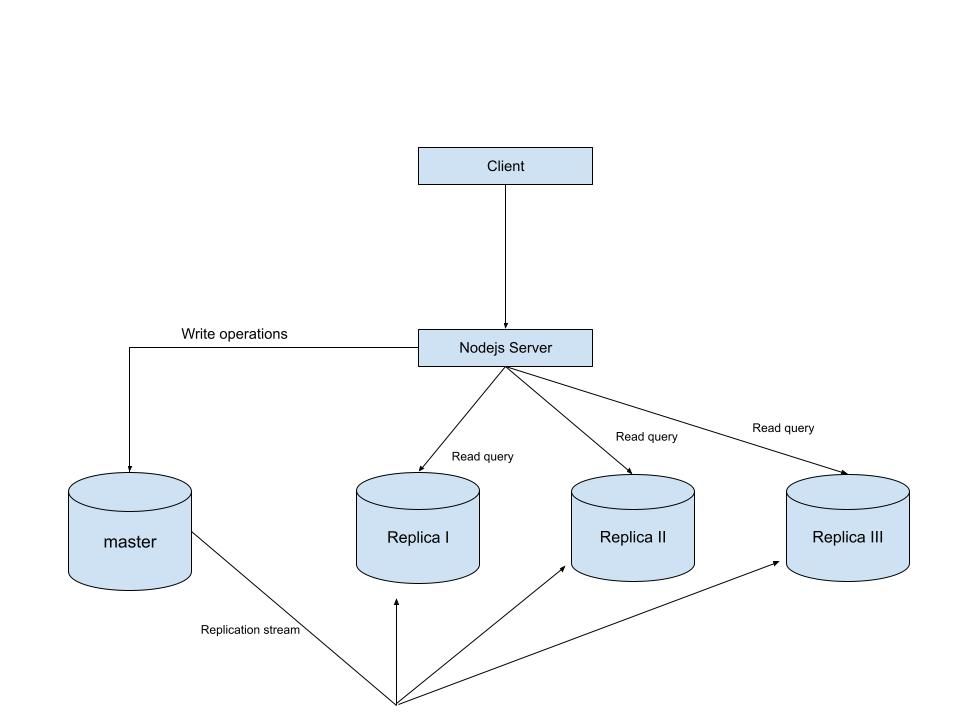
Modern applications demand high availability and the ability to scale reads without compromising performance. One of the most common strategies to achieve this is Replication. In this setup, we configured a single database to act as the leader (master) and handle all write operations, while three replicas handle read operations. In this article, we’ll walk through how to set up MySQL single-leader replication on your local machine using Docker. Once the replication is working, we’ll connect it to a Node.js application using Sequelize ORM, so that reads are routed to the replica and writes go to the master. By the end, you’ll have a working environment where you can see replication in real time Prerequisites knowledge of database replication Background knowledge of docker and docker compose Background knowledge of Nodejs and how to run a NodeJS server An Overview of what we are building Setup Setup our database servers on docker compose in the root of our project directory, create a file named docker-compose.yml with the following content to setup our mysql primary and replica databases. \ \ name: "learn-replica" volumes: mysqlMasterDatabase: mysqlSlaveDatabase: mysqlSlaveDatabaseII: mysqlSlaveDatabaseIII: networks: mysql-replication-network: services: mysql-master: image: mysql:latest container_name: mysql-master command: --server-id=1 --log-bin=ON environment: MYSQL_ROOT_PASSWORD: master MYSQL_DATABASE: replicaDb ports: - "3306:3306" volumes: - mysqlMasterDatabase:/var/lib/mysql networks: - mysql-replication-network mysql-slave: image: mysql:latest container_name: mysql-slave command: --server-id=2 --log-bin=ON environment: MYSQL_ROOT_PASSWORD: slave MYSQL_DATABASE: replicaDb MYSQL_ROOT_HOST: "%" ports: - "3307:3306" volumes: - mysqlSlaveDatabase:/var/lib/mysql depends_on: - mysql-master networks: - mysql-replication-network mysql-slaveII: image: mysql:latest container_name: mysql-slaveII command: --server-id=2 --log-bin=ON environment: MYSQL_ROOT_PASSWORD: slave MYSQL_DATABASE: replicaDb MYSQL_ROOT_HOST: "%" ports: - "3308:3306" volumes: - mysqlSlaveDatabaseII:/var/lib/mysql depends_on: - mysql-master networks: - mysql-replication-network mysql-slaveIII: image: mysql:latest container_name: mysql-slaveIII command: --server-id=3 --log-bin=ON environment: MYSQL_ROOT_PASSWORD: slave MYSQL_DATABASE: replicaDb MYSQL_ROOT_HOST: "%" ports: - "3309:3306" volumes: - mysqlSlaveDatabaseIII:/var/lib/mysql depends_on: - mysql-master networks: - mysql-replication-network In this setup, I’m creating a master database container called mysql-master and 3 replica containers called mysql-slave, mysql-slaveII and mysql-slaveIII. I won’t go too deep into the docker-compose.yml file since it’s just a basic setup, but I do want to walk you through the command line instructions used in all four services because that’s where things get interesting.
command: --server-id=1 --log-bin=ON The --server-id option gives each MySQL server in your replication setup its own name tag. Each one has to be unique and without it, replication won’t work at all. Another cool option not included here is binlog_format=ROW. This tells MySQL how to keep track of changes before passing them along to the replicas. By default, MySQL already uses row-based replication, but you can explicitly set it to ROW to be sure or switch it to STATEMENT if you’d rather log the actual SQL statements instead of row-by-row changes. \ Run our containers on docker Now, in the terminal, we can run the following command to spin up our database containers: docker-compose up -d \ Setting Up Our Master (Primary) Server To configure our master server, we would have to first access the running instance on docker using the following command docker exec -it mysql-master bash This command opens an interactive Bash shell inside the running Docker container named mysql-master, allowing us to run commands directly inside that container. \ Now that we’re inside the container, we can access the MySQL server and start running commands. type: mysql -uroot -p This will log you into MySQL as the root user. You’ll be prompted to enter the password you set in your docker-compose.yml file. \ Next, we need to create a special user that our replicas will use to connect to the master server and pull data. Inside the MySQL prompt, run the following commands: \ CREATE USER 'repl_user'@'%' IDENTIFIED BY 'replication_pass'; GRANT REPLICATION SLAVE ON . TO 'repl_user'@'%'; FLUSH PRIVILEGES; Here’s what’s happening: CREATE USER makes a new MySQL user called repl_user with the password replication_pass. GRANT REPLICATION SLAVE gives this user permission to act as a replication client. FLUSH PRIVILEGES tells MySQL to reload the user permissions so they take effect immediately. \ Time to Configure the Replica (Secondary) Servers a. First, let’s access the replica containers the same way we did with the master. Run this command in your terminal for each of the replica containers: \ docker exec -it <replica_container_name> bash mysql -uroot -p <replica_container_name> should be replace with the name of the replica container you are trying to setup b. Now it’s time to tell our replica where to get its data from. While inside the replica’s MySQL shell, run the following command to configure replication using the master’s details: CHANGE REPLICATION SOURCE TO SOURCE_HOST='mysql-master', SOURCE_USER='repl_user', SOURCE_PASSWORD='replication_pass', GET_SOURCE_PUBLIC_KEY=1; With the replication settings in place, let’s fire up the replica and get it syncing with the master. Still inside the MySQL shell on the replica, run: START REPLICA; This starts the replication process. To make sure everything is working, check the replica’s status with:
SHOW REPLICA STATUS\G; Look for Replica_IO_Running and Replica_SQL_Running — if both say Yes, congratulations! 🎉 Your replica is now successfully connected to the master and replicating data in real time.
Testing Our Replication Setup from the Node.js App Now that our replication is successfully set up, we can configure our Node.js server to observe the real-time effect of data being replicated from the master server to the replica server whenever we write to it. We start by installing the following dependencies:
npm i express mysql2 sequelize \ Now create a folder called src in the root directory and add the following files inside that folder connection.js, index.js and model.js. Our current directory should look like this We can now set up our connections to our master and replica server in the connection.js file as shown below
const Sequelize = require("sequelize"); const sequelize = new Sequelize({ dialect: "mysql", replication: { write: { host: "127.0.0.1", username: "root", password: "master", database: "replicaDb", }, read: [ { host: "127.0.0.1", username: "root", password: "slave", database: "replicaDb", port: 3307 }, { host: "127.0.0.1", username: "root", password: "slave", database: "replicaDb", port: 3308 }, { host: "127.0.0.1", username: "root", password: "slave", database: "replicaDb", port: 3309 }, ], }, }); async function connectdb() { try { await sequelize.authenticate(); } catch (error) { console.error("❌ unable to connect to the follower database", error); } } connectdb(); module.exports = { sequelize, }; \ We can now create a User table in the model.js file
const {DataTypes} = require("sequelize"); const { sequelize } = require("./connection"); const User = sequelize.define("User", { name: { type: DataTypes.STRING, allowNull: false, }, email: { type: DataTypes.STRING, unique: true, allowNull: false, }, }); module.exports = User \ and finally in our index.js file we can start our server and listen for connections on port 3000. from the code sample below, all inserts or updates will be routed by sequelize to the master server. while all read queries will be routed to the read replicas.
const express = require("express"); const { sequelize } = require("./connection"); const User = require("./model"); const app = express(); app.use(express.json()); async function main() { await sequelize.sync({ alter: true }); app.get("/", (req, res) => { res.status(200).json({ message: "first step to setting server up", }); }); app.post("/user", async (req, res) => { const { email, name } = req.body; let newUser = await User.build({ name, email, }); // This INSERT will go to the write (master) connection newUser = newUser.save({ returning: false }); res.status(201).json({ message: "User successfully created", }); }); app.get("/user", async (req, res) => { // This SELECT query will go to one of the read replicas const users = await User.findAll(); res.status(200).json(users); }); app.listen(3000, () => { console.log("server has connected"); }); } main(); When you make a POST request to the /users endpoint, take a moment to check both the master and replica servers to observe how data is replicated in real time. Right now, we are relying on Sequelize to automatically route requests, which works for development but isn’t robust enough for a production environment. In particular, if the master node goes down, Sequelize cannot automatically redirect requests to a newly elected leader. In the next part of this series, we’ll explore strategies to handle these challenges
Share
Hackernoon2025/09/18 14:44
Robinhood: Investors Are Looking Beyond BTC

Robinhood: Investors Are Looking Beyond BTC

The post Robinhood: Investors Are Looking Beyond BTC appeared on BitcoinEthereumNews.com. Investors Diversifying Beyond BTC and ETH Robinhood’s crypto division
Share
BitcoinEthereumNews2026/02/24 08:32