The National Collegiate Athletic Association has asked the US Commodity Futures Trading Commission to immediately suspend college sports prediction markets, warningThe National Collegiate Athletic Association has asked the US Commodity Futures Trading Commission to immediately suspend college sports prediction markets, warning

NCAA Demands CFTC Halt $320M College Sports Betting Markets—Citing Student Safety

3 min read

The National Collegiate Athletic Association has asked the US Commodity Futures Trading Commission to immediately suspend college sports prediction markets, warning that the fast-growing sector is exposing student-athletes to heightened risks and undermining the integrity of college competition.

The request targets an estimated $320 million in active college sports markets, a figure that reflects how quickly prediction platforms have expanded into territory long dominated by regulated sportsbooks.

As Prediction Markets Grow, NCAA Pushes for Safeguards

In a letter dated January 14, 2026, NCAA President Charlie Baker urged CFTC Chairman Michael Selig to halt collegiate sports prediction trading until stronger safeguards are put in place.
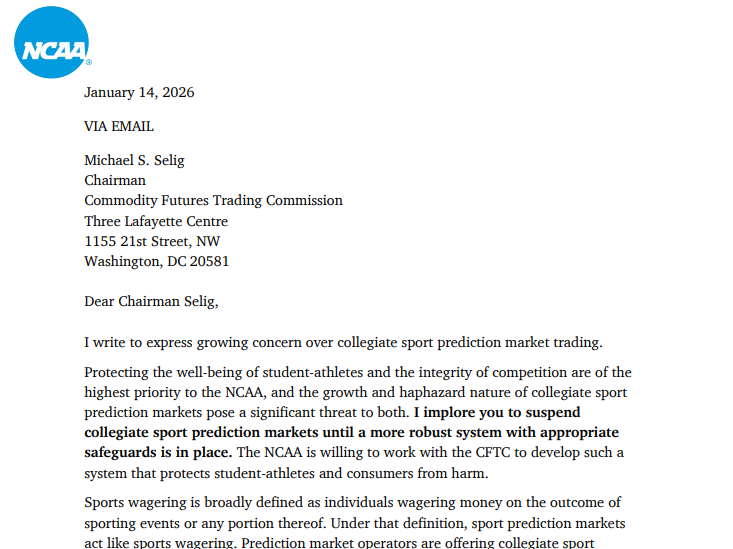
Source: NCAA

Baker argued that although prediction markets are often framed as financial products, many now function in practice like sports wagering.

NCAA noted that platforms are offering moneyline, spread, and total markets on college games that closely mirror traditional betting, while operating under a lighter regulatory framework.

The timing of the letter comes as prediction markets experience explosive growth. Total daily trading volume across major platforms reached a record $701.7 million on January 12, with sports accounting for a growing share of activity.

Source: Dune analysis

Platforms such as Kalshi and Polymarket together processed tens of billions of dollars in trades during 2025, and sports markets now represent roughly three-quarters of Kalshi’s weekly volume and nearly 40% of Polymarket’s.

That scale has drawn institutional interest, but it has also raised alarms among regulators and sports bodies.

At the center of the NCAA’s concern is student safety. Baker warned that college prediction markets often allow participants as young as 18, compared with the 21-and-over requirement in most states for sports betting.

NCAA surveys show that 58 percent of individuals aged 18 to 22 have participated in sports betting, with a significant portion reporting academic, financial, and mental health consequences.

The letter also highlighted gaps in advertising rules. While sportsbooks face restrictions on marketing to college campuses, similar limits do not consistently apply to prediction markets.

The NCAA said some students may mistakenly view prediction trading as a form of investing rather than gambling, despite the inherent unpredictability of sports outcomes.

NCAA Cites Harassment and Integrity Gaps in College Prediction Platforms

That framing, Baker argued, increases the risk of excessive participation and financial harm.

Integrity monitoring was another key issue, as the NCAA monitors more than 23,000 contests annually for suspicious activity and relies on detailed data, including bettor geolocation, to investigate irregularities.

Baker said many prediction platforms lack this level of oversight and are not required to share integrity alerts with other operators or governing bodies.

He pointed to recent efforts by prediction platforms to seek approval for markets tied to the college transfer portal as an example of activity that could create severe risks for athletes if left unchecked.

The NCAA also raised concerns about harassment, as Baker said student-athletes frequently report abuse from bettors, including online harassment tied to game outcomes.

He argued that prediction markets should be required to enforce anti-harassment measures across platforms, including banning participants who target athletes.

Harm reduction resources were also cited as missing, with the NCAA noting that many states direct sportsbook revenue toward gambling education and treatment programs on campuses, a mechanism that prediction markets do not consistently provide.

The request places the CFTC in a difficult position, as prediction markets fall under federal commodities law rather than state gambling statutes, and the agency has previously approved certain sports-related contracts.

However, the rapid growth of college-focused markets and the entry of major sports betting and fantasy operators into the space have intensified scrutiny.

Disclaimer: The articles reposted on this site are sourced from public platforms and are provided for informational purposes only. They do not necessarily reflect the views of MEXC. All rights remain with the original authors. If you believe any content infringes on third-party rights, please contact [email protected] for removal. MEXC makes no guarantees regarding the accuracy, completeness, or timeliness of the content and is not responsible for any actions taken based on the information provided. The content does not constitute financial, legal, or other professional advice, nor should it be considered a recommendation or endorsement by MEXC.

You May Also Like

Three dormant wallets, suspected to belong to the same entity, purchased 5,970 ETH eight hours ago.
Three dormant wallets, suspected to belong to the same entity, purchased 5,970 ETH eight hours ago.

PANews reported on February 4 that, according to Lookonchain monitoring, three wallets that had been dormant for four years (likely controlled by the same entity
Share
PANews2026/02/04 11:36
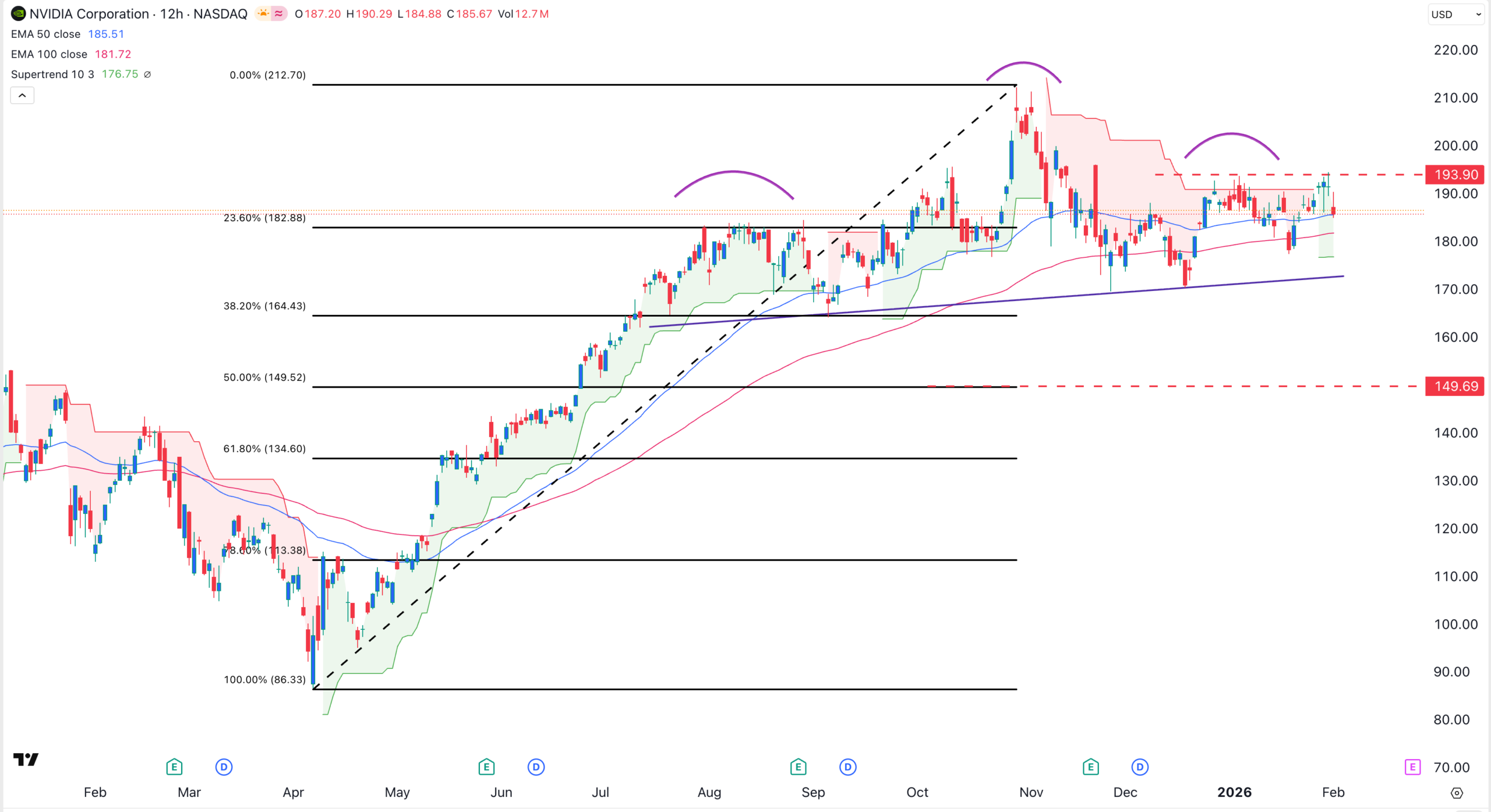
NVIDIA Stock Price Analysis as OpenAI Issues Concerns About its Chips

NVIDIA Stock Price Analysis as OpenAI Issues Concerns About its Chips

Key Insights NVIDIA stock started the week in the red. It crashed by over 2%. Meanwhile, the S&P 500, Dow Jones, and Nasdaq 100 moved close to their all-time highs
Share
Themarketperiodical2026/02/04 11:27
Ondo Finance Launches USDY Yieldcoin on Stellar, Bringing Tokenized U.S. Treasuries to Users

Ondo Finance Launches USDY Yieldcoin on Stellar, Bringing Tokenized U.S. Treasuries to Users

Ondo Finance, a U.S.-based digital asset firm specializing in bringing traditional financial products on-chain through tokenization, is expanding its yieldcoin USDY to the Stellar network. This lates update marks a step forward in merging tokenized real-world assets with a global payments infrastructure, unlocking new opportunities for users worldwide. The announcement was made at the Stellar Meridian event in Copacabana, Rio de Janeiro, on September 17. USDY Joins the Stellar Ecosystem Ondo Finance, a recognized leader in tokenized real-world assets, announced the deployment of United States Dollar Yield (USDY) on Stellar, the payments-focused blockchain known for speed and low transaction costs. USDY is the most widely available “yieldcoin,” offering investors access to onchain assets backed by U.S. Treasuries. This launch allows Stellar’s global user base to tap into permissionless, yield-bearing assets tied to one of the safest financial instruments in the world. It also aligns with Stellar’s mission of driving fast, affordable cross-border payments. Combining Yield with Payments Infrastructure “Stablecoins unlocked global access to the U.S. dollar. With USDY, we’re taking the next step by bringing U.S. Treasuries onchain in a form that combines stability, liquidity, and yield,” said Ian De Bode, Chief Strategy Officer at Ondo Finance. “Fast, affordable cross-border payments are at the center of what Stellar was designed to do. The global reach of the Stellar ecosystem combined with a yield-bearing asset like USDY levels up what is possible onchain, allowing wallets and businesses to offer yield opportunities to their users,” said Denelle Dixon, CEO of the Stellar Development Foundation. Ondo claims by pairing USDY with Stellar’s infrastructure, new possibilities open up in treasury management, collateralization, and everyday financial applications. Unlocking Institutional and Retail Use Cases USDY currently manages over $650 million in total value locked (TVL) across nine blockchains and offers a 5.3% APY. By launching on Stellar, Ondo Finance extends these benefits to global retail and institutional users. The firm explains balances on Stellar can now become productive, supporting use cases such as onchain savings, institutional treasury strategies, cost-efficient collateral for DeFi protocols, and remittance flows that carry yield rather than remaining static. A Milestone for Tokenized Treasuries With the integration of USDY, Stellar users gain more than just access to stable-value assets—they gain access to institutional-grade yield. For investors outside the U.S., the launch represents a new way to combine the safety of Treasuries with the accessibility of blockchain technology. As tokenization accelerates globally, Ondo Finance’s decision to deploy USDY on Stellar reinforces the narrative that blockchain is not just about speculation, but about reimagining the global financial system through secure, yield-bearing digital assets
Share
CryptoNews2025/09/18 00:46
