Academically speaking, what common management best practices are there to deter workers from organizing a union? — Paper Crane. Unfortunately, many of these “bestAcademically speaking, what common management best practices are there to deter workers from organizing a union? — Paper Crane. Unfortunately, many of these “best

Covert union avoidance strategies

Academically speaking, what common management best practices are there to deter workers from organizing a union? — Paper Crane.

Unfortunately, many of these “best practices” are legally questionable, if not outright illegal. Also, they have been silently considered ethically questionable by some human resources (HR) professionals.

I know because I was in a situation where at least three of my prospective employers asked me about my feelings about unions during job interviews. I was flatly rejected when I said I support the establishment of a union, if that’s what the employees want.

At one time, I was asked about how to bust an existing union. I politely ended the job interview. Even today, many of my HR friends still consult me on how to handle those unethical job interview questions as some employers try to explore such actions with their current and prospective HR people.

UNION AVOIDANCE TACTICS
Almost all of these management tactics may constitute unfair labor practices (ULPs) which must be proven in court. They are called gray areas by HR people (sometimes black), which makes it difficult to prove:

One, locating operations in some export processing zones (EPZs). This is preferred by factories that seek out locations with a weak union presence. Some EPZ authorities even silently promote their location as such, promising that they discreetly discourage union formation.

Two, fragmenting or dislocating the workforce. Organizations would prefer hiring only workers from cooperatives or manpower agencies, even if the work to be done is for regular workers. If not, they cycle through the hiring of project-based employees. 

Three, rotating workers under a training program. “Noisy” workers or rabble-rousers who have the potential to become union leaders are deployed to far-flung areas. It’s typically accompanied by a promise of a promotion after a yearlong assignment. 

Four, cultural and social engineering. This is done by establishing and maintaining an active community relations program by hiring workers from the same locality, organizing feeding programs for malnourished children, operating a day care, or sponsoring sports leagues, religious events, and barangay projects.

Five, hiring workers from a specific religion. These religious groups are perceived to have disciplined members that are less confrontational and believe in the supremacy of organizational hierarchy. Their workers are known to follow the orders of their religious leaders, who reciprocate by recommending them to employers.

Six, promoting a ‘family culture’ narrative. Unions are considered divisive as an external force “not aligned with their family values.” Some organizations even promote a bayanihan (communal spirit) culture.

Seven, signaling fear among the workers. Management would often talk about losing competitiveness, telling workers they can’t afford a labor union because their customers don’t like unionized suppliers whose members may sabotage their products.

Eight, selective enforcement of rules. This can take the form of suddenly enforcing dress code, ID, and absenteeism and tardiness rules. These minor offenses are often directed against perceived union sympathizers.

While the rules don’t change, enforcement becomes strict for no reason at all with the help of line supervisors.

Nine, manipulating the bargaining unit’s composition. In unionized establishments, this is typically done when a new collective bargaining agreement is negotiated. The playbook can call for reclassifying certain job categories as supervisory or confidential, rendering such workers unqualified to become union members.

Ten, giving wage increases, promotions, or bonuses. Usually, this could happen before a union certification election to influence the vote. To avoid any suspicion of manipulation, wage increases may given to all employees, including non-union members.

Eleven, paper compliance. Management can tell people that it “respects their right to unionize” while throwing procedural delays during negotiations, including claims of “lost” all documents and endless clarifications about the company’s future.

Twelve, hiring labor relations consultants. The job of these consultants is to coach line supervisors and managers in coded language about the impracticality of having a labor union. Many times, they are provided with scripts (nothing is written down) to minimize legal blowback.

DECEPTION COLLAPSES
From both my experience and from jurisprudence, many employees eventually see through the façade. They ask, “Why bother pretending?” That is why some workers — especially those who fear retaliation — turn to labor inspections, relying on authorities trained to detect patterns of abuse and hidden management intent.

When these cases reach the labor courts, labels no longer matter. What matters is effect. Courts look beyond job titles, policies, and corporate wordplay to determine whether labor rights were violated.

Yes, unethical managers may delay union formation through illegal tactics — but delay is not defeat. In the end, deception collapses under scrutiny, and no strategy is powerful enough to extinguish the workers’ collective will for dignity, voice, and justice.

Discover the answer to the old-age question — “Why People Hate HR?” Join Rey Elbo’s Feb. 20, 2026 public workshop on “Lean HR: Removing Waste from People Processes.” For details, check the link https://reyelbo.com/contact-us

Market Opportunity
Notcoin Logo
Notcoin Price(NOT)
$0.0006356
$0.0006356$0.0006356
+0.53%
USD
Notcoin (NOT) Live Price Chart
Disclaimer: The articles reposted on this site are sourced from public platforms and are provided for informational purposes only. They do not necessarily reflect the views of MEXC. All rights remain with the original authors. If you believe any content infringes on third-party rights, please contact [email protected] for removal. MEXC makes no guarantees regarding the accuracy, completeness, or timeliness of the content and is not responsible for any actions taken based on the information provided. The content does not constitute financial, legal, or other professional advice, nor should it be considered a recommendation or endorsement by MEXC.

You May Also Like

A Netflix ‘KPop Demon Hunters’ Short Film Has Been Rated For Release
A Netflix ‘KPop Demon Hunters’ Short Film Has Been Rated For Release

The post A Netflix ‘KPop Demon Hunters’ Short Film Has Been Rated For Release appeared on BitcoinEthereumNews.com. KPop Demon Hunters Netflix Everyone has wondered what may be the next step for KPop Demon Hunters as an IP, given its record-breaking success on Netflix. Now, the answer may be something exactly no one predicted. According to a new filing with the MPA, something called Debut: A KPop Demon Hunters Story has been rated PG by the ratings body. It’s listed alongside some other films, and this is obviously something that has not been publicly announced. A short film could be well, very short, a few minutes, and likely no more than ten. Even that might be pushing it. Using say, Pixar shorts as a reference, most are between 4 and 8 minutes. The original movie is an hour and 36 minutes. The “Debut” in the title indicates some sort of flashback, perhaps to when HUNTR/X first arrived on the scene before they blew up. Previously, director Maggie Kang has commented about how there were more backstory components that were supposed to be in the film that were cut, but hinted those could be explored in a sequel. But perhaps some may be put into a short here. I very much doubt those scenes were fully produced and simply cut, but perhaps they were finished up for this short film here. When would Debut: KPop Demon Hunters theoretically arrive? I’m not sure the other films on the list are much help. Dead of Winter is out in less than two weeks. Mother Mary does not have a release date. Ne Zha 2 came out earlier this year. I’ve only seen news stories saying The Perfect Gamble was supposed to come out in Q1 2025, but I’ve seen no evidence that it actually has. KPop Demon Hunters Netflix It could be sooner rather than later as Netflix looks to capitalize…
Share
BitcoinEthereumNews2025/09/18 02:23
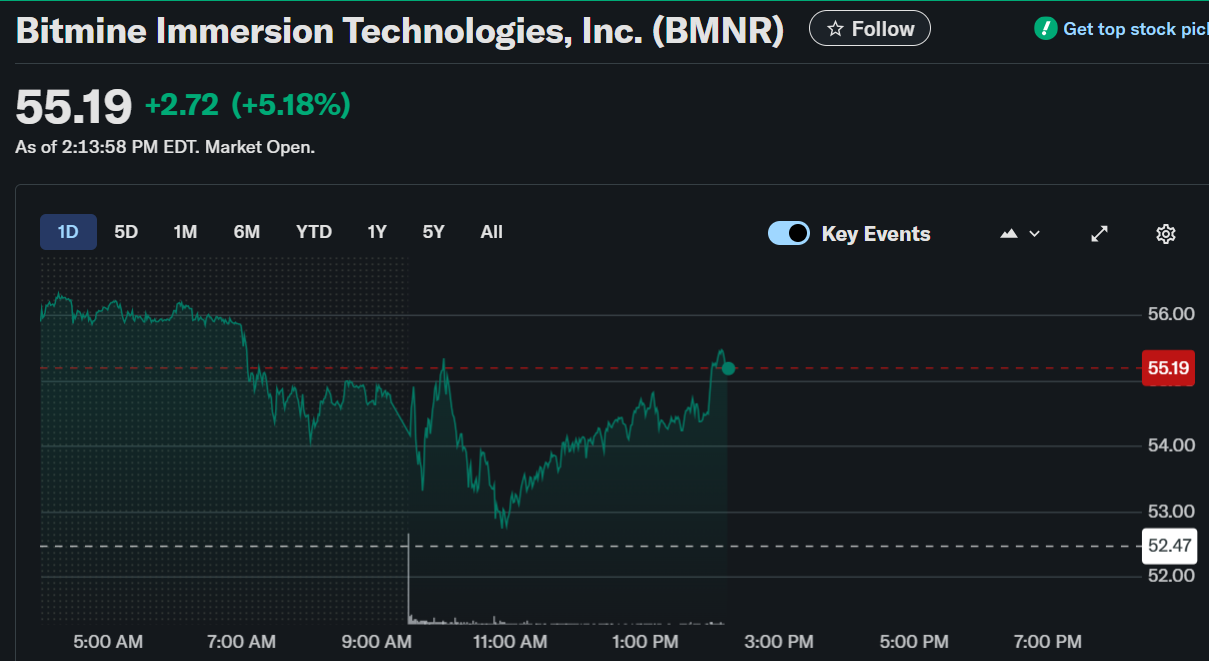
Bitmine Immersion Technologies (BMNR) stock :soars 5% as $13.4B Crypto Treasury Propels Ethereum Supercycle Vision

Bitmine Immersion Technologies (BMNR) stock :soars 5% as $13.4B Crypto Treasury Propels Ethereum Supercycle Vision

TLDR Bitmine surges 5.18% as $13.4B ETH treasury cements crypto dominance. Bitmine’s $12.6B Ethereum trove fuels bold 5% market ownership goal. Bitmine rebounds strong—ETH hoard drives record treasury valuation. Bitmine’s ETH empire grows to 3M coins, powering stock’s sharp rally. With record ETH and cash reserves, Bitmine solidifies crypto supremacy. Bitmine Immersion Technologies closed 5.18% [...] The post Bitmine Immersion Technologies (BMNR) stock :soars 5% as $13.4B Crypto Treasury Propels Ethereum Supercycle Vision appeared first on CoinCentral.
Share
Coincentral2025/10/14 02:40
Headwind Helps Best Wallet Token

Headwind Helps Best Wallet Token

The post Headwind Helps Best Wallet Token appeared on BitcoinEthereumNews.com. Google has announced the launch of a new open-source protocol called Agent Payments Protocol (AP2) in partnership with Coinbase, the Ethereum Foundation, and 60 other organizations. This allows AI agents to make payments on behalf of users using various methods such as real-time bank transfers, credit and debit cards, and, most importantly, stablecoins. Let’s explore in detail what this could mean for the broader cryptocurrency markets, and also highlight a presale crypto (Best Wallet Token) that could explode as a result of this development. Google’s Push for Stablecoins Agent Payments Protocol (AP2) uses digital contracts known as ‘Intent Mandates’ and ‘Verifiable Credentials’ to ensure that AI agents undertake only those payments authorized by the user. Mandates, by the way, are cryptographically signed, tamper-proof digital contracts that act as verifiable proof of a user’s instruction. For example, let’s say you instruct an AI agent to never spend more than $200 in a single transaction. This instruction is written into an Intent Mandate, which serves as a digital contract. Now, whenever the AI agent tries to make a payment, it must present this mandate as proof of authorization, which will then be verified via the AP2 protocol. Alongside this, Google has also launched the A2A x402 extension to accelerate support for the Web3 ecosystem. This production-ready solution enables agent-based crypto payments and will help reshape the growth of cryptocurrency integration within the AP2 protocol. Google’s inclusion of stablecoins in AP2 is a massive vote of confidence in dollar-pegged cryptocurrencies and a huge step toward making them a mainstream payment option. This widens stablecoin usage beyond trading and speculation, positioning them at the center of the consumption economy. The recent enactment of the GENIUS Act in the U.S. gives stablecoins more structure and legal support. Imagine paying for things like data crawls, per-task…
Share
BitcoinEthereumNews2025/09/18 01:27