Ethereum co-founder Vitalik Buterin has signaled a renewed commitment to decentralized social networks for 2026, arguing that platforms built on shared, open dataEthereum co-founder Vitalik Buterin has signaled a renewed commitment to decentralized social networks for 2026, arguing that platforms built on shared, open data

Vitalik Buterin Says He’ll Return to Decentralized Social in 2026

Vitalik Buterin Says He'll Return To Decentralized Social In 2026

Ethereum co-founder Vitalik Buterin has signaled a renewed commitment to decentralized social networks for 2026, arguing that platforms built on shared, open data layers are essential to fostering real competition and mass communication that serves users rather than engagement metrics. In a year marked by broader interest in SocialFi, Buterin has redirected much of his online activity toward decentralized platforms, noting that his 2026 posts have been accessed through Firefly, a cross-client interface that unifies access to X, Lens, Farcaster and Bluesky.

“If we want a better society, we need better mass communication tools,” Buterin said, arguing that decentralization enables competition by allowing multiple clients to operate on a shared social data layer. He criticized many crypto-native social projects for relying on speculative tokens as a substitute for meaningful innovation, arguing that SocialFi experiments have repeatedly failed by rewarding pre-existing social capital and short-term price speculation instead of content quality and constructive discourse. He contrasted these efforts with creator-subscription models such as Substack, which he said better align incentives around high-quality content. Calling for broader community participation, he urged users and builders to spend more time in decentralized social ecosystems, saying the industry must move beyond a single centralized “info warzone” and toward a more competitive frontier where new forms of online interaction can emerge.

The state of decentralized social media

Decentralized social media, or SocialFi, refers to platforms built on open or blockchain-based networks where user identities, content and social graphs are not controlled by a single company. While protocols such as Lens and Farcaster have gained early traction, the sector has so far struggled to translate that momentum into sustained mass-market adoption.

On Wednesday, core infrastructure provider Neynar acquired Farcaster from Merkle. Farcaster co-founder Dan Romero announced the news, saying that “after five years, it’s clear Farcaster needs a new approach and leadership to reach its full potential.”

Lens also underwent a leadership transition this week, as Aave transferred stewardship of the open-source social protocol to Mask Network, tasking the Web3 social company with advancing consumer-ready, on-chain social applications.

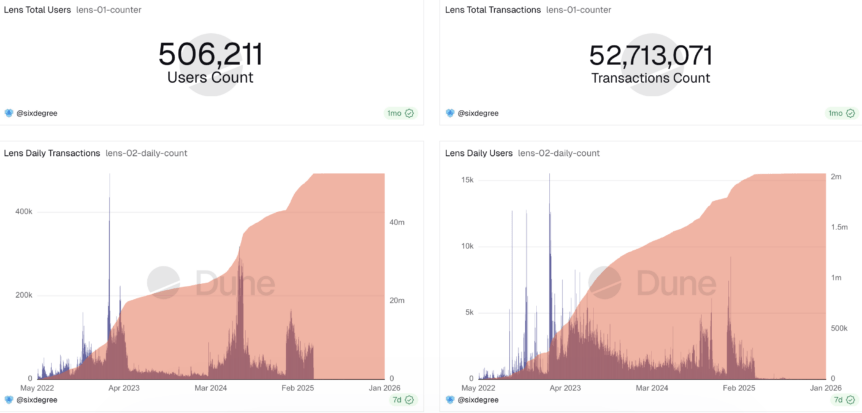
Farcaster features more than two million total registered users and hundreds of thousands of daily interactions, measured by posts and reactions. Lens has accumulated about 506,000 users, according to Dune Analytics data.

Source: Dune Analytics Ethereum, Vitalik Buterin, SocialFiSource: Dune Analytics
This article was originally published as Vitalik Buterin Says He’ll Return to Decentralized Social in 2026 on Crypto Breaking News – your trusted source for crypto news, Bitcoin news, and blockchain updates.

Market Opportunity
LightLink Logo
LightLink Price(LL)
$0.004439
$0.004439$0.004439
+0.40%
USD
LightLink (LL) Live Price Chart
Disclaimer: The articles reposted on this site are sourced from public platforms and are provided for informational purposes only. They do not necessarily reflect the views of MEXC. All rights remain with the original authors. If you believe any content infringes on third-party rights, please contact [email protected] for removal. MEXC makes no guarantees regarding the accuracy, completeness, or timeliness of the content and is not responsible for any actions taken based on the information provided. The content does not constitute financial, legal, or other professional advice, nor should it be considered a recommendation or endorsement by MEXC.

You May Also Like

Qatar pushes tokenization with launch of QCD money market fund

Qatar pushes tokenization with launch of QCD money market fund

QNB Group (Qatar National Bank), along with other partners have officially launched a tokenized money market fund, called the QCD Money Market Fund (QCDT).
Share
Cryptopolitan2025/09/18 18:55
XAG/USD retreats toward $113.00 on profit-taking pressure

XAG/USD retreats toward $113.00 on profit-taking pressure

The post XAG/USD retreats toward $113.00 on profit-taking pressure appeared on BitcoinEthereumNews.com. Silver price (XAG/USD) halts its seven-day winning streak
Share
BitcoinEthereumNews2026/01/30 10:21
Michael Saylor Pushes Digital Capital Narrative At Bitcoin Treasuries Unconference

Michael Saylor Pushes Digital Capital Narrative At Bitcoin Treasuries Unconference

The post Michael Saylor Pushes Digital Capital Narrative At Bitcoin Treasuries Unconference appeared on BitcoinEthereumNews.com. The suitcoiners are in town.  From a low-key, circular podium in the middle of a lavish New York City event hall, Strategy executive chairman Michael Saylor took the mic and opened the Bitcoin Treasuries Unconference event. He joked awkwardly about the orange ties, dresses, caps and other merch to the (mostly male) audience of who’s-who in the bitcoin treasury company world.  Once he got onto the regular beat, it was much of the same: calm and relaxed, speaking freely and with confidence, his keynote was heavy on the metaphors and larger historical stories. Treasury companies are like Rockefeller’s Standard Oil in its early years, Michael Saylor said: We’ve just discovered crude oil and now we’re making sense of the myriad ways in which we can use it — the automobile revolution and jet fuel is still well ahead of us.  Established, trillion-dollar companies not using AI because of “security concerns” make them slow and stupid — just like companies and individuals rejecting digital assets now make them poor and weak.  “I’d like to think that we understood our business five years ago; we didn’t.”  We went from a defensive investment into bitcoin, Saylor said, to opportunistic, to strategic, and finally transformational; “only then did we realize that we were different.” Michael Saylor: You Come Into My Financial History House?! Jokes aside, Michael Saylor is very welcome to the warm waters of our financial past. He acquitted himself honorably by invoking the British Consol — though mispronouncing it, and misdating it to the 1780s; Pelham’s consolidation of debts happened in the 1750s and perpetual government debt existed well before then — and comparing it to the gold standard and the future of bitcoin. He’s right that Strategy’s STRC product in many ways imitates the consols; irredeemable, perpetual debt, issued at par, with…
Share
BitcoinEthereumNews2025/09/18 02:12