

Ethereum Leverage Remains At Record High: What Happens Next?
Ethereum is attempting to reclaim the $3,000 level as the broader crypto market remains trapped in a phase of uncertainty and uneven conviction. Price action suggests buyers are willing to defend key support zones, yet momentum remains fragile, with rallies struggling to extend meaningfully. This hesitation is occurring against a backdrop of elevated leverage and unstable derivatives behavior, which continues to shape short-term market dynamics.
A recent report from CryptoQuant highlights a growing source of risk beneath the surface. Ethereum’s Estimated Leverage Ratio on Binance remains at a record high, with the 7-day simple moving average holding around 0.632.
This indicates a heavy concentration of leveraged positions, leaving the market increasingly sensitive to sudden price swings and liquidation events. In parallel, order-flow data points to erratic trader behavior, reinforcing the view that the current structure lacks balance.
The Taker Buy Sell Ratio illustrates this instability clearly. On January 25, the metric fell to 0.86, its lowest reading since September, signaling strong taker sell dominance. Shortly after, it rebounded sharply to 1.16, the highest daily level since February 2021, reflecting aggressive market buying. Such abrupt reversals underscore a market driven more by short-term positioning than by sustained directional confidence.

Ethereum Consolidates as High Leverage Amplifies Volatility Risk
The report explains that this abrupt shift in taker behavior is unfolding while Ethereum price action remains structurally weak. After failing to break above the $4,800 all-time high, ETH entered a prolonged corrective phase and is now consolidating near the $2,800 support zone.
This level has become a short-term pivot, repeatedly absorbing selling pressure but failing to generate sustained upside momentum. The lack of follow-through highlights a market caught between defensive buyers and aggressive short-term traders.
What makes this phase particularly sensitive is the interaction between price compression and elevated leverage. With Ethereum’s Estimated Leverage Ratio still near record highs, even modest price moves can trigger outsized reactions in the derivatives market.

Rapid reversals in the Taker Buy Sell Ratio reinforce this fragility, signaling that positioning is flipping quickly rather than building in a stable, directional manner. Such conditions often precede sharp expansions in volatility rather than orderly trends.
Under this setup, Ethereum appears highly dependent on a clear external or internal catalyst. Without a decisive shift in macro conditions, spot demand, or network-specific developments, price action is likely to remain reactive. Until conviction emerges on either side, the combination of high leverage and unstable order flow keeps the risk of sudden liquidations elevated, increasing the probability of abrupt and disorderly price movements around key technical levels.
Price Action Details: Testing Critical Resistance
Ethereum’s price action reflects a market caught between stabilization and unresolved downside risk. On the daily chart, ETH is trading near $3,000 after several failed attempts to reclaim higher levels, highlighting this zone as a key psychological and technical pivot.
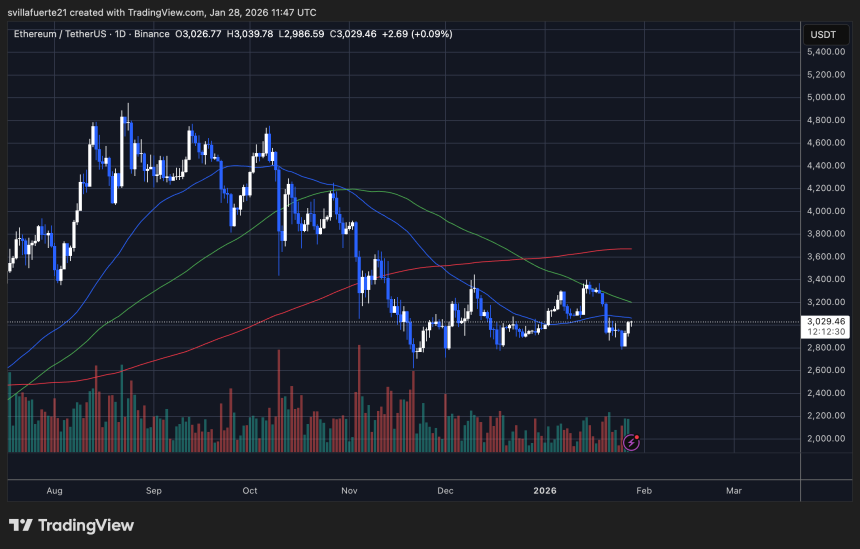
Price remains below the 50-day and 100-day moving averages, both of which are sloping downward, reinforcing the idea that short- to medium-term momentum is still fragile. The 200-day moving average sits higher, near the mid-$3,500 area, acting as a clear marker of the broader trend deterioration since ETH failed to hold above $4,000.
ETH has transitioned from a strong impulsive uptrend into a wide consolidation range, bounded roughly between $2,800 and $3,400. The recent bounce from the lower end of this range suggests that buyers are still defending the $2,800 support zone, but volume remains muted compared to prior selloffs, indicating a lack of strong conviction on either side. Each rally attempt has so far produced lower highs, consistent with a corrective or distributional phase rather than a renewed trend.
As long as ETH holds above $2,800, the market can argue for consolidation and base-building. However, a sustained break below that level would expose the downside toward the $2,500–$2,600 region. Conversely, reclaiming the $3,300–$3,400 area would be required to meaningfully improve the technical outlook.
Featured image from ChatGPT, chart from TradingView.com
You May Also Like

UBS CEO Targets Direct Crypto Access With “Fast Follower” Tokenization Strategy

Ondo Finance launches USDY yieldcoin on Stellar network
