The post Crypto News: CZ Denies Binance Role in Historic $19B Crypto Liquidations appeared on BitcoinEthereumNews.com. CZ rejects claims that Binance caused theThe post Crypto News: CZ Denies Binance Role in Historic $19B Crypto Liquidations appeared on BitcoinEthereumNews.com. CZ rejects claims that Binance caused the

Crypto News: CZ Denies Binance Role in Historic $19B Crypto Liquidations

4 min read

CZ rejects claims that Binance caused the $19B October liquidation crash, as industry leaders debate leverage risks, regulation, and market structure.

Former Binance CEO Changpeng “CZ” Zhao has denied allegations linking Binance to the largest crypto liquidation event. The October 10 sell-off destroyed about $19billion and is still influencing market risk discussions worldwide.

CZ Pushes Back Against Binance Blame for October Liquidation Crash

During a question-and-answer session on Binance’s social media channels, Zhao denied allegations against the cryptocurrency exchange. He said that Binance was not a significant contributor to the wave of forced liquidations.

According to Zhao, stories about Binance being responsible for the crash are far-fetched and have no evidence. Further, he rejected calls from some traders for full compensation for losses.

Related Reading: Binance to Shift $1B SAFU Fund Into Bitcoin Reserves Within 30 Days | Live Bitcoin News

Zhao said that over the entire crypto market, the pressure from too much leverage exacerbated liquidation pressure. Therefore, he suggested that pointing the finger of blame at a single exchange oversimplifies complex market dynamics.

He also highlighted the regulation oversight Binance has in addressing misconduct allegations. Binance is regulated under Abu Dhabi law and is still under the watch of the U.S. government.

According to Zhao, this structure guarantees transparency in operational activities. Consequently, allegations of uncontrolled risk management are widespread, he said.

With regard to the losses to users, Zhao said Binance has already paid about $600 million in compensation. These payments helped cover losses associated with verified technical glitches for extreme volatility.

However, support from industry peers continued in the form of criticism following the event. OKX CEO Star Xu did not hesitate to attack Binance’s role in the market structure.

Xu contended that Binance incentivized the conversion of USDT and USDC into USDe without adequate warnings. He said USDe has the hedge fund-like risk characteristics that are unsuitable for retail users.

According to Xu, Binance also permitted the repetitive use of USDe as collateral. As a result, this created a high-risk feedback loop in times of stressed market conditions.

Industry Divisions Emerge Over Causes of $19B Market Wipeout

In contrast, Wintermute founder Evgeny Gaevoy cautioned about single-exchange blame narratives. He said attributing the crash to one platform is not logical.

Gaevoy explained that bear markets tend to foment emotional scapegoating over analysis. However, he stated systemic leverage and liquidity gaps were behind the decline.

The liquidation event, coined “Crypto Black Friday,” was the largest in the history of the industry. Over $19.1 billion of leveraged positions disappeared in 24 hours.

Analysts largely agree that the crash was linked to macroeconomic shocks and exchange-specific actions. Then-candidate Donald Trump unveiled 100% tariffs on select Chinese technology imports.

That announcement started rapid deleveraging across risk assets, including cryptocurrencies. As a result, Bitcoin plummeted from around $118,000 to around $101,000.

Researchers mentioned technical problems on centralized exchanges exacerbated selling pressure. Additionally, thin liquidity conditions added to the cascading purge of excess leverage.

Despite disagreements, most observers concur that leverage management is a fundamental industry challenge. Therefore, exchanges come under increasing pressure to enhance risk disclosures and risk controls.

Zhao maintained that Binance didn’t orchestrate or accelerate the liquidation cascade. Instead, he reiterated that market-wide leverage and macro shocks dominated price action.

The episode heightened regulatory oversight and investor caution in digital asset markets. Moreover, it transformed discussions of accountability of exchanges and systemic risk exposure.

As the markets become more stable, participants continue to reassess the practices of leverage and collateral structures. As a result, the October crash is still a lesson in the resilience of the crypto market.

While stories vary, the liquidation event highlighted vulnerabilities in times of extreme volatility. At the end of the day, it remains elusive to have an industry consensus that is reflective of the evolving risk framework of crypto.

Source: https://www.livebitcoinnews.com/cz-denies-binance-role-in-historic-19b-crypto-liquidations/

Disclaimer: The articles reposted on this site are sourced from public platforms and are provided for informational purposes only. They do not necessarily reflect the views of MEXC. All rights remain with the original authors. If you believe any content infringes on third-party rights, please contact [email protected] for removal. MEXC makes no guarantees regarding the accuracy, completeness, or timeliness of the content and is not responsible for any actions taken based on the information provided. The content does not constitute financial, legal, or other professional advice, nor should it be considered a recommendation or endorsement by MEXC.

You May Also Like

Best Crypto to Buy as Saylor & Crypto Execs Meet in US Treasury Council

Best Crypto to Buy as Saylor & Crypto Execs Meet in US Treasury Council

The post Best Crypto to Buy as Saylor & Crypto Execs Meet in US Treasury Council appeared on BitcoinEthereumNews.com. Michael Saylor and a group of crypto executives met in Washington, D.C. yesterday to push for the Strategic Bitcoin Reserve Bill (the BITCOIN Act), which would see the U.S. acquire up to 1M $BTC over five years. With Bitcoin being positioned yet again as a cornerstone of national monetary policy, many investors are turning their eyes to projects that lean into this narrative – altcoins, meme coins, and presales that could ride on the same wave. Read on for three of the best crypto projects that seem especially well‐suited to benefit from this macro shift:  Bitcoin Hyper, Best Wallet Token, and Remittix. These projects stand out for having a strong use case and high adoption potential, especially given the push for a U.S. Bitcoin reserve.   Why the Bitcoin Reserve Bill Matters for Crypto Markets The strategic Bitcoin Reserve Bill could mark a turning point for the U.S. approach to digital assets. The proposal would see America build a long-term Bitcoin reserve by acquiring up to one million $BTC over five years. To make this happen, lawmakers are exploring creative funding methods such as revaluing old gold certificates. The plan also leans on confiscated Bitcoin already held by the government, worth an estimated $15–20B. This isn’t just a headline for policy wonks. It signals that Bitcoin is moving from the margins into the core of financial strategy. Industry figures like Michael Saylor, Senator Cynthia Lummis, and Marathon Digital’s Fred Thiel are all backing the bill. They see Bitcoin not just as an investment, but as a hedge against systemic risks. For the wider crypto market, this opens the door for projects tied to Bitcoin and the infrastructure that supports it. 1. Bitcoin Hyper ($HYPER) – Turning Bitcoin Into More Than Just Digital Gold The U.S. may soon treat Bitcoin as…
Share
BitcoinEthereumNews2025/09/18 00:27
Breaking: CME Group Unveils Solana and XRP Options

Breaking: CME Group Unveils Solana and XRP Options

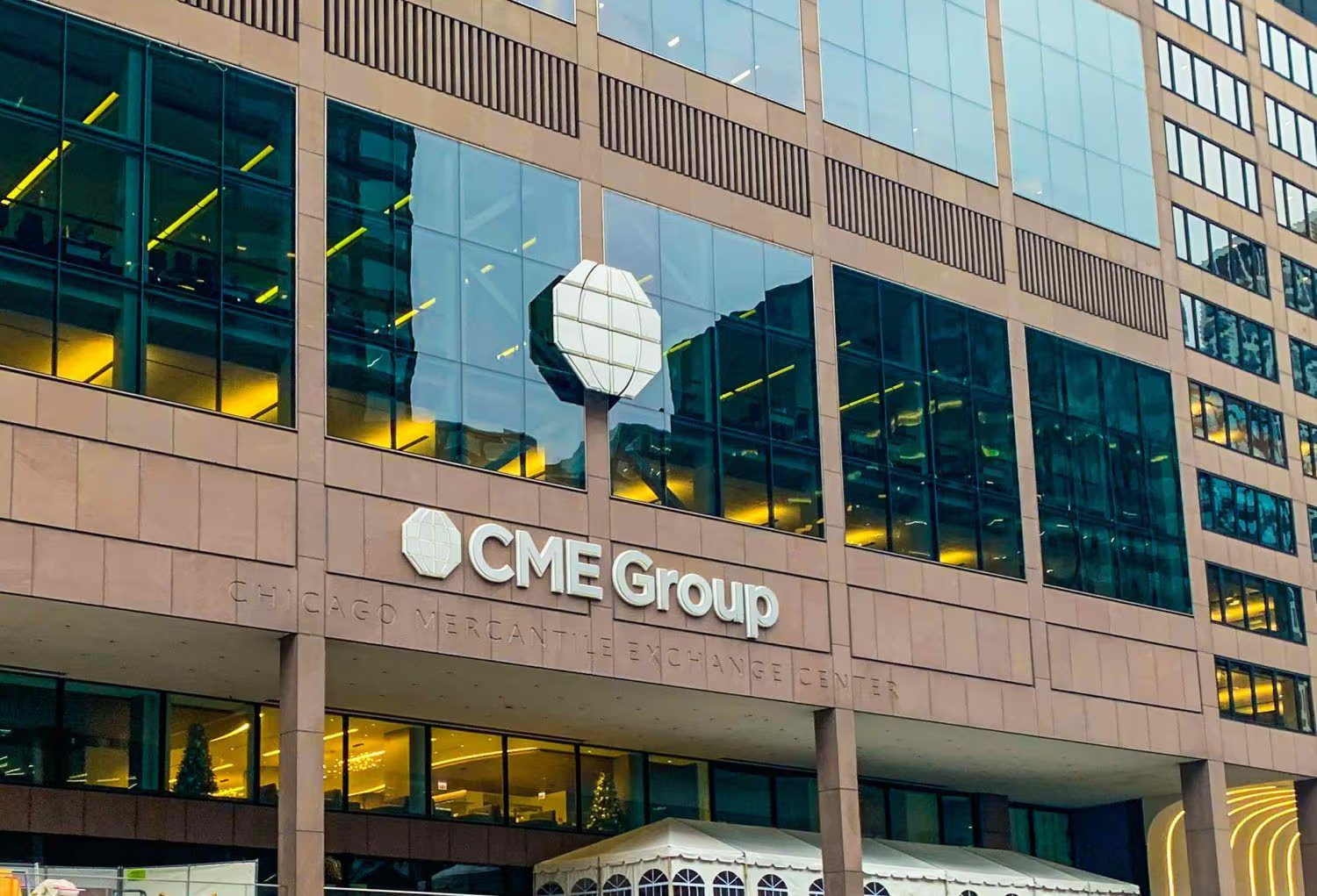
CME Group launches Solana and XRP options, expanding crypto offerings. SEC delays Solana and XRP ETF approvals, market awaits clarity. Strong institutional demand drives CME’s launch of crypto options contracts. In a bold move to broaden its cryptocurrency offerings, CME Group has officially launched options on Solana (SOL) and XRP futures. Available since October 13, 2025, these options will allow traders to hedge and manage exposure to two of the most widely traded digital assets in the market. The new contracts come in both full-size and micro-size formats, with expiration options available daily, monthly, and quarterly, providing flexibility for a diverse range of market participants. This expansion aligns with the rising demand for innovative products in the crypto space. Giovanni Vicioso, CME Group’s Global Head of Cryptocurrency Products, noted that the new options offer increased flexibility for traders, from institutions to active individual investors. The growing liquidity in Solana and XRP futures has made the introduction of these options a timely move to meet the needs of an expanding market. Also Read: Vitalik Buterin Reveals Ethereum’s Bold Plan to Stay Quantum-Secure and Simple! Rapid Growth in Solana and XRP Futures Trading CME Group’s decision to roll out options on Solana and XRP futures follows the substantial growth in these futures products. Since the launch of Solana futures in March 2025, more than 540,000 contracts, totaling $22.3 billion in notional value, have been traded. In August 2025, Solana futures set new records, with an average daily volume (ADV) of 9,000 contracts valued at $437.4 million. The average daily open interest (ADOI) hit 12,500 contracts, worth $895 million. Similarly, XRP futures, which launched in May 2025, have seen significant adoption, with over 370,000 contracts traded, totaling $16.2 billion. XRP futures also set records in August 2025, with an ADV of 6,600 contracts valued at $385 million and a record ADOI of 9,300 contracts, worth $942 million. Institutional Demand for Advanced Hedging Tools CME Group’s expansion into options is a direct response to growing institutional interest in sophisticated cryptocurrency products. Roman Makarov from Cumberland Options Trading at DRW highlighted the market demand for more varied crypto products, enabling more advanced risk management strategies. Joshua Lim from FalconX also noted that the new options products meet the increasing need for institutional hedging tools for assets like Solana and XRP, further cementing their role in the digital asset space. The launch of options on Solana and XRP futures marks another step toward the maturation of the cryptocurrency market, providing a broader range of tools for managing digital asset exposure. SEC’s Delay on Solana and XRP ETF Approvals While CME Group expands its offerings, the broader market is also watching the progress of Solana and XRP exchange-traded funds (ETFs). The U.S. Securities and Exchange Commission (SEC) has delayed its decisions on multiple crypto-related ETF filings, including those for Solana and XRP. Despite the delay, analysts anticipate approval may be on the horizon. This week, REX Shares and Osprey Funds are expected to launch an XRP ETF that will hold XRP directly and allocate at least 40% of its assets to other XRP-related ETFs. Despite the delays, some analysts believe that approval could come soon, fueling further interest in these assets. The delay by the SEC has left many crypto investors awaiting clarity, but approval of these ETFs could fuel further momentum in the Solana and XRP futures markets. Also Read: Tether CEO Breaks Silence on $117,000 Bitcoin Price – Market Reacts! The post Breaking: CME Group Unveils Solana and XRP Options appeared first on 36Crypto.
Share
Coinstats2025/09/18 02:35
Optimizely Named a Leader in the 2026 Gartner® Magic Quadrant™ for Personalization Engines

Optimizely Named a Leader in the 2026 Gartner® Magic Quadrant™ for Personalization Engines

Company recognized as a Leader for the second consecutive year NEW YORK, Feb. 5, 2026 /PRNewswire/ — Optimizely, the leading digital experience platform (DXP) provider
Share
AI Journal2026/02/06 00:47