Zcash price is hovering near a key technical support zone after weeks of steady losses, with traders watching closely for signs of short-term exhaustion. As of Zcash price is hovering near a key technical support zone after weeks of steady losses, with traders watching closely for signs of short-term exhaustion. As of

Zcash price tests lower Bollinger Band near $290 — is a technical bounce forming?

2026/02/03 15:10
3 min read

Zcash price is hovering near a key technical support zone after weeks of steady losses, with traders watching closely for signs of short-term exhaustion.

Summary
  • ZEC is trading near $290 after sliding more than 40% over the past month.
  • Derivatives activity has cooled, with futures volume falling even as open interest holds steady.
  • Price is testing the lower Bollinger Band, raising the odds of a short-term bounce if support holds.

As of this writing, Zcash was trading at $289, down 1.7% in the past day. The token has struggled to keep pace with recent market moves and remains one of the few large-cap assets in the red despite a slight crypto market rebound.

Zcash (ZEC) has fluctuated between $282 and $401 over the last week, but the trend has clearly shifted lower. The token is down 21% in the last seven days and has lost 43% over the past month, giving back much of its late-2025 rally.

Market activity has softened as prices fell. Zcash recorded $423 million in trading volume in the past 24 hours, a 15% drop. Derivatives tell a similar story.

CoinGlass data shows futures volume down 20% to $1.14 billion, while open interest edged slightly higher to $451 million, suggesting some traders are holding positions rather than aggressively adding new exposure.

Why Zcash is still under pressure

The recent weakness comes after a strong rally late last year and is likely the result of profit-taking combined with unresolved governance problems. In January, the entire core development team at Zcash developer Electric Coin Company resigned, including chief executive officer Josh Swihart.

The departures followed a dispute with the Bootstrap non-profit board over governance design, funding access, and control of major products such as the Zashi wallet. The Zcash network itself has not experienced any technical issues or security problems.

However, sentiment has been impacted by uncertainty about planned upgrades, development schedules, and future direction. At the same time, regulatory pressure continues to weigh down on privacy tokens. 

The most recent decline appears to be a grinding consolidation rather than a sell-off triggered by panic. ZEC may be exposed to further decline if nearby support levels give way because each bounce attempt has faded rapidly.

Recent marketing initiatives might provide some temporary relief. In an attempt to raise awareness and spark interest, Zcash has launched new advertising campaigns with updated branding.

If market conditions improve, stronger engagement might help stabilize price action, but it is unlikely to stop the trend on its own. 

Zcash price technical analysis

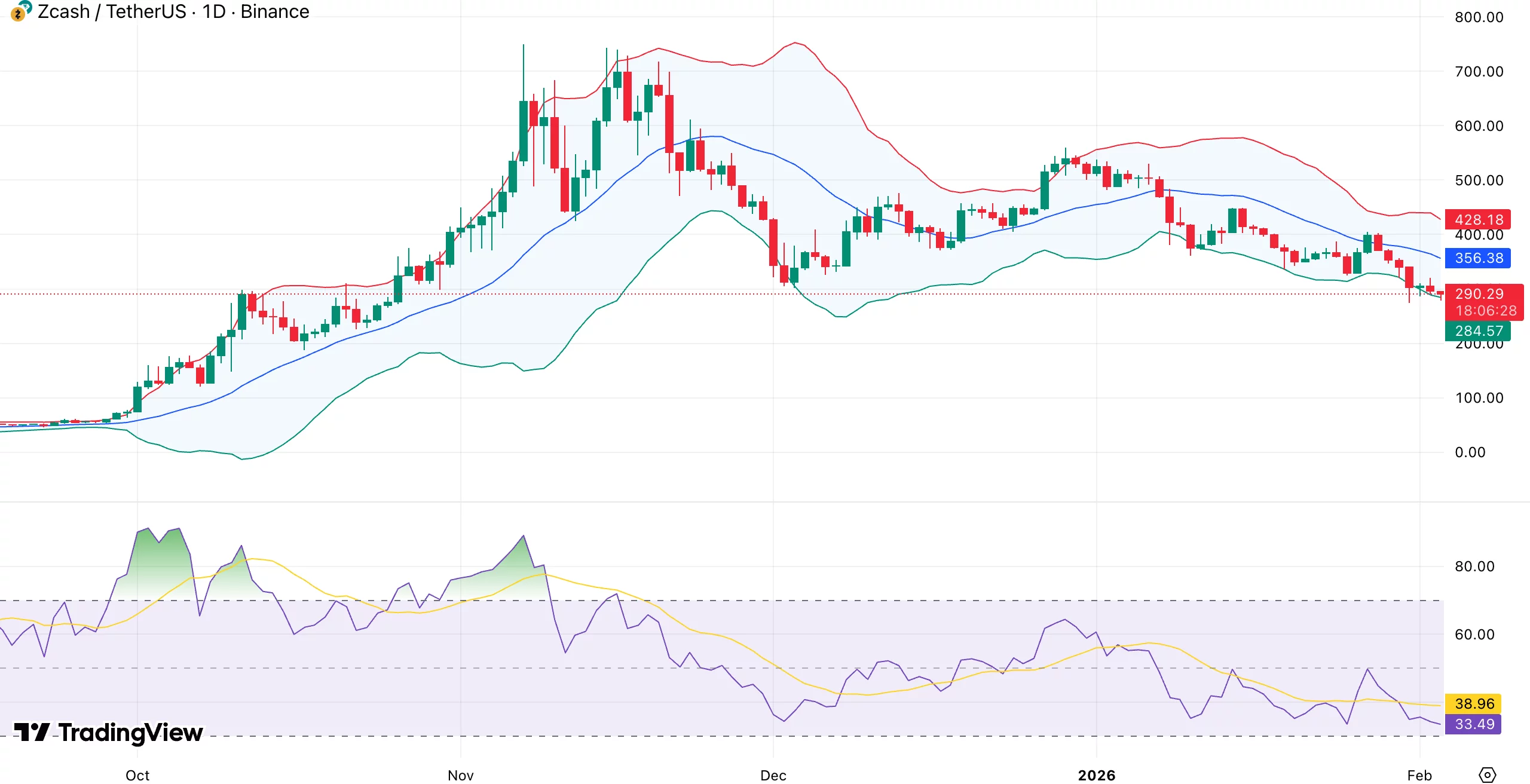
ZEC is trading close to the lower Bollinger Band near $290 on the daily chart. Although it does not guarantee a reversal, this area often indicates short-term exhaustion following prolonged declines.

The price is still below the 20-day moving average, which keeps the overall trend downward. In the past, short relief bounces have been preceded by the relative strength index falling into the low-30s like in the current setup.
Zcash price tests lower Bollinger Band near $290 — is a technical bounce forming? - 1

Any attempt to move higher might encounter resistance in the $320–$350 range, where the short-term averages and middle Bollinger Band converge.

A brief push toward $310–$330 may occur if buyers intervene, particularly if the RSI stabilizes and the price returns to the mid-Bollinger range. On the downside, ZEC would be vulnerable to larger losses if it breaks below $280, with little visible support until lower psychological levels.

Disclaimer: The articles reposted on this site are sourced from public platforms and are provided for informational purposes only. They do not necessarily reflect the views of MEXC. All rights remain with the original authors. If you believe any content infringes on third-party rights, please contact [email protected] for removal. MEXC makes no guarantees regarding the accuracy, completeness, or timeliness of the content and is not responsible for any actions taken based on the information provided. The content does not constitute financial, legal, or other professional advice, nor should it be considered a recommendation or endorsement by MEXC.

You May Also Like

China Blocks Nvidia’s RTX Pro 6000D as Local Chips Rise
China Blocks Nvidia’s RTX Pro 6000D as Local Chips Rise

The post China Blocks Nvidia’s RTX Pro 6000D as Local Chips Rise appeared on BitcoinEthereumNews.com. China Blocks Nvidia’s RTX Pro 6000D as Local Chips Rise China’s internet regulator has ordered the country’s biggest technology firms, including Alibaba and ByteDance, to stop purchasing Nvidia’s RTX Pro 6000D GPUs. According to the Financial Times, the move shuts down the last major channel for mass supplies of American chips to the Chinese market. Why Beijing Halted Nvidia Purchases Chinese companies had planned to buy tens of thousands of RTX Pro 6000D accelerators and had already begun testing them in servers. But regulators intervened, halting the purchases and signaling stricter controls than earlier measures placed on Nvidia’s H20 chip. Image: Nvidia An audit compared Huawei and Cambricon processors, along with chips developed by Alibaba and Baidu, against Nvidia’s export-approved products. Regulators concluded that Chinese chips had reached performance levels comparable to the restricted U.S. models. This assessment pushed authorities to advise firms to rely more heavily on domestic processors, further tightening Nvidia’s already limited position in China. China’s Drive Toward Tech Independence The decision highlights Beijing’s focus on import substitution — developing self-sufficient chip production to reduce reliance on U.S. supplies. “The signal is now clear: all attention is focused on building a domestic ecosystem,” said a representative of a leading Chinese tech company. Nvidia had unveiled the RTX Pro 6000D in July 2025 during CEO Jensen Huang’s visit to Beijing, in an attempt to keep a foothold in China after Washington restricted exports of its most advanced chips. But momentum is shifting. Industry sources told the Financial Times that Chinese manufacturers plan to triple AI chip production next year to meet growing demand. They believe “domestic supply will now be sufficient without Nvidia.” What It Means for the Future With Huawei, Cambricon, Alibaba, and Baidu stepping up, China is positioning itself for long-term technological independence. Nvidia, meanwhile, faces…
Share
BitcoinEthereumNews2025/09/18 01:37
Market Records Largest Long-Term Bitcoin Supply Release In History, Here’s What It Means For BTC

Market Records Largest Long-Term Bitcoin Supply Release In History, Here’s What It Means For BTC

Bitcoin has recorded what analysts describe as the largest long-term supply release in its history, coinciding with a sharp rise in leverage across derivatives
Share
Coinstats2026/02/08 07:06
Bitcoin Cash’s rally faces KEY test – Can BCH hold above $500?

Bitcoin Cash’s rally faces KEY test – Can BCH hold above $500?

On-chain activity points to improving conditions that could support further gains in Bitcoin Cash, though the outlook remains mixed.
Share
Coinstats2026/02/08 07:00