According to the Core Team, the latest changes will unblock roughly 2.5 million users who were previously unable to complete the Mainnet migration due to additionalAccording to the Core Team, the latest changes will unblock roughly 2.5 million users who were previously unable to complete the Mainnet migration due to additional

Pi Coin Price Prediction: 2.5 Million Accounts Just Unlocked – Is the Long-Awaited Mainnet Explosion Finally Here?

3 min read

According to the Core Team, the latest changes will unblock roughly 2.5 million users who were previously unable to complete the Mainnet migration due to additional security and compliance checks.

For a project that has faced years of criticism over delayed onboarding and opaque KYC procedures, this marks one of the most important updates so far.

Pi Network Unblocks Millions

Many community members had been stuck in tentative KYC states or subjected to increased regional compliance reviews that prevented their balances from becoming transferable. The team explained that these issues were not uniform and that different technical fixes were required for different user groups.

As each solution rolls out, migration and KYC unblocking will continue in batches, which is why progress has often looked uneven despite constant backend work.

Alongside this, the Core Team confirmed that more than 700,000 additional users will soon be able to submit KYC applications for the first time. Once the system update is fully live, eligible users are encouraged to complete KYC as early as possible to position their accounts for future migration phases.

PI Price Analysis: Sell-off Exhaustion Incoming?

PI prices are down 7% in the past week.

Over the next month, nearly seven million PI tokens are scheduled to unlock daily on average and investors look worried with 24 million tokens scheduled to release on February 13.

As per CoinMarketCap, PI is up more than 1% in the past 24 hours, trading at $0.1583.

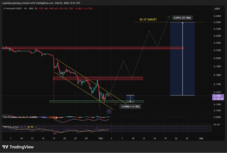
The 4-hour chart below shows that the token is trapped inside a well-defined descending channel that has guided price action since the last major breakdown.
Source: TradingView

Each recovery attempt has failed beneath descending resistance. However, if the PI token breaks hold above the $0.175-$0.180 resistance zone, the next target would be $0.21. If demand continues to rise over mainnet adoption, a test of $0.25 is also likely.

Immediate support sits in the $0.150-$0.152 region, an area that has already been tested multiple times. A drop below this zone would expose PI to the $0.145 area.

New $MAXI Presale Could Be the Next Viral Meme Coin

Maxi Doge ($MAXI) is dominating social talks as the next potential 1000x opportunity.

It isn’t nostalgia bait or another recycled dog theme hoping vibes carry it. It brings a massive community focused on competing, outperforming, and flexing wins.

The $MAXI community encourages people to trade, post setups, track performance, and care about being seen doing it.

User engagement is encouraged with events like Maxi Ripped and Maxi Gains.

$MAXI presale has already raked in $4.5 million, offering 68% in annual staking rewards.

Don’t miss out on this one.

To buy $MAXI during the presale stage, head over to the official Maxi Doge website and connect a supported wallet (like Best Wallet).

Once done, you can use a debit/credit card or swap existing crypto to complete the transaction in seconds.

next

The post Pi Coin Price Prediction: 2.5 Million Accounts Just Unlocked – Is the Long-Awaited Mainnet Explosion Finally Here? appeared first on Coinspeaker.

Disclaimer: The articles reposted on this site are sourced from public platforms and are provided for informational purposes only. They do not necessarily reflect the views of MEXC. All rights remain with the original authors. If you believe any content infringes on third-party rights, please contact [email protected] for removal. MEXC makes no guarantees regarding the accuracy, completeness, or timeliness of the content and is not responsible for any actions taken based on the information provided. The content does not constitute financial, legal, or other professional advice, nor should it be considered a recommendation or endorsement by MEXC.

You May Also Like

Cashing In On University Patents Means Giving Up On Our Innovation Future

Cashing In On University Patents Means Giving Up On Our Innovation Future

The post Cashing In On University Patents Means Giving Up On Our Innovation Future appeared on BitcoinEthereumNews.com. “It’s a raid on American innovation that would deliver pennies to the Treasury while kneecapping the very engine of our economic and medical progress,” writes Pipes. Getty Images Washington is addicted to taxing success. Now, Commerce Secretary Howard Lutnick is floating a plan to skim half the patent earnings from inventions developed at universities with federal funding. It’s being sold as a way to shore up programs like Social Security. In reality, it’s a raid on American innovation that would deliver pennies to the Treasury while kneecapping the very engine of our economic and medical progress. Yes, taxpayer dollars support early-stage research. But the real payoff comes later—in the jobs created, cures discovered, and industries launched when universities and private industry turn those discoveries into real products. By comparison, the sums at stake in patent licensing are trivial. Universities collectively earn only about $3.6 billion annually in patent income—less than the federal government spends on Social Security in a single day. Even confiscating half would barely register against a $6 trillion federal budget. And yet the damage from such a policy would be anything but trivial. The true return on taxpayer investment isn’t in licensing checks sent to Washington, but in the downstream economic activity that federally supported research unleashes. Thanks to the bipartisan Bayh-Dole Act of 1980, universities and private industry have powerful incentives to translate early-stage discoveries into real-world products. Before Bayh-Dole, the government hoarded patents from federally funded research, and fewer than 5% were ever licensed. Once universities could own and license their own inventions, innovation exploded. The result has been one of the best returns on investment in government history. Since 1996, university research has added nearly $2 trillion to U.S. industrial output, supported 6.5 million jobs, and launched more than 19,000 startups. Those companies pay…
Share
BitcoinEthereumNews2025/09/18 03:26
Trump foe devises plan to starve him of what he 'craves' most

Trump foe devises plan to starve him of what he 'craves' most

A longtime adversary of President Donald Trump has a plan for a key group to take away what Trump craves the most — attention. EX-CNN journalist Jim Acosta, who
Share
Rawstory2026/02/04 01:19
Why Bitcoin Is Struggling: 8 Factors Impacting Crypto Markets

Why Bitcoin Is Struggling: 8 Factors Impacting Crypto Markets

Failed blockchain adoption narratives and weak fee capture have undercut confidence in major crypto projects.
Share
CryptoPotato2026/02/04 01:05