The Cardano (ADA) price is sitting at a level that usually separates panic from opportunity. After months of downside pressure, price is now pressing into a clearlyThe Cardano (ADA) price is sitting at a level that usually separates panic from opportunity. After months of downside pressure, price is now pressing into a clearly

Time to Buy Cardano? $ADA at Max Pain Levels

3 min read

The Cardano (ADA) price is sitting at a level that usually separates panic from opportunity. After months of downside pressure, price is now pressing into a clearly defined demand zone, right where sellers historically lose control.

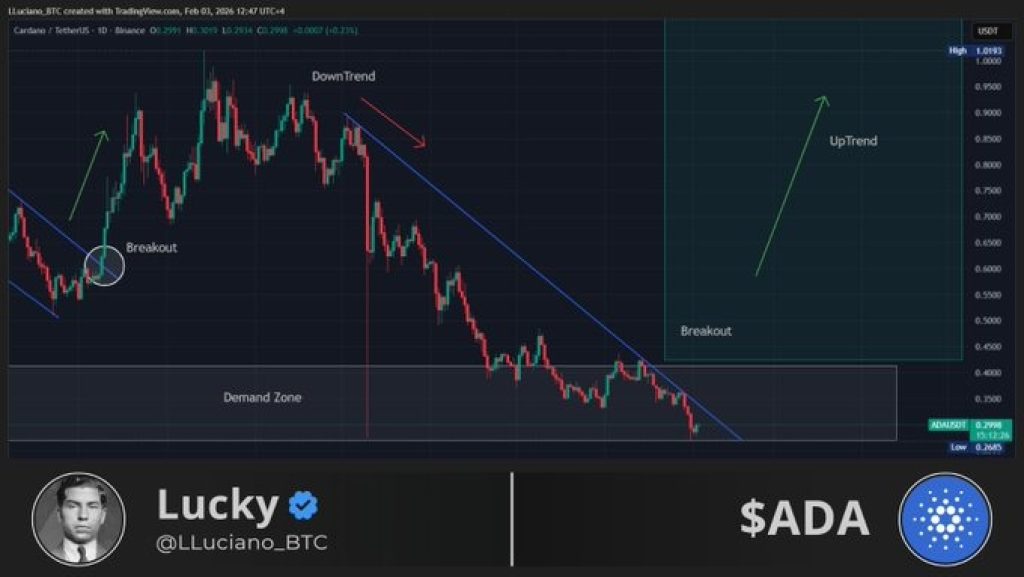
This setup was highlighted by top analyst Lucky who has over 1.9m followers on X, shared a clean chart showing why $ADA is now trading near what many would call max pain. Not because the price feels good here, but because it feels uncomfortable.

What the Cardano Chart Is Showing

The chart shows the prolonged downtrend, with the price being forced lower step by step through the descending trend line, which has acted as an obstacle for every relief rally. The ADA price was forced lower through the trend line.

Now price sits inside a broad demand zone, an area where buyers previously stepped in aggressively. This is where downside moves have stalled in the past, not because sentiment improved, but because selling power ran out.

The most important detail is location. The $ADA  price is no longer mid-range or chasing highs. It is sitting at the lower edge of structure, where risk compresses and reactions tend to start.
Source: X/Lucky

Why This Zone Matters For Cardano Price

Demand zones form when large buyers absorb supply over time. Price does not bounce instantly. It grinds, frustrates, and tests patience. That is usually how accumulation phases look.

In Lucky’s chart, the prior breakout and uptrend are clearly marked. Those moves began from similar conditions: extended downside, weak sentiment, and the ADA price pressing into areas where sellers were already exhausted.

If buyers defend this zone again, the downtrend line becomes the next key reference. A break above it would signal that control has started to rotate away from sellers.

Read Also: 5 Reasons You May Not Want to Ignore Hedera (HBAR) in 2026

Furthermore, this setup is forming during a broader market drawdown. Not just crypto, but risk assets across the board have taken hits. That environment pushes fear higher and conviction lower.

That is exactly why these zones matter. Max pain does not appear during euphoria. It appears when confidence is thin and most participants are positioned the wrong way. The $ADA price does not need hype to move from here. It only needs selling to dry up.

What Comes Next For Cardano 

As long as price holds inside the demand zone, the downside becomes increasingly limited relative to potential upside. A reclaim of the descending trendline would shift structure and open room for a broader recovery leg.

Until then, this remains a patience trade, not a momentum chase. The ADA chart is doing the talking, and it shows the Cardano price is sitting where decisions get made.

Whether this becomes another failed bounce or the start of a new trend will be decided right here.

Subscribe to our YouTube channel for daily crypto updates, market insights, and expert analysis.

The post Time to Buy Cardano? $ADA at Max Pain Levels appeared first on CaptainAltcoin.

Disclaimer: The articles reposted on this site are sourced from public platforms and are provided for informational purposes only. They do not necessarily reflect the views of MEXC. All rights remain with the original authors. If you believe any content infringes on third-party rights, please contact [email protected] for removal. MEXC makes no guarantees regarding the accuracy, completeness, or timeliness of the content and is not responsible for any actions taken based on the information provided. The content does not constitute financial, legal, or other professional advice, nor should it be considered a recommendation or endorsement by MEXC.
Tags:

You May Also Like

Cashing In On University Patents Means Giving Up On Our Innovation Future

Cashing In On University Patents Means Giving Up On Our Innovation Future

The post Cashing In On University Patents Means Giving Up On Our Innovation Future appeared on BitcoinEthereumNews.com. “It’s a raid on American innovation that would deliver pennies to the Treasury while kneecapping the very engine of our economic and medical progress,” writes Pipes. Getty Images Washington is addicted to taxing success. Now, Commerce Secretary Howard Lutnick is floating a plan to skim half the patent earnings from inventions developed at universities with federal funding. It’s being sold as a way to shore up programs like Social Security. In reality, it’s a raid on American innovation that would deliver pennies to the Treasury while kneecapping the very engine of our economic and medical progress. Yes, taxpayer dollars support early-stage research. But the real payoff comes later—in the jobs created, cures discovered, and industries launched when universities and private industry turn those discoveries into real products. By comparison, the sums at stake in patent licensing are trivial. Universities collectively earn only about $3.6 billion annually in patent income—less than the federal government spends on Social Security in a single day. Even confiscating half would barely register against a $6 trillion federal budget. And yet the damage from such a policy would be anything but trivial. The true return on taxpayer investment isn’t in licensing checks sent to Washington, but in the downstream economic activity that federally supported research unleashes. Thanks to the bipartisan Bayh-Dole Act of 1980, universities and private industry have powerful incentives to translate early-stage discoveries into real-world products. Before Bayh-Dole, the government hoarded patents from federally funded research, and fewer than 5% were ever licensed. Once universities could own and license their own inventions, innovation exploded. The result has been one of the best returns on investment in government history. Since 1996, university research has added nearly $2 trillion to U.S. industrial output, supported 6.5 million jobs, and launched more than 19,000 startups. Those companies pay…
Share
BitcoinEthereumNews2025/09/18 03:26
Trump foe devises plan to starve him of what he 'craves' most

Trump foe devises plan to starve him of what he 'craves' most

A longtime adversary of President Donald Trump has a plan for a key group to take away what Trump craves the most — attention. EX-CNN journalist Jim Acosta, who
Share
Rawstory2026/02/04 01:19
Why Bitcoin Is Struggling: 8 Factors Impacting Crypto Markets

Why Bitcoin Is Struggling: 8 Factors Impacting Crypto Markets

Failed blockchain adoption narratives and weak fee capture have undercut confidence in major crypto projects.
Share
CryptoPotato2026/02/04 01:05