Daniel, the founder of Tex Capital, has been clear about what’s driving the renewed interest: revenue-based financing is entering its second phase—and technologyDaniel, the founder of Tex Capital, has been clear about what’s driving the renewed interest: revenue-based financing is entering its second phase—and technology

Revenue-Based Financing Enters Phase Two: How Technology Is Transforming a Hidden Asset Class

4 min read

Daniel, the founder of Tex Capital, has been clear about what’s driving the renewed interest: revenue-based financing is entering its second phase—and technology is the catalyst.

Often grouped with merchant cash advances, revenue-based financing (RBF) allows investors to deploy capital in exchange for a contracted share of a business’s future sales. For years, the asset class has delivered attractive returns through short duration, rapid capital recycling, and performance tied directly to operating revenue rather than interest-rate exposure. But until recently, it remained operationally heavy and opaque to most investors.

Revenue-Based Financing Enters Phase Two: How Technology Is Transforming a Hidden Asset Class

That’s now changing.

Phase One: Proving the Model

The first phase of revenue-based financing was about proving viability. Underwriting relied on bank statements, tax returns, and manual reviews. Servicing was labor-intensive, and growth was constrained by operational friction rather than capital availability.

Even so, disciplined operators built profitable portfolios by focusing on real cash flow, diversification, and active risk management. As a result, revenue-based financing quietly embedded itself into the infrastructure of commerce.

Platforms like PayPal, Shopify, Stripe, Amazon, and Toast began offering sales-linked funding directly to merchants. Institutional capital followed. J.P. Morgan’s senior funding of YouLend, enabling billions of dollars in revenue-based advances across global marketplaces, underscored that this was no longer a fringe product; it was institutional credit wearing fintech clothes.

“Phase one proved the economics,” the Tex Capital founder says. “Phase two is about removing friction and letting the asset class scale the way it always should have.”

Phase Two: No-Doc, Automated, and AI-Driven

Phase Two of revenue-based financing is defined by automation, real-time data, and AI-driven underwriting. Instead of static documentation, decisions are increasingly made using live transaction feeds, payment processor data, and open-banking integrations.

This shift is turning RBF into a true “no-doc” asset class. Merchants no longer need to submit tax returns or financial statements. Underwriting happens continuously, not episodically. Risk models update as sales change, allowing capital to move faster and with greater precision.

For investors, the implications are significant. Faster underwriting means a shorter time from capital commitment to deployment. Automated servicing reduces operating costs, and AI-driven monitoring allows managers to identify deterioration or opportunity earlier than traditional credit frameworks.

Just as importantly, these advances enable balance-sheet-light models. Capital can be originated, distributed, and recycled with minimal overhead, making RBF more scalable and repeatable than its earlier iterations.

Discipline Still Defines Winners

Technology does not eliminate risk—it reallocates it. The same fundamentals still apply: tight position sizing, controls against stacking and fraud, industry-level diversification, and conservative exposure management. AI enhances these disciplines; it doesn’t replace them.

“In this space, automation without discipline just lets you make mistakes faster,” the Tex Capital founder notes. “The edge comes from combining technology with conservative risk frameworks. This way, all merchants can benefit from no-doc approvals, rather than only those who accept card payments.”

The Future of Alternative Credit

Revenue-based financing remains largely underrepresented in traditional portfolios, but that gap is narrowing. As Phase Two infrastructure matures, the asset class is becoming faster, cleaner, and easier for institutional capital to access—without sacrificing its defining characteristics.

The Tex Capital founder sums it up succinctly: “This asset class stayed hidden because it was operationally hard. AI and automation are changing that. The investors who understand this transition early are going to benefit the most.”


Comments
Disclaimer: The articles reposted on this site are sourced from public platforms and are provided for informational purposes only. They do not necessarily reflect the views of MEXC. All rights remain with the original authors. If you believe any content infringes on third-party rights, please contact [email protected] for removal. MEXC makes no guarantees regarding the accuracy, completeness, or timeliness of the content and is not responsible for any actions taken based on the information provided. The content does not constitute financial, legal, or other professional advice, nor should it be considered a recommendation or endorsement by MEXC.
Tags:

You May Also Like

Fed Decides On Interest Rates Today—Here’s What To Watch For

Fed Decides On Interest Rates Today—Here’s What To Watch For

The post Fed Decides On Interest Rates Today—Here’s What To Watch For appeared on BitcoinEthereumNews.com. Topline The Federal Reserve on Wednesday will conclude a two-day policymaking meeting and release a decision on whether to lower interest rates—following months of pressure and criticism from President Donald Trump—and potentially signal whether additional cuts are on the way. President Donald Trump has urged the central bank to “CUT INTEREST RATES, NOW, AND BIGGER” than they might plan to. Getty Images Key Facts The central bank is poised to cut interest rates by at least a quarter-point, down from the 4.25% to 4.5% range where they have been held since December to between 4% and 4.25%, as Wall Street has placed 100% odds of a rate cut, according to CME’s FedWatch, with higher odds (94%) on a quarter-point cut than a half-point (6%) reduction. Fed governors Christopher Waller and Michelle Bowman, both Trump appointees, voted in July for a quarter-point reduction to rates, and they may dissent again in favor of a large cut alongside Stephen Miran, Trump’s Council of Economic Advisers’ chair, who was sworn in at the meeting’s start on Tuesday. It’s unclear whether other policymakers, including Kansas City Fed President Jeffrey Schmid and St. Louis Fed President Alberto Musalem, will favor larger cuts or opt for no reduction. Fed Chair Jerome Powell said in his Jackson Hole, Wyoming, address last month the central bank would likely consider a looser monetary policy, noting the “shifting balance of risks” on the U.S. economy “may warrant adjusting our policy stance.” David Mericle, an economist for Goldman Sachs, wrote in a note the “key question” for the Fed’s meeting is whether policymakers signal “this is likely the first in a series of consecutive cuts” as the central bank is anticipated to “acknowledge the softening in the labor market,” though they may not “nod to an October cut.” Mericle said he…
Share
BitcoinEthereumNews2025/09/18 00:23
While Shiba Inu and Turbo Chase Price, 63% APY Staking Puts APEMARS at the Forefront of the Best Meme Coin Presale 2026 – Stage 6 Ends in 3 Days!

While Shiba Inu and Turbo Chase Price, 63% APY Staking Puts APEMARS at the Forefront of the Best Meme Coin Presale 2026 – Stage 6 Ends in 3 Days!

What if your meme coin investment could generate passive income without selling a single token? Shiba Inu climbed 4.97% as 207 billion tokens left exchanges. Turbo
Share
Coinstats2026/02/04 03:15
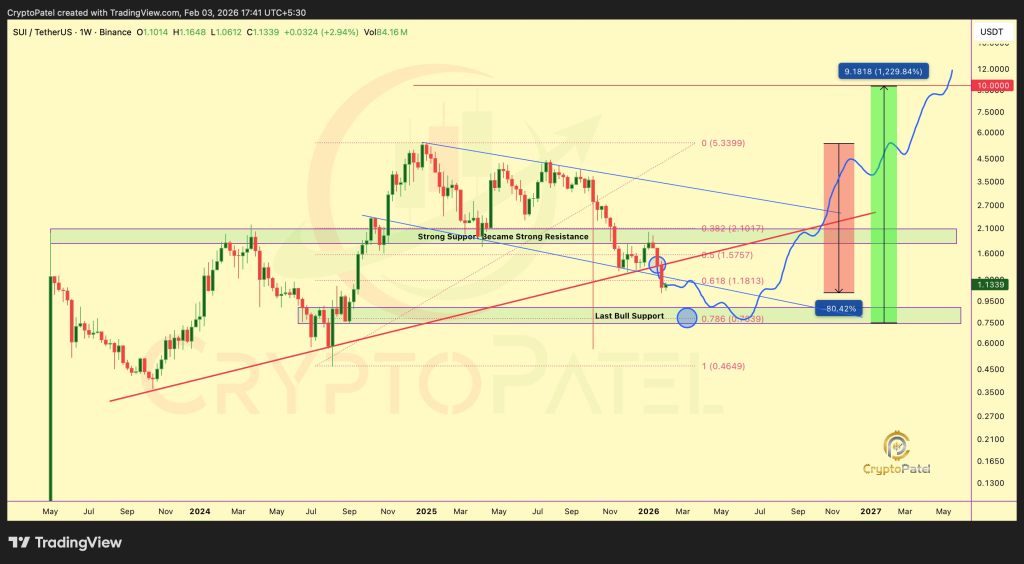
SUI Price Is Down 80%: Price Nears Level Bulls Cannot Afford to Lose

SUI Price Is Down 80%: Price Nears Level Bulls Cannot Afford to Lose

SUI price has quietly slipped into a zone that usually decides everything. Charts show an 80% drop from the peak, yet the market is no longer moving fast. This
Share
Captainaltcoin2026/02/04 03:00