

This year's Ethereum is the Plus version of last year's Bitcoin
By Martin, W3C DAO
At the end of June 2025, a publicly traded company called BitMine Immersion Technologies launched an Ethereum treasury plan. In the past 10 hours, it has increased its holdings by more than 135,000 Ethereum, bringing its total holdings to over 1.3 million. Thomas Lee, the company's chairman, publicly declared: "Our goal is to hold 5% of the world's Ethereum."
This is not an isolated case. From traditional gaming company SharpLink to investment institution BTCS, listed companies are hoarding Ethereum at an unprecedented rate. Strategic ETH reserve data shows that as of August this year, the total amount of ETH held by institutions has reached 8.3% of the total supply, doubling from 3% in early April.

During the same period, the price of Ethereum soared from $1,385 to $4,788, and the daily trading volume climbed to the range of $4.5-4.9 billion. Wall Street analysts began to call ETH "digital oil" - it is not only the energy that drives the blockchain economy, but also an indispensable strategic reserve in institutional asset allocation.
1. Institutional Hoarding Frenzy: Ethereum Becomes the “New Gold” for Corporate Vaults
In 2025, Wall Street's capital is pouring into Ethereum at an unprecedented rate. The latest data shows that the proportion of ETH held in corporate vaults and ETFs has exceeded 8.3% of the total supply, doubling from 3% at the beginning of the year. This equates to approximately 10 million ETH locked in institutional vaults. Three major players stand out:
• Bitmine Immersion Tech (formerly a Bitcoin mining company), the Ethereum microstrategist BitMine, has accelerated its holdings, increasing by over 135,000 ETH in the past 10 hours, bringing its total holdings to over 1.3 million, making it the world's largest enterprise Ethereum holder. Since launching its Ethereum reserve strategy on June 30th, BitMine's holdings have grown from 0 to 1.3 million in just seven weeks, averaging over 27,000 daily increases. Even more impressive was its weekly increase of 247,000 ETH from August 10th to 16th, valued at over $1 billion. The company previously announced its plan to control 5% of the global ETH supply, approximately 6 million ETH. With 21.7% already achieved, this clearly demonstrates that BitMine's ETH reserves have entered a period of exponential growth, and its aggressive strategy could usher in a new era for enterprise Ethereum allocation.
• The latest data shows that there are 70 Ethereum treasury companies with a total holding of more than 3.7 million Ethereum tokens. SharpLink, ranked second, holds more than 728,000 Ethereum tokens.
• The Ether Machine has already exceeded the 340,000 mark.
It is expected that the total holdings of enterprise-level Ethereum may exceed 8 million by the end of the year.

Even more astonishing is the speed of ETF fund flow. BlackRock's ETHA spot ETF has purchased more than 3.6 million Ethereums, totaling more than US$12 billion. Grayscale's Ethereum ETF has purchased nearly 2 million Ethereums, totaling approximately US$7.3 billion. In the past week, the net inflow of Ethereum ETF was US$2.85 billion, of which the net inflow on August 11 exceeded US$1 billion!
2. Technological Evolution: From Merger to Pectra Upgrade to the Digital Oil Revolution
Ethereum's market performance in 2025 is impressive. Ethereum's underlying transformation is subverting the performance ceiling. The Pectra upgrade, which will be implemented in Q1 2025, will reshape the network's structure through 12 key EIP proposals:
• EIP-7702 allows ordinary wallets to obtain "smart contract-level functions", allowing users to realize gas payment and social recovery like WeChat Pay, and completely say goodbye to the fear of mnemonics;
• EIP-7251 increases the validator staking limit from 32 ETH to 2048 ETH, and triples the node communication efficiency, clearing the way for institutional staking;

As network activity increases, ETH destruction accelerates, creating a self-reinforcing cycle of supply reduction and price support.
3. Ecological Explosion: Value Reconstruction from DeFi to RWA to Stablecoins
Ethereum is shedding the label of “Bitcoin’s follower” and evolving into a global settlement layer that puts trillions of dollars of real assets on the chain.
RWA (real world assets) has become one of the strongest narratives in 2025, covering traditional assets such as US Treasury bonds, real estate equity and carbon credits. BlackRock's BUIDL fund has exceeded US$2.4 billion, with more than 90% of its assets deposited in Ethereum.
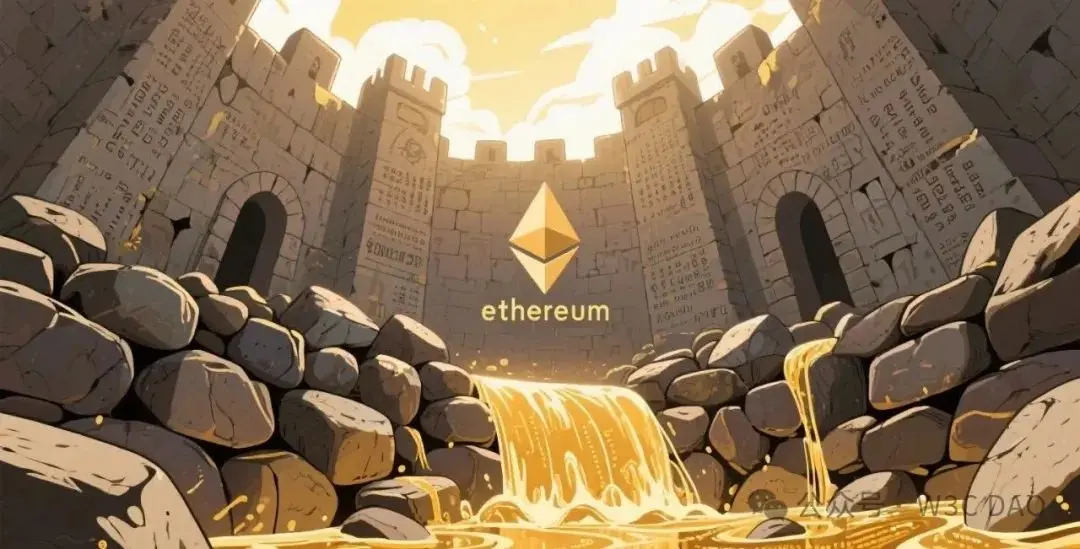
The integration of DeFi and AI has opened up a new dimension. AI agents can independently execute dynamic interest rate lending strategies and optimize the MEV distribution mechanism, attracting more than 100,000 traditional developers to join the ecosystem. The DeFi locked-in volume soared to US$85.9 billion in July, a three-year high, of which Ethereum alone accounted for 60%.
Stablecoins have consolidated Ethereum's position as the "on-chain dollar". 54% of the stablecoins in the entire network (about US$137.7 billion) are circulating on Ethereum. Every transfer burns ETH, strengthening its "digital crude oil" attributes.
4. Wall Street Trends: Why does capital choose Ethereum?
The most notable trend in 2025 will be the widespread inclusion of Ethereum in treasury reserves by listed companies. Unlike Bitcoin, which was initially viewed by companies as a simple store of value, institutions now view ETH as a "productive asset"—capable of generating returns through staking and participating in the DeFi ecosystem for additional returns.
The massive influx of institutional capital into Ethereum is due to its irreplaceable practical value in the crypto ecosystem. Unlike Bitcoin, which is mainly used as a means of storing value, Ethereum has become the operating basis of the blockchain economy.
As the core platform for the tokenization of real-world assets (RWA), Ethereum will account for 81% of the RWA market by the end of 2024, locking approximately US$14.9 billion in assets and serving over 80,000 asset holders. Analysts believe that this will become a key factor driving Ethereum's strong growth in 2025.
As the cornerstone of stablecoin infrastructure, Ethereum holds a 54% share of the stablecoin market, supporting the most successful application scenario in the crypto field. The circulating supply of stablecoins reached US$200 billion in 2024 and is expected to exceed US$400 billion in 2025.

Compared to Bitcoin's "digital gold" narrative, Ethereum's core reason for winning institutional favor lies in three advantages:
1. Productive asset attributes: Staking ETH can earn an annualized return of 3-5%, making it more attractive than US Treasuries during the Fed's interest rate cut cycle;
2. First-mover advantage in compliance: The EU MiCA regulation lists ETH as a "compliance benchmark," and Trump's nomination of a pro-cryptocurrency SEC chairman further clears policy uncertainty.
3. Ecological network effect: 5,000 active DApps and 500,000 developers build a moat, which is five times the scale of competitors such as Solana.
Fundstrat founder Thomas Lee asserted: "The fair value of Ethereum should be in the range of $10,000-15,000." Bitwise CIO's forecast is relatively conservative: ETH will exceed $7,000 in 2025.
5. Challenges and Future: Ethereum’s Path to “Digital Oil”
While Bitcoin ETF is driving the first wave of institutional investors, Ethereum is launching a more imaginative value narrative with a combination of technological surge, ecological explosion, and compliance breakthroughs.
It is not only a better "digital gold" - it is also a productive asset that connects traditional finance and the crypto world, the settlement layer of the trillion-dollar RWA market, and the infrastructure of the AI agent economy. Every ETH added to the corporate treasury is a vote for this value reconstruction.

As Bitmine stated during its transformation: "We're not betting on token prices, but on the operating system of the entire digital economy." As Ethereum sheds its old label, a golden age for the smart contract ecosystem is just dawning.
BlackRock is hosting $2.4 billion in Treasury bonds on Ethereum, and Sony is building the metaverse on Layer 2. The entry of the traditional world indicates that Ethereum’s “institutional narrative” has just begun.
The more far-reaching impact lies in the reconstruction of financial infrastructure. As the trend of RWA (real-world assets) on-chain accelerates, a market opportunity worth $16 trillion is opening up. As the underlying platform, Ethereum is expected to become the core infrastructure of the next-generation financial system.
When Ethereum holds 81% of the RWA market and 54% of the stablecoin market, a question deserves investors’ deep consideration: Are we witnessing a repeat of the Bitcoin story, or the beginning of a more profound “digital oil” revolution?
You May Also Like
Solana Hits $4B in Corporate Treasuries as Companies Boost Reserves

SHIB Price Prediction: Mixed Signals Point to $0.0000085 Target by February End
