Cryptocurrency may be going mainstream, but traditional banks are still struggling to keep pace, and the disconnect is becoming increasingly visible. Recent dataCryptocurrency may be going mainstream, but traditional banks are still struggling to keep pace, and the disconnect is becoming increasingly visible. Recent data

Crypto Is Going Mainstream: So Why Are Banks Still Blocking It?

2026/02/21 03:19
3 min read

Cryptocurrency may be going mainstream, but traditional banks are still struggling to keep pace, and the disconnect is becoming increasingly visible.

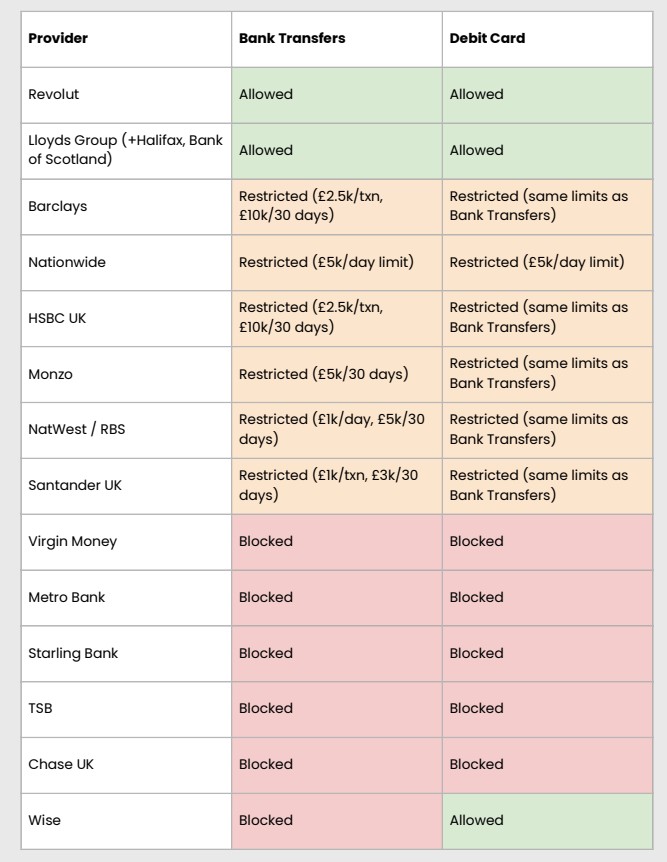
Recent data comparing major UK banks shows a fragmented and often restrictive approach toward crypto transactions. While some institutions allow both bank transfers and debit card purchases, many impose strict limits, and several block crypto-related payments altogether.
Source: https://x.com/Cointelegraph/status/2024732196293267600

UK Banks: Restrictions and Blocks

Among UK providers, Revolut and Lloyds Group (including Halifax and Bank of Scotland) currently allow crypto transactions through both bank transfers and debit cards. However, others are significantly more restrictive.

Barclays and HSBC UK impose transaction limits such as £2,500 per transaction and £10,000 per 30 days. Nationwide caps activity at £5,000 per day. NatWest and Santander apply even tighter monthly thresholds.

Several major names, including Virgin Money, Metro Bank, Starling Bank, TSB, and Chase UK, have outright blocked crypto-related transactions through both bank transfers and debit cards. Wise blocks bank transfers but still allows debit card purchases.

The pattern suggests that while crypto access exists, it is often throttled by internal risk controls rather than fully integrated into banking services.

U.S. Banks: Limited Bitcoin Services

The situation in the United States reflects a different but related constraint.

Among the top 25 U.S. banks, Bitcoin trading and custody services remain limited. JP Morgan Chase has announced trading support, but custody is not yet available.

Citigroup is exploring custody solutions, and several banks, including Wells Fargo, Goldman Sachs, and Morgan Stanley, restrict crypto trading to high-net-worth clients only.

Retail access remains constrained, and full custody services are largely absent across major institutions.

XRP Adds $1.3 Billion in 2026, Already Surpasses All of 2025

A Structural Gap

The contrast is clear: crypto markets operate 24/7 globally, spot Bitcoin ETFs are live, and tokenized assets are expanding rapidly, yet mainstream banking rails remain hesitant, limited, or outright closed.

Banks cite fraud risk, regulatory ambiguity, and consumer protection concerns. However, the restrictions also highlight an operational lag. Traditional banking systems were not built for decentralized, always-on digital assets, and integration has proven slower than adoption.

As institutional capital increases exposure to digital assets, the friction between banking infrastructure and crypto markets becomes more visible. While crypto has moved into exchange-traded products and sovereign-level discussions, many consumers still face limits or blocks at the bank level.

The post Crypto Is Going Mainstream: So Why Are Banks Still Blocking It? appeared first on ETHNews.

Market Opportunity
Major Logo
Major Price(MAJOR)
$0.07466
$0.07466$0.07466
+0.52%
USD
Major (MAJOR) Live Price Chart
Disclaimer: The articles reposted on this site are sourced from public platforms and are provided for informational purposes only. They do not necessarily reflect the views of MEXC. All rights remain with the original authors. If you believe any content infringes on third-party rights, please contact [email protected] for removal. MEXC makes no guarantees regarding the accuracy, completeness, or timeliness of the content and is not responsible for any actions taken based on the information provided. The content does not constitute financial, legal, or other professional advice, nor should it be considered a recommendation or endorsement by MEXC.
Tags:

You May Also Like

WSJ demands 'ugly' Trump apologize to the Supreme Court

WSJ demands 'ugly' Trump apologize to the Supreme Court

The conservative learning Wall Street Journal blasted President Donald Trump for “smearing” members of the Supreme Court who overruled his unilateral tariff policy
Share
Alternet2026/02/21 10:31
The Resilient Supply Chain: AI-Driven “Anticipatory Logistics” in 2026

The Resilient Supply Chain: AI-Driven “Anticipatory Logistics” in 2026

The global supply chains of the early 2020s were built for “Efficiency.” But in the volatile landscape of 2026—marked by climate events and geopolitical shifts—
Share
Techbullion2026/02/21 09:57
UK Eyes £20K Limit in New Stablecoin Framework

UK Eyes £20K Limit in New Stablecoin Framework

The post UK Eyes £20K Limit in New Stablecoin Framework appeared on BitcoinEthereumNews.com. The Bank of England is preparing to launch a regulatory framework for stablecoins, which could reshape how digital currencies operate in the UK’s financial system. According to Bloomberg, the plan may include temporary limits on asset storage, setting a £20,000 cap for individuals and £10 million for businesses. Sources familiar with the draft indicate that certain exceptions will apply. Deputy Governor Sarah Breeden said that the UK is advancing in step with the US in developing its stablecoin regime. She emphasized that the limits are temporary, intended to ensure market stability as the regulatory environment matures. Why the UK Is More Cautious Breeden highlighted that the credit structures of the US and UK differ sharply. In the US, a significant portion of mortgages are financed through the securities market, whereas in the UK, they are largely funded by commercial banks.This structural difference, she noted, drives British regulators to take a more cautious stance as they balance innovation with financial security. Bloomberg reported that the Bank of England expects to finalize its framework by late 2025.The new rules are also set to require asset reserves and greater issuer transparency, aligning with international best practices. Stablecoin Regulation Around the World Globally, stablecoin regulation has become a top priority for central banks and financial watchdogs: United States The US Treasury and Federal Reserve are exploring a regulatory model focused on bank-like supervision for major issuers such as Circle and Tether. Several bills in Congress — including the Clarity for Payment Stablecoins Act — propose strict reserve and audit requirements. European Union The EU’s Markets in Crypto-Assets (MiCA) framework, taking effect in 2024–2025, will be the world’s first comprehensive crypto regulation. MiCA mandates 1:1 reserve backing for stablecoins and limits their use if they threaten financial stability — a move seen as setting the…
Share
BitcoinEthereumNews2025/11/07 05:07