

White House crypto chief David Sacks' diverse background: Silicon Valley investor, Musk confidant, Vance funder
Author: Weilin, PANews
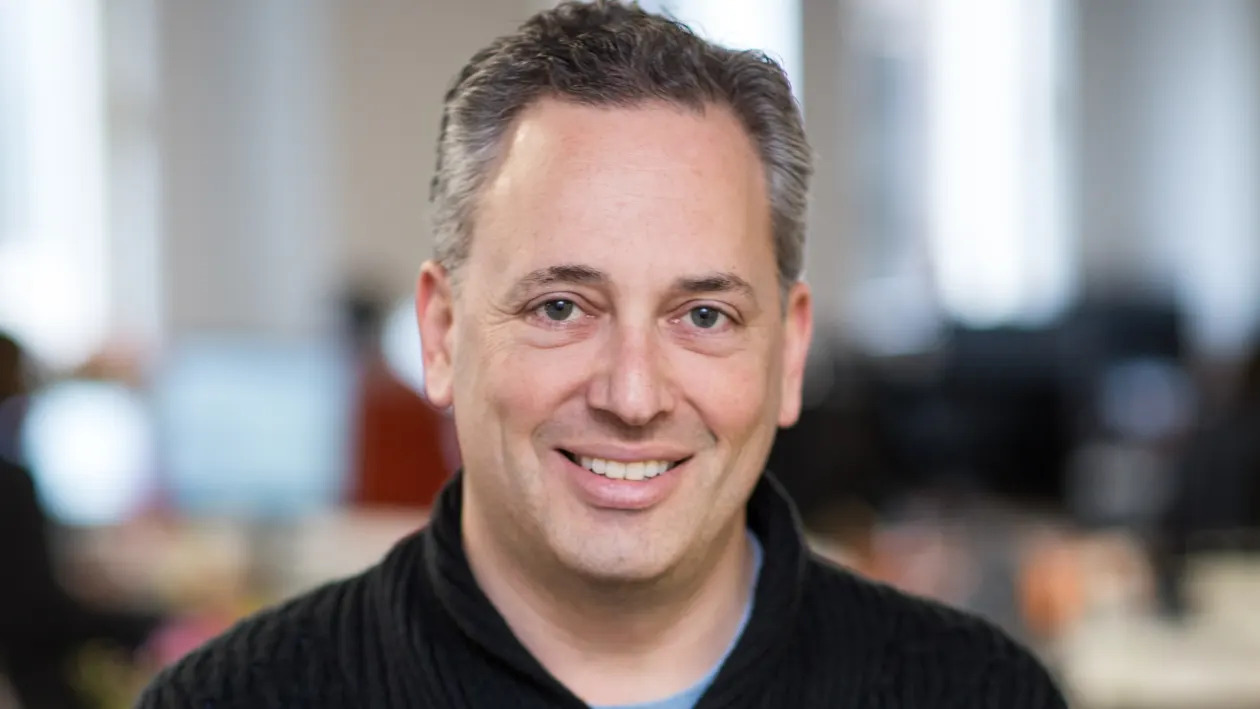
On December 6, US President-elect Trump announced the appointment of David Sacks as the "White House Commissioner for Artificial Intelligence and Cryptocurrency Affairs." This investor, who has made great achievements in Silicon Valley and politics, will lead the formulation of US policies in the fields of artificial intelligence and cryptocurrency.
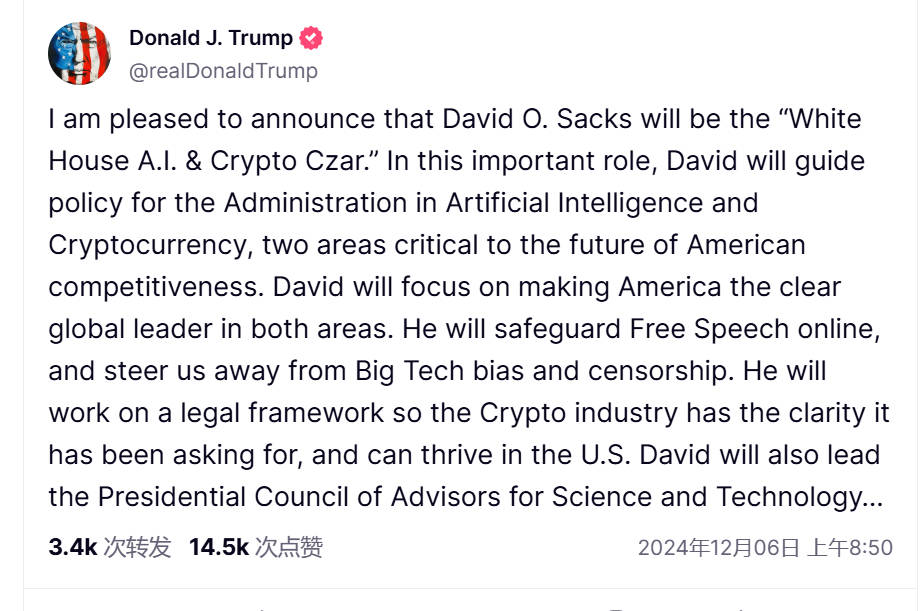
Trump said on Truth Social: "I am pleased to announce that David O. Sacks will serve as the 'White House Director of Artificial Intelligence and Cryptocurrency.' In this important position, David will guide the government's policy direction in two areas that are critical to the future of American competitiveness, Artificial Intelligence and Cryptocurrency. David will focus on making the United States the clear global leader in these two areas. He will protect free speech on the Internet from bias and censorship by big tech companies. He will work to develop a legal framework that gives the encryption industry the clear guidance it expects and allows it to thrive in the United States. David will also lead the President's Council of Advisors on Science and Technology."
Later, Sacks responded on social media, "Thank you for the President's trust. I am deeply honored and look forward to promoting the competitiveness of the United States in key technologies. Under your leadership, the future is bright!"
From South Africa to Silicon Valley, David Sacks' company invests in multiple crypto projects
David Oliver Sacks was born in 1972 in a Jewish family in Cape Town, South Africa. When he was five years old, he moved to Tennessee, USA with his family. He is a South African-American entrepreneur, writer and investor in Internet technology companies.
Sacks served as PayPal's chief operating officer and head of product, and became famous there. He is an important member of Silicon Valley's "PayPal Mafia". Later, he founded Yammer, a workplace social network company, which was acquired by Microsoft for $1.2 billion in 2012. In 2016, Sacks briefly served as interim CEO of Zenefits, and in 2017 founded Craft Ventures, which focuses on early-stage technology investments. His angel investments include companies such as Facebook, Uber, SpaceX, Palantir Technologies and Airbnb.
Craft has invested in Musk's Boring, Neuralink and SpaceX. Craft has also invested in companies that align with Sacks' free speech philosophy, such as social podcast company Callin and social media platform Reddit, as well as some companies related to enterprise technology, such as productivity startup ClickUp and compliance startup Vanta.
According to Rootdata data, Craft Ventures' investment in cryptocurrency projects includes: dYdX, Lightning Labs, River Financial, Kresus, Set Protocol, FOLD, Harbor, Handshake, Voltage, Galoy, Lumina, Rare Bits . In addition, he is a firm holder of Solana and has not sold his SOL holdings even after the collapse of FTX. He also publicly claimed that Solana may surpass Ethereum. Sacks also has a hand in Hollywood, producing the 2005 satirical film "Thank You for Smoking", which explores how political lobbyists rationalize unacceptable views through packaging. In addition, he is also the co-host of the "All In" podcast with Chamath Palihapitiya, Jason Calacanis and David Friedberg.
Influencing the election: Musk's close friends and Vice President Vance's financial backers
As his wealth in the tech world grew, Sacks became a major political donor, and while his donations were not as large as those of Steve Ballmer (former Microsoft CEO) and Ron Conway (one of Google's earliest investors, known as the "Godfather of Silicon Valley"), his donations in recent years were large enough to attract attention. He also founded a political action committee called Purple Good Government PAC, where he and his wife Jacqueline were major donors, and through which they provided political donations to the Kennedy family.
Sacks is a close friend of Elon Musk and has been one of the people who has encouraged Musk to get more deeply involved in Republican politics over the past year or so. He hosted a fundraiser for Trump in San Francisco in June and spoke at the Republican National Convention in July. Trump also appeared on his podcast this summer.
Sacks has a close relationship with Vice President-elect and Ohio Senator JD Vance and has become an important funder of his political career. In California, Sacks has funded some politicians who aim to fight back against those many conservatives in the state consider to be too liberal. From 2022 to 2023, Sacks' total political donations to national candidates were close to $2 million, most of which went to Vance. Republican political consultant Rob Stutzman said, "As Vance's reputation grows, I think Sacks is one of those people who may gain more influence as a result."
Despite his high-profile political donations, Sacks has publicly stated that he has no intention of running for public office, and believes that political appointments such as ambassadors are too cumbersome and less attractive than developing products or investing in technology companies.
His political allies say he is helping conservatives in the tech industry find their political voice. “There are a lot of interesting movements in Silicon Valley that are getting attention in Washington,” said Saurabh Sharma, head of American Moment, a right-leaning policy group that Sacks helps fund. “David is at the forefront of that.”
Cryptocurrency and artificial intelligence: Challenges of the White House’s new role
Sacks has long supported cryptocurrencies. In 2017, Sacks said that digital assets and tokenization pose a challenge to traditional venture capital, and venture capital firms that want to invest before ICOs must compete with angel investors to provide real value-added. In addition, LP interests may be tokenized like most other illiquid assets.
At the time, Sacks noted, “It feels like we’re witnessing the birth of a new type of web. Some people call it the decentralized web or the internet of money.” Bitcoin enforces its scarcity through a combination of cryptography and economic incentives (cryptoeconomics).
At the time, Sacks also said he believed cryptocurrencies like Bitcoin and Ethereum fulfilled PayPal’s “original vision”: creating a “monetary database” that would allow payments to always be made within the system.
Many of Sacks' views are typical conservatives. He criticizes the government's profligate spending and overly aggressive regulatory policies. He takes a distinctly libertarian stance on free speech. Since his undergraduate years at Stanford University in the early 1990s, Sacks has worked for the Stanford Review, a libertarian newspaper founded by PayPal co-founder and investor Peter Thiel. Sacks and Thiel also co-authored a book in 1995 called The Diversity Myth, which reflected his early focus on public affairs.
Sacks' views on artificial intelligence and its policy making are less clear, but overall his policy stance is clearly right-leaning and tends to relax regulation, which may mean that the policies he adopts will be more relaxed than those of the outgoing Biden administration.
From Silicon Valley investors to political donors, David Sacks' multiple identities demonstrate his influence in the fields of technology, business, and politics. Now, as the director of cryptocurrency and artificial intelligence affairs at the White House, how he will promote the development of these key areas in the United States is attracting much attention.
You May Also Like

Cashing In On University Patents Means Giving Up On Our Innovation Future

Trump foe devises plan to starve him of what he 'craves' most
