After a short-lived recovery, Bitcoin (BTC) is attempting to bounce from a crucial level to reclaim the $110,000 support. However, some analysts suggest that a retest of the $90,000 level could be the next stop for the cryptocurrency. Related Reading: Another Short-Lived Solana Rally? Here’s Why It May Be Different This Time Bitcoin Drops To Weekly Lows Bitcoin lost the $110,000 support for the first time in nearly two months, dipping below the lower boundary of its local range, between $108,700-$119,500. The flagship crypto hit an eight-week low of $107,900 on Friday afternoon, raising concerns for its short-term rally among investors. Crypto analyst Ali Martinez suggested that the market is starting to show signs of fatigue, with Bitcoin Dominance displaying cracks after carrying “the bulk of the bull market momentum.” To the analyst, BTC’s current price action signals a macro trend shift, mirroring the 2021 price action and the conditions that preceded the 2021 cycle peak. At the time, the cryptocurrency hit a peak of $60,000 in April, retraced, rallied to $70,000, and set a strong bearish divergence against the Relative Strength Index (RSI) before the bear market began. This time, Bitcoin is showing the same setup that foreshadowed the end of the last cycle, with price making higher highs while the RSI makes lower lows, Martinez explained. Among other technical signals, the analyst highlighted that the MACD indicator had turned bearish this week. He detailed that this bearish crossover aligns with the price drop and reinforces the downside risks. Meanwhile, he added that the recent death cross in the Bitcoin MVRV Momentum indicator “signals a macro momentum reversal from positive to negative. This is a historically reliable warning sign of cyclical tops.” The analyst affirmed that the on-chain evidence suggests Bitcoin’s top may be in, at least temporarily, with bias shifting bearish and a risk of retesting lower support levels. Will BTC Mirror Its 2021 Drop? Martinez also noted that the $108,700 support is crucial for BTC’s short-term performance, as a weekly close below this area would confirm a deeper trend shift, which occurred in 2021. After peaking in late 2021, the flagship crypto lost its local range above the $58,000 mark, which led to a retest of the macro range’s mid-zone and an eventual drop below the macro range’s lows in the coming months. If BTC loses its immediate technical floor, the price could retest the $104,500 and $97,000 support levels, risking a drop to the mid-zone of the macro range, around the $94,000 area. Altcoin Sherpa weighed in on the cryptocurrency’s performance, stating that Bitcoin should have strong support between the $103,000-$108,000 levels, as the 200-day Exponential Moving Average (EMA) sits around the $104,000 mark. Related Reading: XRP Shows Strength Amid $3 Retest, But Analyst Warns Of Potential Correction However, analyst Ted Pillows considers that $124,000 appears to be the local top. He explained that, historically, Bitcoin’s bottoms occur after a retest of the weekly 60 EMA, which currently sits around the $92,000 support zone and has a CME gap. “In this scenario, Bitcoin will start a reversal after 3-4 weeks and a new ATH by November/December,” Ted concluded. As of this writing, Bitcoin trades at $107,947, a 7.5% decline in the weekly timeframe. Featured Image from Unsplash.com, Chart from TradingView.comAfter a short-lived recovery, Bitcoin (BTC) is attempting to bounce from a crucial level to reclaim the $110,000 support. However, some analysts suggest that a retest of the $90,000 level could be the next stop for the cryptocurrency. Related Reading: Another Short-Lived Solana Rally? Here’s Why It May Be Different This Time Bitcoin Drops To Weekly Lows Bitcoin lost the $110,000 support for the first time in nearly two months, dipping below the lower boundary of its local range, between $108,700-$119,500. The flagship crypto hit an eight-week low of $107,900 on Friday afternoon, raising concerns for its short-term rally among investors. Crypto analyst Ali Martinez suggested that the market is starting to show signs of fatigue, with Bitcoin Dominance displaying cracks after carrying “the bulk of the bull market momentum.” To the analyst, BTC’s current price action signals a macro trend shift, mirroring the 2021 price action and the conditions that preceded the 2021 cycle peak. At the time, the cryptocurrency hit a peak of $60,000 in April, retraced, rallied to $70,000, and set a strong bearish divergence against the Relative Strength Index (RSI) before the bear market began. This time, Bitcoin is showing the same setup that foreshadowed the end of the last cycle, with price making higher highs while the RSI makes lower lows, Martinez explained. Among other technical signals, the analyst highlighted that the MACD indicator had turned bearish this week. He detailed that this bearish crossover aligns with the price drop and reinforces the downside risks. Meanwhile, he added that the recent death cross in the Bitcoin MVRV Momentum indicator “signals a macro momentum reversal from positive to negative. This is a historically reliable warning sign of cyclical tops.” The analyst affirmed that the on-chain evidence suggests Bitcoin’s top may be in, at least temporarily, with bias shifting bearish and a risk of retesting lower support levels. Will BTC Mirror Its 2021 Drop? Martinez also noted that the $108,700 support is crucial for BTC’s short-term performance, as a weekly close below this area would confirm a deeper trend shift, which occurred in 2021. After peaking in late 2021, the flagship crypto lost its local range above the $58,000 mark, which led to a retest of the macro range’s mid-zone and an eventual drop below the macro range’s lows in the coming months. If BTC loses its immediate technical floor, the price could retest the $104,500 and $97,000 support levels, risking a drop to the mid-zone of the macro range, around the $94,000 area. Altcoin Sherpa weighed in on the cryptocurrency’s performance, stating that Bitcoin should have strong support between the $103,000-$108,000 levels, as the 200-day Exponential Moving Average (EMA) sits around the $104,000 mark. Related Reading: XRP Shows Strength Amid $3 Retest, But Analyst Warns Of Potential Correction However, analyst Ted Pillows considers that $124,000 appears to be the local top. He explained that, historically, Bitcoin’s bottoms occur after a retest of the weekly 60 EMA, which currently sits around the $92,000 support zone and has a CME gap. “In this scenario, Bitcoin will start a reversal after 3-4 weeks and a new ATH by November/December,” Ted concluded. As of this writing, Bitcoin trades at $107,947, a 7.5% decline in the weekly timeframe. Featured Image from Unsplash.com, Chart from TradingView.com

Is The Bitcoin Rally Over? Analyst Forecasts Drop To $94,000 If This Level Doesn’t Hold

2025/08/30 12:00
3 min read

After a short-lived recovery, Bitcoin (BTC) is attempting to bounce from a crucial level to reclaim the $110,000 support. However, some analysts suggest that a retest of the $90,000 level could be the next stop for the cryptocurrency.

Bitcoin Drops To Weekly Lows

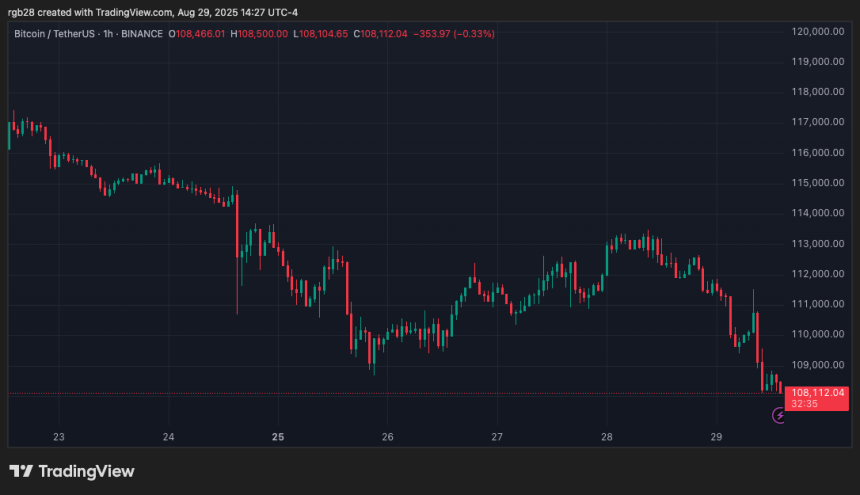
Bitcoin lost the $110,000 support for the first time in nearly two months, dipping below the lower boundary of its local range, between $108,700-$119,500. The flagship crypto hit an eight-week low of $107,900 on Friday afternoon, raising concerns for its short-term rally among investors.

Crypto analyst Ali Martinez suggested that the market is starting to show signs of fatigue, with Bitcoin Dominance displaying cracks after carrying “the bulk of the bull market momentum.”

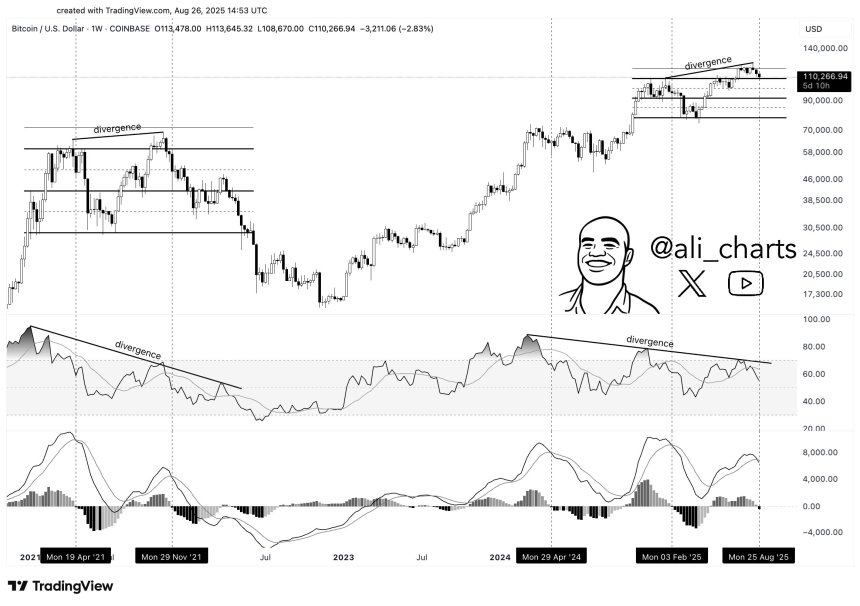
To the analyst, BTC’s current price action signals a macro trend shift, mirroring the 2021 price action and the conditions that preceded the 2021 cycle peak. At the time, the cryptocurrency hit a peak of $60,000 in April, retraced, rallied to $70,000, and set a strong bearish divergence against the Relative Strength Index (RSI) before the bear market began.
bitcoin

This time, Bitcoin is showing the same setup that foreshadowed the end of the last cycle, with price making higher highs while the RSI makes lower lows, Martinez explained.

Among other technical signals, the analyst highlighted that the MACD indicator had turned bearish this week. He detailed that this bearish crossover aligns with the price drop and reinforces the downside risks.

Meanwhile, he added that the recent death cross in the Bitcoin MVRV Momentum indicator “signals a macro momentum reversal from positive to negative. This is a historically reliable warning sign of cyclical tops.”

The analyst affirmed that the on-chain evidence suggests Bitcoin’s top may be in, at least temporarily, with bias shifting bearish and a risk of retesting lower support levels.

Will BTC Mirror Its 2021 Drop?

Martinez also noted that the $108,700 support is crucial for BTC’s short-term performance, as a weekly close below this area would confirm a deeper trend shift, which occurred in 2021.

After peaking in late 2021, the flagship crypto lost its local range above the $58,000 mark, which led to a retest of the macro range’s mid-zone and an eventual drop below the macro range’s lows in the coming months.

If BTC loses its immediate technical floor, the price could retest the $104,500 and $97,000 support levels, risking a drop to the mid-zone of the macro range, around the $94,000 area.

Altcoin Sherpa weighed in on the cryptocurrency’s performance, stating that Bitcoin should have strong support between the $103,000-$108,000 levels, as the 200-day Exponential Moving Average (EMA) sits around the $104,000 mark.

However, analyst Ted Pillows considers that $124,000 appears to be the local top. He explained that, historically, Bitcoin’s bottoms occur after a retest of the weekly 60 EMA, which currently sits around the $92,000 support zone and has a CME gap.

“In this scenario, Bitcoin will start a reversal after 3-4 weeks and a new ATH by November/December,” Ted concluded.

As of this writing, Bitcoin trades at $107,947, a 7.5% decline in the weekly timeframe.
bitcoin, btc, btcusdt
Market Opportunity
LETSTOP Logo
LETSTOP Price(STOP)
$0.01838
$0.01838$0.01838
+1.37%
USD
LETSTOP (STOP) Live Price Chart
Disclaimer: The articles reposted on this site are sourced from public platforms and are provided for informational purposes only. They do not necessarily reflect the views of MEXC. All rights remain with the original authors. If you believe any content infringes on third-party rights, please contact [email protected] for removal. MEXC makes no guarantees regarding the accuracy, completeness, or timeliness of the content and is not responsible for any actions taken based on the information provided. The content does not constitute financial, legal, or other professional advice, nor should it be considered a recommendation or endorsement by MEXC.

You May Also Like

Cashing In On University Patents Means Giving Up On Our Innovation Future

Cashing In On University Patents Means Giving Up On Our Innovation Future

The post Cashing In On University Patents Means Giving Up On Our Innovation Future appeared on BitcoinEthereumNews.com. “It’s a raid on American innovation that would deliver pennies to the Treasury while kneecapping the very engine of our economic and medical progress,” writes Pipes. Getty Images Washington is addicted to taxing success. Now, Commerce Secretary Howard Lutnick is floating a plan to skim half the patent earnings from inventions developed at universities with federal funding. It’s being sold as a way to shore up programs like Social Security. In reality, it’s a raid on American innovation that would deliver pennies to the Treasury while kneecapping the very engine of our economic and medical progress. Yes, taxpayer dollars support early-stage research. But the real payoff comes later—in the jobs created, cures discovered, and industries launched when universities and private industry turn those discoveries into real products. By comparison, the sums at stake in patent licensing are trivial. Universities collectively earn only about $3.6 billion annually in patent income—less than the federal government spends on Social Security in a single day. Even confiscating half would barely register against a $6 trillion federal budget. And yet the damage from such a policy would be anything but trivial. The true return on taxpayer investment isn’t in licensing checks sent to Washington, but in the downstream economic activity that federally supported research unleashes. Thanks to the bipartisan Bayh-Dole Act of 1980, universities and private industry have powerful incentives to translate early-stage discoveries into real-world products. Before Bayh-Dole, the government hoarded patents from federally funded research, and fewer than 5% were ever licensed. Once universities could own and license their own inventions, innovation exploded. The result has been one of the best returns on investment in government history. Since 1996, university research has added nearly $2 trillion to U.S. industrial output, supported 6.5 million jobs, and launched more than 19,000 startups. Those companies pay…
Share
BitcoinEthereumNews2025/09/18 03:26
XRP Ledger Unlocks Permissioned Domains With 91% Validator Backing

XRP Ledger Unlocks Permissioned Domains With 91% Validator Backing

XRP Ledger activated XLS-80 after 91% validator approval, enabling permissioned domains for credential-gated use on the public XRPL. The XRP Ledger has activated
Share
LiveBitcoinNews2026/02/06 13:00
TrendX Taps Trusta AI to Develop Safer and Smarter Web3 Network

TrendX Taps Trusta AI to Develop Safer and Smarter Web3 Network

The purpose of collaboration is to advance the Web3 landscape by combining the decentralized infrastructure of TrendX with AI-led capabilities of Trusta AI.
Share
Blockchainreporter2025/09/18 01:07