

How do traditional financial institutions adopt cryptocurrencies in stages?
By Chainalysis
Compiled by: Felix, PANews
Cryptocurrencies have become a mainstream asset class over the past few years, with institutional investment being a factor driving global adoption. In 2024, several notable developments solidified cryptocurrencies’ place in traditional finance (TradFi). Institutions such as BlackRock, Fidelity, and Grayscale launched Bitcoin and Ethereum ETPs, providing retail and institutional investors with an easier channel to access these digital assets. These financial products have turned people’s attention to understanding the investment value of cryptocurrencies versus traditional securities.
In addition, the tokenization of real-world assets (such as bonds and real estate) is also becoming more popular, enhancing the liquidity and accessibility of financial markets. Siemens issued a $330 million digital bond, indicating that traditional financial institutions (FIs) are adopting blockchain to improve operational efficiency. While many similar institutions have begun to incorporate crypto technology into their service offerings, others are still in the evaluation stage.
This article outlines the considerations for launching a cryptocurrency product, allowing financial institutions to assess market opportunities while addressing regulatory and compliance requirements.
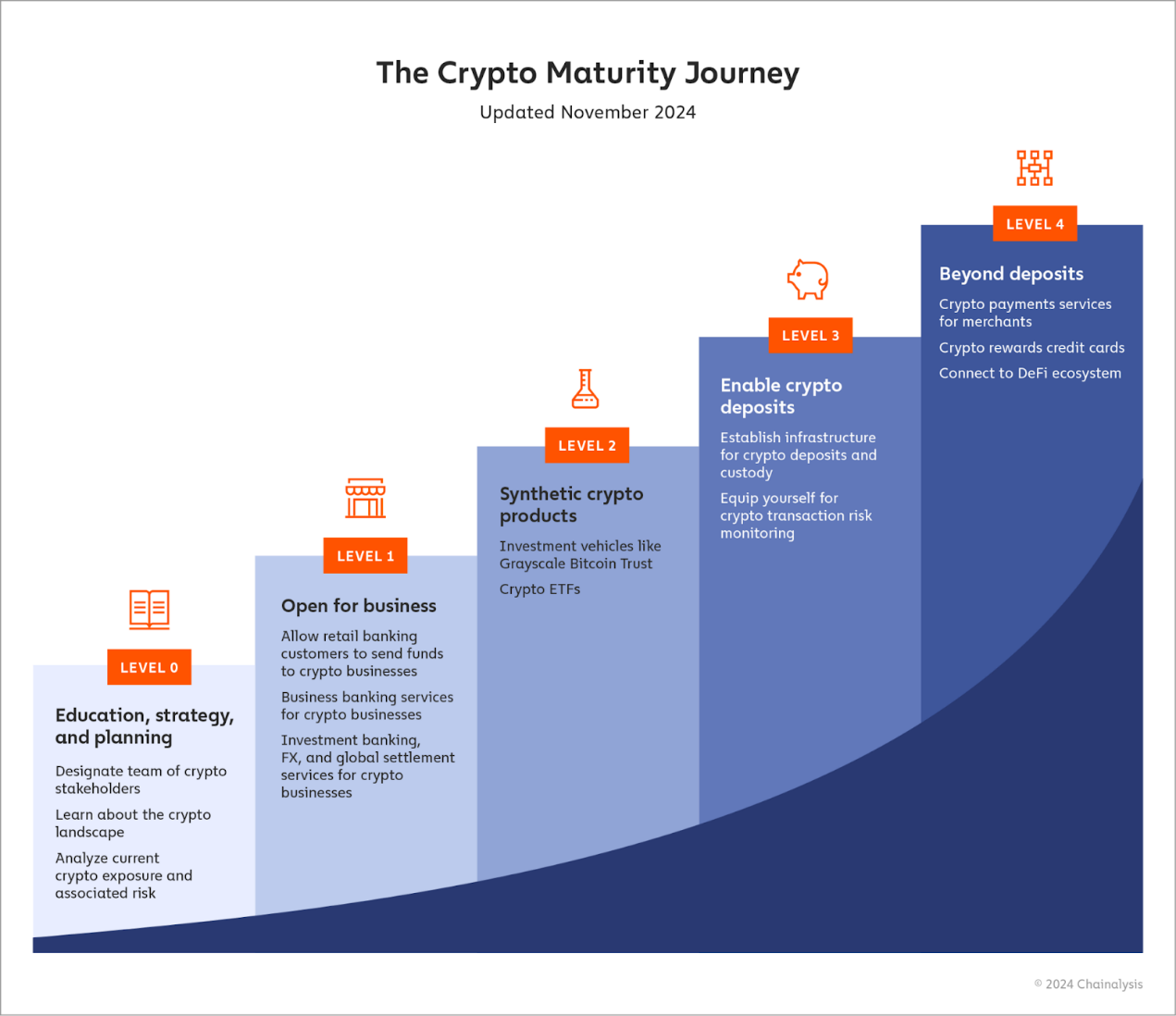
This article explores five typical levels of cryptocurrency adoption by financial institutions:
- Level 0: Education, Strategy and Planning
- Level 1: Open for business
- Level 2: Synthetic Cryptocurrency Products
- Level 3: Enabling Cryptocurrency Deposits
- Level 4: Complex products, DeFi, etc.
Level 0 : Education, Strategy and Planning
Considering entering the crypto space usually starts with designating key stakeholders across multiple functions, as well as a person to lead this effort. This person may be hired from the crypto industry, although external hiring can also wait until open business, when the business is looking at how to support cryptocurrencies or launch crypto initiatives. In general, designated stakeholders can be divided into two categories:
People who work directly with cryptocurrencies or crypto businesses; such as investment bankers, commercial bankers, traders, corporate lenders and wealth managers.
Corporate risk professionals who will determine which crypto products are viable, such as those specializing in market risk, KYC, AML/CFT, sanctions, financial crime and fraud, and compliance.
The above are just a list, but these two groups will be the largest players in the launch of any crypto product. However, when these products become a reality, they will likely require company-wide coordination and support, as well as executive buy-in and involvement.
Once the initial crypto team is established, bring them together to figure out how to enter crypto in a way that fits within the institution’s risk appetite and identify the learning gaps that must be filled to properly assess the risk of any crypto opportunity, including any compliance risks. This part includes training the team to use blockchain analysis tools.
Banks at Level 0 can also start by looking at their current cryptocurrency exposure and measuring the resulting risks. Given the current level of adoption, many banks have some financial connection to the cryptocurrency industry, whether through retail banking programs, cross-border treasury services, or corporate lending programs. In doing so, banks may need to understand the specific crypto businesses they or their customers interact with and consider screening them using industry intelligence tools.
Ultimately, any financial institution interested in entering the crypto space should start by learning as much as possible about the industry. There are many resources available.
- Educational content: Industry leaders regularly publish content that can help institutions better understand the opportunities and risks in the crypto ecosystem.
- Social Media: The crypto industry is one of the most active on social media, and Crypto X is a key focus. For example, Vitalik regularly posts his views on the latest industry developments, and a large number of insightful online journalists, commentators, and lay investigators follow him.
- Community: Crypto communities are also widely available for real-time conversations, as almost every project has its own Discord or Telegram channel for users to gather and chat. One hour in an active channel can be equivalent to several hours of research. In addition, these chats often provide opportunities for face-to-face meetings and socializing.
- Personalized consultation: You can make an appointment with an expert to learn how to better use these tools and get more industry information.
Level 1 : Open for business
Once a financial institution has designated its key stakeholders, educated them about the crypto ecosystem, and established its risk appetite and compliance procedures, it can start thinking about its customers. The first step is to start supporting and interacting with crypto businesses, just as you would with any other business.
On the retail banking side, this means allowing clients to transact with crypto businesses that match their risk appetite. Historically, financial institutions have been unable to make accurate assessments of retail banking businesses.
The lack of a standardized regulatory framework, reliable data sources, and transparency into crypto market activity has led to lower exposure to clients and other crypto counterparties, which has made it challenging to effectively assess risk. But with tools such as crypto compliance solutions, many banks have successfully modified their processes to properly assess the risks of individual crypto businesses and expand their exposure to the industry in a safe and regulated manner.
Crypto-friendly banks can also start accepting cryptocurrency businesses as customers. Notably, BankProl (formerly Provident Bank), one of the oldest banks in the United States, now offers services specifically for crypto businesses, including USD-denominated accounts and crypto-to-fiat conversions. Banks such as AllyBank and Monzo also allow customers to connect their accounts with external cryptocurrency exchanges, reducing friction between crypto and TradFi and making it easier for users to manage their cryptocurrencies alongside traditional assets.
Banks can provide more services to crypto customers. For example, in 2018, JP Morgan ChaseUPMC and Goldman Sachs advised Coinbase to go public through a direct listing. Recently, Coinbase sought consulting services from M&A expert Architect Partners to acquire derivatives exchange FairX, after Architect merged with crypto investment bank Emergent. Many crypto companies have now grown into global businesses and also need foreign exchange (FX) services, as well as more powerful global settlement mechanisms.
Architect’s acquisition of Emergent highlights another key need: crypto expertise that Architect needs in order to move into the crypto space. Fortunately, this can be achieved through targeted hiring rather than full-scale acquisitions. Building one or more digital asset teams means recruiting experienced crypto experts in key areas such as compliance, security, and other specific services the company hopes to provide.
Level 2 : Synthetic Cryptocurrency Products
Once a bank gets used to working with crypto businesses, it may want to help retail and institutional clients gain exposure to the crypto market. However, this does not mean that it must accept cryptocurrency deposits or hold cryptocurrencies on behalf of its clients. Instead, financial institutions can offer synthetic investment products based on cryptocurrencies, allowing clients to gain some of the upside of cryptocurrencies without actually accepting cryptocurrency deposits.
In 2024, Bitcoin ETPs became the breakthrough vehicle for providing exposure to cryptocurrencies. The most prominent ETPs are BlackRock’s iShares Bitcoin Trust (lBlT) and Fidelity’s Wise Origin Bitcoin ETP (FBTC), both of which hold Bitcoin. Similarly, Ethereum ETPs have also gained traction. Major funds such as VanEck and ArkInvest’s Ethereum ETPs were launched in 2024, allowing investors to indirectly hold Ether, the native token of the Ethereum network. Given the crucial role Ethereum and smart contracts play in DeFi, these ETPs provide a direct way to invest in the development of blockchain.
Looking ahead, it is possible that ETPs will appear on other blockchains such as Solana. Although ETPs such as Solana have not yet been approved, investors can already invest through products such as Grayscale's SolanaTrust (GSOL). As the Solana blockchain ecosystem continues to expand, it is likely that more ETPs will appear to meet the growing needs of investors.
Level 3 : Enabling crypto deposits
At Level 3, banks give clients direct access to crypto markets, allowing deposits of digital assets and potentially even safekeeping them on their behalf. In 2024, while only a handful of traditional financial institutions have taken this step, growing interest from both retail and institutional clients is driving more banks to support crypto deposits.
Similarly, rather than building a transaction monitoring tool from scratch, Bank of New York integrated Chainalysis software and used our product suite to conduct real-time transaction monitoring, view real-time risk information on crypto companies that clients may interact with, and investigate suspicious activity. This enabled us to launch crypto solutions faster and with fewer resources invested up front, while also leveraging crypto-native expertise.
Fortunately, financial institutions are not exploring this space alone. Partnering with crypto-native companies allows banks to outsource the technical complexity of holding digital assets. BNY Mellon launched its own digital asset custody solution in 2022. Instead of building the entire platform themselves, BNY Mellon partnered with digital asset security company Fireblocks to get the infrastructure they needed.
Level 4 : Complex products, DeFi, etc.
When it comes to cryptocurrency adoption, few financial institutions are offering products beyond accepting deposits, but that doesn’t mean it’s unheard of. For example, Fidelity has expanded its custody services to allow institutional clients to pledge Bitcoin as collateral in DeFi-based loans, while SEBA Bank continues to work with DeFi native companies such as DeFi Technologies, which is perhaps the fastest-growing and most exciting area in cryptocurrency.
Payments are another area where cryptocurrency adoption is advancing. Visa continues to lead this space, recently expanding its stablecoin settlement capabilities to allow USDC to be traded with merchant acquirers. Similarly, PMC’s IP Coin continues to support commercial transaction payments, further integrating blockchain into traditional banks.
Conclusion
As cryptocurrency becomes increasingly mainstream, banks are recognizing the ways it can help customers while driving revenue and trying to incorporate it into their larger strategy. While it may seem daunting at first glance, banks can adopt cryptocurrency in a structured, incremental way that allows them to test and improve their offerings every step of the way.
The key is to determine the right types of products and services to build at each step, and the inherent transparency of cryptocurrency makes this easier. With the right tools, financial institutions can interact with blockchain-based transaction data with their own proprietary records, observe how funds flow between different types of wallets and services, and use this data to inform business decisions, determining which crypto services are best for their desired customer base. From there, it's a matter of hiring the right talent or partnering with the right crypto-native businesses to build the necessary infrastructure and compliance tools for new cryptocurrency products.
Related reading: Japanese listed company Remixpoint purchased $5.27 million in crypto assets and sold its exchange to SBI after being stolen
You May Also Like

Botanix launches stBTC to deliver Bitcoin-native yield

Unprecedented Surge: Gold Price Hits Astounding New Record High
