Christie’s the world’s largest art auction house, its shuttering its digital art division, home to many NFTs. The institution hosted a $69 million NFT auction in 2021, helping kickstart the sector’s fame. Theoretically, the firm may continue selling NFTs in the “21st Century Art” category, but this seems unlikely. The Art World Ditches NFTs The NFT sector took the world by storm in 2022, but the broader Web3 sector has largely moved on. Although there was a brief revival earlier this year, and the space is still exploring use cases, this is unrelated to their purported use as an art form. Christie’s, the world’s largest art auction house, is shuttering all its NFT services: “Christie’s has made a strategic decision to reformat digital art sales. The company will continue to sell digital art within the larger 20th and 21st Century Art category,” the institution claimed in a statement. This may seem like a minor development, but the art auction house is very key to NFT history. In 2021, Christie’s made history by selling an NFT collection for $69 million. This largely helped trigger the technology’s rise to fame, powering the gains of 2022. Christie’s even launched an on-chain auction platform as a show of confidence. It may be difficult to see why that confidence is gone today. Objectively, NFTs aren’t performing much worse than they have been in 2023 or 2024. For one, the top NFT collections’ trading volume increased by nearly 90% in the last 24 hours. The sector’s most recent peak is smaller than in 2024, but it’s not a significant drop. NFT Market Caps. Source: CoinGecko More Than Volumes and Market Caps Unfortunately, though, stats like that are irrelevant to NFTs’ place in the art world. Years ago, serious artists heralded them as an important future for digital art, and famous creators have launched their own collections on many occasions. In 2025, though, this use case has apparently fallen out of favor. Simply put, the art world has moved on. Decisions like this are key “intangibles” in the market, and investors shouldn’t take them lightly. Would NFTs have ever taken off if major institutions like Christie’s didn’t think they were legitimate art? If the exact same organizations have lost their faith in NFTs, who will keep it alive? This development may serve as a canary in the coal mine. The NFT sector isn’t dead yet, but its oldest friends are abandoning it. Although it may linger on for quite some time, a full return to the limelight seems unlikely.Christie’s the world’s largest art auction house, its shuttering its digital art division, home to many NFTs. The institution hosted a $69 million NFT auction in 2021, helping kickstart the sector’s fame. Theoretically, the firm may continue selling NFTs in the “21st Century Art” category, but this seems unlikely. The Art World Ditches NFTs The NFT sector took the world by storm in 2022, but the broader Web3 sector has largely moved on. Although there was a brief revival earlier this year, and the space is still exploring use cases, this is unrelated to their purported use as an art form. Christie’s, the world’s largest art auction house, is shuttering all its NFT services: “Christie’s has made a strategic decision to reformat digital art sales. The company will continue to sell digital art within the larger 20th and 21st Century Art category,” the institution claimed in a statement. This may seem like a minor development, but the art auction house is very key to NFT history. In 2021, Christie’s made history by selling an NFT collection for $69 million. This largely helped trigger the technology’s rise to fame, powering the gains of 2022. Christie’s even launched an on-chain auction platform as a show of confidence. It may be difficult to see why that confidence is gone today. Objectively, NFTs aren’t performing much worse than they have been in 2023 or 2024. For one, the top NFT collections’ trading volume increased by nearly 90% in the last 24 hours. The sector’s most recent peak is smaller than in 2024, but it’s not a significant drop. NFT Market Caps. Source: CoinGecko More Than Volumes and Market Caps Unfortunately, though, stats like that are irrelevant to NFTs’ place in the art world. Years ago, serious artists heralded them as an important future for digital art, and famous creators have launched their own collections on many occasions. In 2025, though, this use case has apparently fallen out of favor. Simply put, the art world has moved on. Decisions like this are key “intangibles” in the market, and investors shouldn’t take them lightly. Would NFTs have ever taken off if major institutions like Christie’s didn’t think they were legitimate art? If the exact same organizations have lost their faith in NFTs, who will keep it alive? This development may serve as a canary in the coal mine. The NFT sector isn’t dead yet, but its oldest friends are abandoning it. Although it may linger on for quite some time, a full return to the limelight seems unlikely.

World’s Largest Art Auction House Is Shutting Down Its NFT Division

2025/09/09 07:07
2 min read

Christie’s the world’s largest art auction house, its shuttering its digital art division, home to many NFTs. The institution hosted a $69 million NFT auction in 2021, helping kickstart the sector’s fame.

Theoretically, the firm may continue selling NFTs in the “21st Century Art” category, but this seems unlikely.

The Art World Ditches NFTs

The NFT sector took the world by storm in 2022, but the broader Web3 sector has largely moved on. Although there was a brief revival earlier this year, and the space is still exploring use cases, this is unrelated to their purported use as an art form. Christie’s, the world’s largest art auction house, is shuttering all its NFT services:

This may seem like a minor development, but the art auction house is very key to NFT history. In 2021, Christie’s made history by selling an NFT collection for $69 million.

This largely helped trigger the technology’s rise to fame, powering the gains of 2022. Christie’s even launched an on-chain auction platform as a show of confidence.

It may be difficult to see why that confidence is gone today. Objectively, NFTs aren’t performing much worse than they have been in 2023 or 2024. For one, the top NFT collections’ trading volume increased by nearly 90% in the last 24 hours. The sector’s most recent peak is smaller than in 2024, but it’s not a significant drop.
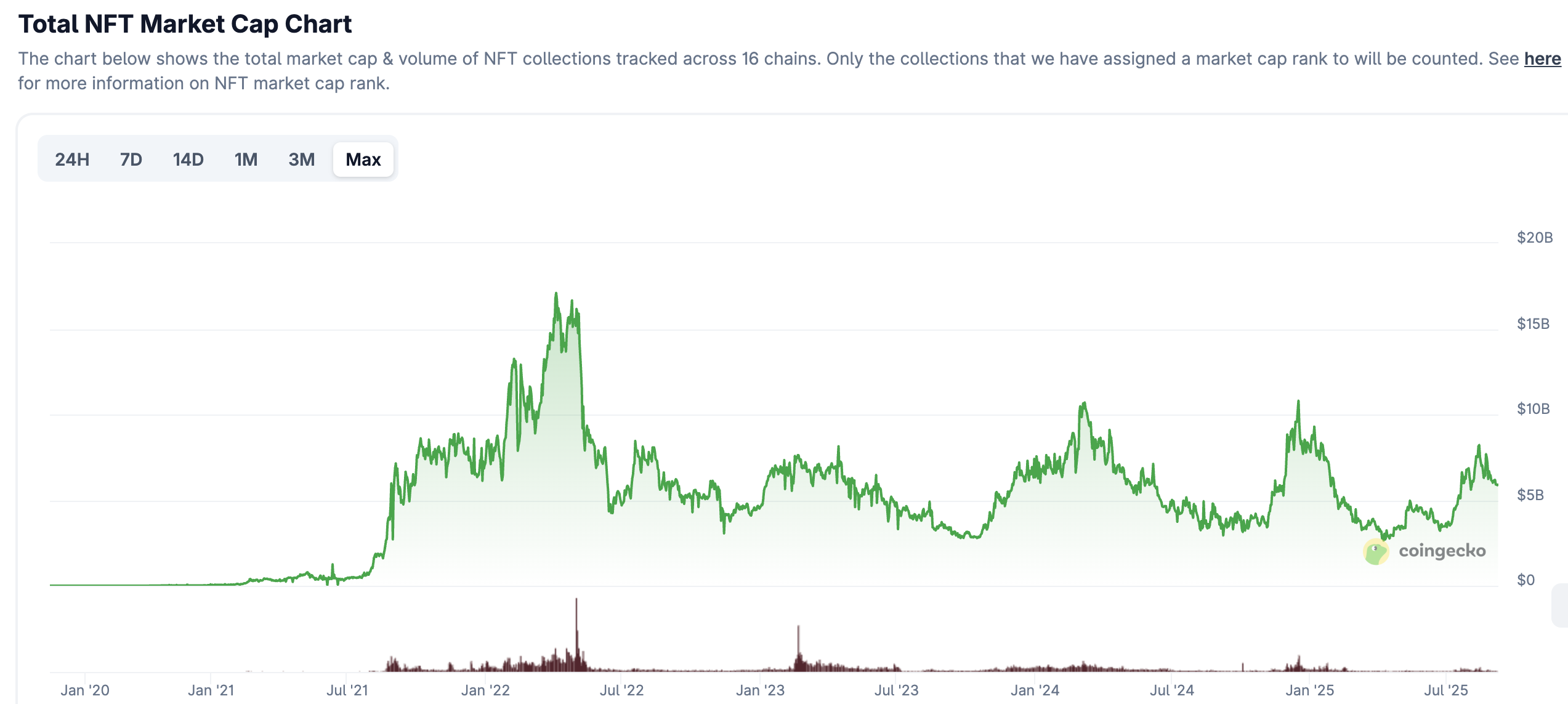
NFT Market CapsNFT Market Caps. Source: CoinGecko

More Than Volumes and Market Caps

Unfortunately, though, stats like that are irrelevant to NFTs’ place in the art world. Years ago, serious artists heralded them as an important future for digital art, and famous creators have launched their own collections on many occasions.

In 2025, though, this use case has apparently fallen out of favor. Simply put, the art world has moved on.

Decisions like this are key “intangibles” in the market, and investors shouldn’t take them lightly. Would NFTs have ever taken off if major institutions like Christie’s didn’t think they were legitimate art? If the exact same organizations have lost their faith in NFTs, who will keep it alive?

This development may serve as a canary in the coal mine. The NFT sector isn’t dead yet, but its oldest friends are abandoning it. Although it may linger on for quite some time, a full return to the limelight seems unlikely.

Market Opportunity
Threshold Logo
Threshold Price(T)
$0.006792
$0.006792$0.006792
-1.13%
USD
Threshold (T) Live Price Chart
Disclaimer: The articles reposted on this site are sourced from public platforms and are provided for informational purposes only. They do not necessarily reflect the views of MEXC. All rights remain with the original authors. If you believe any content infringes on third-party rights, please contact [email protected] for removal. MEXC makes no guarantees regarding the accuracy, completeness, or timeliness of the content and is not responsible for any actions taken based on the information provided. The content does not constitute financial, legal, or other professional advice, nor should it be considered a recommendation or endorsement by MEXC.

You May Also Like

Vàng Cán Mốc Lịch Sử 5.000 USD: Khi Dự Báo Của CEO Bitget Gracy Chen Trở Thành Hiện Thực Và Tầm Nhìn Về Đích Đến 5.400 USD

Vàng Cán Mốc Lịch Sử 5.000 USD: Khi Dự Báo Của CEO Bitget Gracy Chen Trở Thành Hiện Thực Và Tầm Nhìn Về Đích Đến 5.400 USD

Thị trường tài chính toàn cầu vừa chứng kiến một khoảnh khắc lịch sử chấn động: Giá Vàng thế giới [...] The post Vàng Cán Mốc Lịch Sử 5.000 USD: Khi Dự Báo Của
Share
Vneconomics2026/02/10 16:26
Why the Bitcoin Boom Is Not Another Tulip Mania

Why the Bitcoin Boom Is Not Another Tulip Mania

Bitcoin is an amazing success story. It was only invented in January of 2009 and was only worth a tiny fraction of a cent for each token. Over just a few years
Share
Medium2026/02/10 15:44
Non-Opioid Painkillers Have Struggled–Cannabis Drugs Might Be The Solution

Non-Opioid Painkillers Have Struggled–Cannabis Drugs Might Be The Solution

The post Non-Opioid Painkillers Have Struggled–Cannabis Drugs Might Be The Solution appeared on BitcoinEthereumNews.com. In this week’s edition of InnovationRx, we look at possible pain treatments from cannabis, risks of new vaccine restrictions, virtual clinical trials at the Mayo Clinic, GSK’s $30 billion U.S. manufacturing commitment, and more. To get it in your inbox, subscribe here. Despite their addictive nature, opioids continue to be a major treatment for pain due to a lack of effective alternatives. In an effort to boost new drugs, the FDA released new guidelines for non-opioid painkillers last week. But making these drugs hasn’t been easy. Vertex Pharmaceuticals received FDA approval for its non-opioid Journavx in January, then abandoned a next generation drug after a failed clinical trial earlier this summer. Acadia similarly abandoned a promising candidate after a failed trial in 2022. One possible basis for non-opioids might be cannabis. Earlier this year, researchers at Washington University at St. Louis and Stanford published a study showing that a cannabis-derived compound successfully eased pain in mice with minimal side effects. Munich-based pharmaceutical company Vertanical is perhaps the furthest along in this quest. It is developing a cannabinoid-based extract to treat chronic pain it hopes will soon become an approved medicine, first in the European Union and eventually in the United States. The drug, currently called Ver-01, packs enough low levels of cannabinoids (including THC) to relieve pain, but not so much that patients get high. Founder Clemens Fischer, a 50-year-old medical doctor and serial pharmaceutical and supplement entrepreneur, hopes it will become the first cannabis-based painkiller prescribed by physicians and covered by insurance. Fischer founded Vertanical, with his business partner Madlena Hohlefelder, in 2017, and has invested more than $250 million of his own money in it. With a cannabis cultivation site and drug manufacturing plant in Denmark, Vertanical has successfully passed phase III clinical trials in Germany and expects…
Share
BitcoinEthereumNews2025/09/18 05:26