

DeSci Manifesto: How decentralized science can “disrupt” scientific research?
Author: @mattigags
Compiled by: Felix, PANews
Recently, Binance Labs announced its investment in the decentralized science (DeSci) protocol BIO Protocol. This is also the first time that Binance Labs has invested in a project in the DeSci track (PANews note: CZ also participated in a DeSci-themed event during Devcon in Thailand). However, there are relatively few studies on the DeSci track. This article aims to explore the value and significance of DeSci and how it will "disrupt" scientific research.
The word Science has recently been misused to support dogmatism, resulting in the term being misinterpreted or misunderstood to a great extent. Using science as a religious prayer to solve something goes against the original spirit of science.
According to David Deutsch's definition, science is the pursuit of better explanations, not a set of ultimate truths. Science is about the discovery of new knowledge, which itself is infinite, and new knowledge that better explains the world replaces old knowledge. Therefore, science is self-correcting and constantly evolving.
The De in DeSci refers to decentralization, a set of underlying technologies that will help revolutionize the way scientific research is funded. Trusted neutral currency and finance can quickly mobilize capital around the world in a permissionless manner.
Many people often go beyond “decentralization” and jokingly refer to “degen” as part of DeSci. Financial degens are a meme archetype that describes a person who takes risks when trading crypto assets. In this case, a degen is redefined as someone who gambles on the results of a scientific experiment. Risk-taking is a necessary part of unlocking new knowledge, and it comes with negative consequences for the individual, but also greater consequences for the whole.
Many people like to portray the scientists of Degen as independent Victorian scientists. People like Michael Faraday. He often funded risky experiments and was Degen. The original scientists were truly curious entrepreneurs who took risks rather than trained professionals.
This was before governments became the main sponsors of science and academia became a bureaucracy. Today science is increasingly dependent on politics and rules, limiting the ability to find new knowledge. Politics breeds obedience and subjection to power.
It can be argued that science has strayed from the spiritual core of its early pioneering days of the Enlightenment, when science attracted more adventurous people who were keen on seeking knowledge and whose views were very controversial. Disobedience is part of breaking through the status quo or bottleneck.
DeSci is thus a way to decouple research from existing power structures where incentives are misaligned for rapid progress. In summary, DeSci can be defined as experimental exploration for better explanations independent of institutional or state-controlled funding. It is market over status with the explicit goal of discovering information quickly. Is this the best option for achieving rapid technological progress?
3 arguments
During the Enlightenment, what had once been an exclusive privilege was granted to a wider audience. The rapid development of science and industry in the 18th century was built on these expanding freedoms. Knowledge began to increase rapidly.
Cryptocurrency is fundamentally about promoting freedom by enabling permissionless access to (new) markets. It is opening up the exclusive prerogatives of organizations such as central and commercial banks, brokers and custodians to the public, and there is nothing inherently meaningful about tying politics and power to markets.

Today, as science becomes increasingly dependent on authoritarianism, the state, politics and power, it is becoming a bureaucracy with institutions operating on “autopilot” and disproportionately favouring regulation over experimentation.
To paraphrase Nietzsche, cryptocurrencies inject a bit of Dionysus into the Apollonian spirit; injecting primitive experimentation into fragile, bloated bureaucracies, opening up new possibilities for introducing cutting-edge technologies to the market.
This is not without its drawbacks. The frontier is often disorderly and profits are more illusory than real. The question is whether the overall benefits outweigh the costs. The author's point is that while most DeSci projects will fail, the few winners can achieve very positive results. Just like startups, most fail and only a few thrive.
To further elaborate on the overall view of DeSci, the author presents three independent arguments that are intertwined but can be considered separately.
- Philosophical argument: DeSci decouples science from academia, bureaucracy, and government funding by introducing crypto incentives and funding. Scientists become entrepreneurial tinkerers rather than bureaucrats optimizing grants.
- Degen's argument: Biotech stocks are known for volatility and direct gambling on clinical trial results. If you can bet on the results of trials and make it a research program early, Degens may launch "outrageous" research tokens on pump.science (rather than memecoin).
- Business argument: DeSci brings science closer to the masses through open funding. Science becomes a product that users can buy and own. Imagine memecoin is a brand with real utility or promise.

Tokens are access rights
Similar to how facts are selected based on ideology, we may be entering an era of consumption where culture is more important than the product itself. Crypto has always been selling culture rather than product. Since Bitcoin, Ethereum, and Solana are all in the market for selling block space, a commodity that is plentiful for some reason, a premium is attributed to specific tokens.
Arguably, security is higher on more mature and expensive chains, so it’s not necessarily just a premium commodity. But the meme premium comes into play. The rotation of narratives is more important than actual progress. In a way, the token has become a combination of brand and product.
The memecoin craze is an extension of this craze. Pump.fun made $150 million in a year by introducing memecoins into a simple up-and-down social game. Each token becomes a productized meme with a higher or lower meme premium.
Tokens are a means of expanding markets into new areas, and the productization of memes is a classic example. This tokenized liquidity can be brought to scientific research.
The combination of speculation, commercialization and philosophical reform has opened up new markets for scientific research. R&D is packaged into a brand and sold to consumers. Tokens are a brand for scientific research in a pay-per-use form.
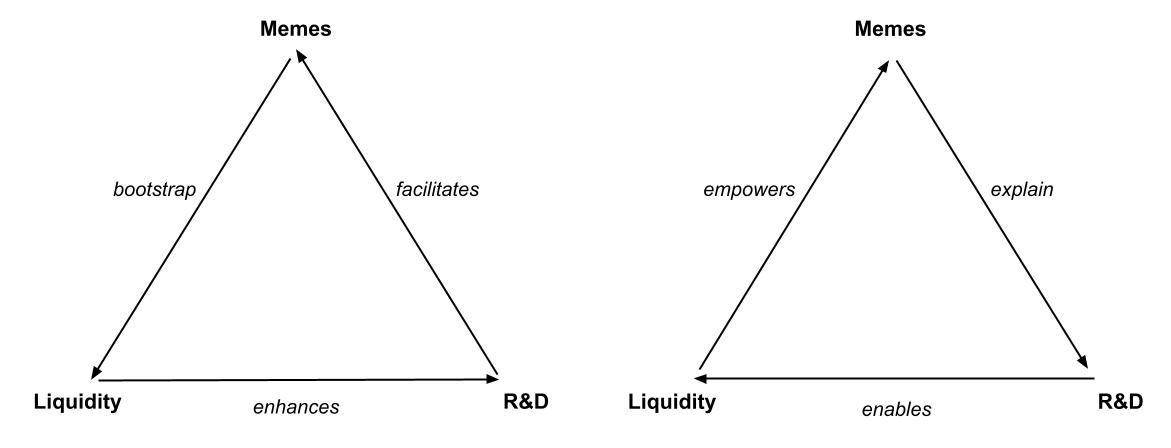
Here we reiterate our understanding of tokens: tokens are products and a novel form of online organization. They can:
- Rapid global capital formation (around purpose/product/R&D, etc.)
- Co-creation and attribution (social recognition + directing financial value to the origin of an idea)
- Alignment of incentives (creating cohesive microeconomic units)
- Governance Agent
Starting with culture and memes, they have the potential to transform consumer culture from UGC to UGP (user generated content to product). Asking if tokens are a form of security is the wrong question, securities will one day be a form of tokens. Is a book a type of bible, or is the bible a type of book?
Plus Ultra
To achieve this, scientific research can be packaged into products along with pop culture memes/culture/icons, and then liquidity or funding can be directed to them through goals/promises. This is a shift from influencer-driven goal-product culture to vision-driven commercialization of science.
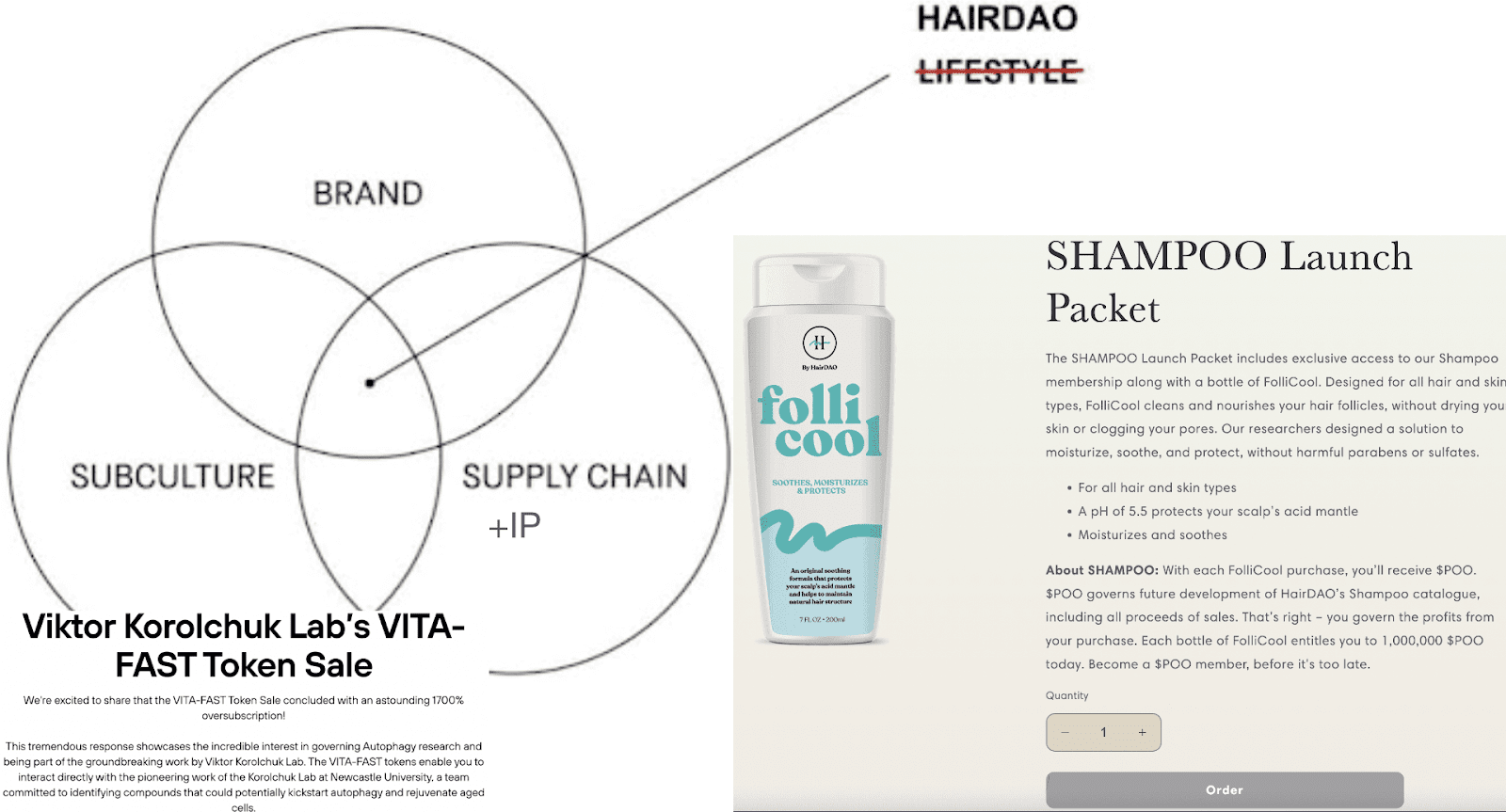
Let science become a completely commercial enterprise, not a tool sanctioned by governments and/or corporations. Just like the journey to the New World a few centuries ago, everyone can fund the very questionable exploration of new territories.
Nick Szabo published a 2006 article titled “How to Succeed or Fail on the Frontier” that compared the voyages of Portuguese sailors from Africa to Japan to build a commercial empire with the PR fleets of 15th-century Chinese emperors. One was an agile commercial enterprise, the other an oversized naval fleet that displayed the emperor’s glory.
Whether it applies to space exploration or Earth science, it is a good idea to explore a more decentralized approach to funding scientific experiments, small or grand. Frontiers should never be a "walled garden of credentials."
This is probably why information technology is advancing so rapidly, and the frontier is not artificially limited. You can be a college dropout and develop technology that changes the world. There is no need to spend years getting a PhD, and the rules of the game are not conducive to experimentation.
To some, this is a radical idea, but just as consumers spend money on products of questionable quality because they belong to an idol (influencer), some of that money could be diverted to scientific research packaged as tokens. Speculation plays a role here, but so do the noble ideas of progress.

We are at the dawn of the DeSci space, with the ability to start science DAOs from the bottom up and build top-down liquidity vectors through protocols like bio.xyz. This bottom-up cultural movement will eventually fund and develop products (conduct scientific research).
Related reading: Why did Binance invest in BIO Protocol? Read DeSci’s new narrative in one article
You May Also Like

Trading time: Tonight, the US GDP and the upcoming non-farm data will become the market focus. Institutions are bullish on BTC to $120,000 in the second quarter.

Ethereum Fusaka Upgrade Set for December 3 Mainnet Launch, Blob Capacity to Double
