The U.S. is about to get its first Dogecoin ETF — and with it, the crypto industry is forced to ask a very uncomfortable question: are we legitimizing a cultural phenomenon, or just dressing up speculation in Wall Street clothes?The U.S. is about to get its first Dogecoin ETF — and with it, the crypto industry is forced to ask a very uncomfortable question: are we legitimizing a cultural phenomenon, or just dressing up speculation in Wall Street clothes?

Dogecoin ETF: A Joke Gone Institutional

2025/09/12 03:01
3 min read
The U.S. is about to get its first Dogecoin ETF — and with it, the crypto industry is forced to ask a very uncomfortable question: are we legitimizing a cultural phenomenon, or just dressing up speculation in Wall Street clothes?

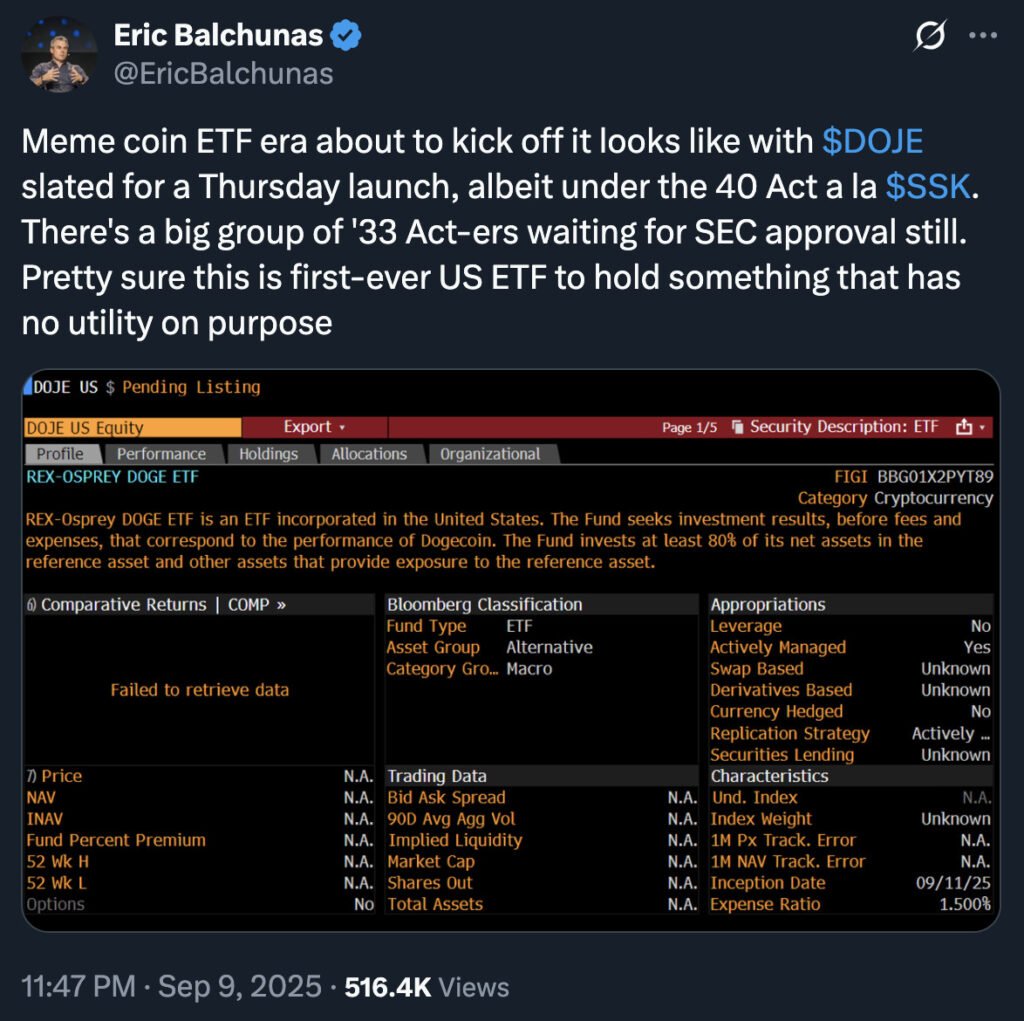
On Thursday, the Rex-Osprey Dogecoin ETF (ticker: DOJE) goes live. Unlike Bitcoin spot ETFs, which are approved under the Securities Act of 1933 and simply hold BTC in custody (BlackRock’s version keeps coins parked with Coinbase), this Dogecoin fund had to squirm its way through a very different legal loophole: the Investment Company Act of 1940. That framework was designed for diversified mutual funds — not single-asset gambles — which is why DOJE had to route exposure through a Cayman Islands subsidiary and use derivatives. Translation: Wall Street lawyers earned their retainers.
The U.S. is about to get its first Dogecoin ETF — and with it, the crypto industry is forced to ask a very uncomfortable question: are we legitimizing a cultural phenomenon, or just dressing up speculation in Wall Street clothes?

Meme coin ETF begins, source: X

Speculation With a Smile

Crypto loves to celebrate new ETFs as milestones, but this one feels different. Critics argue DOJE institutionalizes pure casino energy. Why pay fund fees when you could just buy Dogecoin directly on Coinbase in five minutes, as Brian Huang of Glider points out? He calls the ETF a “ridiculous” way to wrap a single asset — like packaging Tesla stock into a “diversified fund” with a hefty expense ratio.

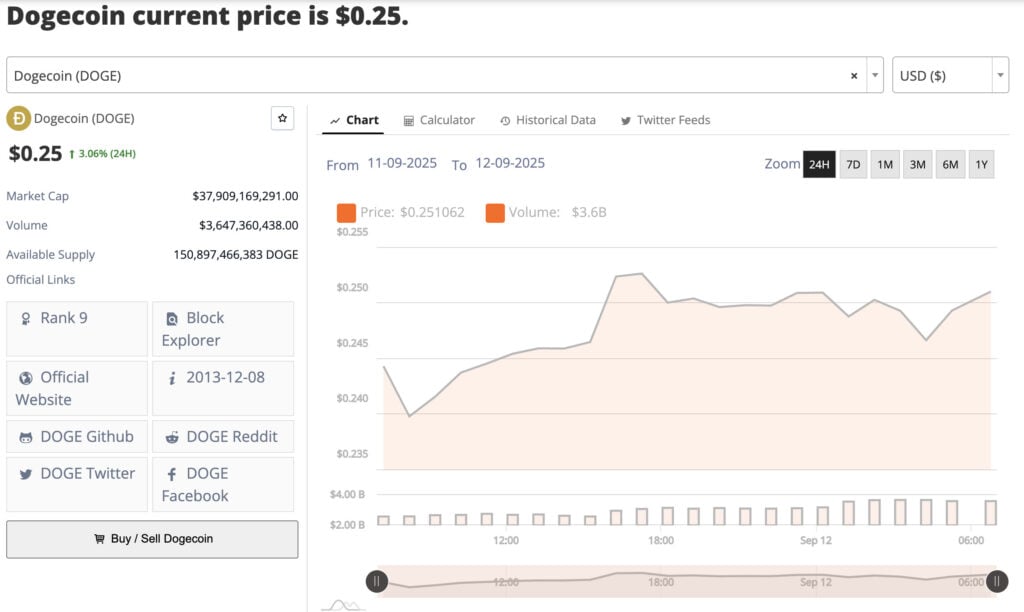
And yet, that’s Dogecoin’s magic trick. Born in 2013 as a joke fork of a fork of a fork (Bitcoin → Litecoin → Luckycoin → Dogecoin), it somehow clawed its way into the top 10 by market cap. It spawned the entire memecoin category, a subculture often dismissed as a distraction from “serious” blockchain projects. Its tokenomics mock Bitcoin’s scarcity fetish — instead of a 21M cap, DOGE has unlimited supply, with 10,000 new coins minted every minute (that’s 5 billion a year). Scarcity maxis hate it; Doge holders don’t care.
The U.S. is about to get its first Dogecoin ETF — and with it, the crypto industry is forced to ask a very uncomfortable question: are we legitimizing a cultural phenomenon, or just dressing up speculation in Wall Street clothes?

Dogecoin is sitting at 0.25c, Source: BNC

The Bigger Picture

Here’s where it gets interesting. By late August, 92 crypto ETP applications were sitting with the SEC — everything from serious altcoins to joke tokens like Pengu (tied to Pudgy Penguins NFTs). The fact that Dogecoin is cutting the line ahead of more “serious” projects says something brutal about crypto’s reality: cultural capital moves faster than technical capital.

Meme vs. Market

So, do we need a Dogecoin ETF? From a functionality standpoint, no. From a narrative standpoint, maybe. For skeptics, this is Wall Street legitimizing a meme while fleecing investors with fees. For optimists, it’s another bridge between retail culture and institutional money.

Here’s the uncomfortable truth: Dogecoin doesn’t need a use case beyond existing as a mirror to the absurdity of modern markets. In that sense, it’s the most honest token of all. A Dogecoin ETF doesn’t blur the line between meme and market — it obliterates it.

If a memecoin can become a regulated ETF, then anything is on the table. And maybe that’s the point.


Market Opportunity
Union Logo
Union Price(U)
$0.001503
$0.001503$0.001503
+3.15%
USD
Union (U) Live Price Chart
Disclaimer: The articles reposted on this site are sourced from public platforms and are provided for informational purposes only. They do not necessarily reflect the views of MEXC. All rights remain with the original authors. If you believe any content infringes on third-party rights, please contact [email protected] for removal. MEXC makes no guarantees regarding the accuracy, completeness, or timeliness of the content and is not responsible for any actions taken based on the information provided. The content does not constitute financial, legal, or other professional advice, nor should it be considered a recommendation or endorsement by MEXC.

You May Also Like

House Judiciary Rejects Vote To Subpoena Banks CEOs For Epstein Case

House Judiciary Rejects Vote To Subpoena Banks CEOs For Epstein Case

The post House Judiciary Rejects Vote To Subpoena Banks CEOs For Epstein Case appeared on BitcoinEthereumNews.com. Topline House Judiciary Committee Republicans blocked a Democrat effort Wednesday to subpoena a group of major banks as part of a renewed investigation into late sex offender Jeffrey Epstein’s financial ties. Congressman Jim Jordan, R-OH, is the chairman of the committee. (Photo by Nathan Posner/Anadolu via Getty Images) Anadolu via Getty Images Key Facts A near party-line vote squashed the effort to vote on a subpoena, with Rep. Thomas Massie, R-Ky., who is leading a separate effort to force the Justice Department to release more Epstein case materials, voting alongside Democrats. The vote, if successful, would have resulted in the issuing of subpoenas to JPMorgan Chase CEO Jamie Dimon, Bank of America CEO Brian Moynihan, Deutsche Bank CEO Christian Sewing and Bank of New York Mellon CEO Robin Vince. The subpoenas would have specifically looked into multiple reports that claimed the four banks flagged $1.5 billion in suspicious transactions linked to Epstein. The failed effort from Democrats followed an FBI oversight hearing in which agency director Kash Patel misleadingly claimed the FBI cannot release many of the files it has on Epstein. Get Forbes Breaking News Text Alerts: We’re launching text message alerts so you’ll always know the biggest stories shaping the day’s headlines. Text “Alerts” to (201) 335-0739 or sign up here. Crucial Quote Dimon, who attended a lunch with Senate Republicans before the vote, according to Politico, told reporters, “We regret any association with that man at all. And, of course, if it’s a legal requirement, we would conform to it. We have no issue with that.” Chief Critic “Republicans had the chance to subpoena the CEOs of JPMorgan, Bank of America, Deutsche Bank, and Bank of New York Mellon to expose Epstein’s money trail,” the House Judiciary Democrats said in a tweet. “Instead, they tried to bury…
Share
BitcoinEthereumNews2025/09/18 08:02
Propel to Report Q4 and Full Year 2025 Financial Results and Announces Dividend Increase

Propel to Report Q4 and Full Year 2025 Financial Results and Announces Dividend Increase

TORONTO, Feb. 10, 2026 /CNW/ – Propel Holdings Inc. (“Propel”) (TSX: PRL), the fintech facilitating access to credit for underserved consumers, announced today
Share
AI Journal2026/02/11 09:15
CME Group to launch options on XRP and SOL futures

CME Group to launch options on XRP and SOL futures

The post CME Group to launch options on XRP and SOL futures appeared on BitcoinEthereumNews.com. CME Group will offer options based on the derivative markets on Solana (SOL) and XRP. The new markets will open on October 13, after regulatory approval.  CME Group will expand its crypto products with options on the futures markets of Solana (SOL) and XRP. The futures market will start on October 13, after regulatory review and approval.  The options will allow the trading of MicroSol, XRP, and MicroXRP futures, with expiry dates available every business day, monthly, and quarterly. The new products will be added to the existing BTC and ETH options markets. ‘The launch of these options contracts builds on the significant growth and increasing liquidity we have seen across our suite of Solana and XRP futures,’ said Giovanni Vicioso, CME Group Global Head of Cryptocurrency Products. The options contracts will have two main sizes, tracking the futures contracts. The new market will be suitable for sophisticated institutional traders, as well as active individual traders. The addition of options markets singles out XRP and SOL as liquid enough to offer the potential to bet on a market direction.  The options on futures arrive a few months after the launch of SOL futures. Both SOL and XRP had peak volumes in August, though XRP activity has slowed down in September. XRP and SOL options to tap both institutions and active traders Crypto options are one of the indicators of market attitudes, with XRP and SOL receiving a new way to gauge sentiment. The contracts will be supported by the Cumberland team.  ‘As one of the biggest liquidity providers in the ecosystem, the Cumberland team is excited to support CME Group’s continued expansion of crypto offerings,’ said Roman Makarov, Head of Cumberland Options Trading at DRW. ‘The launch of options on Solana and XRP futures is the latest example of the…
Share
BitcoinEthereumNews2025/09/18 00:56