📣SPOTIFY PREMIUM RSS FEED | USE CODE: SPOTIFY24 https://bankless.cc/spotify-premium------BlackRock’s Head of Crypto Robbie Mitchnick joins Ryan to unpack ho...📣SPOTIFY PREMIUM RSS FEED | USE CODE: SPOTIFY24 https://bankless.cc/spotify-premium------BlackRock’s Head of Crypto Robbie Mitchnick joins Ryan to unpack ho...

The Bitcoin Future Now Runs On Wall Street Inflows, BlackRock Exec Says

2025/11/12 12:00

BlackRock’s head of crypto, Robbie Mitchnick, says the gravitational center of Bitcoin’s market structure has shifted decisively from miner issuance to exchange-traded fund demand—and that’s why classic four-year “halving cycles” should command far less attention than they used to. In a Bankless interview released November 10, Mitchnick argued that the ETF era is now the dominant flow regime for BTC, even as leverage and short-term derivatives noise continue to whipsaw prices.

ETF Inflows Now Dwarf The Bitcoin Halving

“It’s not over,” Mitchnick said when asked whether the latest sell-off marked the end of Bitcoin’s current cycle. “This is the fifth cycle we’ve seen […] through each successive cycle, the level that Bitcoin reached was massively higher than the prior cycle.” He added a pointed caveat for anyone still treating halvings as the metronome of BTC: “A lot of people believe the cycle is tied to [the] Bitcoin halving. The Bitcoin halving at this point is almost totally irrelevant […] when ETFs are accumulating inflows, the magnitude of those inflows is many, many multiples larger than any change in supply created by a Bitcoin halving event.”

Mitchnick’s framing puts Wall Street, not the protocol schedule, at the center of the next phase. BlackRock’s spot Bitcoin ETF, IBIT, “has been the fastest-growing ETF post-launch in history,” he said, reaching milestones at roughly four times the pace of the previous record. More telling than raw AUM, in his view, is the changing composition of holders. In the first quarter after launch, “IBIT was over 80% direct retail investors. Every quarter thereafter that number has come down […] today it’s close to 50%,” reflecting the steady rise of wealth advisory and institutional channels.

That institutional cohort is still early, but broadening. “If you think about the big categories of institutional investors, you’ve got family offices, asset managers, sovereign wealth funds, university endowments, foundations, corporate treasurers, insurers, pension funds. You have some adopters in every one of those archetypes, but not the majority, not even close,” he said.

For those allocating, typical position sizes land in the “1% to 3% range.” The gating factor, again, is less about custody or access—and more about how Bitcoin behaves inside a portfolio. “It’s all about correlation,” Mitchnick noted, recounting a conversation with a pension CIO who is “literally” watching that metric. If Bitcoin persistently tracks “digital gold” rather than “levered NASDAQ,” he argued, “it’s a slam dunk to put a couple percentage of portfolio allocation in it.”

The tension is that short-term market action still looks like crypto. Mitchnick called the October 10 washout—roughly “$21 billion in liquidations”—a leverage event rather than a shift in fundamentals, and contrasted it with the steadiness of fund buyers: “What was the impact on ETF outflows? Tiny […] a couple hundred million.” That discrepancy, he said, is precisely why cycles should attenuate over time: a larger, slower-moving base of ETF and advisory capital can absorb derivatives-driven shocks without mechanically exiting.

He also pushed back on narratives that Bitcoin’s 2025 underperformance versus gold invalidates the “uncorrelated hedge” thesis. The digital asset, he argued, already banked its “debasement trade” in late 2024, rallying from the “high $60s to over $100K,” and even notched a new all-time high around $126,000 before the October crash “derailed the momentum.” In other words, the year-to-date scoreboard reflects sequencing and leverage, not a structural repudiation of Bitcoin’s store-of-value pitch.

On supply dynamics, Mitchnick acknowledged that legacy cohorts have taken profits at psychological levels, but he dismissed the idea that Bitcoin is in an “IPO moment” where early adopters permanently hand the float to institutions. What’s more plausible, he said, is simple risk management by ultra-early holders whose basis sits at “$100 or $500,” many of whom had $100,000 as a round-number trim target. “At some point you do have to take some chips off the table,” he said, adding that long-term performance has favored patience over short-term, levered trading.

Mitchnick was careful not to oversell universal adoption among big pools of capital. Central banks, he suggested, remain a tail-risk buyer rather than a base case. The near-term path instead runs through the institutions already tiptoeing in—pensions, insurers, sovereign wealth funds—whose conviction will hinge on medium-term behavior and policy clarity.

The message for allocators facing their first full drawdown with ETFs live was direct: don’t mistake derivatives noise for broken fundamentals, and be selective. “There’s a reason Bitcoin is still roughly 65% of the market cap of the space,” he said. “One has to be very wary going far down the table […] the vast majority of [tokens] are or will be totally worthless.”

For Bitcoin, the test is whether it keeps behaving like what institutions think they’re buying. “People have to look beyond these short-term moves […] and more about, you know, medium and longer term how does it track,” Mitchnick said.

At press time, BTC traded at $105,497.
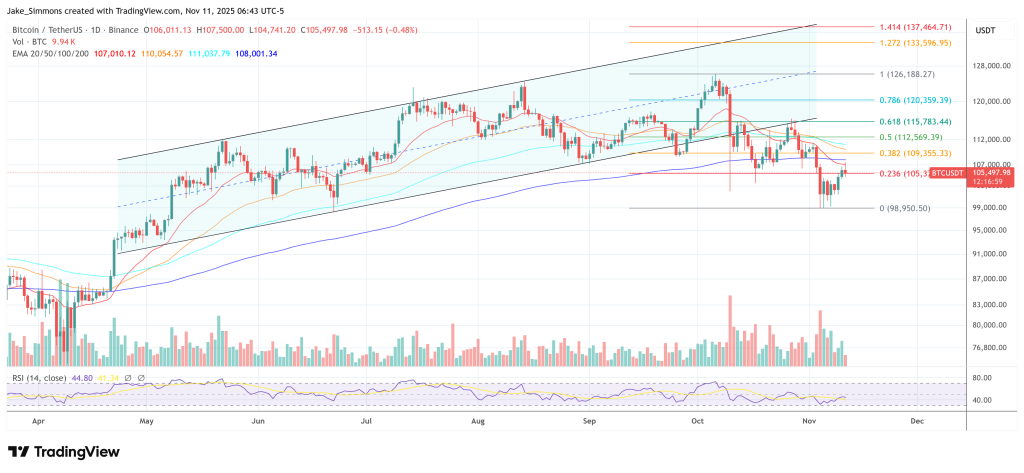
Bitcoin price
Piyasa Fırsatı
FUTURECOIN Logosu
FUTURECOIN Fiyatı(FUTURE)
$0.12086
$0.12086$0.12086
+0.96%
USD
FUTURECOIN (FUTURE) Canlı Fiyat Grafiği
Sorumluluk Reddi: Bu sitede yeniden yayınlanan makaleler, halka açık platformlardan alınmıştır ve yalnızca bilgilendirme amaçlıdır. MEXC'nin görüşlerini yansıtmayabilir. Tüm hakları telif sahiplerine aittir. Herhangi bir içeriğin üçüncü taraf haklarını ihlal ettiğini düşünüyorsanız, kaldırılması için lütfen [email protected] ile iletişime geçin. MEXC, içeriğin doğruluğu, eksiksizliği veya güncelliği konusunda hiçbir garanti vermez ve sağlanan bilgilere dayalı olarak alınan herhangi bir eylemden sorumlu değildir. İçerik, finansal, yasal veya diğer profesyonel tavsiye niteliğinde değildir ve MEXC tarafından bir tavsiye veya onay olarak değerlendirilmemelidir.

Ayrıca Şunları da Beğenebilirsiniz

The Channel Factories We’ve Been Waiting For

The Channel Factories We’ve Been Waiting For

The post The Channel Factories We’ve Been Waiting For appeared on BitcoinEthereumNews.com. Visions of future technology are often prescient about the broad strokes while flubbing the details. The tablets in “2001: A Space Odyssey” do indeed look like iPads, but you never see the astronauts paying for subscriptions or wasting hours on Candy Crush.  Channel factories are one vision that arose early in the history of the Lightning Network to address some challenges that Lightning has faced from the beginning. Despite having grown to become Bitcoin’s most successful layer-2 scaling solution, with instant and low-fee payments, Lightning’s scale is limited by its reliance on payment channels. Although Lightning shifts most transactions off-chain, each payment channel still requires an on-chain transaction to open and (usually) another to close. As adoption grows, pressure on the blockchain grows with it. The need for a more scalable approach to managing channels is clear. Channel factories were supposed to meet this need, but where are they? In 2025, subnetworks are emerging that revive the impetus of channel factories with some new details that vastly increase their potential. They are natively interoperable with Lightning and achieve greater scale by allowing a group of participants to open a shared multisig UTXO and create multiple bilateral channels, which reduces the number of on-chain transactions and improves capital efficiency. Achieving greater scale by reducing complexity, Ark and Spark perform the same function as traditional channel factories with new designs and additional capabilities based on shared UTXOs.  Channel Factories 101 Channel factories have been around since the inception of Lightning. A factory is a multiparty contract where multiple users (not just two, as in a Dryja-Poon channel) cooperatively lock funds in a single multisig UTXO. They can open, close and update channels off-chain without updating the blockchain for each operation. Only when participants leave or the factory dissolves is an on-chain transaction…
Paylaş
BitcoinEthereumNews2025/09/18 00:09
SOLANA NETWORK Withstands 6 Tbps DDoS Without Downtime

SOLANA NETWORK Withstands 6 Tbps DDoS Without Downtime

The post SOLANA NETWORK Withstands 6 Tbps DDoS Without Downtime appeared on BitcoinEthereumNews.com. In a pivotal week for crypto infrastructure, the Solana network
Paylaş
BitcoinEthereumNews2025/12/16 20:44
Why The Green Bay Packers Must Take The Cleveland Browns Seriously — As Hard As That Might Be

Why The Green Bay Packers Must Take The Cleveland Browns Seriously — As Hard As That Might Be

The post Why The Green Bay Packers Must Take The Cleveland Browns Seriously — As Hard As That Might Be appeared on BitcoinEthereumNews.com. Jordan Love and the Green Bay Packers are off to a 2-0 start. Getty Images The Green Bay Packers are, once again, one of the NFL’s better teams. The Cleveland Browns are, once again, one of the league’s doormats. It’s why unbeaten Green Bay (2-0) is a 8-point favorite at winless Cleveland (0-2) Sunday according to betmgm.com. The money line is also Green Bay -500. Most expect this to be a Packers’ rout, and it very well could be. But Green Bay knows taking anyone in this league for granted can prove costly. “I think if you look at their roster, the paper, who they have on that team, what they can do, they got a lot of talent and things can turn around quickly for them,” Packers safety Xavier McKinney said. “We just got to kind of keep that in mind and know we not just walking into something and they just going to lay down. That’s not what they going to do.” The Browns certainly haven’t laid down on defense. Far from. Cleveland is allowing an NFL-best 191.5 yards per game. The Browns gave up 141 yards to Cincinnati in Week 1, including just seven in the second half, but still lost, 17-16. Cleveland has given up an NFL-best 45.5 rushing yards per game and just 2.1 rushing yards per attempt. “The biggest thing is our defensive line is much, much improved over last year and I think we’ve got back to our personality,” defensive coordinator Jim Schwartz said recently. “When we play our best, our D-line leads us there as our engine.” The Browns rank third in the league in passing defense, allowing just 146.0 yards per game. Cleveland has also gone 30 straight games without allowing a 300-yard passer, the longest active streak in the NFL.…
Paylaş
BitcoinEthereumNews2025/09/18 00:41