Visible buying from spot bitcoin ETPs and corporates has not translated into decisive upside, leaving traders to ask a blunt question: who is supplying the market? For Chris Kuiper, CFA, vice president of research at Fidelity Digital Assets, the answer is clear. “ ‘Who is selling?’ is the number one question I’ve been getting regarding bitcoin’s continued price pressure against a backdrop of visible buying,” he wrote on X on November 12. “I’m not unique in suggesting it’s the long-term holders (or HODLers).” Kuiper points to a simple but powerful on-chain gauge: the percentage of outstanding bitcoin that has not moved for at least one year. Glassnode’s “Percent of Supply Last Active 1+ Years Ago” rises in bear markets as coins age in place and investors sit on unrealized losses, then typically falls sharply when bull markets let those same investors exit into strength. Related Reading: Bitcoin Death Cross Is Coming: Don’t Be Fooled By The Name “As you can see in the chart below, this line goes up during bear markets … and then usually a dramatic decline as these longer-term holders sell into the strength of a bull market,” Kuiper explained. What stands out to him today is that “with this cycle” the drawdown is “a relatively gentle slope down.” When bitcoin hit new highs earlier this year, the long-term-holder line “didn’t plunge,” he said. Instead, the market has been experiencing “a consistent slow bleed as the market has slowly moved sideways and up.” That slow bleed aligns with what Kuiper says he hears from the client side. “Bitcoin’s performance has recently lagged gold’s, even the S&P, and people are getting tired,” he wrote. Many investors, in his view, had been positioned for a textbook four-year cycle blow-off and were “waiting to sell into the historically strong seasonality of October and now November.” When October’s typical strength did not materialize and year-end approached, “long-term holders are looking to make year-end tax and positional changes, calling it a day with the gains they already have.” Related Reading: Bitcoin “Arguably Undervalued,” Says Analytics Firm: Here’s Why The Glassnode chart shows how different this looks from past cycles. In the 2017–2018 run-up and subsequent reversal, the share of coins last active more than a year ago rolled over violently as price spiked and then collapsed. In the current cycle, the curve that represents long-term-holder supply has been trending lower since 2023, but without the vertical collapse normally associated with euphoric distribution. On-chain analyst Julio Moreno of CryptoQuant added another layer by reframing the same dynamic as “1-year inactive supply drawdown” in percentage points of total supply. “Here’s another way to visualize this,” he replied to Kuiper, “by looking at the 1-year inactive supply drawdown in terms of % of total Bitcoin supply.” Moreno quantified the last three major cycles. In 2017–2018, 1-year inactive supply declined by about 20 percentage points of total supply. In the 2021 cycle, the drawdown was around 10 percentage points. In the 2024–2025 period so far, the decline is again roughly 10 percentage points. The CryptoQuant chart, which uses an inverted scale, renders that as a purple wave that rises as more long-dormant coins are spent or reallocated. This means that long-term holders have already released a volume of supply comparable to the 2021 cycle, even if it is still well below the 2017–2018 peak. What differs is the tempo. Rather than a short burst of profit-taking at the top, the market has absorbed roughly a 10-percentage-point reduction in inactive supply over a longer, choppier price path. Kuiper welcomed the alternative visualization, replying simply: “Great chart!” He also made clear what he will be monitoring from here. “I will be watching this slope along with some other metrics to gauge seller exhaustion,” he said. For now, he argues that “the positive fundamental developments and lackluster price action continue to diverge.” At press time, BTC traded at $102,609. Featured image created with DALL.E, chart from TradingView.comVisible buying from spot bitcoin ETPs and corporates has not translated into decisive upside, leaving traders to ask a blunt question: who is supplying the market? For Chris Kuiper, CFA, vice president of research at Fidelity Digital Assets, the answer is clear. “ ‘Who is selling?’ is the number one question I’ve been getting regarding bitcoin’s continued price pressure against a backdrop of visible buying,” he wrote on X on November 12. “I’m not unique in suggesting it’s the long-term holders (or HODLers).” Kuiper points to a simple but powerful on-chain gauge: the percentage of outstanding bitcoin that has not moved for at least one year. Glassnode’s “Percent of Supply Last Active 1+ Years Ago” rises in bear markets as coins age in place and investors sit on unrealized losses, then typically falls sharply when bull markets let those same investors exit into strength. Related Reading: Bitcoin Death Cross Is Coming: Don’t Be Fooled By The Name “As you can see in the chart below, this line goes up during bear markets … and then usually a dramatic decline as these longer-term holders sell into the strength of a bull market,” Kuiper explained. What stands out to him today is that “with this cycle” the drawdown is “a relatively gentle slope down.” When bitcoin hit new highs earlier this year, the long-term-holder line “didn’t plunge,” he said. Instead, the market has been experiencing “a consistent slow bleed as the market has slowly moved sideways and up.” That slow bleed aligns with what Kuiper says he hears from the client side. “Bitcoin’s performance has recently lagged gold’s, even the S&P, and people are getting tired,” he wrote. Many investors, in his view, had been positioned for a textbook four-year cycle blow-off and were “waiting to sell into the historically strong seasonality of October and now November.” When October’s typical strength did not materialize and year-end approached, “long-term holders are looking to make year-end tax and positional changes, calling it a day with the gains they already have.” Related Reading: Bitcoin “Arguably Undervalued,” Says Analytics Firm: Here’s Why The Glassnode chart shows how different this looks from past cycles. In the 2017–2018 run-up and subsequent reversal, the share of coins last active more than a year ago rolled over violently as price spiked and then collapsed. In the current cycle, the curve that represents long-term-holder supply has been trending lower since 2023, but without the vertical collapse normally associated with euphoric distribution. On-chain analyst Julio Moreno of CryptoQuant added another layer by reframing the same dynamic as “1-year inactive supply drawdown” in percentage points of total supply. “Here’s another way to visualize this,” he replied to Kuiper, “by looking at the 1-year inactive supply drawdown in terms of % of total Bitcoin supply.” Moreno quantified the last three major cycles. In 2017–2018, 1-year inactive supply declined by about 20 percentage points of total supply. In the 2021 cycle, the drawdown was around 10 percentage points. In the 2024–2025 period so far, the decline is again roughly 10 percentage points. The CryptoQuant chart, which uses an inverted scale, renders that as a purple wave that rises as more long-dormant coins are spent or reallocated. This means that long-term holders have already released a volume of supply comparable to the 2021 cycle, even if it is still well below the 2017–2018 peak. What differs is the tempo. Rather than a short burst of profit-taking at the top, the market has absorbed roughly a 10-percentage-point reduction in inactive supply over a longer, choppier price path. Kuiper welcomed the alternative visualization, replying simply: “Great chart!” He also made clear what he will be monitoring from here. “I will be watching this slope along with some other metrics to gauge seller exhaustion,” he said. For now, he argues that “the positive fundamental developments and lackluster price action continue to diverge.” At press time, BTC traded at $102,609. Featured image created with DALL.E, chart from TradingView.com

Who’s Selling Bitcoin? Fidelity Research Boss Breaks It Down

2025/11/14 10:00

Visible buying from spot bitcoin ETPs and corporates has not translated into decisive upside, leaving traders to ask a blunt question: who is supplying the market?

For Chris Kuiper, CFA, vice president of research at Fidelity Digital Assets, the answer is clear. “ ‘Who is selling?’ is the number one question I’ve been getting regarding bitcoin’s continued price pressure against a backdrop of visible buying,” he wrote on X on November 12. “I’m not unique in suggesting it’s the long-term holders (or HODLers).”

Kuiper points to a simple but powerful on-chain gauge: the percentage of outstanding bitcoin that has not moved for at least one year. Glassnode’s “Percent of Supply Last Active 1+ Years Ago” rises in bear markets as coins age in place and investors sit on unrealized losses, then typically falls sharply when bull markets let those same investors exit into strength.

“As you can see in the chart below, this line goes up during bear markets … and then usually a dramatic decline as these longer-term holders sell into the strength of a bull market,” Kuiper explained. What stands out to him today is that “with this cycle” the drawdown is “a relatively gentle slope down.” When bitcoin hit new highs earlier this year, the long-term-holder line “didn’t plunge,” he said. Instead, the market has been experiencing “a consistent slow bleed as the market has slowly moved sideways and up.”
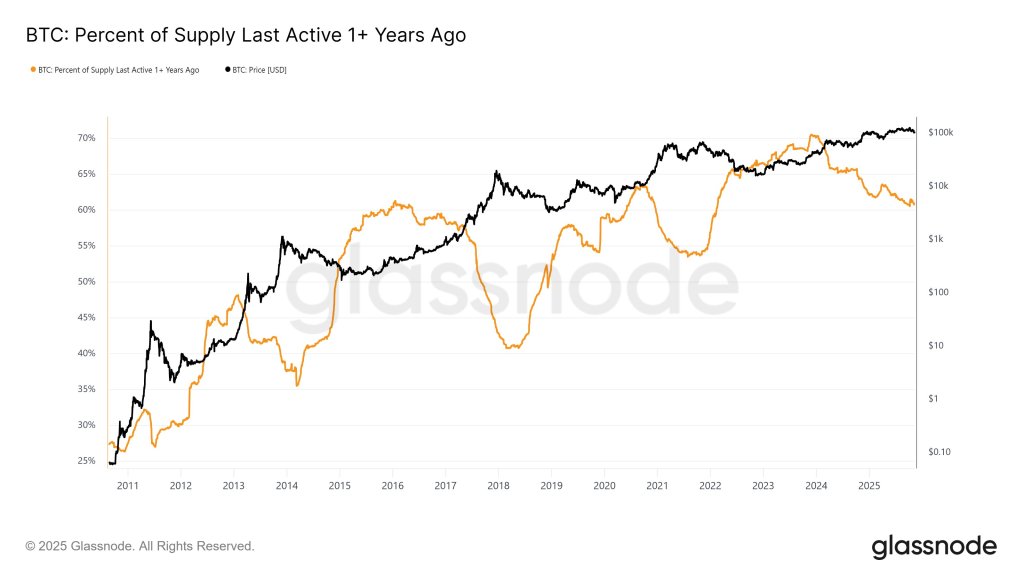
Percent of Bitcoin supply last active 1+ years ago

That slow bleed aligns with what Kuiper says he hears from the client side. “Bitcoin’s performance has recently lagged gold’s, even the S&P, and people are getting tired,” he wrote. Many investors, in his view, had been positioned for a textbook four-year cycle blow-off and were “waiting to sell into the historically strong seasonality of October and now November.”

When October’s typical strength did not materialize and year-end approached, “long-term holders are looking to make year-end tax and positional changes, calling it a day with the gains they already have.”

The Glassnode chart shows how different this looks from past cycles. In the 2017–2018 run-up and subsequent reversal, the share of coins last active more than a year ago rolled over violently as price spiked and then collapsed. In the current cycle, the curve that represents long-term-holder supply has been trending lower since 2023, but without the vertical collapse normally associated with euphoric distribution.

On-chain analyst Julio Moreno of CryptoQuant added another layer by reframing the same dynamic as “1-year inactive supply drawdown” in percentage points of total supply. “Here’s another way to visualize this,” he replied to Kuiper, “by looking at the 1-year inactive supply drawdown in terms of % of total Bitcoin supply.”
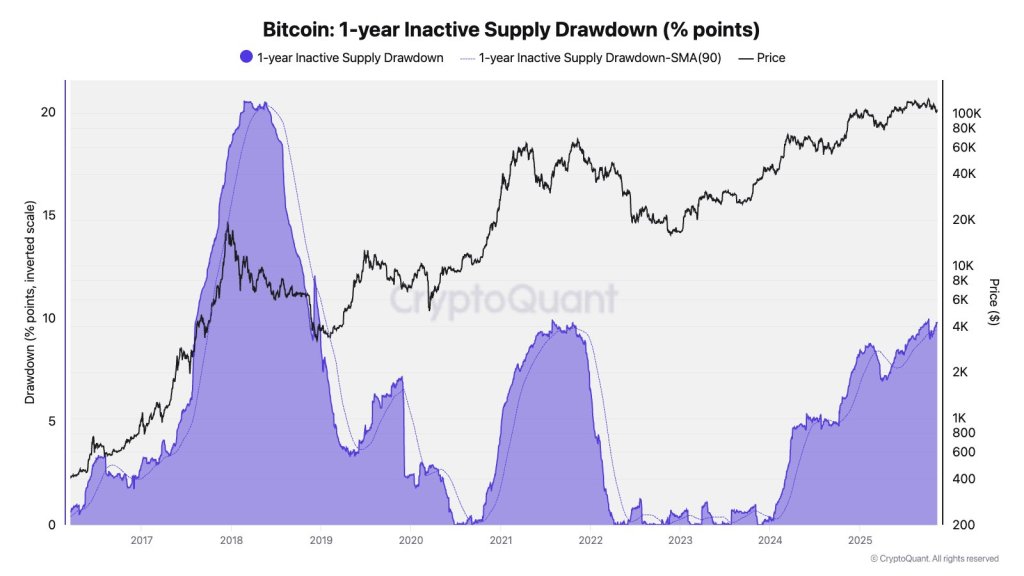
Bitcoin 1-year inactive supply drawdown

Moreno quantified the last three major cycles. In 2017–2018, 1-year inactive supply declined by about 20 percentage points of total supply. In the 2021 cycle, the drawdown was around 10 percentage points. In the 2024–2025 period so far, the decline is again roughly 10 percentage points. The CryptoQuant chart, which uses an inverted scale, renders that as a purple wave that rises as more long-dormant coins are spent or reallocated.

This means that long-term holders have already released a volume of supply comparable to the 2021 cycle, even if it is still well below the 2017–2018 peak. What differs is the tempo. Rather than a short burst of profit-taking at the top, the market has absorbed roughly a 10-percentage-point reduction in inactive supply over a longer, choppier price path.

Kuiper welcomed the alternative visualization, replying simply: “Great chart!” He also made clear what he will be monitoring from here. “I will be watching this slope along with some other metrics to gauge seller exhaustion,” he said. For now, he argues that “the positive fundamental developments and lackluster price action continue to diverge.”

At press time, BTC traded at $102,609.
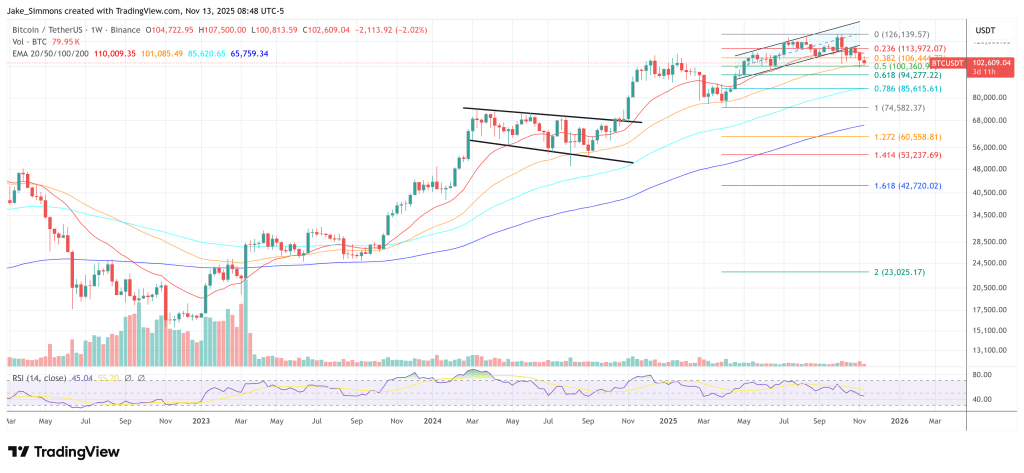
Bitcoin price
Piyasa Fırsatı
Ibiza Final Boss Logosu
Ibiza Final Boss Fiyatı(BOSS)
$0.0001769
$0.0001769$0.0001769
+15.09%
USD
Ibiza Final Boss (BOSS) Canlı Fiyat Grafiği
Sorumluluk Reddi: Bu sitede yeniden yayınlanan makaleler, halka açık platformlardan alınmıştır ve yalnızca bilgilendirme amaçlıdır. MEXC'nin görüşlerini yansıtmayabilir. Tüm hakları telif sahiplerine aittir. Herhangi bir içeriğin üçüncü taraf haklarını ihlal ettiğini düşünüyorsanız, kaldırılması için lütfen [email protected] ile iletişime geçin. MEXC, içeriğin doğruluğu, eksiksizliği veya güncelliği konusunda hiçbir garanti vermez ve sağlanan bilgilere dayalı olarak alınan herhangi bir eylemden sorumlu değildir. İçerik, finansal, yasal veya diğer profesyonel tavsiye niteliğinde değildir ve MEXC tarafından bir tavsiye veya onay olarak değerlendirilmemelidir.

Ayrıca Şunları da Beğenebilirsiniz

‘One Battle After Another’ Becomes One Of This Decade’s Best-Reviewed Movies
‘One Battle After Another’ Becomes One Of This Decade’s Best-Reviewed Movies

The post ‘One Battle After Another’ Becomes One Of This Decade’s Best-Reviewed Movies appeared on BitcoinEthereumNews.com. Topline Critics have hailed Paul Thomas Anderson’s “One Battle After Another,” starring Leonardo DiCaprio, as a “masterpiece,” indicating potential Academy Awards success as it boasts near-perfect scores on review aggregators Metacritic and Rotten Tomatoes based on early reviews. Leonardo DiCaprio stars in “One Battle After Another,” which opens in theaters next week. (Photo by Jeff Spicer/Getty Images for Warner Bros. Pictures) Getty Images for Warner Bros. Pictures Key Facts “One Battle After Another” boasts a nearly perfect 97 out of a possible 100 on Metacritic based on its first 31 reviews, making it the highest-rated movie of this decade on Metacritic’s best movies of all time list. The movie also has a 96% score on Rotten Tomatoes based on the first 56 reviews, with only two reviews considered “rotten,” or negative. The Associated Press hailed the movie as “an American masterpiece,” noting the movie touches on topical political themes and depicts a society where “gun violence, white power and immigrant deportations recur in an ongoing dance, both farcical and tragic.” The movie stars DiCaprio as an ex-revolutionary who reunites with former accomplices to rescue his 16-year-old daughter when she goes missing, and Anderson has said the movie was inspired by the 1990 novel, “Vineland.” Most critics have described the movie as an action thriller with notable chase scenes, which jumps in time from DiCaprio’s character’s early days with fictional revolutionary group, the French 75, to about 15 years later, when he is pursued by foe and military leader Captain Steven Lockjaw, played by Sean Penn. The Warner Bros.-produced film was made on a big budget, estimated to be between $130 million and $175 million, and co-stars Penn, Benicio del Toro, Regina Hall and Teyana Taylor. When Will ‘one Battle After Another’ Open In Theaters And Streaming? The move opens in…
Paylaş
BitcoinEthereumNews2025/09/18 07:35
XRP Price Prediction: Can Ripple Rally Past $2 Before the End of 2025?

XRP Price Prediction: Can Ripple Rally Past $2 Before the End of 2025?

The post XRP Price Prediction: Can Ripple Rally Past $2 Before the End of 2025? appeared first on Coinpedia Fintech News The XRP price has come under enormous pressure
Paylaş
CoinPedia2025/12/16 19:22
DMCC and Crypto.com Partner to Explore Blockchain Infrastructure for Physical Commodities

DMCC and Crypto.com Partner to Explore Blockchain Infrastructure for Physical Commodities

The Dubai Multi Commodities Centre and Crypto.com have announced a partnership to explore on-chain infrastructure for physical commodities including gold, energy, and agricultural products. The collaboration brings together one of the world's leading free trade zones with a global cryptocurrency exchange, signaling serious institutional interest in commodity tokenization.
Paylaş
MEXC NEWS2025/12/16 20:46