ACX, the native token of Across Protocol, has dropped sharply following serious allegations of insider self-dealing involving $23 million in decentralized autonomous organization funds. The token is trading at $0.1342, down 10% in the past 24 hours and over 40%…ACX, the native token of Across Protocol, has dropped sharply following serious allegations of insider self-dealing involving $23 million in decentralized autonomous organization funds. The token is trading at $0.1342, down 10% in the past 24 hours and over 40%…

Across Protocol token plunges amid allegations of $23M misappropriation by team

2025/06/27 14:28

ACX, the native token of Across Protocol, has dropped sharply following serious allegations of insider self-dealing involving $23 million in decentralized autonomous organization funds.

The token is trading at $0.1342, down 10% in the past 24 hours and over 40% in the past month. It’s now 91% below its all-time high of $1.69 set in December 2024.

The allegations were made public on June 27 by Ogle, the pseudonymous founder of Layer 1 project Glue and advisor to World Liberty Financial. In a detailed post on X, Ogle accused the Across Protocol team, particularly project lead Kevin Chan and chief executive officer Hart Lambur, of orchestrating two secretive proposals that directly benefited their own company using undisclosed wallets.

These proposals, made to appear as having community support, transferred 150 million ACX tokens worth about $23 million at current prices to Risk Labs over two separate governance votes. The first vote in October 2023 granted 100 million ACX under the pretense of future development support, with claims that the tokens would not be sold for two years.

But soon after, Risk Labs allegedly began selling token option agreements to external investors  A second vote, for “retroactive funding” of 50 million ACX, passed primarily due to insider-controlled wallets. Without those votes, it would not have reached quorum.

The report argues that such actions run counter to DAO governance principles and create significant future sell pressure, especially harmful to ACX holders unaware of the conflicts of interest behind these decisions. Across Protocol has not publicly responded to the allegations at the time of writing.

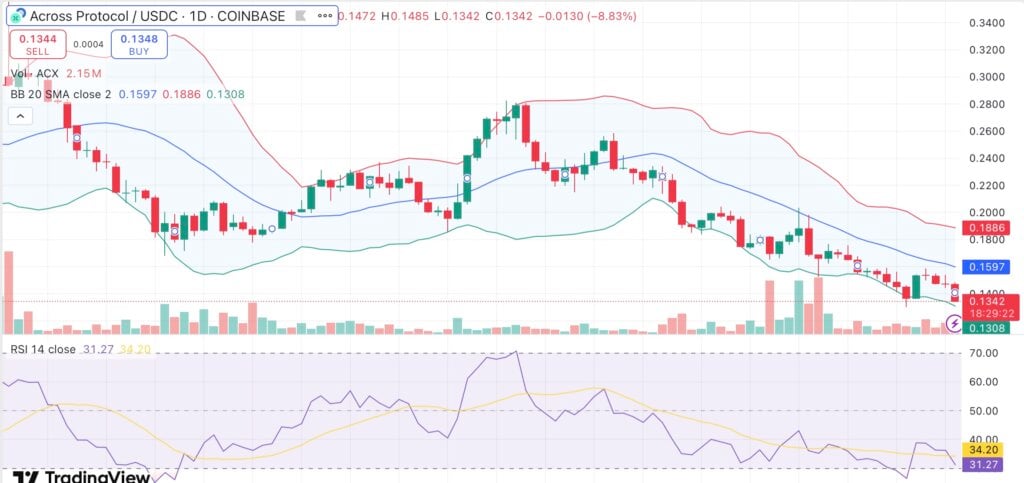
Looking at the technical picture, the chart shows clear downward pressure. The token is currently hugging the lower Bollinger Band at $0.1308 and trading below its 20-day simple moving average of $0.1597. At 31.27, the relative streghth index, which is trending downwards, is close to oversold territory.
Across Protocol token plunges amid allegations of $23M misappropriation by team - 1

More declines may occur if the price breaks through the $0.13 support zone. Some investors may watching for a bounce move back toward the mid-Bollinger band despite the sell-off. However, in the short term, upward momentum might be limited due to deteriorating sentiment and eroded trust in the team.

Sorumluluk Reddi: Bu sitede yeniden yayınlanan makaleler, halka açık platformlardan alınmıştır ve yalnızca bilgilendirme amaçlıdır. MEXC'nin görüşlerini yansıtmayabilir. Tüm hakları telif sahiplerine aittir. Herhangi bir içeriğin üçüncü taraf haklarını ihlal ettiğini düşünüyorsanız, kaldırılması için lütfen [email protected] ile iletişime geçin. MEXC, içeriğin doğruluğu, eksiksizliği veya güncelliği konusunda hiçbir garanti vermez ve sağlanan bilgilere dayalı olarak alınan herhangi bir eylemden sorumlu değildir. İçerik, finansal, yasal veya diğer profesyonel tavsiye niteliğinde değildir ve MEXC tarafından bir tavsiye veya onay olarak değerlendirilmemelidir.

Ayrıca Şunları da Beğenebilirsiniz

Tokenized Assets Shift From Wrappers to Building Blocks in DeFi

Tokenized Assets Shift From Wrappers to Building Blocks in DeFi

The post Tokenized Assets Shift From Wrappers to Building Blocks in DeFi appeared on BitcoinEthereumNews.com. RWAs are rapidly moving on-chain, unlocking new opportunities for investors and DeFi protocols, according to a new report from Dune and RWAxyz. Tokenized real-world assets (RWAs) are moving beyond digital versions of traditional securities to become key building blocks of decentralized finance (DeFi), according to the 2025 RWA Report from Dune and RWAxyz. The report notes that Treasuries, bonds, credit, and equities are now being used in DeFi as collateral, trading instruments, and yield products. This marks tokenization’s “real breakthrough” – composability, or the ability to combine and reuse assets across different protocols. Projects are already showing how this works in practice. Asset manager Maple Finance’s syrupUSDC, for example, has grown to $2.5 billion, with more than 30% placed in DeFi apps like Spark ($570 million). Centrifuge’s new deJAAA token, a wrapper for Janus Henderson’s AAA CLO fund, is already trading on Aerodrome, Coinbase and other exchanges, with Stellar planned next. Meanwhile, Aave’s Horizon RWA Market now lets institutional users post tokenized Treasuries and CLOs as collateral. This trend underscores a bigger shift: RWAs are no longer just copies of traditional assets; instead, they are becoming core parts of on-chain finance, powering lending, liquidity, and yield, and helping to close the gap between traditional finance (TradFi) and DeFi. “RWAs have crossed the chasm from experimentation to execution,” Sid Powell, CEO of Maple Finance, says in the report. “Our growth to $3.5B AUM reflects a broader shift: traditional financial services are adopting crypto assets while institutions seek exposure to on-chain markets.” Investor demand for higher returns and more diversified options is mainly driving this growth. Tokenized Treasuries proved there is strong demand, with $7.3 billion issued by September 2025 – up 85% year-to-date. The growth was led by BlackRock, WisdomTree, Ondo, and Centrifuge’s JTRSY (Janus Henderson Anemoy Treasury Fund). Spark’s $1…
Paylaş
BitcoinEthereumNews2025/09/18 06:10