

Must Read
CIVIL SOCIETY DISCUSSION. Senate finance committee chairman Sherwin Gatchalian speaks to budget watchdogs regarding the national budget process in a hearing on CIVIL SOCIETY DISCUSSION. Senate finance committee chairman Sherwin Gatchalian speaks to budget watchdogs regarding the national budget process in a hearing on
Bicam reconciles education, health, agri 2026 budgets on first day
MANILA, Philippines – The proposed 2026 budgets of the education, health, and agriculture sectors took centerstage during the first day of the bicameral conference committee (bicam) meetings on Saturday, December 13.
It is during these bicam meetings that the House of Representatives and the Senate reconcile their versions of the proposed budget.
This was also the first time in history that the bicam deliberations were livestreamed following public scrutiny due to the flood control corruption scandal linked to budget insertions.
Farm-to-market roads
Bicam discussions were at a deadlock for nearly an hour on Saturday night as House lawmakers and senators butt heads over proposed funding for farm-to-market roads.
Under the Senate’s version of the spending plan, the Department of Agriculture (DA) would receive P16 billion in funding to construct farm-to-market roads. However, the House contingent appealed to nearly double the funding to P33 billion to cover projects in far-flung areas of the country.
Senators, however, questioned whether the DA was ready to take on the additional funding as it takes over construction of the roads from the Department of Public Works and Highways.
Senator Imee Marcos flagged that the DA had only 65 people nationwide for the task, while Senators Pia Cayetano and Erwin Tulfo raised concerns that farm-to-market roads would become the next target for infrastructure corruption.
“Kung iisipin, wala nga ‘yung flood control, dito naman sa farm-to-market. Ito naman ang iisipin mo na dito magkaroon ng problema. I mean, lumipat lang from flood control dito naman sa farm-to-market. Magiging source of corruption,” Tulfo said.
(If you think about it, there are no flood control projects but there are farm-to-market roads. You will suspect it will cause problems. I mean, it may have just moved from flood control to farm-to-market. It will be a source of corruption.)
While the bicam eventually agreed to nearly double funding for farm-to-market roads at P33 billion, Cayetano, Legarda, and Tulfo voiced their reservations surrounding the move.
Play Video 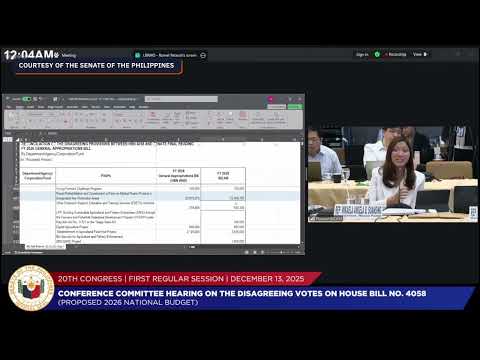
“I want to see countryside development. Rest assured, that is what’s in my heart. But I cannot stand to see corruption continue to happen,” Cayetano said.
‘Soft pork’ in health?
House and Senate lawmakers agreed to increase funding for the Department of Health’s (DOH) MAIFIP program (Medical Assistance for Indigent and Financially Incapacitated Patients) to P51 billion from P49 billion.
The program offers financial assistance to cover the medical costs for indigent patients. It is also among the four social aid programs criticized by budget watchdogs as a form of pork.
Senators raised concerns that the program would perpetuate political patronage since recipients often relied on guarantee letters from politicians to receive funds. But the House contingent argued that reducing funding for MAIFIP would affect some 1.1 million patients since the universal healthcare law has yet to be fully implemented.
“Until such time that the UHC law is really completely properly implemented and PhilHealth is able to handle all of this, I believe that we must provide for the poorest of the poor,” said Senator Loren Legarda.
Lawmakers from both chambers of Congress also agreed to tighten the wording of a general provision that prohibits elected officials from participating in ayuda (social aid) distribution since the current language only covers cash transfers.
From PhilHealth to foreign-assisted projects
Senator Imee Marcos also questioned how the Department of Finance used the P60 billion in “excess” Philippine Health Insurance Corporation (PhilHealth) funds that were transferred to the national treasury in 2024.
Bataan 2nd District Representative Abet Garcia explained that the funding went to the following programs:
- Health emergency allowance for frontline health workers during the COVID-19 pandemic – P27.45 billion
- Foreign-assisted projects – P13 billion
- MAIFIP – P10 billion
- Procurement of various medical equipment for DOH hospitals – P4.1 billion
- Funding for three DOH health facilities – P3.37 billion
- Health Facilities Enhancement Program – P1.69 billion
Marcos’ remarks come after the Supreme Court ordered the return of P60 billion, which will be done through an appropriation in the 2026 spending plan.
Garcia also said they would require PhilHealth to submit a detailed breakdown and clarify how future appropriations would comply with the high court’s ruling.
Education gets lion’s share
The bicam approved a whopping P1.38 trillion in funding for agencies in the education sector, which includes the Department of Education (DepEd), state universities and colleges (SUCs), and the Commission on Higher Education (CHED).
DepEd’s Office of the Secretary will receive P961 billion in funding, SUCs will get P138 billion, while CHED will receive P47 billion.
Lawmakers from both the House and Senate also agreed to transfer P2 billion of funding for the Tulong Dunong student assistance program to CHED from the SUCs. They believed the move would streamline implementation and allow more students to access assistance.
Under the Tulong Dunong program, eligible students with a combined gross income of less than P400,000 can receive P15,000 in assistance per academic year.
The Bicam meeting will resume on Sunday, December 14, at 2 pm. – Rappler.com
Sorumluluk Reddi: Bu sitede yeniden yayınlanan makaleler, halka açık platformlardan alınmıştır ve yalnızca bilgilendirme amaçlıdır. MEXC'nin görüşlerini yansıtmayabilir. Tüm hakları telif sahiplerine aittir. Herhangi bir içeriğin üçüncü taraf haklarını ihlal ettiğini düşünüyorsanız, kaldırılması için lütfen [email protected] ile iletişime geçin. MEXC, içeriğin doğruluğu, eksiksizliği veya güncelliği konusunda hiçbir garanti vermez ve sağlanan bilgilere dayalı olarak alınan herhangi bir eylemden sorumlu değildir. İçerik, finansal, yasal veya diğer profesyonel tavsiye niteliğinde değildir ve MEXC tarafından bir tavsiye veya onay olarak değerlendirilmemelidir.
Ayrıca Şunları da Beğenebilirsiniz

SEC Backs Nasdaq, CBOE, NYSE Push to Simplify Crypto ETF Rules
The US SEC on Wednesday approved new listing rules for major exchanges, paving the way for a surge of crypto spot exchange-traded funds.
On Wednesday, the regulator voted to let Nasdaq, Cboe BZX and NYSE Arca adopt generic listing standards for commodity-based trust shares. The decision clears the final hurdle for asset managers seeking to launch spot ETFs tied to cryptocurrencies beyond Bitcoin and Ether.
In July, the SEC outlined how exchanges could bring new products to market under the framework. Asset managers and exchanges must now meet specific criteria, but will no longer need to undergo drawn-out case-by-case reviews.
Solana And XRP Funds Seen to Be First In Line
Under the new system, the time from filing to launch can shrink to as little as 75 days, compared with up to 240 days or more under the old rules.
“This is the crypto ETP framework we’ve been waiting for,” Bloomberg research analyst James Seyffart said on X, predicting a wave of new products in the coming months.
The first filings likely to benefit are those tracking Solana and XRP, both of which have sat in limbo for more than a year.
SEC Chair Paul Atkins said the approval reflects a commitment to reduce barriers and foster innovation while maintaining investor protections. The move comes under the administration of President Donald Trump, which has signaled strong support for digital assets after years of hesitation during the Biden era.
New Standards Replace Lengthy Reviews And Repeated Denials
Until now, the commission reviewed each application separately, requiring one filing from the exchange and another from the asset manager. This dual process often dragged on for months and led to repeated denials. Even Bitcoin spot ETFs, finally approved in Jan. 2024, arrived only after years of resistance and a legal battle with Grayscale.
According to Bloomberg ETF analyst Eric Balchunas, the streamlined rules could apply to any cryptocurrency with at least six months of futures trading on the Coinbase Derivatives Exchange. That means more than a dozen tokens may now qualify for listing, potentially unleashing a new wave of altcoin ETFs.
SEC Clears Grayscale Large Cap Fund Tracking CoinDesk 5 Index
The SEC also approved the Grayscale Digital Large Cap Fund, which tracks the CoinDesk 5 Index, including Bitcoin, Ether, XRP, Solana and Cardano. Alongside this, it cleared the launch of options linked to the Cboe Bitcoin US ETF Index and its mini contract, broadening the set of crypto-linked derivatives on regulated US markets.
Analysts say the shift shows how far US policy has moved. Where once regulators resisted digital assets, the latest changes show a growing willingness to bring them into the mainstream financial system under established safeguards
Paylaş
CryptoNews2025/09/18 12:40

SHow ShowTime Advanced Supports Healthy Skin, Coat, and Digestion
Choosing the right diet is one of the most important decisions you can make for your dog’s long-term health—especially when it comes to supporting healthy skin,
Paylaş
Techbullion2025/12/15 00:59
The hard truth behind the US-Indo Pacific strategy
MOST of the world knows how to respond to the US’ new National Security Strategy. As my colleague Marc Champion has written, Russia loves it. Liberal Europeans
Paylaş
Bworldonline2025/12/15 00:04