When you search "is sol a currency," the answer is yes—but there are actually two different currencies called SOL. One is the Peruvian sol (PEN), the official money used in Peru for everydayWhen you search "is sol a currency," the answer is yes—but there are actually two different currencies called SOL. One is the Peruvian sol (PEN), the official money used in Peru for everyday
When you search "is sol a currency," the answer is yes—but there are actually two different currencies called SOL.
One is the Peruvian sol (PEN), the official money used in Peru for everyday purchases.
The other is Solana (SOL), a cryptocurrency that exists only in digital form on blockchain networks.
This article explains both currencies, shows you the key differences, and helps you understand where each one fits into the financial world.
For a complete overview of Solana blockchain, see our beginner's guide.
Key Takeaways
SOL refers to two distinct currencies: Peru's national currency (PEN) and Solana's cryptocurrency (SOL).
The Peruvian sol replaced the inti in 1991 following hyperinflation exceeding 7,000% and remains Peru's stable legal tender today.
Solana (SOL) launched in March 2020 as a high-speed blockchain platform using proof-of-stake consensus for decentralized applications.
Peruvian sol exists as physical cash issued by Peru's central bank, while Solana exists only as digital tokens on a global blockchain network.
SOL cryptocurrency can be traded on exchanges like MEXC, staked for rewards, and used across DeFi, NFTs, and smart contract applications.
Understanding which SOL you're researching—traditional fiat or cryptocurrency—determines whether you need currency exchange services or a digital wallet.
The Peruvian sol is Peru's official national currency, represented by the symbol S/ and the currency code PEN.
The Central Reserve Bank of Peru introduced the nuevo sol in 1991 to replace the previous currency, the inti, at a dramatic exchange rate of one million intis to one nuevo sol.
This change was necessary because Peru experienced severe hyperinflation during the late 1980s, with inflation rates exceeding 7,000% by 1990.
In 2015, the government simplified the name from "nuevo sol" to just "sol," which means "sun" in Spanish.
The sol divides into 100 smaller units called céntimos.
Banknotes come in denominations of 10, 20, 50, 100, and 200 soles, while coins include 10, 20, and 50 céntimos, plus 1, 2, and 5 soles.
Peru's currency has remained relatively stable since 1991, making it a reliable medium of exchange throughout the country for locals and travelers alike.
Solana (SOL) is a completely different type of currency—it's a cryptocurrency that operates on a blockchain network rather than being issued by any government.
Launched in March 2020, Solana functions as both a blockchain platform and its native digital token used for transactions within that ecosystem.
SOL ranks among the top cryptocurrencies by market capitalization, competing with established digital assets in the decentralized finance space.
Unlike the Peruvian sol, which exists as physical cash and coins, Solana exists only as digital tokens stored in cryptocurrency wallets.
Traders and investors can buy, sell, and trade SOL on cryptocurrency exchanges worldwide, making it accessible to anyone with internet access regardless of their geographic location.
Solana operates through a decentralized blockchain network with no single controlling entity, relying instead on thousands of validators worldwide to maintain the system.
You can hold Peruvian soles in your hand as paper bills or metal coins, making them tangible assets you can use at any market or store in Peru.
Solana exists purely as digital code on a blockchain, with no physical form—you access it through cryptocurrency wallets and digital exchanges instead of your pocket or purse.
The Peruvian sol works only within Peru's borders as legal tender for goods and services.
Solana trades on global cryptocurrency exchanges and works across borders without geographic restrictions, available to users in most countries through platforms like MEXC.
The Peruvian sol maintains relative stability against major currencies like the US dollar, with exchange rates moving gradually based on economic policies and trade conditions.
Solana experiences high volatility typical of cryptocurrency markets, with prices potentially swinging by double-digit percentages within days or even hours based on market sentiment and adoption trends.
Peru's citizens use their sol for everyday transactions: buying groceries, paying rent, receiving salaries, and conducting normal business activities.
Solana serves different purposes including executing smart contracts, participating in decentralized finance protocols, purchasing NFTs, staking for passive income, and trading as a speculative investment asset.
Travelers obtain Peruvian soles through currency exchange houses called casas de cambio, banks, ATMs throughout Peru, or by exchanging foreign currency at hotels and airports.
Cryptocurrency enthusiasts acquire Solana by creating accounts on exchanges, purchasing with fiat currency or other cryptocurrencies, or earning it through staking rewards and blockchain participation.
Cryptocurrency exchanges provide the primary marketplace for acquiring and trading Solana tokens.
Platforms like MEXC offer SOL trading pairs against multiple currencies, allowing users to buy Solana with US dollars, Bitcoin, Ethereum, or stablecoins depending on their preferences and existing holdings.
New users should start by researching cryptocurrency basics and understanding blockchain technology before investing.
Creating a secure wallet—either hardware-based for maximum security or software-based for convenience—gives you control over your SOL tokens.
Many holders participate in staking, which involves locking their tokens to help validate transactions on the Solana network while earning passive rewards.
The Solana ecosystem supports diverse applications including decentralized exchanges, lending platforms, NFT marketplaces, and payment systems.
Users should practice proper security measures like enabling two-factor authentication, never sharing private keys, and starting with small amounts until they understand the market dynamics and risks involved in cryptocurrency trading.
SOL represents two currencies: the Peruvian sol (PEN) meaning "sun" in Spanish, and Solana's cryptocurrency ticker symbol.
Can I use Peruvian sol outside Peru?
The Peruvian sol functions only as legal tender within Peru, though some exchange services internationally may accept it for conversion.
Is Solana a good investment?
Solana's investment potential depends on market conditions, personal risk tolerance, and financial goals—all cryptocurrencies carry significant volatility and risk.
How do I convert Peruvian sol to US dollars?
Exchange Peruvian soles at casas de cambio, banks, or ATMs in Peru, checking current rates before transactions for the best value.
Where can I buy Solana cryptocurrency?
Cryptocurrency exchanges including MEXC provide access to purchase Solana using various payment methods and trading pairs.
What makes Solana different from Bitcoin?
Solana offers faster transaction speeds and lower fees than Bitcoin, using proof-of-stake consensus rather than proof-of-work mining.
Yes—both the Peruvian sol and Solana qualify as currencies, though they serve completely different purposes in separate financial systems.
The Peruvian sol remains Peru's stable national currency for everyday transactions, controlled by the central bank and used by millions of citizens daily.
Solana represents the digital future of money, operating as a decentralized cryptocurrency that enables global transactions, smart contracts, and innovative blockchain applications.
Understanding which SOL you're researching helps you find the right information and make informed decisions about currency exchange, travel planning, or cryptocurrency investment opportunities.
How to Get Free Solana? Proven Methods That Actually Work
Want to explore Solana without spending money upfront? You're in the right place. This guide reveals legitimate ways to earn free SOL through airdrops, staking rewards, and task-based platforms.
What Is a Solana ETF? Spot Funds, Staking, and SEC Approval Decoded
Solana ETFs became a reality in October 2025, when the SEC approved spot SOL products for U.S. trading — making Solana only the third cryptocurrency to clear that regulatory bar, after Bitcoin and
What Is Solana Stock? A Beginner's Guide to SOL and Solana ETFs
If you've ever searched "Solana stock" expecting to find a ticker symbol on the NYSE, you're not alone. The term gets used loosely — but it actually refers to several very different investment
How to Read the Solana Price Chart: A Beginner's Guide to SOL/USD
The Solana price chart tells you more than just a number — it shows the full story of where SOL has been, where it's stalling, and where traders are watching closely. Whether you just bought your
The crypto market changes minute by minute, and the latest Solana (SOL) price offers the most up-to-date snapshot of its value. In this article, we highlight the newest movements, fresh data from the
Solana (SOL) Price Prediction: Market Forecast and Analysis
Understanding the price prediction of Solana (SOL) gives traders and investors a forward-looking perspective on potential market trends. SOL price predictions aren't guarantees, but they provide
Solana (SOL) Bullish Price Prediction
Introduction to Bullish SOL Outlook Optimistic investors often look to bullish price predictions for Solana (SOL) to identify the coin's growth potential during favorable market cycles. A bullish
Solana (SOL) Short-Term Price Prediction
Introduction to SOL Short-Term Price Predictions In the fast-paced world of cryptocurrency, short-term price predictions can help traders identify opportunities in daily, weekly, and monthly
Solana News April 2026: ETF Inflows Rise but Pepeto Presale Is Primed for Explosive Returns
Solana news is heating up as institutional demand builds quietly through five consecutive weeks of positive ETF flows and the derivatives market shows its most
Best Crypto Presale Alpha Leak: APEMARS Emerges in Top 5 Cryptos to Buy Watchlist Amid Ethereum, XRP, and Solana Liquidity Cooling
APEMARS leads best crypto presale watchlist as ETH, XRP, and SOL cool. Explore top 5 cryptos to buy and early-stage rotation signals.
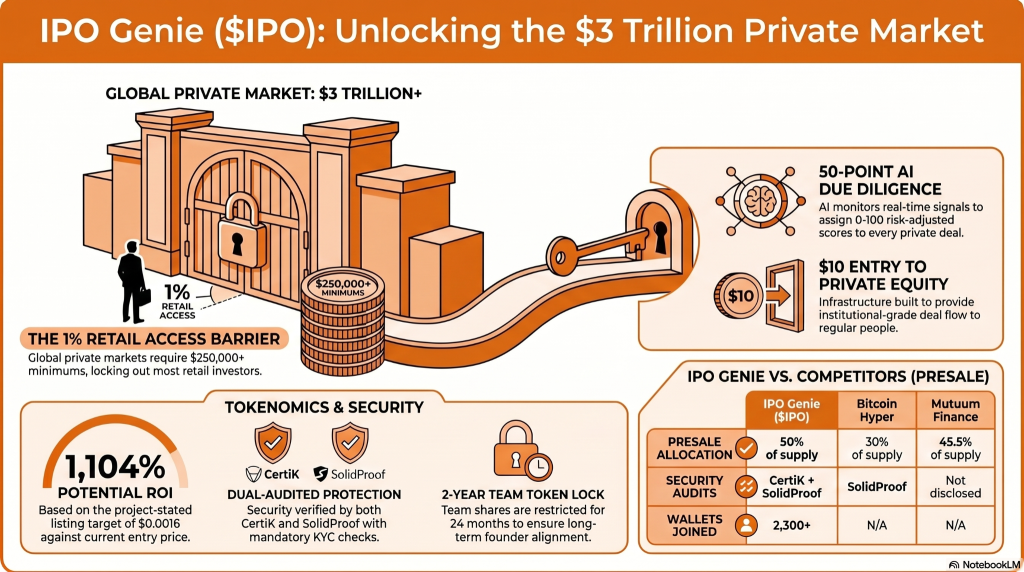
Best Crypto Presale to Buy Now in Q2 2026: IPO Genie $IPO Gains Momentum
You watched Ethereum launchat “$0.30. You saw Solana seed buyers turn $500 into fortunes whenSOL was trading at $84.77 today after peaking near $295. Right now,
Solana Price Prediction Holds $90 as Pepeto Crosses $9.13M
Mastercard, Worldpay, and Western Union just joined the Solana Developer initiative in its launch cohort, bringing household names of global payments directly onto
Ethereum Code Review: Is It a Scam or a Legitimate Trading Platform?
If you've searched for the Ethereum Code platform, you probably want one answer: is it safe to invest your money there?This article breaks down exactly what the Ethereum Code trading app claims to off
Ethereum Market Cap Explained: What It Is and Why It Matters
If you've ever looked up ETH and wondered why the price alone doesn't tell the full story, you're not alone.The Ethereum market cap is the number that actually shows you how big Ethereum is as a netwo
Ethereum Investing Guide: Risks, Strategies, and Whether It's Worth It
If you've been wondering whether investing in Ethereum makes sense, you're not alone.This guide walks you through what Ethereum actually is, why it works differently from Bitcoin, what the real risks
Ethereum Price History by Year: Every Major Bull Run and Crash Explained
Ethereum has gone from a $0.31 ICO token to one of the most closely watched assets in global finance.Its price history isn't just a chart — it's a record of every major shift in the crypto market, fro