Author: Trading Strategy Compiled by: Tim, PANews Stream xUSD is a "tokenized hedge fund" masquerading as a DeFi stablecoin, claiming to operate using a delta-neutral strategy. Currently, this project is insolvent. Over the past five years, several projects have followed this model, attempting to drive their token growth through returns from delta-neutral investments. Successful examples include MakerDAO, Frax, Ohm, Aave, and Ethena. Unlike many of its more purist DeFi competitors, Stream lacks transparency regarding its strategies and holdings. Portfolio tracking platform DeBank shows that only $150 million of its claimed total locked value is visible on-chain. In reality, Stream invested in off-chain trading strategies run by its proprietary traders, some of whom suffered margin calls, reportedly resulting in a $100 million loss. 1. CCN report points out It should be noted that the $120 million hack that Balancer DEX suffered this Monday is unrelated to this. Rumors suggest (which we cannot verify as Stream has not publicly disclosed this information) that the incident allegedly involves an off-chain trading strategy of "shorting volatility." In quantitative finance, "shorting volatility" refers to profiting when market volatility decreases, remains stable, or the actual volatility is lower than the implied volatility in the pricing of the financial instrument. If the price of the underlying asset fluctuates smoothly (i.e., in a low-volatility environment), the option may expire, allowing the seller to retain the premium as profit. However, this strategy is significantly risky; a sudden surge in volatility can trigger huge losses, often described as "picking up coins in front of a steamroller." 2. Detailed Explanation of Shorting Volatility: We experienced such a surge in volatility on "Red Friday," October 10th. As market fervor surrounding Trump-related developments in 2025 continued to build, systemic leverage risk gradually accumulated in the crypto market. When Trump announced his new tariff policy on Friday afternoon, October 10th, panic gripped all markets, quickly spreading to the crypto market. In the midst of this panic, those who rushed to sell their available assets often gained an advantage. This sell-off ultimately triggered a chain reaction of liquidations. Due to the long-term accumulation of leverage risk, systemic leverage has reached a high level, and the perpetual futures market lacks sufficient market depth to smoothly unwind and liquidate all leveraged positions. Under these circumstances, the automatic liquidation mechanism is activated, beginning to distribute losses among profitable traders. This further distorts an already volatile market. 3. What is an automatic position reduction mechanism ? The market volatility triggered by this event is considered a once-in-a-decade event for the crypto market. While not unprecedented—a similar crash occurred in the early 2016 crypto market—most algorithmic traders' strategies were built on recent data of "stable fluctuations" due to a lack of reliable data at that time. Given the market's long absence of such dramatic volatility, even moderately leveraged positions of around 2x were not spared, ultimately resulting in numerous liquidations. Maxim Shilo provides an in-depth analysis of the impact of this "Red Friday" event on algorithmic traders and the potential fundamental shift in trading patterns in the crypto market: 4. Shilo discusses how October 10th will change algorithmic trading in the crypto market. Now, the first bodies of victims have emerged from the "Red Friday" attacks, and Stream is among them. The fundamental definition of a delta-neutral fund is that it will not incur losses. If losses occur, it cannot be considered delta-neutral by definition. Stream promised to adopt a delta-neutral strategy, but secretly invested in proprietary, opaque, off-chain operational strategies. Delta-neutral strategies are not always black and white; hindsight is always 20/20. Many experts might argue that these strategies are too risky to be considered truly delta-neutral because they could be counterproductive, and this has proven to be true. When Stream lost its principal in these failed trades, the platform became insolvent. The DeFi sector is high-risk, and some losses are acceptable. As long as you eventually break even and achieve a 15% annual return, a 10% drop in account balance is not fatal. However, the problem lies in the fact that Stream has pushed leverage to the extreme through a "recursive loop" lending strategy with another stablecoin, Elixir. 5. What is a recursive loop? 6. How does Stream increase leverage and its leverage size ? To make matters worse, Elixir, through an off-chain protocol, claims priority in recovering the principal of Stream in the event of its bankruptcy. This means that Elixir will recover more funds, while other DeFi investors in Stream will only recover less (or even lose everything). Due to a lack of transparency, the existence of recursive loops, and proprietary strategies, we are unable to know the actual scale of losses suffered by Stream users. Currently, the price of Stream's xUSD stablecoin has fallen to $0.6 per unit. Because this matter was not disclosed to these DeFi users, many users are now extremely indignant towards Stream and Elixir: they not only suffer financial losses, but are also forced to share the losses to ensure that wealthy Americans with Wall Street backgrounds can preserve their profits. This incident also impacted the loan agreement and its management: "Everyone who thinks they are taking out a secured loan on Euler is actually participating in unsecured lending through a proxy," says Rob from infiniFi. Furthermore, given Stream's lack of transparency regarding its positions and profit/loss status, or the absence of on-chain data, users have begun to question whether Stream has fraudulently misappropriated user profits for its management team. Stream's xUSD stakers rely on self-reported "oracle" data to generate returns, and third parties cannot verify the accuracy or fairness of these calculations. How to deal with it? Such Stream events could have been avoided, especially in emerging industries like DeFi. While "high risk, high reward" is a timeless principle, the key is to understand that risk is not homogeneous, and some risks are simply unnecessary. Several reputable liquidity mining, lending, and stablecoin (essentially tokenized hedge funds) protocols already maintain transparency in their risk exposure, investment strategies, and positions, making them worthy of market attention. Stani, founder of Aave, discussed the timing of DeFi governance and excessive risk-taking, and shared his views on recent events that have brought DeFi risks to the forefront: The survival of DeFi lending rests on trust. One of the biggest fallacies is comparing DeFi lending with AMM (Agent Matchmaker) liquidity pools—the two operate on completely different logics. The lending model can only continue to operate when people are confident that the market mechanism is sound, the collateral assets are reliable, the risk parameters are reasonable, and the system as a whole is stable. Once this trust collapses, an on-chain version of a bank run will occur. This is precisely why the model that allows anyone to deploy a fund pool and promote it on the same platform without permission is inherently flawed. Because most investment strategies are highly homogenized, strategy managers lack effective means to stand out and often can only push fees to the bare minimum or compete for capital from other fund pools by taking on higher risks. One day, a major collapse will destroy market confidence and set back the industry's progress. The next Terra Luna-style crash will inevitably stem from the out-of-control actions of an aggressive strategy manager on an open platform.Author: Trading Strategy Compiled by: Tim, PANews Stream xUSD is a "tokenized hedge fund" masquerading as a DeFi stablecoin, claiming to operate using a delta-neutral strategy. Currently, this project is insolvent. Over the past five years, several projects have followed this model, attempting to drive their token growth through returns from delta-neutral investments. Successful examples include MakerDAO, Frax, Ohm, Aave, and Ethena. Unlike many of its more purist DeFi competitors, Stream lacks transparency regarding its strategies and holdings. Portfolio tracking platform DeBank shows that only $150 million of its claimed total locked value is visible on-chain. In reality, Stream invested in off-chain trading strategies run by its proprietary traders, some of whom suffered margin calls, reportedly resulting in a $100 million loss. 1. CCN report points out It should be noted that the $120 million hack that Balancer DEX suffered this Monday is unrelated to this. Rumors suggest (which we cannot verify as Stream has not publicly disclosed this information) that the incident allegedly involves an off-chain trading strategy of "shorting volatility." In quantitative finance, "shorting volatility" refers to profiting when market volatility decreases, remains stable, or the actual volatility is lower than the implied volatility in the pricing of the financial instrument. If the price of the underlying asset fluctuates smoothly (i.e., in a low-volatility environment), the option may expire, allowing the seller to retain the premium as profit. However, this strategy is significantly risky; a sudden surge in volatility can trigger huge losses, often described as "picking up coins in front of a steamroller." 2. Detailed Explanation of Shorting Volatility: We experienced such a surge in volatility on "Red Friday," October 10th. As market fervor surrounding Trump-related developments in 2025 continued to build, systemic leverage risk gradually accumulated in the crypto market. When Trump announced his new tariff policy on Friday afternoon, October 10th, panic gripped all markets, quickly spreading to the crypto market. In the midst of this panic, those who rushed to sell their available assets often gained an advantage. This sell-off ultimately triggered a chain reaction of liquidations. Due to the long-term accumulation of leverage risk, systemic leverage has reached a high level, and the perpetual futures market lacks sufficient market depth to smoothly unwind and liquidate all leveraged positions. Under these circumstances, the automatic liquidation mechanism is activated, beginning to distribute losses among profitable traders. This further distorts an already volatile market. 3. What is an automatic position reduction mechanism ? The market volatility triggered by this event is considered a once-in-a-decade event for the crypto market. While not unprecedented—a similar crash occurred in the early 2016 crypto market—most algorithmic traders' strategies were built on recent data of "stable fluctuations" due to a lack of reliable data at that time. Given the market's long absence of such dramatic volatility, even moderately leveraged positions of around 2x were not spared, ultimately resulting in numerous liquidations. Maxim Shilo provides an in-depth analysis of the impact of this "Red Friday" event on algorithmic traders and the potential fundamental shift in trading patterns in the crypto market: 4. Shilo discusses how October 10th will change algorithmic trading in the crypto market. Now, the first bodies of victims have emerged from the "Red Friday" attacks, and Stream is among them. The fundamental definition of a delta-neutral fund is that it will not incur losses. If losses occur, it cannot be considered delta-neutral by definition. Stream promised to adopt a delta-neutral strategy, but secretly invested in proprietary, opaque, off-chain operational strategies. Delta-neutral strategies are not always black and white; hindsight is always 20/20. Many experts might argue that these strategies are too risky to be considered truly delta-neutral because they could be counterproductive, and this has proven to be true. When Stream lost its principal in these failed trades, the platform became insolvent. The DeFi sector is high-risk, and some losses are acceptable. As long as you eventually break even and achieve a 15% annual return, a 10% drop in account balance is not fatal. However, the problem lies in the fact that Stream has pushed leverage to the extreme through a "recursive loop" lending strategy with another stablecoin, Elixir. 5. What is a recursive loop? 6. How does Stream increase leverage and its leverage size ? To make matters worse, Elixir, through an off-chain protocol, claims priority in recovering the principal of Stream in the event of its bankruptcy. This means that Elixir will recover more funds, while other DeFi investors in Stream will only recover less (or even lose everything). Due to a lack of transparency, the existence of recursive loops, and proprietary strategies, we are unable to know the actual scale of losses suffered by Stream users. Currently, the price of Stream's xUSD stablecoin has fallen to $0.6 per unit. Because this matter was not disclosed to these DeFi users, many users are now extremely indignant towards Stream and Elixir: they not only suffer financial losses, but are also forced to share the losses to ensure that wealthy Americans with Wall Street backgrounds can preserve their profits. This incident also impacted the loan agreement and its management: "Everyone who thinks they are taking out a secured loan on Euler is actually participating in unsecured lending through a proxy," says Rob from infiniFi. Furthermore, given Stream's lack of transparency regarding its positions and profit/loss status, or the absence of on-chain data, users have begun to question whether Stream has fraudulently misappropriated user profits for its management team. Stream's xUSD stakers rely on self-reported "oracle" data to generate returns, and third parties cannot verify the accuracy or fairness of these calculations. How to deal with it? Such Stream events could have been avoided, especially in emerging industries like DeFi. While "high risk, high reward" is a timeless principle, the key is to understand that risk is not homogeneous, and some risks are simply unnecessary. Several reputable liquidity mining, lending, and stablecoin (essentially tokenized hedge funds) protocols already maintain transparency in their risk exposure, investment strategies, and positions, making them worthy of market attention. Stani, founder of Aave, discussed the timing of DeFi governance and excessive risk-taking, and shared his views on recent events that have brought DeFi risks to the forefront: The survival of DeFi lending rests on trust. One of the biggest fallacies is comparing DeFi lending with AMM (Agent Matchmaker) liquidity pools—the two operate on completely different logics. The lending model can only continue to operate when people are confident that the market mechanism is sound, the collateral assets are reliable, the risk parameters are reasonable, and the system as a whole is stable. Once this trust collapses, an on-chain version of a bank run will occur. This is precisely why the model that allows anyone to deploy a fund pool and promote it on the same platform without permission is inherently flawed. Because most investment strategies are highly homogenized, strategy managers lack effective means to stand out and often can only push fees to the bare minimum or compete for capital from other fund pools by taking on higher risks. One day, a major collapse will destroy market confidence and set back the industry's progress. The next Terra Luna-style crash will inevitably stem from the out-of-control actions of an aggressive strategy manager on an open platform.
DeFi Autopsy Report: A Deep Dive into How Stream xUSD Went From "Stablecoin" to Off-Chain Ponzi Scheme

2025/11/06 16:30
6 min read

Author: Trading Strategy

Compiled by: Tim, PANews

Stream xUSD is a "tokenized hedge fund" masquerading as a DeFi stablecoin, claiming to operate using a delta-neutral strategy. Currently, this project is insolvent. Over the past five years, several projects have followed this model, attempting to drive their token growth through returns from delta-neutral investments. Successful examples include MakerDAO, Frax, Ohm, Aave, and Ethena.

Unlike many of its more purist DeFi competitors, Stream lacks transparency regarding its strategies and holdings. Portfolio tracking platform DeBank shows that only $150 million of its claimed total locked value is visible on-chain. In reality, Stream invested in off-chain trading strategies run by its proprietary traders, some of whom suffered margin calls, reportedly resulting in a $100 million loss.

1. CCN report points out

It should be noted that the $120 million hack that Balancer DEX suffered this Monday is unrelated to this.

Rumors suggest (which we cannot verify as Stream has not publicly disclosed this information) that the incident allegedly involves an off-chain trading strategy of "shorting volatility." In quantitative finance, "shorting volatility" refers to profiting when market volatility decreases, remains stable, or the actual volatility is lower than the implied volatility in the pricing of the financial instrument. If the price of the underlying asset fluctuates smoothly (i.e., in a low-volatility environment), the option may expire, allowing the seller to retain the premium as profit. However, this strategy is significantly risky; a sudden surge in volatility can trigger huge losses, often described as "picking up coins in front of a steamroller."

2. Detailed Explanation of Shorting Volatility:

We experienced such a surge in volatility on "Red Friday," October 10th. As market fervor surrounding Trump-related developments in 2025 continued to build, systemic leverage risk gradually accumulated in the crypto market. When Trump announced his new tariff policy on Friday afternoon, October 10th, panic gripped all markets, quickly spreading to the crypto market. In the midst of this panic, those who rushed to sell their available assets often gained an advantage. This sell-off ultimately triggered a chain reaction of liquidations.

Due to the long-term accumulation of leverage risk, systemic leverage has reached a high level, and the perpetual futures market lacks sufficient market depth to smoothly unwind and liquidate all leveraged positions. Under these circumstances, the automatic liquidation mechanism is activated, beginning to distribute losses among profitable traders. This further distorts an already volatile market.

3. What is an automatic position reduction mechanism ?

The market volatility triggered by this event is considered a once-in-a-decade event for the crypto market. While not unprecedented—a similar crash occurred in the early 2016 crypto market—most algorithmic traders' strategies were built on recent data of "stable fluctuations" due to a lack of reliable data at that time. Given the market's long absence of such dramatic volatility, even moderately leveraged positions of around 2x were not spared, ultimately resulting in numerous liquidations.

Maxim Shilo provides an in-depth analysis of the impact of this "Red Friday" event on algorithmic traders and the potential fundamental shift in trading patterns in the crypto market:

4. Shilo discusses how October 10th will change algorithmic trading in the crypto market.

Now, the first bodies of victims have emerged from the "Red Friday" attacks, and Stream is among them.

The fundamental definition of a delta-neutral fund is that it will not incur losses. If losses occur, it cannot be considered delta-neutral by definition. Stream promised to adopt a delta-neutral strategy, but secretly invested in proprietary, opaque, off-chain operational strategies. Delta-neutral strategies are not always black and white; hindsight is always 20/20. Many experts might argue that these strategies are too risky to be considered truly delta-neutral because they could be counterproductive, and this has proven to be true.

When Stream lost its principal in these failed trades, the platform became insolvent.

The DeFi sector is high-risk, and some losses are acceptable. As long as you eventually break even and achieve a 15% annual return, a 10% drop in account balance is not fatal. However, the problem lies in the fact that Stream has pushed leverage to the extreme through a "recursive loop" lending strategy with another stablecoin, Elixir.

5. What is a recursive loop?

6. How does Stream increase leverage and its leverage size ?

To make matters worse, Elixir, through an off-chain protocol, claims priority in recovering the principal of Stream in the event of its bankruptcy. This means that Elixir will recover more funds, while other DeFi investors in Stream will only recover less (or even lose everything).

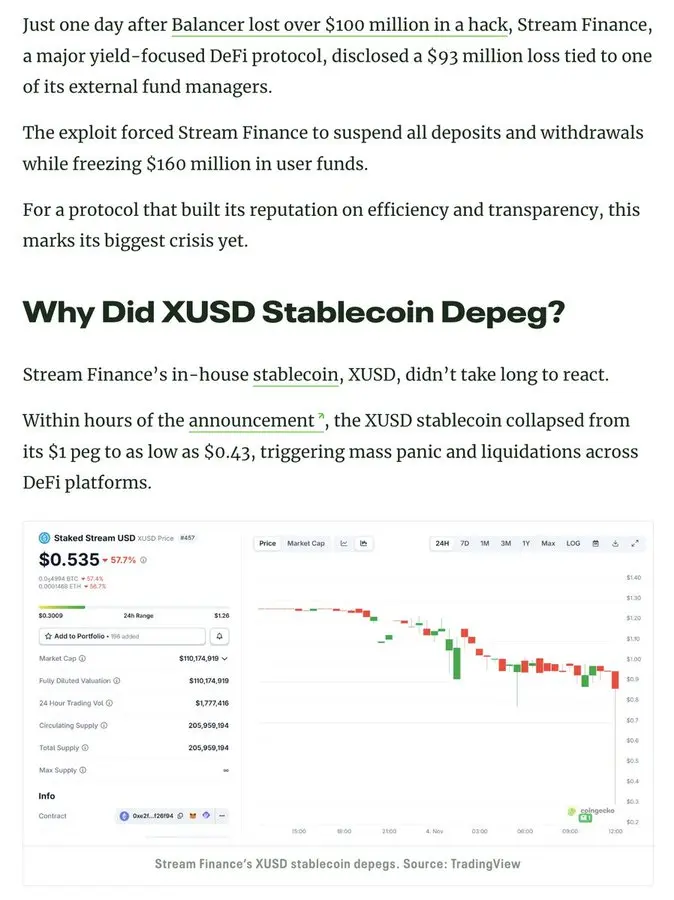
Due to a lack of transparency, the existence of recursive loops, and proprietary strategies, we are unable to know the actual scale of losses suffered by Stream users. Currently, the price of Stream's xUSD stablecoin has fallen to $0.6 per unit.

Because this matter was not disclosed to these DeFi users, many users are now extremely indignant towards Stream and Elixir: they not only suffer financial losses, but are also forced to share the losses to ensure that wealthy Americans with Wall Street backgrounds can preserve their profits.

This incident also impacted the loan agreement and its management:

"Everyone who thinks they are taking out a secured loan on Euler is actually participating in unsecured lending through a proxy," says Rob from infiniFi.

Furthermore, given Stream's lack of transparency regarding its positions and profit/loss status, or the absence of on-chain data, users have begun to question whether Stream has fraudulently misappropriated user profits for its management team. Stream's xUSD stakers rely on self-reported "oracle" data to generate returns, and third parties cannot verify the accuracy or fairness of these calculations.

How to deal with it?

Such Stream events could have been avoided, especially in emerging industries like DeFi. While "high risk, high reward" is a timeless principle, the key is to understand that risk is not homogeneous, and some risks are simply unnecessary. Several reputable liquidity mining, lending, and stablecoin (essentially tokenized hedge funds) protocols already maintain transparency in their risk exposure, investment strategies, and positions, making them worthy of market attention.

Stani, founder of Aave, discussed the timing of DeFi governance and excessive risk-taking, and shared his views on recent events that have brought DeFi risks to the forefront:

Market Opportunity
DeFi Logo
DeFi Price(DEFI)
$0.000348
$0.000348$0.000348
+9.77%
USD
DeFi (DEFI) Live Price Chart
Disclaimer: The articles reposted on this site are sourced from public platforms and are provided for informational purposes only. They do not necessarily reflect the views of MEXC. All rights remain with the original authors. If you believe any content infringes on third-party rights, please contact [email protected] for removal. MEXC makes no guarantees regarding the accuracy, completeness, or timeliness of the content and is not responsible for any actions taken based on the information provided. The content does not constitute financial, legal, or other professional advice, nor should it be considered a recommendation or endorsement by MEXC.

You May Also Like

Ex-Alipay UK Chief Eva Zhang to Lead Blockscout Into AI-Driven Growth

Ex-Alipay UK Chief Eva Zhang to Lead Blockscout Into AI-Driven Growth

Blockscout, the leading open-source block explorer for EVM chains, has appointed Eva Zhang, former CEO of Alipay UK, as its new chief executive officer.
Share
Blockchainreporter2025/09/18 19:00
Gold price in Malaysia: Rates on February 16
Gold price in Malaysia: Rates on February 16

The post Gold price in Malaysia: Rates on February 16 appeared on BitcoinEthereumNews.com. Gold prices fell in Malaysia on Monday, according to data compiled by
Share
BitcoinEthereumNews2026/02/16 13:21
U.S. Treasury Seeks Public Input on Game-Changing Stablecoin Regulations

U.S. Treasury Seeks Public Input on Game-Changing Stablecoin Regulations

U.S. Treasury invites feedback on groundbreaking stablecoin regulations under GENIUS. Key questions around stablecoin tax treatment and foreign issuer rules. Treasury explores marketing restrictions, oversight balance, and AML enforcement options. The U.S. Treasury Department is now inviting public feedback on the implementation of the groundbreaking GENIUS Act, the first piece of crypto-specific legislation passed in the U.S. this summer. The new law is a milestone in terms of regulation of stablecoins, as the Treasury is aiming to balance the need to innovate and the aim of protecting consumers and monetary stability. According to Treasury officials, the GENIUS Act is designed to stimulate the growth of payment stablecoins while addressing potential risks related to illicit financial activities and maintaining overall economic stability. The department especially shows interest in the acquisition of data that could assist in refining the regulatory guidelines as it proceeds with the writing of its formal proposal. The commenting is active through the October 20 deadline, which gives both opponents and players in the industry time to express their views. One of the most pressing questions under consideration is how the IRS will handle the federal income tax treatment of stablecoins. The GENIUS Act does not directly cover this, and there is room to interpret and make decisions by regulation in the future. Also unclear is when and how foreign issuers can be allowed to offer stablecoins in the U.S., and it does not look like there is a timeline involved in making any changes. Also Read: Ripple Partners with DZ BANK to Launch Institutional Digital Asset Custody Solution Key Areas Under Scrutiny as Treasury Prepares Stablecoin Regulations Several key issues are currently up for discussion as part of the Treasury’s review of the GENIUS Act’s implementation. These include whether stablecoins should have certain marketing limitations, whether it should be at the state or federal level, and how the current anti-money laundering (AML) and sanctions policies will relate to digital assets. Moreover, the Treasury is analyzing how the current regulations, such as the Bank Secrecy Act (BSA), are capable of mitigating the risks of digital assets. This is after it was earlier sought to seek the views of people on the detection of illicit use in the digital asset markets. As the Treasury moves toward finalizing the regulations, it is clear that the department aims to craft a robust and flexible framework that can adapt to the evolving landscape of digital currencies. The outcome will have lasting implications for the future of stablecoin regulation in the U.S., shaping the path forward for both domestic and international players in the crypto space. Also Read: Shiba Inu Faces Major Selling Pressure as 157 Billion SHIB Floods Exchanges! The post U.S. Treasury Seeks Public Input on Game-Changing Stablecoin Regulations appeared first on 36Crypto.
Share
Coinstats2025/09/20 17:22