Launchpad

Launchpads are decentralized platforms that facilitate early-stage fundraising for new Web3 projects through Initial DEX Offerings (IDOs). They provide investors with curated access to token sales while offering startups a community-driven capital injection. In 2026, launchpads have evolved into full-stack incubators, focusing on project quality and long-term sustainability. Follow this tag for the latest in token distribution models, tier-based participation, and the emergence of the next generation of "unicorn" protocols across various blockchain ecosystems.

2898 Articles
Created: 2026/02/02 18:52
Updated: 2026/02/02 18:52

Solana Up 5% as x402 Protocol Rallies; $BEST Presale Enters Final 3 Days

Solana Up 5% as x402 Protocol Rallies; $BEST Presale Enters Final 3 Days

Quick Facts: ➡️ Solana’s latest 5% move on the back of x402 activity highlights how fast liquidity can rotate into high-beta ecosystems and their tooling. ➡️ Wallet fragmentation remains a critical bottleneck as users juggle multiple apps for Solana, Ethereum, presales, staking, and cross-chain swaps across dozens of networks. ➡️ The Best Wallet presale targets […]

Author: Bitcoinist
Best Wallet Token to 10x?

Best Wallet Token to 10x?

The post Best Wallet Token to 10x? appeared on BitcoinEthereumNews.com. Crypto Presales Takeaways: Most crypto wallets remain either centralized or clunky, offering basic send-and-swap functions without meaningful rewards, curated access, or truly mobile-first design. Users increasingly want their primary wallet to double as a hub for presales, cross-chain swaps, and yield, not just passive storage of assets. Best Wallet positions itself as the best crypto wallet contender by combining Fireblocks MPC security, presale access, and integrated DEX aggregation. $BEST token, in presale until Friday, powers reduced fees, curated presale access, and staking via a dynamic rewards pool, aligning long-term token holders with wallet ecosystem growth Crypto is back in risk-on mode, and retail traders are behaving like it. From meme coins to infrastructure plays, you’re seeing capital rotate into narratives that promise real utility rather than just hype. In that environment, the ’best crypto wallet’ is no longer just about storage – it’s about access, yield, and upside. Wallets have quietly become the main interface for Web3, but most options still feel stuck in 2019. You either get centralized services with custodial risk, or clunky DeFi wallets that punish newcomers with confusing UX and no real benefits beyond sending and swapping tokens. That gap has set the stage for a new wave of wallet-centric tokens. Best Wallet is leaning directly into that shift. Branded as ‘The Next-Gen Crypto Wallet,’ it’s pitching a mobile-first, non-custodial app that doesn’t just hold assets but actively improves how you invest, trade, and farm yield. The project wants to turn the wallet itself into your launchpad for presales, staking, and cross-chain swaps. With just days left on the clock, momentum behind its $BEST token presale is clear. The early funding round has already raised $17,45M at a token price of $0.025995, with whales piling in at the last minute. For traders hunting asymmetric plays that…

Author: BitcoinEthereumNews
$17M Presale Ends in 3 Days with Explosive Promises: Best Wallet Token to 10x?

$17M Presale Ends in 3 Days with Explosive Promises: Best Wallet Token to 10x?

Takeaways: Most crypto wallets remain either centralized or clunky, offering basic send-and-swap functions without meaningful rewards, curated access, or truly […] The post $17M Presale Ends in 3 Days with Explosive Promises: Best Wallet Token to 10x? appeared first on Coindoo.

Author: Coindoo
The New Battleground for Parallel EVMs: A Look at 12 Emerging Forces in the Monad Ecosystem

The New Battleground for Parallel EVMs: A Look at 12 Emerging Forces in the Monad Ecosystem

Author: Jae, PANews Monad, the high-performance public blockchain that the community has been eagerly anticipating this year, has finally launched. On the evening of November 24th, the Monad mainnet and MON token officially launched. Previously, as Coinbase's first Launchpad project, it attracted 85,820 participants who invested $269 million. Even in a sluggish market environment, the oversubscription of the Monad token sale demonstrates its ability to attract funds and its popularity. As a leader in the parallel EVM track, Monad has been touting a throughput promise of up to 10,000 TPS (transactions per second) and a final confirmation time of 1 second. Now, it's time for the market to put its claims to the test. For Paradigm, another major investment in the public blockchain sector, Monad serves as a litmus test for its investment capabilities in the crypto market. Whether it can redeem itself from Blast's previous failure will depend on this battle. The value of a high-performance public blockchain will depend on the carrying capacity of its ecosystem. Unlike strategies that simply rely on "copying and pasting" existing EVM applications, Monad has attracted a number of emerging projects seeking to leverage its high-frequency trading capabilities thanks to its unique technical architecture. The Monad ecosystem comprises 304 protocols, 77 of which are proprietary, with DeFi protocols accounting for over 60%. PANews has compiled a list of representative emerging projects within the Monad ecosystem, considering factors such as Monad exclusivity, investment institutions, and project activity. These projects cover DeFi, Launchpad, prediction markets, DeAI, and DePin, among others. However, Monad is still in the early stages of ecosystem development, with many projects still in testing or early interaction phases. Users should be aware of potential risks before participating. Mynt (USDm) Mynt (USDm) is a zero-knowledge proof stablecoin protocol powered by Succinct's SP1 zkVM (Zero-Knowledge Virtual Machine) and incorporating a collateralized minting model. Users can mint USDm using MON tokens as collateral while earning yield from reserve assets. Mynt prioritizes verifiable privacy, collaborating with Fairblock to use additive homomorphic encryption (PHE) and multi-party computation (MPC) to encrypt transaction amounts, avoiding the risk of front-running. Mynt also introduced the concept of "state liquidity." Thanks to ZK technology, USDm can achieve seamless combination of rents across different protocols, meaning that users do not need to frequently transfer tokens between different DeFi protocols; liquidity can be reused and verified simply through state proofs. During the testnet phase, Myn processed over 1 million transactions, generating $250,000 in revenue. Kintsu Kintsu is positioned as a liquidity staking protocol focused on maximizing capital efficiency. Users who stake MON receive sMON, a circulating token that accumulates staking rewards over time. The sMON token model is designed for deep DeFi integration. By allowing sMON to circulate and trade across various DeFi applications, Kintsu not only maintains the liquidity of staked assets but also allows users to deploy assets to yield markets without sacrificing the base staking rewards. Since its mainnet launch, Kintsu has demonstrated a strong early lead, with a TVL of 17.5 million MON (approximately $540,000) and 605 sMON holders. The protocol previously secured $4 million in seed funding led by Castle Island Ventures. Magma Magma is a liquidity staking platform that allows users to earn circulating staking tokens (gMON) by staking MON tokens. gMON not only represents staking rewards but is also composable, serving as collateral across various dApps (decentralized applications) within the Monad ecosystem for activities such as lending and trading. Since its mainnet launch, Magma's TVL (Total Value Locked) has exceeded 7.13 million MON (approximately $200,000), with over 800 gMON holders across 800 unique addresses and over 1,000 transactions. The protocol previously secured $3.9 million in seed funding from investors including Animoca Ventures. Kuru Kuru is a CLOB DEX (Centralized Order Book Decentralized Exchange) that executes entirely on-chain. Its unique feature lies in leveraging Monad's parallel execution and low latency to provide a CEX-like user experience while maintaining self-custody. Kuru's design allows market makers to place and cancel limit orders at high frequency with low, constant gas costs, addressing the core pain points of traditional DEXs in efficiency and price discovery. Keone Hon, co-founder and CEO of Monad Labs, has stated that Kuru can help DEXs narrow the execution gap with CEXs. After its mainnet launch, Kuru's TVL quickly surpassed $1.4 million, with 24-hour trading volume exceeding $11 million, generating approximately $9,000 in protocol revenue. Kuru previously secured $2 million in seed funding led by Electric Capital and $11.5 million in Series A funding led by Paradigm. Perpl Perpl is a full-chain Perp DEX (decentralized perpetual contract trading platform) built on Monad, and it also adopts the CLOB model. Derivatives trading has extremely high requirements for real-time price feeds, settlement, and margin; any delay can lead to high slippage or liquidation risks. The protocol leverages Monad's high throughput and sub-second finality to ensure that the entire process of order matching and trade execution can be completed on-chain, thereby eliminating reliance on centralized components such as off-chain sorters and further improving the transparency and efficiency of trading. Perpl previously secured $9.25 million in funding led by Dragonfly. Mu Digital Mu Digital is an RWA (Real-World Asset) platform designed to bring the Asian credit market on-chain, aiming to tokenize Asia's $20 trillion credit market. The protocol offers two main risk-tiered products: 1) AZND (Asian Dollar): a premium risk-tiered product backed by high-quality Asian credit instruments, offering a native yield of 6% to 7% upon launch; 2) muBOND: a basic risk-tiered product designed to provide enhanced yields of up to 15% for users seeking higher returns. The protocol had secured $1.5 million in pre-seed funding, with investors including traditional financial institution UOB Venture Management. Mu Digital launched its mainnet simultaneously, with muBond TVL (total value locked) reaching $20 million and AZND TVL reaching a staggering $80 million. Castora Castora is a decentralized P2P (peer-to-peer) prediction market, similar to platforms like Polymarket and Kalshi. It allows users to place P2P bets on real-world events, such as elections or sporting events, and settles the bets on-chain. The protocol leverages Monad's low latency to achieve real-time odds updates. Unlike traditional order book-based prediction markets, Castora employs a pool-based betting model. Users pay an "entry fee" to enter a specific prediction pool, and the system determines the winner at snapshot time. The user whose prediction is closest to the actual outcome wins the prize pool. Compared to order book-based prediction markets, Castora's mechanism is more similar to a "full share" or "pool" model, which lowers the barrier to entry for market makers, making it easier for ordinary retail investors to participate in liquidity provision and betting. Currently, Castora has launched early pools such as ETH price prediction and is one of the most frequently interacted dApps within the Monad community. Nad.fun Nad.fun is a social meme token issuance platform that allows users to deploy tokens in minutes at extremely low cost, supporting the entire process of creation, issuance, and trading, similar to pump.fun. The protocol uses classic bonding curve pricing to ensure fair early launches. Since its mainnet launch, Nad.fun has generated 30 new Meme tokens. Currently, the Meme token with the highest market capitalization is NADS, at $730,000, while ATH (its all-time high) once had a market capitalization approaching $2 million. FortyTwo Fortytwo is a DeAI inference network that utilizes "swarm inference" technology to achieve scalable, low-illusion AI through node contributions. The protocol supports distributed model training and inference, where AI agents can directly exchange data on-chain. Fortytwo operates with extremely high latency requirements. It leverages Monad's high-performance parallel execution environment to ensure that data exchange and inference tasks between AI agents are completed with very low latency. High transaction speed is also a prerequisite for achieving scalable intelligence. The protocol relies on a dynamic load balancing system to optimize resource utilization, ensuring nodes maintain high activity during light tasks such as video calls or web browsing, but automatically reducing or pausing inference when users perform heavy operations such as 4K video editing. This fine-grained resource management is only feasible if the underlying public blockchain can handle fast and inexpensive transactions. To date, Fortytwo has 450 active nodes, with over 4,500 inference tasks completed daily. The protocol previously secured $2.3 million in Pre-Seed funding led by Big Brain Holdings. Rumi Rumi aims to build an AI-driven media and advertising company. Its protocol employs a unique "watch-to-earn" model, rewarding users' content consumption behavior through a visual language model. Rumi is committed to transforming passive media content into interactive experiences, and its protocol supports intelligent media content parsing. It has already partnered with companies such as TVision and Story Protocol. Rumi's live streaming duration reached 8.5 billion hours in Q3, equivalent to 970,000 years of attention. The protocol previously secured $4.7 million in Pre-Seed funding led by a16z crypto, CSX, and EV3. Multisynq Multisynq aims to build a real-time application layer for the internet, bringing the instant collaboration experience of Google Docs to all online applications, including DeFi, gaming, and ambient coding, without relying on centralized cloud service giants. The agreement had previously secured $2.2 million in seed funding led by Manifold. Poply Poply is an NFT marketplace and distribution platform whose protocol emphasizes respect for creators' royalties and optimizes the NFT minting and listing experience based on Monad's high-frequency trading characteristics. Poply also provides AI tools (such as generative artwork based on prompts, which can be minted into series of NFTs) and user-friendly real-time bidding and trading functions. The protocol will launch 6,000 Poply Otters series NFTs on November 24, and will give holders user benefits such as lower transaction fees, higher token allocation, and exclusive airdrops.

Author: PANews
Pump.fun Pushes Back Against Lookonchain Claims…

Pump.fun Pushes Back Against Lookonchain Claims…

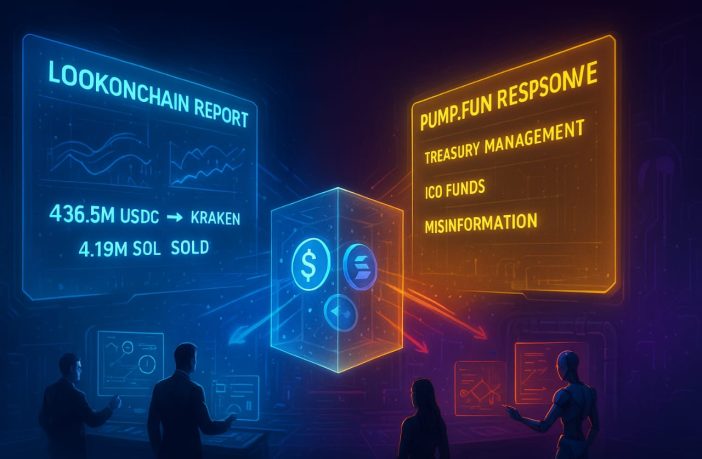
The post Pump.fun Pushes Back Against Lookonchain Claims… appeared on BitcoinEthereumNews.com. A new on-chain report from Lookonchain has reignited debate around Pump.fun’s treasury activity. But the team behind the memecoin launchpad is openly rejecting the claims, calling the circulating numbers “misinformation” and insisting the large transfers reflect internal treasury management, not cash-outs. Lookonchain’s report surfaced major USDC and SOL outflows over the last year, sparking speculation across X. Pump.fun quickly responded, denying any wrongdoing and arguing that the movements stem from reorganizing treasury funds raised during the PUMP ICO. The conflicting narratives are now driving one of the platform’s biggest transparency tests to date. Lookonchain Reports Over $1B in Combined USDC + SOL Movements Lookonchain’s thread presents a detailed breakdown of on-chain activity involving Pump.fun wallets. The core claims: 436.5M USDC sent to Kraken since October 15 Between October 15 and today, Lookonchain tracked 436.5M USDC flowing from Pump.fun-linked wallets into Kraken. The on-chain flow also showed:  537.6M USDC leaving Kraken and moving into Circle through wallet DTQK7G  A nearly matching inflow/outflow pattern that raised questions around whether Pump.fun was off-ramping proceeds Lookonchain framed the activity as part of a broader pattern of exchange deposits and potential cash-outs. It appears https://t.co/C909I8882s has cashed out at least 436.5M $USDC since Oct 15. Since Oct 15, https://t.co/C909I8882s has deposited 436.5M $USDC into#$Kraken. During the same period, 537.6M $USDC flowed from #Kraken to #Circle through wallet DTQK7G. Between May 19, 2024… pic.twitter.com/WQGnUcA8l4 — Lookonchain (@lookonchain) November 24, 2025 4.19M SOL sold between May 2024 and August 2025 The report also highlighted long-term SOL selling: 4.19M SOL sold in total since May 19, 2024 Valued at $757M at an average price of $181 Of that: 264,373 SOL was sold directly on-chain (~$41.64M) 3.93M SOL (~$715.5M) was deposited into Kraken This multi-year accumulation of transactions intensified concerns that Pump.fun has been liquidating assets steadily. The thread…

Author: BitcoinEthereumNews
Pump.fun Pushes Back Against Lookonchain Claims as Treasury Movements Trigger Debate

Pump.fun Pushes Back Against Lookonchain Claims as Treasury Movements Trigger Debate

A new on-chain report from Lookonchain has reignited debate around Pump.fun’s treasury activity. But the team behind the memecoin launchpad is openly rejecting the claims, calling the circulating numbers “misinformation” and insisting the large transfers reflect internal treasury management, not cash-outs. Lookonchain’s report surfaced major USDC and SOL outflows over the last year, sparking speculation [...]

Author: Null TX
Best Crypto Presales: Is Best Wallet Token The Next Cryptocurrency To Explode?

Best Crypto Presales: Is Best Wallet Token The Next Cryptocurrency To Explode?

Best Wallet (BEST) is now only three days away from going live, and the timing appears favorable. Market sentiment has improved, with Bitcoin bouncing on the weekly chart and climbing 10% to $88,000. This move has created stronger optimism for traders and the Best Wallet community as the launch approaches. Many investors are now watching […]

Author: The Cryptonomist
Best Crypto to Buy Now: Hedera (HBAR) Price Prediction

Best Crypto to Buy Now: Hedera (HBAR) Price Prediction

Hedera (HBAR) has recently shown relative strength compared to many other altcoins. Despite the turbulence, $HBAR managed to hold its key support zone between $0.13 and $0.15, a range that previously acted as both support and resistance throughout 2024. This technical area remains crucial for determining whether the asset can stabilize or risk further downside. […]

Author: The Cryptonomist
iOSG: The App Cycle is Coming, and Asian Developers Are Entering a Golden Age

iOSG: The App Cycle is Coming, and Asian Developers Are Entering a Golden Age

Author: Jiawei, IOSG In the mid-to-late 1990s, internet investment focused primarily on infrastructure. The capital markets at the time were almost entirely betting on fiber optic networks, ISPs, CDNs, and server and router manufacturers. Cisco's stock price soared, reaching a market capitalization of over $500 billion by 2000, making it one of the world's most valuable companies; fiber optic equipment manufacturers such as Nortel and Lucent also became highly sought after, attracting tens of billions of dollars in funding. In this frenzy, the United States added millions of kilometers of fiber optic cable between 1996 and 2001, far exceeding the actual demand at the time. As a result, a severe overcapacity emerged around 2000—transcontinental bandwidth prices plummeted by more than 90% in just a few years, and the marginal cost of connecting to the Internet approached zero. While this infrastructure boom allowed later-born companies like Google and Facebook to take root and flourish on the cheap, ubiquitous internet, it also brought growing pains for the then-frenzied investors: the infrastructure valuation bubble burst rapidly, and the market value of star companies like Cisco shrank by more than 70% in a few years. Doesn't it sound a lot like Crypto from the past two years? Is the era of infrastructure coming to a temporary end? Block space has gone from scarce to abundant. The expansion of the block space and the exploration of the "impossible three" of blockchain largely dominated the early development of the crypto industry for several years, and therefore it is appropriate to discuss it as a landmark element. ▲Source: EtherScan In its early stages, public blockchains had extremely limited throughput, making block space a scarce resource. Taking Ethereum as an example, during the DeFi Summer, with various on-chain activities overlapping, the cost of a single DEX interaction often ranged from $20 to $50, reaching hundreds of dollars during periods of extreme congestion. With the advent of NFTs, the market's demand and calls for scaling reached their peak. Ethereum's composability is a major advantage, but it also increases the complexity of individual calls and gas consumption, with high-value transactions prioritizing limited block capacity. As investors, we often discuss L1's renewal fees and burning mechanism, using this as an anchor for L1 valuation. During this period, the market gave infrastructure a very high price, and the so-called "fat protocol, thin application" argument—that infrastructure can capture a large portion of value—was accepted, triggering a construction boom, or even a bubble, of scaling solutions. ▲Source: L2Beats In conclusion, key Ethereum upgrades (such as EIP-4844) migrated L2 data availability from expensive calldata to lower-cost blobs, significantly reducing the unit cost of L2. Transaction fees for mainstream L2 blockchains have generally decreased by several US dollars. The introduction of modularity and Rollup-as-a-Service solutions has also significantly reduced the marginal cost of block space. Various Alt-L1 blockchains supporting different virtual machines have also emerged. As a result, block space has transformed from a single, scarce asset into a highly fungible commodity. The chart above shows the evolution of various L2 on-chain costs over the past few years. It can be seen that in 2023 and early 2024, calldata accounted for the majority of costs, with daily costs even approaching $4 million. Then, in mid-2024, the introduction of EIP-4844 allowed Blobs to gradually replace calldata as the dominant cost, significantly reducing overall on-chain costs. After 2025, overall costs have tended to be at a lower level. In this way, more and more applications can place their core logic directly on the blockchain, instead of adopting a complex architecture that processes off-chain data and then uploads it to the blockchain. From this point on, we see value capture begin to migrate from the underlying infrastructure to the application and distribution layer, which can directly handle traffic, improve conversion rates, and form a closed loop of current flow. Evolution of income Following on from the last paragraph of the previous chapter, we can intuitively verify this viewpoint at the revenue level. During a cycle dominated by infrastructure narratives, the market's valuation of L1/L2 protocols is primarily based on expectations of their technological capabilities, ecosystem potential, and network effects—the so-called "protocol premium." Token value capture models are often indirect (e.g., through network staking, governance rights, and vague expectations of renewal fees). Application value capture is more direct: verifiable on-chain revenue is generated through renewal fees, subscription fees, and service fees. This revenue can be directly used for token buybacks and burns, dividends, or reinvested in growth, forming a tight feedback loop. The application's revenue streams become more robust—coming more from actual service fee revenue than from token incentives or market narratives. ▲Source: Dune@reallario The chart above roughly compares the revenue of protocols (red) and applications (green) from 2020 to the present. We can see that the value captured by applications is gradually increasing, reaching approximately 80% of the total this year. The table below lists the 30-day protocol revenue rankings compiled by TokenTerminal, with L1/L2 accounting for only 20% of the 20 projects. Stablecoins, DeFi, wallets, and trading instruments are particularly prominent. ▲Source: ASXN Furthermore, due to the market reaction to buybacks, the correlation between the application token's price performance and its earnings data is gradually increasing. Hyperliquid's daily buybacks of approximately $4 million have provided significant support for the token price. Buybacks are considered a key factor driving the price rebound. This indicates that the market is beginning to directly link protocol gains and buyback activity to token value, rather than relying solely on sentiment or narrative. And I expect this trend to continue to strengthen. II. Embracing the New Cycle with Applications as the Main Theme The Golden Age of Asian Developers ▲Source: Electric Capital ▲Source: Electric Capital According to Electric Capital's 2024 Developer Report, blockchain developers in Asia accounted for 32% of the total, surpassing North America to become the world's largest developer hub. Over the past decade, global products such as TikTok, Temu, and DeepSeek have demonstrated the outstanding capabilities of Chinese teams in engineering, product development, growth, and operations. Asian teams, especially Chinese teams, possess a strong iterative pace, can quickly validate needs, and achieve overseas expansion through localization and growth strategies. Crypto perfectly aligns with these characteristics: it requires rapid iteration and adjustments to adapt to market trends; and it needs to simultaneously serve global users, cross-language communities, and multi-market regulations. Therefore, Asian developers, especially Chinese teams, have a structural advantage in the Crypto application lifecycle: they possess both strong engineering capabilities and a keen sensitivity to market speculation cycles, along with exceptional execution ability. Against this backdrop, Asian developers have a natural advantage, enabling them to deliver globally competitive crypto applications more quickly. Projects like Rabby Wallet, gmgn.ai, and Pendle, which we've seen in this cycle, represent Asian teams on the global stage. We anticipate seeing this shift soon: a new market trend moving away from a US-dominated narrative towards a model where Asian products are first launched, then expanded into European and American markets from there. Asian teams and markets will have more say in the application cycle. Primary market investment under the application cycle Here are some perspectives on primary market investing: Trading, asset issuance, and financial applications still offer the best product-to-market (PMF) ratios, and are practically the only products capable of weathering a bear market. These correspond to products like Hyperliquid (perp), Pump.fun (launchpad), and Ethena, respectively. The latter packages capital rate arbitrage into a product that can be understood and used by a wider range of users. If there is significant uncertainty in investing in a specific sector, consider investing in the sector's beta, and think about which projects will benefit from the sector's development. A typical example is prediction markets—there are approximately 97 publicly available prediction market projects, with Polymarket and Kalshi being the more obvious winners. In this case, the probability of betting on a mid-to-long-term project to overtake the leader is very low. However, investing in tool-based prediction market projects, such as aggregators and chip analysis tools, offers greater certainty and allows you to benefit from the sector's growth, transforming a difficult multiple-choice question into a single-choice one. Once the product is developed, the next key step is to truly bring these applications to the masses. Besides common entry points like Social Login provided by Privy, I believe that a unified trading front-end and mobile platform are also crucial. Throughout the application lifecycle, whether it's perp or prediction markets, mobile will be the most natural user interface. Whether it's the user's first deposit or frequent daily operations, the experience will be much smoother on mobile. The value of an aggregation front-end lies in traffic distribution. Distribution channels directly determine user conversion efficiency and project cash flow. Wallets are also an important part of this logic. The author believes that wallets are no longer simply asset management tools, but rather have a role similar to Web2 browsers. Wallets directly capture order flows, distributing them to block builders and searchers, thereby monetizing traffic. Simultaneously, wallets also act as distribution channels, connecting to third-party services such as staking through built-in cross-chain bridges and DEXs, becoming a direct entry point for users to access other applications. In this sense, wallets control order flows and traffic distribution, serving as the primary entry point for user relationships. Regarding the infrastructure throughout the entire cycle, I believe that some public chains created out of thin air have lost their meaning; however, the infrastructure that provides basic services around applications can still capture value. Several specific examples are listed below: Provides infrastructure for customized multi-chain deployment and application chain building for applications, such as VOID; Companies that provide user onboarding services (covering login, wallet, deposits and withdrawals, cash withdrawals, etc.), such as Privy and Fun.xyz; this can also cover wallets and payment layers (fiat-on/off ramps, SDKs, MPC hosting, etc.). Cross-chain bridges: As the multi-chain world becomes a reality, the surge in application traffic will urgently require secure and compliant cross-chain bridges.

Author: PANews
10 Best Crypto Exchange for Beginners In 2025

10 Best Crypto Exchange for Beginners In 2025

As you step into the world of cryptocurrency, finding the best crypto exchange can transform your trading experience. The right platform not only simplifies buying and selling but also ensures your journey is secure, user-friendly, and rewarding. Whether you’re exploring the best crypto app for convenience or the best crypto trading platform for advanced tools, choosing wisely can set you up for success. In this guide, we’ll walk you through the top exchanges tailored for beginners, highlighting features that matter most, like trust score, security, and supported coins. Ready to take the first step toward confident crypto trading? Keep reading to become an informed investor. Best Crypto Exchanges, Platforms, and Apps Exchange Trust Score Rating Trading Fees (Maker/Taker) Supported Coins Key Security Features Best For Binance 9.9 / 10 Up to 0.1% / 0.1% 350+ Proof of Reserves (PoR), 2FA, SAFU Fund Massive coin selection and deep liquidity. Bybit 9.4 / 10 Up to 0.1% / 0.1% 1000+ PoR, Cold Storage, 2FA Derivatives trading and a user-friendly app. Gate.io 9.7 / 10 Up to 0.2% / 0.2% 4,000+ PoR, Cold Storage, Bug Bounties The widest variety of altcoins. Coinbase 9.8 / 10 Up to 0.4% / 0.6% 250+ PoR, Cold Storage, FDIC Insurance (USD) Simplicity and regulatory compliance. OKX 9.5 / 10 Up to 0.08% / 0.1% 300+ PoR, 2FA, Cold Wallet All-in-one platform with low fees. Bitget 9.4 / 10 Up to 0.1% / 0.1% 800+ PoR, Protection Fund, Cold Storage Copy trading and social trading features. Kraken 9.8 / 10 Up to 0.16% / 0.26% 570+ PoR, Cold Storage, 2FA, Platform Bug Bounty Top-tier security and excellent support. MEXC 9.6  / 10 0.0% / 0.0% (Spot) 3,000+ PoR, Cold Storage, 2FA Zero-fee spot trading and a huge coin list. KuCoin 9.3 / 10 Up to 0.1% / 0.1% 1,000+ PoR, 2FA, Multi-Layer Encryption Finding new and emerging “crypto gems.” Crypto.com 9.7 / 10 0%-2.99% (Varies) 250+ PoR, Cold Storage, 2FA, Insurance Large ecosystem with a crypto debit card. 10 Best Crypto Exchanges in 2025 – Our Top Picks Your choice of the best crypto app or best bitcoin exchange can significantly impact your trading success. With so many options available, it’s essential to focus on platforms that offer security, low fees, and a seamless user experience. Below, we’ve outlined the 10 best crypto exchanges in 2025, each excelling in key areas to meet diverse trading needs. 1. Binance – Best for Massive Coin Selection and Deep Liquidity Launched in 2017, Binance has quickly grown into the world’s largest cryptocurrency exchange by trading volume. With over 350 cryptocurrencies and trading pairs available, it caters to a diverse range of traders, from beginners to professionals. Binance operates in more than 100+ regions with over 275+ million users, making it a truly global platform for crypto trading. The platform is renowned for its low trading fees, starting at just 0.1%, and its robust liquidity ensures smooth transactions even for high-volume trades. Binance also offers advanced trading options, including spot, margin, futures, and options trading, making it a versatile choice for all trading strategies. Security is a top priority, with features like two-factor authentication (2FA) and Binance’s Secure Asset Fund for Users (SAFU) to protect user funds. Pros & Cons of Binance Pros Cons Low trading fees starting at 0.1%. Not available in some regions like the U.S. Over 350 cryptocurrencies and trading pairs. Complex interface for beginners. High liquidity for seamless transactions. Customer support can be slow at times. Advanced trading options (spot, futures, etc.) Regulatory scrutiny in certain jurisdictions. Strong security measures, including SAFU. User Score9.9 Promotion100 USDT Sign-Up Bonus-20% Trading FeesClaim RewardBinance Review 2. Bybit – Best for Advanced Derivatives Trading and User-Friendly Interface Bybit launched in March 2018 under the leadership of Ben Zhou and quickly became a leading cryptocurrency exchange. It serves millions of users in over 160 countries, offering a platform that combines advanced trading tools with an easy-to-use interface. Traders rely on Bybit for its high-leverage derivatives trading, which goes up to 100x. The platform also supports spot trading, staking, copy trading, and passive income opportunities. Bybit’s trading engine processes orders quickly and ensures minimal downtime, even during high market activity. Its design makes it accessible to both beginners and experienced traders. Pros & Cons of Bybit Pros Cons Offers high-leverage derivatives trading (up to 100x). Limits access in regions like the U.S. Provides an intuitive interface for all users. Includes fewer spot trading pairs than some competitors. Delivers multiple passive income options like staking. Experiences occasional delays in customer support during busy times. Implements strong security with cold storage and real-time monitoring. Faces regulatory restrictions in certain areas. User Score9.7 Promotion30,050+ USDT Sign-Up Bonus-30% Trading FeesClaim RewardBybit Review 3. Gate.io – Best for Altcoin Variety and Early Project Access You’ll find Gate.io, established in 2013, to be one of the most trusted crypto exchanges in the industry. Known for its extensive selection of altcoins, Gate.io supports over 1,700 cryptocurrencies and thousands of trading pairs, making it a top choice for traders seeking access to emerging tokens and diverse markets. As one of the best crypto trading platforms, Gate.io offers a wide range of features, including spot trading, margin trading, futures, staking, liquidity mining, and a startup launchpad for early project access. The platform also provides a Web3 wallet, enabling users to interact with decentralized applications and manage assets across multiple blockchains. Its competitive fees and earning opportunities make it appealing to both beginners and experienced traders. For those looking for the best app for crypto trading, Gate.io’s mobile app delivers access to all its features, including trading, staking, and project launches, though its interface may feel crowded for new users. With its long-standing reputation and robust security measures, Gate.io also ranks among the best bitcoin exchanges, offering a secure and reliable environment for trading Bitcoin and other cryptocurrencies. Pros & Cons of Gate.io Pros Cons Offers one of the largest selections of cryptocurrencies. Interface can feel crowded for new users. Competitive fees with discounts for GT token holders. Regional restrictions apply in some countries. Provides staking, liquidity mining, and early project access. Withdrawal fees can be higher for certain assets. Advanced security features, including cold storage and multi-factor authentication. Mobile app navigation is less intuitive compared to competitors. User Score9.7 Promotion10,000 USDT Sign-Up Bonus-30% Trading FeesClaim RewardGate.io Review 4. Coinbase Exchange – Best for Regulated Spot Trading and Deep Liquidity Coinbase Exchange has been a market leader since 2012, offering a secure and regulated platform for cryptocurrency trading. Known for its compliance with global regulations, Coinbase provides one of the deepest liquidity pools among crypto spot exchanges, making it ideal for both institutional and individual traders. As one of the best crypto trading platforms, Coinbase features a dynamic fee structure that rewards high-volume trading.  The platform also supports advanced trading through its FIX/REST APIs and WebSocket feeds, ensuring seamless order execution and real-time market data access. With its acquisition of LMX Labs, Coinbase has expanded into the futures market, offering regulated derivatives trading under the Coinbase Derivatives brand. For those looking for the best app for crypto trading, Coinbase delivers a user-friendly mobile experience, allowing traders to manage portfolios, monitor markets, and execute trades effortlessly. Its strong focus on security and compliance also places it among the most trusted crypto exchanges, providing a safe environment for buying, selling, and holding Bitcoin and other cryptocurrencies. Pros & Cons of Coinbase Pros Cons Regulated platform with deep liquidity. Higher fees compared to some competitors. Beginner-friendly interface and mobile app. Limited altcoin selection. Advanced APIs for institutional traders. Fewer earning opportunities like staking. Access to regulated futures markets. Regional restrictions in certain countries. User Score9.8 Promotion200 USDT Sign-Up Bonus-10% Trading FeesClaim RewardCoinbase Review 5. OKX – Best for Advanced Trading and Web3 Integration If you’re looking for a platform that combines advanced trading tools with cutting-edge features, OKX is the perfect choice. Since its launch in 2017, OKX has grown into a global leader in cryptocurrency trading, offering support for over 400 cryptocurrencies and a wide range of trading options, including spot, futures, margin, and options trading. What sets OKX apart is its Web3 ecosystem, which gives you access to a non-custodial OKX wallet, an NFT marketplace, and DeFi integration. These features allow you to explore decentralized finance, trade NFTs, and manage your digital assets with ease, even if you’re new to crypto or getting started with Web3 wallets. OKX also prioritizes your security, with measures like Proof of Reserves, two-factor authentication, and cold storage to keep your funds safe. If you’re a cost-conscious trader, you’ll appreciate OKX’s competitive fees, starting at just 0.08% for spot trading makers and 0.10% for takers. The platform also offers advanced tools like trading bots and copy trading, so you can automate your strategies or follow expert traders to enhance your trading experience. Pros & Cons of OKX Pros Cons Low trading fees for spot, futures, and options. Complex interface may overwhelm beginners. Advanced tools like trading bots and copy trading. Limited fiat deposit options compared to competitors. Comprehensive Web3 ecosystem with OKX wallet and NFT marketplace. Restricted in certain regions, including Canada and the USA. Strong security measures, including Proof of Reserves and cold storage. Advanced features may require a learning curve for new users. User Score9.5 Promotion10,000 USDT Sign-Up Bonus-30% Trading FeesClaim RewardOKX Review 6. Bitget – Best App for Crypto Trading and Trusted Exchange Bitget, launched in 2018, stands out as one of the most trusted crypto exchanges, offering a secure and feature-rich platform. With support for over 800 cryptocurrencies, it provides diverse trading options, including spot, futures, and margin trading. Recognized as the best app for crypto trading, Bitget’s mobile platform delivers seamless functionality, allowing you to trade, monitor markets, and manage portfolios on the go.  Its standout copy trading feature enables users to replicate strategies from top traders, making it ideal for both beginners and experts. For a deeper look at platforms that excel in this area, check out the best crypto copy trading platforms. Bitget prioritizes security with Proof of Reserves and a Protection Fund, ensuring user assets remain safe. Its advanced tools, trading bots, and APIs further enhance the trading experience for professionals. Pros & Cons of Bitget Pros Cons Copy trading for beginners and experts. Limited availability in certain regions. Supports over 800 cryptocurrencies. Advanced features may overwhelm new users. Strong security measures, including Proof of Reserves. Withdrawal fees vary by asset. User-friendly app for trading on the go. Customer support response times can vary. User Score9.4 Promotion6,200 USDT Sign-Up Bonus-20% Trading FeesClaim RewardBitget Review 7. Kraken – Best Crypto Exchange for Beginners and Advanced Traders If you’re looking for the best crypto exchange for beginners, Kraken is a fantastic choice. Established in 2011, Kraken has built a reputation as one of the most trusted and secure platforms in the crypto space. With support for over 570 cryptocurrencies and availability in 190+ countries, Kraken offers a user-friendly experience for newcomers while providing advanced tools for seasoned traders. Kraken’s intuitive interface makes it easy for you to buy, sell, and trade NFTs, whether you’re on desktop or mobile, especially if you need a clear, step-by-step guide on how to buy NFTs. For advanced users, Kraken Pro offers features like margin trading with up to 10x leverage, futures contracts, and deep liquidity for large-volume trades. The platform also emphasizes security, with robust measures like cold storage and two-factor authentication to protect your assets. Additionally, Kraken provides educational resources to help you understand blockchain, trading, and crypto concepts, ensuring you feel confident every step of the way. Pros & Cons of Kraken Pros Cons User-friendly interface for beginners. Higher fees on the standard platform. Advanced tools like margin trading and futures. Limited availability in some regions. Supports over 570 cryptocurrencies. Advanced features may require a learning curve. Strong security measures, including cold storage. Customer support response times can vary. 8. MEXC – Best for High-Leverage Trading MEXC is one of the most trusted crypto exchanges that you can invest in in 2025. The exchange was launched in 2018 by a team of blockchain enthusiasts and has since become a global leader, serving traders in over 170 countries. Known for its extensive cryptocurrency offerings, MEXC supports over 3,000 digital assets and 2,600+ spot pairs, making it the best platform for altcoin enthusiasts. With trading fees as low as 0.00% for makers and 0.05% for takers, MEXC is one of the most cost-effective exchanges for both spot and futures trading. The platform also offers leverage of up to 500x, catering to high-risk takers looking to maximize their trading potential. For beginners, MEXC provides demo accounts and copy trading features, allowing you to practice and learn from experienced traders. Security is a priority at MEXC, with measures like cold storage, two-factor authentication, and an insurance fund to protect user assets. While its advanced interface may feel complex for newcomers, the platform’s frequent updates, detailed tutorials, and responsive customer support make it easier for users to adapt and trade confidently. Pros & Cons of MEXC Pros Cons Access to over 3,000 cryptocurrencies. Limited fiat deposit and withdrawal options. Low trading fees for spot and futures markets. Interface can be complex for beginners. High leverage options, up to 500x. Restricted in certain regions, including the U.S. Supports copy trading and demo accounts. Customer support response times can vary. Frequent token listings and early access to new projects. Smaller tokens may have lower liquidity. User Score9.6 Promotion10,000 USDT Sign-Up Bonus-50% Trading FeesClaim RewardMEXC Review 9. KuCoin – Best for Altcoin Access and Flexible Trading KuCoin, launched in 2017, has established itself as one of the most versatile cryptocurrency exchanges globally. Known for its extensive range of supported cryptocurrencies, KuCoin offers access to over 700 digital assets and 1,300+ trading pairs, making it the best platform for altcoin enthusiasts and traders seeking emerging tokens. The platform provides a variety of trading options, including spot, futures, and margin trading, along with advanced tools like trading bots and a peer-to-peer (P2P) NFT marketplace. KuCoin also stands out for its early listings of new and trending cryptocurrencies, giving you the opportunity to explore projects before they gain mainstream attention. KuCoin’s competitive fee structure, starting at 0.10% for both makers and takers, becomes even more attractive when you hold its native token, KCS, which unlocks additional discounts. Beyond trading, KuCoin Earn offers flexible and fixed-term savings plans, staking, and structured financial products to help you grow your crypto holdings. Pros & Cons of KuCoin Pros Cons Access to over 700 cryptocurrencies. Limited availability in some regions. Competitive fees with discounts for KCS holders. Customer support response times can vary. Advanced trading tools, including bots and P2P marketplace. Interface may feel complex for beginners. Early listings of new and trending tokens. Trading fees can be higher for certain pairs. Flexible earning options through KuCoin Earn. Some features may require a learning curve. User Score9.3 Promotion11,000 USDT Sign-Up Bonus-10% Trading FeesClaim RewardKuCoin Review 10. Crypto.com – Best App for Crypto Trading and Buying Crypto.com is widely recognized as one of the best apps for crypto trading and the best place to buy crypto in 2025. With support for over 442 cryptocurrencies and 480+ trading pairs, Crypto.com offers a comprehensive platform for both beginners and experienced traders. Its user-friendly interface and advanced features make it a top choice for anyone looking to trade or invest in digital assets. The platform stands out for its low fees, with maker fees starting at 0% and taker fees as low as 0.15%. Crypto.com also provides a seamless mobile app experience, allowing you to trade, manage your portfolio, and access advanced tools on the go. For those looking to earn passive income, Crypto.com offers staking options with up to 13.74% APY and a crypto-earning debit card for everyday spending. Security is a priority at Crypto.com, with features like 1:1 reserves, $120 million in crime insurance, and self-custody wallet options to protect your assets. Whether you’re a beginner or a seasoned trader, Crypto.com combines accessibility, security, and advanced tools to meet your trading expectations.  Pros & Cons of Crypto.com Pros Cons Supports over 440 cryptocurrencies. Unavailable in New York. Low trading fees with maker fees starting at 0%. No phone support available. User-friendly app for trading and portfolio management. Advanced features may require a learning curve. Offers staking with up to 13.74% APY. Some features may not be available in all regions. Provides a crypto-earning debit card. Fees for fiat deposits and withdrawals can vary. User Score9.5 Promotion1 BTC Worth Sign-Up Bonus-50% Trading FeesClaim RewardCrypto.com Review What Is a Crypto Exchange? A crypto exchange is a digital platform where you can trade digital assets such as Bitcoin, Ethereum, and many others, as explained in a detailed guide on how a cryptocurrency exchange works. These platforms simplify the process of accessing cryptocurrencies, making it easier for you to participate in the digital economy. Exchanges act as a marketplace, connecting buyers and sellers while providing tools to facilitate transactions. They also offer features like price tracking, trading pairs, and secure storage options. When choosing an exchange, consider factors like fees, security, and the range of cryptocurrencies available to ensure it meets your needs. These exchanges act as a bridge, connecting buyers and sellers while providing tools to facilitate transactions. Types of Crypto Exchanges When diving into the world of cryptocurrency, you’ll encounter several types of exchanges. Each serves a unique purpose, and understanding their differences can help you choose the one that fits your needs. Centralized Exchanges (CEXs) When using a centralized exchange, you’re engaging with a platform managed by a company that facilitates cryptocurrency trading. These exchanges are known for their user-friendly interfaces, making them a great choice if you’re new to crypto. They often provide additional features like staking, lending, and customer support to enhance your trading experience. CEXs require identity verification to comply with regulations, which adds a layer of security and trust. They also offer protection measures like crime insurance and custodial services for your funds. However, since these platforms act as intermediaries, you’ll need to trust them to manage your assets securely. Decentralized Exchanges (DEXs) If you prefer more control and privacy, decentralized exchanges might be for you. These platforms operate on blockchain technology, allowing you to trade directly with others without intermediaries. Transactions are automated through smart contracts, but you’ll need to manage your own wallet and private keys. Hybrid Exchanges Combine features of centralized and decentralized exchanges, offering both user-friendly interfaces and greater control over your assets. They let you trade using a familiar, simple platform while maintaining custody of your funds during specific operations. Hybrid exchanges aim to provide faster transactions, better security, and less dependence on third-party intermediaries. This makes them a good choice for traders who want the convenience of CEXs but also value the independence offered by DEXs. Other Variations During your interaction with the best bitcoin exchanges, you’ll come across additional variations that cater to specific needs and preferences: Peer-to-Peer (P2P) Platforms: Allow you to trade directly with other users, often with customizable payment methods and no intermediaries. Instant Swap Services: Enable quick exchanges between cryptocurrencies without the need for an account or extensive verification. Futures and Derivatives Platforms: Focus on advanced trading options like futures contracts and leveraged trading for experienced users. Crypto-to-Crypto Only Exchanges: Specialize in trading between cryptocurrencies without fiat currency support. Should You Use a Broker or a Crypto Exchange? Deciding between a broker and a crypto exchange depends on your goals and how hands-on you want to be with your cryptocurrency investments. Use a Broker if: You prefer simplicity and convenience. Brokers often offer a straightforward way to buy and sell cryptocurrencies, bundling the process into a single transaction. They’re ideal if you’re new to crypto or want to invest without diving into the technical details. However, brokers may charge higher fees and offer fewer cryptocurrency options compared to exchanges. Use a Crypto Exchange if: You want more control and flexibility. Exchanges provide access to a wide range of cryptocurrencies, advanced trading tools, and lower fees. They’re a better fit if you’re comfortable managing your own trades and exploring features like staking or margin trading. Keep in mind, exchanges may require more effort to navigate and secure your assets. Crypto Exchanges Here’s what you can typically expect from using a crypto exchange; Offer a wide selection of cryptocurrencies for trading, including altcoins and emerging tokens. Provide advanced tools like staking, margin trading, and automated trading bots. Typically have lower fees compared to brokers, especially for high-volume traders. Allow you to directly own and manage your cryptocurrencies. Require you to handle your own wallet security and private keys. Traditional Brokers Below are the key characteristics of traditional brokers when it comes to crypto investing; Simplify the process of buying and selling cryptocurrencies, making them beginner-friendly. Often bundle crypto trading with other investment options like stocks and ETFs. Provide a more regulated and secure environment, with added consumer protections. May not offer direct ownership of cryptocurrencies, limiting wallet transfers. Charge higher fees and offer fewer cryptocurrency options compared to exchanges. How to Choose the Best Crypto Exchange Finding the best crypto exchange starts with identifying what matters most to you. If you are new to cryptocurrency, look for platforms that are easy to navigate, offer strong customer support, and provide educational tools. The best place to buy crypto for first-timers often includes exchanges like Coinbase or Gemini, which are known for their simplicity and security. For experienced traders, the best crypto trading platform might include advanced features like margin trading, staking, and access to a wide range of altcoins. Security should be a top priority when choosing the best crypto app. The most trusted crypto exchanges offer robust measures like two-factor authentication, cold storage for funds, and insurance against cyber threats. Additionally, consider the fees associated with trading, deposits, and withdrawals, and check out the best zero fee crypto exchanges to find platforms that maximize your profits. Platforms like Binance and Crypto.com are often regarded as the best bitcoin exchanges due to their competitive fees and extensive features, making them ideal for both beginners and seasoned traders. Your trading style also plays a role in selecting the right platform. If you prefer trading on the go, the best app for crypto trading should provide a seamless mobile experience with all the tools you need. For those who value transparency and trust, focus on platforms with a strong reputation and regulatory compliance.  How to Buy Cryptocurrency (Step-by-Step) Choose a Trusted Platform Start by selecting the best crypto exchange that suits your needs. Look for platforms with a strong reputation, user-friendly interfaces, and robust security measures. If you’re a beginner, consider exchanges like Coinbase or Kraken, which are known for their simplicity and reliability. Create and Verify Your Account Sign up for an account on your chosen platform. Most exchanges will require you to verify your identity by submitting documents like a government-issued ID. This step ensures compliance with regulations and enhances the security of your account. Deposit Funds Add money to your account using a bank transfer, credit card, or other supported payment methods. Be mindful of deposit fees, as they can vary between platforms. Some exchanges also allow you to deposit cryptocurrency directly if you already own some. Select the Cryptocurrency You Want to Buy Browse the available cryptocurrencies on the platform and choose the one you want to purchase. Whether it’s Bitcoin, Ethereum, or another altcoin, ensure you understand the asset before buying. Place Your Order Decide how much you want to invest and place your order. Most exchanges offer options like market orders (buying at the current price) or limit orders (buying at a specific price). Review the transaction details before confirming. Secure Your Investment Once your purchase is complete, transfer your cryptocurrency to a secure wallet. While exchanges offer built-in wallets, using a private wallet gives you more control and reduces the risk of hacks. Risks of Using a Crypto Exchange One of the primary risks of using a crypto exchange is security vulnerabilities. Exchanges are frequent targets for hackers, and breaches can result in the loss of funds. Even with advanced security measures like two-factor authentication and cold storage, no platform is entirely immune to cyberattacks. Additionally, if you leave your assets on the exchange instead of transferring them to a private wallet, you risk losing access if the platform experiences technical issues or shuts down. Another significant risk is regulatory uncertainty. Cryptocurrency regulations vary by country and can change rapidly, potentially affecting the operation of exchanges. Some platforms may face restrictions or even bans in certain regions, leaving users unable to access their accounts or funds. It’s crucial to choose a trusted exchange with a strong compliance record and to stay informed about the legal landscape in your area. Conclusion Choosing the best crypto exchange depends on your individual needs, whether you’re a beginner looking for simplicity or an experienced trader seeking advanced tools. The best crypto exchange for beginners should prioritize user-friendly interfaces, strong security, and reliable customer support, while seasoned traders may value features like low fees, diverse cryptocurrency options, and advanced trading capabilities. By carefully evaluating factors like security, fees, and platform reputation, you can find an exchange that aligns with your goals and provides a secure and efficient way to engage with the cryptocurrency market. FAQs What is the best crypto exchange in 2025?The best crypto exchange in 2025 depends on your needs. For overall features, Binance and Coinbase are top choices, offering a wide range of cryptocurrencies, advanced tools, and strong security. Binance is ideal for experienced traders, while Coinbase is great for simplicity and reliability. Which crypto exchange is best for beginners?The best crypto exchange for beginners is Coinbase. It provides an intuitive interface, educational resources, and excellent customer support, making it easy for newcomers to start trading. Kraken is another beginner-friendly option with strong security and straightforward tools. What is the safest and most trusted crypto exchange?The safest and most trusted crypto exchange is Kraken, known for its robust security measures, including two-factor authentication, cold storage, and regulatory compliance. Coinbase also ranks high for trustworthiness due to its insurance coverage and adherence to regulations. What crypto exchange has the lowest fees?Binance is the crypto exchange with the lowest fees, offering competitive maker and taker fees starting at 0.1%. For high-volume traders, platforms like KuCoin and Bybit also provide low-cost trading options. Which app is best for crypto trading?The best app for crypto trading is Binance for its advanced features, low fees, and wide range of cryptocurrencies. For beginners, the Coinbase app is highly recommended due to its user-friendly design and educational tools. What is the best crypto exchange for altcoins?Binance is the best crypto exchange for altcoins, offering a vast selection of cryptocurrencies, including many emerging tokens. Its advanced trading tools and liquidity make it ideal for altcoin enthusiasts. Can I use a crypto exchange without verifying my identity?Some exchanges, like KuCoin and Bybit, allow limited trading without identity verification. However, to access full features and higher withdrawal limits, most platforms require identity verification for compliance and security. What is the difference between a crypto wallet and a crypto exchange?A crypto wallet is used to store your cryptocurrencies securely, while a crypto exchange is a platform for buying, selling, and trading cryptocurrencies. For maximum security, it’s recommended to transfer your assets from an exchange to a private wallet. The post 10 Best Crypto Exchange for Beginners In 2025 appeared first on NFT Plazas.

Author: Coinstats